The manager backed away from window four with Grandma Maggie’s muddy blue passbook held tightly between both hands, as if the little book had suddenly become something he was afraid to drop.
For the first time since I had walked into the bank, nobody was asking me to explain myself.
They were looking at me as though they already knew part of the explanation.
Just not the part I knew.
The teller reached beneath the counter and pressed something I couldn’t see.
The manager glanced toward the entrance, then motioned for me to follow him through a side door.
“Ms. Henderson, please bring your identification.”
“My grandmother’s book too?”
He looked down at it.
“I’m bringing that.”
That answer scared me more than if he had said yes.
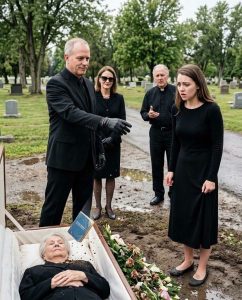
I followed him into a small office behind the teller line, still wearing the black dress I had worn at Grandma’s burial.
Dried mud had hardened along the hem.
There was dirt beneath my fingernails from digging the passbook out of her grave.
I noticed all of it because noticing stupid little things was easier than thinking about the teller’s words.
The girl from the case file.
I sat in a vinyl chair while the manager remained standing.
He placed the passbook on the desk but kept one hand beside it.
The teller came in carrying a printed sheet facedown against her chest.
“What case file?” I asked.
Neither answered immediately.
Then the manager pulled his chair around instead of sitting behind the desk.
That small movement changed the room.
He wasn’t treating me like a customer anymore.
He was treating me like someone involved in something already underway.
“Before I explain what I can,” he said, “I need to confirm a few things.”
He asked my full name.
My date of birth.
My current address.
Then he asked whether Margaret Henderson was my biological grandmother.
“Yes.”
“And Richard Henderson?”
“My father.”
The teller’s eyes dropped to the paper in her hands.
The manager noticed.
So did I.
“Say it,” I told him.
He folded his hands.
“Several years ago, this branch placed a restriction on an account connected to your identity.”
I stared at him.
“I don’t have an account here.”
“You do.”
Two words.
That was all it took.
I felt the chair beneath me, the stiff fabric of my funeral dress against my knees, and the dried mud pulling at the skin on my fingers.
Then I heard Grandma’s voice again.
He also tried to take something that has been rightfully yours since you were born.
“What kind of account?”
The manager turned the passbook toward me and opened it to the faded red circle.
“That routing notation points to a restricted savings account that was established in your name when you were an infant.”
My mouth went dry.
“By Grandma?”
“Margaret Henderson was listed as the person authorized to safeguard it during your childhood.”
“And my father?”
He paused.
“Richard Henderson was not.”
The room seemed to shrink around that sentence.
I thought about every birthday when Dad had complained that Grandma spoiled me.
Every time she slipped twenty dollars into my hand and told me not to mention it.
Every argument where he accused her of turning me against him.
I had believed those fights were about personality.
Now I wasn’t so sure.
The manager told me the account had been largely dormant when I was young.
Over time, Margaret had made additional deposits into it.
Nothing about that surprised me until he explained why the restriction existed.
Someone had repeatedly tried to gain control of the account after I became an adult.
The teller placed her sheet on the desk.
I couldn’t read the details from where I sat, but I could see dates running down one side.
The manager tapped the first one.
“There was an attempt to change the mailing information.”
Another date.
“Then a request to add an authorized signer.”
Another.
“Then an attempted withdrawal.”
I already knew the name before I asked.
“Richard?”
The manager did not say yes.
He didn’t have to.
He turned Grandma’s passbook around and pointed to the same initials I had studied all night.
R.H.
My father’s initials.
But the real shock came next.
Those large entries I had assumed were withdrawals from Grandma’s life savings had not all been money disappearing from her.
Some were transfers she had deliberately made after discovering that money connected to my account had been moved without her approval.
She had been replacing it.
Fifty dollars at a time at first.
Then hundreds.
Then larger amounts whenever she could manage them.
Her baking money.
Her laundry money.
Her hemming money.
The same ordinary little deposits I had seen when I was a child had become something else later.
Grandma hadn’t been quietly building a fortune.
She had been quietly repairing damage.
“She was paying it back?” I whispered.
The manager nodded carefully.
“Based on what we have here, it appears she was trying to restore funds she believed should never have been removed.”
I pressed my hands together under the desk.
For years, Dad had called Grandma controlling.
Paranoid.
Difficult.
He said she kept records because she didn’t trust anyone.
Maybe she had finally learned she couldn’t.
The manager turned to another page.
The handwriting changed there.
Grandma’s normally soft loops became narrow, hard strokes.
Beside one transfer, she had written only three words.
For Chloe. Replace.
I had to look away.
Not because of the money.
Because I suddenly understood how long she had been fighting a battle I didn’t even know existed.
A knock sounded at the office door.
The manager stood.
Two police officers were waiting outside with a bank security employee.
My first instinct was to stand too.
The manager raised a hand.
“You’re not in trouble.”
That should have helped.
It didn’t.
One officer asked if I was willing to answer questions about how I had obtained the passbook.
So I told them everything.
Grandma’s warning two nights before she died.
Dad throwing the book onto her casket.
His words about letting it rot with her.
The family leaving.
Me digging through wet cemetery dirt with my hands.
The note tucked between the pages.
The red stamp.
When I finished, the younger officer looked at the mud still packed beneath one of my nails.
“You recovered this from the grave yesterday?”
“This morning, basically. After the burial.”
“And your father deliberately put it there?”
“In front of everyone.”
The officer wrote that down.
That mattered.
Dad had spent years making sure ugly things happened behind closed doors.
This one hadn’t.
My uncles had seen it.
My cousins had seen it.
Susan had seen it.
Tyler had joked about it.
Even the pastor had been standing there.
For once, Richard Henderson had created his own witnesses.
The other officer asked about Grandma’s folded letter.
I had brought it with me inside the grocery bag.
I handed it over reluctantly.
He read it without changing expression until he reached the sentence about Dad trying to take something that had been mine since birth.
Then he looked toward the manager.
“Does that line match what’s already in your file?”
The manager answered cautiously.
“It is consistent with the reason the account was restricted.”
That was when I finally understood why the teller had gone pale.
The bank had not called police because I had appeared with an old passbook.
They had called because a woman connected to a long-running fraud concern had died, the granddaughter named in the restricted account had suddenly appeared, and the physical record everyone had apparently been trying to locate was sitting on their counter covered in cemetery mud.
Grandma had not sent me there to collect money.
She had sent me there to finish the record.
The manager asked whether I wanted to know the balance.
For a strange second, I almost said no.
Dad’s voice was still in my head.
No house, no land, no money.
An old notebook.
Worthless.