My Neighbor Built His Fence Eight Feet Inside My Property, Certain He Could Steal Part of My Land—But When He Applied for a Pool Permit, One Property Record Exposed the Truth and Turned His Entire Plan Against Him.
He built the fence on a Saturday, and I almost didn’t notice.
That’s the part people never believe when I tell this story now. I didn’t come storming out of my house the moment the first post went into the ground.
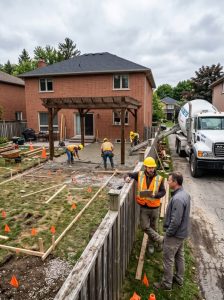
I was inside making coffee, half-watching the news, and it wasn’t until I heard the compressor kick on that I even looked out the kitchen window. Two men in matching polo shirts were unloading cedar panels from a trailer parked crooked across Tyler’s driveway.
Tyler himself stood at the edge of what I still thought was my yard, arms crossed, nodding at something one of the workers said, looking like a man supervising the construction of his own kingdom.
I remember thinking, that’s a big project for a Saturday. I remember thinking it was none of my business exactly where he put a fence on his own property. That’s the thing about boundaries — you don’t think about them until somebody moves one, and by then it can already feel too late to say anything without looking petty.
By afternoon the frame was up. By evening, most of the panels were in. I walked out with a mug of coffee going cold in my hand and stood at what I had always understood to be the line between our two lots, and something looked wrong.
The angle was off. My mower had been cutting a straight path along that boundary for eleven years, ever since I bought the house from the Reynolds family, and now there was a brand-new fence sitting well inside where that path should have been.
I didn’t say anything that first night. I told myself I was imagining it, that fences always look strange when they’re new, that maybe the shadows were playing tricks on me in the fading light. I went back inside and told myself I’d look again in the morning.
In the morning it looked worse.
I walked the length of it with a tape measure I kept in the garage, more out of curiosity than suspicion, and by the third measurement I stopped pretending I didn’t already know. The fence wasn’t just a little off. It was eight feet into what I was almost certain was my land, running the entire depth of the property, swallowing a strip of lawn I’d mowed, edged, and fertilized for over a decade.
I found Tyler out back a little after nine, drinking coffee on his new deck like he already owned the ground beneath it.
“Morning,” I said, trying to sound easier than I felt. “Fence looks good. Fast work.”
“Contractor’s efficient,” he said. “Wanted it done before the pool guys start digging.”
“About that,” I said. “I think it might be a little further onto my side than the old line.”
He didn’t even blink. That’s what got me, looking back. There was no surprise on his face at all, no confusion, none of the things you’d expect from a man who’d genuinely made an honest mistake.
“I don’t think so,” he said. “But even if it is, moving it now would cost a fortune. Contractor’s already broken down the equipment.”
“I haven’t even confirmed anything yet,” I said. “I just think we should check before you go any further with the pool.”
He smiled at me then. It was a smile I’d come to know very well over the following year, the kind of smile a man gives you when he thinks the conversation is already over and he’s just waiting for you to realize it.
“You’ve got plenty of yard, Jason,” he said. “I don’t think eight feet is going to change your life.”
I want to be honest about something. In that moment, standing there with my coffee going cold for the second morning in a row, some tired, conflict-avoidant part of me almost agreed with him. Almost. I’m the kind of man who lets things go.
I don’t send back a wrong order at a restaurant unless it’s genuinely inedible. I’ve paid for parking tickets I didn’t deserve because arguing felt like more trouble than it was worth.
If Tyler had asked me first, I probably would have said yes to some smaller accommodation just to keep the peace. That was exactly the kind of neighbor I’d always tried to be.
But he hadn’t asked. He’d built first and smiled second, and something about the certainty in his voice — that easy, practiced confidence that I would simply decide it wasn’t worth the trouble — was the thing that finally made me stop being agreeable.
“I’m going to have it surveyed,” I told him. “Just to be sure.”
The smile flickered, just slightly, before it came back. “Sure. Do what you need to do.”
I called Carl Whitfield that same afternoon. He’d surveyed a property for a friend of mine a few years back and had a reputation in the county for being meticulous almost to a fault, the kind of man who would remeasure a corner three times before he’d put his stamp on a drawing. It took him ten days to
get out to the property, and those were ten long days of watching Tyler’s contractors dig footings for a pergola on the strip of land in question, watching a delivery truck drop off pavers, watching a small army of landscapers plant ornamental grasses along what I was becoming more and more certain was my property line.
Carl arrived on a Tuesday morning with a tripod, a robotic total station, and an assistant who didn’t say much. He walked the boundary twice, checked it against the recorded plat, cross-referenced it with the county’s monument records, and by early afternoon he was driving a series of orange survey flags into
the ground in a straight line that ran, unmistakably, six inches inside Tyler’s actual fence.
“You were right to call,” Carl told me, packing up his equipment. “This isn’t a case of a few inches here or there. He’s got a structure and landscaping sitting almost entirely on your parcel.”
I remember standing there staring at that thin orange flag, feeling something shift in my chest. Not triumph, not yet. Just a kind of stunned clarity, the recognition that what I’d suspected for two weeks was now a documented fact, stamped and signed by a licensed professional, sitting in a folder that no
amount of charm or confidence could talk its way out of.
I called Tyler that evening and asked if we could talk. He came over with the same easy posture he always carried, hands in his pockets, like a man doing me a favor by showing up.
I laid the survey out on my kitchen table.
He looked at it for maybe three seconds.
“Surveys are wrong all the time,” he said.
“This one has your permit application attached to it,” I said. “The one you filed with the county. It shows the fence six inches inside your line. What’s standing in your yard right now is eight feet further than that.”
For the first time, something in his expression cracked, just slightly, like a man realizing the room he’d walked into wasn’t the one he expected.
“The contractor probably made an error staking it out,” he said.
“Then you’ll want to fix that,” I said. “Before you finish the pergola. Before the pool goes in. It’ll only get more expensive the longer you wait.”
He picked up the survey, studied it a moment longer, and set it back down.
“Let me think about it,” he said, and left.
He did not think about it. Or rather, he thought about it and decided, apparently, that the smart move was to keep building as fast as possible and let the concrete cure before I could do anything meaningful about it. Two days later, a crew poured footings for the pergola. A week after that, the pool excavation began, right up to the very edge of the disputed strip.
I sent him a certified letter. I have never in my life sent a certified letter to a neighbor, and there was something almost surreal about standing at the post office counter, watching the clerk print out the tracking number, knowing that somewhere down the road that green receipt might end up being the only proof I had that I’d tried to handle this the reasonable way before anything got worse.
He signed for it. He never responded.
I hired Rachel Adler, a property attorney a coworker had used during a messy commercial lease dispute, and within a month we had filed a formal complaint.
Tyler retained an attorney of his own, a heavyset man named Martin Shaw who specialized, as far as I could tell, in making expensive problems sound smaller than they were.
The county, once alerted, opened its own inquiry into the permit discrepancy, and for a few weeks it felt like the whole dispute existed on paper, in filings and emails and phone calls, far away from the actual dirt sitting between our two houses.
Then the judge ordered us into mediation, and that was when I finally sat across a table from Tyler and watched, for the first time, some of the truth come out on its own.
The room went silent.
We were sitting in a conference room at Rachel’s office because the judge had ordered us into mediation before the property case moved any further. Tyler’s attorney, Martin Shaw, slowly reached for the contractor’s estimate. Ashley didn’t let him take it. She kept reading the handwritten sentence at the bottom of the page, the one that had come from Tyler’s own contractor’s file, the one Rachel’s paralegal had pulled during discovery.
OWNER REQUESTS FENCE SHIFTED WEST APPROX. 8 FT TO INCREASE USABLE YARD.
She looked at Tyler.
“You told me the contractor made a mistake.”
Tyler’s face hardened. “Ashley, this isn’t the place.”
“It’s exactly the place.”
He glanced at Martin. His attorney looked like a man who had just received information he would have preferred to hear privately, in an office, with time to prepare a response instead of watching it detonate live in front of a mediator.
Martin asked, carefully, “Did you instruct the contractor to move the fence away from the permitted location?”
Tyler rubbed his jaw. “It wasn’t like that.”
Rachel leaned back in her chair. “What was it like?”
Tyler looked at me. That familiar half smile tried to return. It didn’t quite make it.
“The old mowing line looked arbitrary,” he said.
Carl, my surveyor, was sitting beside Rachel as a technical consultant. “It wasn’t arbitrary.”
Tyler ignored him. “The previous owners had always treated that strip like part of their yard.”
I almost laughed. “I bought my house from those previous owners.”
He stopped.
The previous owner, Mr. Reynolds, had walked the property with me before closing, eleven years earlier. I could still picture him, an older man with a bad hip who insisted on hobbling the entire perimeter with me before we signed anything, pointing out the survey monuments buried in the grass
with the toe of his boot. “People forget where these things are,” he’d told me. “Buried metal, easy to lose. Good idea to know where yours are.” I still had the original boundary disclosure from that sale in a folder in my office.
Rachel placed it on the table. Tyler stared at the signature. Then she added county aerial photographs dating back more than a decade, one from nearly every year, showing the same unbroken line of grass, the same edging, the same maintenance pattern running straight through what was now his backyard.
My grass. My edging. My maintenance. My use. The line never changed. Only Tyler’s fence did.
The mediator, a retired judge named Ellen Price, folded her hands on the table. “Mr. Bennett, I want to make sure I understand your position.
You obtained a permit showing one fence location, instructed your contractor to move the fence approximately eight feet onto the neighboring parcel, received a certified survey identifying the encroachment, and then declined to relocate the structure.”
Tyler shifted in his seat. “I believed the usable boundary was different from the legal boundary.”
Judge Price stared at him for a long moment. “That sentence is not helping you.”
Ashley closed her eyes. I almost felt sorry for her. Almost. Unlike Tyler, she seemed to be learning several facts for the first time — the permit, the contractor’s note, the pool setback, even the pergola footings that had gone in before the survey came back.
Tyler had apparently told her, at one point, that the county was harassing them because I supposedly knew someone in inspections. The truth was less dramatic. The county simply had documents. And documents do not care whose version of a story sounds more confident.
The mediator asked what I wanted. Tyler answered for me.
“He wants money.”
“No,” I said.
He looked surprised.
“I want my land back.”
Rachel listed the terms. The fence relocated entirely onto Tyler’s parcel. The pergola footing removed from my property. Any landscaping installed on my strip removed or abandoned at my option. Damaged sod restored. Survey, legal, and filing costs reimbursed.
A recorded boundary acknowledgment to prevent future disputes. And no interference with my access to the strip in the meantime.
Tyler laughed, an ugly, disbelieving sound. “You want me to tear up my whole backyard.”
“No,” I said. “I want you to move your backyard off mine.”
He looked toward the mediator like he expected her to intervene on his behalf. “This is insane.”
Judge Price shook her head slowly. “No. This is property law.”
Negotiations lasted three hours. Tyler offered money for the strip. First five thousand dollars, said almost casually, like he was tossing out a number just to see how I’d react. I refused. Then ten thousand. I refused again.
Then eighteen thousand, and I watched Ashley’s face when he said it, watched her do some private math in her head about where that money might come from.
I refused a third time. Not because the land was priceless. Everything has a number, if you go high enough. But that eight-foot strip controlled the spacing between my house and any future structure next door. Selling it could affect drainage. Privacy.
Resale value. Future improvements I hadn’t even thought of yet. And after the way Tyler had behaved, I had no interest in rearranging my own property simply to make his unauthorized construction convenient for him.
Then he offered something that surprised everyone in the room.
“Twenty-five thousand.”