They Laughed at Me in Front of Everyone, Certain I Was Nobody Important—Then a SEAL Commander Walked In, Saw Me, and Saluted, Turning Their Mockery Into Instant Regret.
My Family Laughed When I Sat Alone At My Brother’s Trident Ceremony Until The SEAL Commander Saluted Me
The first thing my mother did when she saw me at Naval Amphibious Base Coronado was look past my face and down at my black dress.
Not into my eyes.
Not at the visitor pass clipped near my shoulder.
Not at the small dark-blue folder tucked under my arm.
The dress. Her gaze dropped to it like a verdict.
The second thing she did was ask the security guard to move me.
“She is just the disappointing sister,” my mother said softly, as if soft cruelty did not count. “Please don’t let her make this awkward.”
My father laughed. Not a big laugh. Thomas Carter did not like to appear vulgar in public. It was the small, polished kind he used when he wanted strangers to understand the family had already voted and I had already lost.
The security guard stood between us with a clipboard in one hand and my visitor pass in the other. He was young enough to still look uncomfortable when wealthy-looking mothers turned family problems into administrative instructions. His eyes moved from my mother’s pearls to my father’s watch, then to me.
I saw my name on his clipboard before my mother did.
Emily Carter.
Beside the family list was another column with fewer names and a different heading.
Official Protocol Addendum.
The guard’s eyes paused there.
My mother stepped closer, her voice dropping into the tone she used when she wanted to seem reasonable while doing something unkind.
“Today is about Ryan.”
Ryan stood twenty feet away in dress whites with a new Trident waiting for its moment on his chest. He looked exactly like my father’s favorite story. Tall, clean-cut, broad-shouldered, golden in the bright California morning. Football captain. Homecoming king. The son who had made it through BUD/S,
SEAL Qualification Training, and every sentence my father had ever bragged through in hardware stores, church lobbies, airport lounges, and Fourth of July backyards.
Then Ryan looked at me.
“Don’t embarrass me today, Emily.”
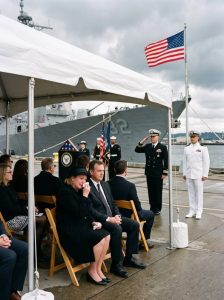
The morning smelled like salt air and hot pavement and sunscreen and coffee going cold in paper cups. White tents snapped lightly in the Pacific breeze. Children waved small American flags from rows behind us, and parents sat straighter than usual because pride makes people fix their posture.
I had driven six hours through the night to sit in one chair and clap for my brother.
No speech. No scene. No correction.
I had promised myself that.
So I sat. I folded my hands in my lap. I smiled politely.
And I said nothing.
That was the part my family always hated most. They could handle anger because anger let them call me dramatic. They could handle tears because tears let them call me unstable. Quiet gave them nothing to hold. Quiet forced them to hear themselves.
My mother leaned toward Aunt Patricia, who sat to her left in a coral blazer and the satisfied expression of a woman who had never missed a chance to be on the winning side of a family argument.
“She wore black,” Mom whispered, loudly enough for three rows to hear. “To her own brother’s proudest day.”
I looked down at the plain dress.
Black was not an insult. Black packed well. Black did not wrinkle badly. Black did not show coffee spills. Black did not show sweat when you had driven through the night with one hand on the wheel and old memories sitting beside you like passengers who refused to sleep.
Black did not show blood easily.
That last part was not a family detail. It belonged to rooms my mother had never entered and nights I did not have permission to describe.
To my family, I was still the woman who had left college, stopped explaining herself, missed holidays, sent expensive gifts without return addresses, and come home with calm eyes and scars nobody knew how to ask about. They preferred that version. It kept the house simple. If I was secretive, they did not
have to be incurious. If I was strange, they did not have to be cruel. If I was the disappointing sister, Ryan could remain the easy son in every story they told.
My cousin Madison turned around in her red sundress and glossy confidence. Madison had been raised on the same family mythology, though she had absorbed it with more enthusiasm than intelligence.
“Emily, seriously,” she said, glancing at the seat beside mine, “why are you sitting here? This section is for immediate family.”
“I am immediate family.”
“I mean supportive immediate family.”
Aunt Patricia laughed into her program.
My father did not correct her. My mother did not correct her. Ryan heard it too. He was lined up with the other candidates, jaw tight, eyes forward, but when Madison said it, the corner of his mouth moved.
Not a smile.
Worse.
Agreement.
The stage held a podium, an American flag, rows of polished chairs, and a table lined with velvet cases. The gold Tridents caught the morning light like small pieces of fire. Families held programs that rustled against nervous fingers. Somewhere behind me, a little boy asked his grandfather why that lady looked sad.
I did not look sad. I looked trained. There is a difference.
At 5:42 that morning, I had received the protocol email. At 6:14, my visitor pass had cleared the gate. At 6:31, Senior Chief Alvarez had texted that Commander Nathaniel Hayes knew I was on base.
I had the email in my purse. I had the addendum folded in a dark-blue folder. I had the number I could call if I wanted to resolve the seating issue in less than thirty seconds.
I used none of it. Facts are useful. Timing matters more.
My father leaned across my mother, his voice low enough to pretend privacy and loud enough to make sure it landed.
“Emily, after this, don’t try to come to the private reception unless Ryan invites you. This is a military crowd. People will ask questions.”
That was how Dad hurt people. Quietly enough that witnesses could pretend they heard nothing.
I turned my head slowly. “What questions?”
He gave me his patient smile, the one he used when explaining something obvious to someone he believed had failed a basic test of life.
“About what you do. Where you have been. Why you never talk about it.”
Mom gave a small public laugh, the kind meant to make the insult sound affectionate. “Honey, today is about Ryan. Don’t make it strange.”
“I drove here for Ryan.”
Ryan turned just enough for me to see his face. “No,” he said. “You drove here to be seen.”
The words reached old places.
Christmas Eve, when my mother said she had not set a plate because she did not know I was coming, even though I had texted twice and driven through a storm with a wrapped gift in the back seat. A funeral where my father introduced me to a church elder as “our complicated one” while Ryan stood
beside him in a suit, receiving condolences like a prince accepting tribute. Ryan’s thirtieth birthday, when he thanked me for an expensive watch I could not explain affording and joked that maybe someday I would get a real job.
I remembered all of it. Then I let it pass through me.
For one ugly second, I wanted to pull the folder from my purse and lay it on my father’s knee. I wanted him to read my name. I wanted my mother to see the rank. I wanted Ryan to know that the sister he had warned not to embarrass him had been listed in official ceremony paperwork before he ever stepped onto that stage.
I did not move.
Sometimes dignity is not a speech. Sometimes it is letting people finish showing you who they are.
My family had been showing me for years.
I used to fight harder. That might surprise people who only knew me after the quiet had settled into my bones. At thirteen I argued. At fifteen I slammed doors. At seventeen I wrote letters I never sent, full of the hot, pleading language of a daughter still convinced the right explanation could unlock a parent’s heart.
Ryan was three years younger than me, but in our family, age never decided importance. From the time he could throw a football in a clean spiral, my father treated him like a forecast of greatness. My mother dressed him in little polos and called him their sunshine. Teachers loved him. Coaches adored him.
Neighbors stopped by the fence to say he had natural leadership, which mostly meant he was loud and handsome and had learned early that confidence could be mistaken for character.
I was quieter. Not because I had nothing to say, but because saying it rarely changed anything.
When I brought home straight A’s, my mother put the report card in a drawer and asked me to help Ryan with math. When I won a regional science competition, Dad said “that’s great, Em” while watching Ryan’s football highlights on his phone. When I got into a strong university on a partial scholarship, my
parents said they were proud, then spent dinner discussing Ryan’s recruiting prospects.
Ryan did not ask for all of it, not in the beginning. That was the part that made resentment complicated. Little boys do not build thrones. Adults do. And once a child has been placed on one, he often learns to mistake height for virtue.
There were moments when Ryan was still my brother. Real ones.
When he was nine, he broke Mom’s porcelain angel throwing a tennis ball in the living room. He crawled under the couch and cried because he thought Dad would be furious. I found him there with dust on his cheek and told our parents I had knocked it over while vacuuming, even though no one had asked me to vacuum.
When he was twelve, he sat on the back steps after a bad football practice, rubbing grass stains on his knees, and asked whether fear made him weak. I told him no. Fear was information. Courage was what you did after receiving it.
He hugged me hard that night. Then morning came, our parents wrapped pride around him like armor, and he remembered who he was supposed to be.
I left home at nineteen.
My parents told people I left college because I lacked discipline. That was the version that made sense to them. In truth, I left because the Navy offered a path my family had not chosen for me, and I was desperate enough for a life of my own to take it. I enlisted first, then earned my commission later
through a program that required more stubbornness than elegance. I studied at night. I trained before dawn. I learned that competence was a language people could not easily dismiss when lives depended on it.
My work moved into places where family newsletters did not go.
At first I tried to explain what I could. “I’m attached to a support unit.” “I work with special operations communications and medical coordination.” “I can’t discuss details, but I’m safe.”
My mother heard secrecy and called it evasiveness. My father heard limitations and called them excuses. Ryan heard military and decided my service was a strange little hobby that made family dinners inconvenient.
Over the years, I gave up. Not in my work. Never there. I gave up translating myself for people who preferred the wrong language.
The Navy did not need me to be charming. It needed me precise. It needed me awake at 0200 when a satellite call came in from a place most Americans could not find on a map. It needed me to memorize sequence timing, evacuation windows, medical readiness reports, and the small details that separate a clean extraction from a letter delivered to someone’s mother.
By thirty, I had learned to enter rooms where men looked through me once and never made that mistake again. By thirty-two, I had scars no one at home knew how to name. By thirty-six, I had been attached to enough sensitive operations that my family’s idea of my life had become almost peaceful in its ignorance.
I was the disappointing sister.
Fine. Disappointment is easier to survive than being loved only when convenient.
Still, when Ryan called three months before his Trident ceremony, I answered.
He did not call often. When he did, it was usually because my mother had told him to ask whether I would attend a holiday, or because he wanted advice he would pretend later came from somewhere else.
This time his voice was different.
“Em?”
I was in my apartment in San Diego, packing a go-bag I hoped I would not need. Rain had been falling since afternoon, soft against the windows.
“Yeah?”
“I finished.”
There was no need to ask what. BUD/S. SEAL Qualification Training. The long, brutal path he had spent years chasing.
For a moment, the little boy under the couch and the man on the phone became the same person. I sat on the edge of the bed.
“I’m proud of you,” I said.
He was quiet. Then he breathed out. “Thanks.”
“Are you okay?”
“Just tired.”
“That makes sense.”
Another pause. Then, lower: “Were you ever scared? In your training?”
The question landed gently in a place I had not let him near for years.
“Yes.”
He laughed once, uncomfortable. “You don’t seem like you get scared.”
“That just means I got better at filing it.”
He was quiet again.
“I don’t want to mess it up,” he said.
“You will mess things up. Everyone does. The question is whether you become the kind of man who can admit it fast enough to fix it.”
He did not answer right away. Then he said, “Will you come?”
“To the ceremony?”
“Yeah.”
I looked at my half-packed bag. “Do you want me there?”
It should have been an easy question. It was not.
Finally, he said, “You’re my sister.”
That was not yes. It was close enough for the part of me that still remembered him at nine years old under the couch.
“I’ll come,” I said.
Now, three months later, under a white tent at Coronado, my brother had looked at me and said I had driven six hours to be seen.
Maybe that was why I did not show him the folder. I wanted to know whether the boy who had called me in the rain still existed when the audience arrived.
At first, the answer seemed to be no.
The ceremony staff moved with controlled urgency near the podium. Families settled into rows. A chaplain checked the microphone. Senior chiefs gathered in quiet conversation, the kind where faces barely moved but decisions did. The candidates stood in disciplined formation, each man trying to look calm while the biggest symbol of his young career waited in velvet.
Commander Nathaniel Hayes stood near the stage speaking to two senior chiefs. He was tall, gray at the temples, with a face that did not waste movement. I knew him from years earlier, not as a family guest but from a place where maps were classified, coffee was terrible, and every sentence carried
weight. Back then he had been a lieutenant commander with sharper edges and darker hair, the kind of officer who noticed who had done the work before anyone said who should get credit.
I had not expected him to remember me with warmth. I expected accuracy. In my world, accuracy was often kinder than affection.
At 8:47, Commander Hayes stopped talking.
His eyes moved across the family section once. Then again. The second time, they were not searching. They were finding.
He looked at the security guard. He looked at the empty reserved chair near the stage. Then he looked directly at me.
My mother noticed first. Her small laugh died with her mouth still open.
Commander Hayes stepped away from the podium. The senior chiefs turned with him. The candidates sensed the shift before the audience did. That was something training did: it made men notice when command attention moved. Ryan’s jaw changed by a fraction, but I had known him since he was a little
boy hiding broken dishes under couch cushions.
I knew fear when it crossed his face.
Commander Hayes walked straight toward our row. Conversation thinned under the tent. Madison stopped smiling. My father sat back, then leaned forward again, as if posture could rescue him.
Commander Hayes stopped in front of my chair.
He brought his heels together.
Then he raised his right hand to his brow.
“Ma’am.”
The salute cut through the tent cleaner than any insult ever had.
I stood. Not quickly. Not dramatically. I stood the way I had learned to stand in rooms where panic helped nobody.
Commander Hayes lowered his hand only after I acknowledged him.
“We’ve been waiting,” he said.
The microphone near the podium was still live enough. Not booming. Enough.
A ripple moved through the first rows.
My mother looked at my father. My father looked at the security clipboard. Madison looked at Ryan. Ryan looked at me.
For once, nobody in my family knew what part to play.
Senior Chief Alvarez approached with the dark-blue ceremony folder. He was broad, square-jawed, and calm in the way senior enlisted leaders become calm after years of making chaos stand in line. He placed the folder on the security stand, opened it, and turned it so the guard could see.
My name was printed in block letters on the addendum.
Lieutenant Commander Emily Carter.
Special recognition guest.
Protocol hold until seated.
My mother made a sound too small to be a word. The guard’s face went red. Aunt Patricia folded her program shut.
“Emily,” Mom whispered. “What is this?”
It was remarkable how quickly people learned softness when authority entered the room.
Commander Hayes looked at my family, then back at me.
“Lieutenant Commander Carter was not assigned to general family seating,” he said. “That was an error.”
I almost felt sorry for the guard. Almost. He had seen the second column and still let my mother talk over it. The loudest person in a room is not always right. Sometimes they are only louder than the truth.
Commander Hayes gestured toward the reserved chair near the stage.
“Your assigned place is waiting, ma’am.”
Ryan stared at the folder.
I wondered if he remembered the night before training, the call in the rain, the question about fear. I wondered if shame felt like fear to him now, and whether he knew what to do after receiving it.
“Emily,” Dad said.
It was the first time that morning he said my name without making it smaller.
“Maybe there has been some confusion.”
“There has,” I said.
My mother reached for my wrist. I stepped back before she touched me. That hurt her more than a speech would have.
Commander Hayes waited. Then he said, “Before we continue, Lieutenant Commander Carter should decide whether her family remains seated in the front row.”
The sentence landed like a gavel.
Ryan swallowed. “Sir, with respect, she is my sister.”
Commander Hayes turned his head. “Yes. I am aware.”
No anger. No lecture. Some sentences are devastating because they refuse decoration.
I could have removed them. Everyone under that tent would have watched my parents stand. My mother would have cried. My father would have called it disrespect. Ryan would have remembered his Trident ceremony as the day I finally made him pay for every time he had let silence become agreement.
But I had not come for revenge.
I looked at Commander Hayes. “They can stay.”
My mother exhaled too soon.
I turned toward her. “But they will not speak for me again.”
Nobody moved. Even the little flag behind us seemed to stop tapping against the chair.
Commander Hayes nodded. “Understood, ma’am.”
He escorted me to the reserved chair. I walked past my family without looking down. At the front, Senior Chief Alvarez pulled the chair out, and the ceremony resumed.
Only it was not the same ceremony anymore.
The tent felt different. Not louder. More awake. Families still whispered, but carefully. Programs rustled with a softer shame. The children kept waving their flags because children do not understand adult corrections unless someone tells them, and thankfully no one did.
I sat with the dark-blue folder on my lap. The stage was close enough that I could see the individual threads on the velvet cases.
The Tridents lay in perfect rows, each one representing months of pain, endurance, discipline, and a kind of voluntary suffering most people could not imagine and should not romanticize too easily.
Ryan had earned his place. That was important.
My family’s cruelty did not erase his work. His work did not excuse their cruelty. Two truths can sit beside each other even when everyone else wants one to destroy the other.
Commander Hayes returned to the podium and let the tent settle around the correction that had just taken place.
“Ladies and gentlemen,” he said, “thank you for your patience.”
No explanation. No apology. Not yet.
He spoke about discipline, sacrifice, and the difference between earning a symbol and understanding its weight. His voice moved across the tent, steady and exact. He told the candidates that the Trident was not a trophy. It was a responsibility. It would not make them better than others.
It would require them to become better for others.
Then his tone shifted.
“Today we recognize the men who have completed a demanding course and earned the right to wear this insignia. We also recognize that no operator, no team, and no mission stands alone. Some service is visible because uniforms make it visible. Some service stays quiet because silence is part of the duty.
But quiet service is still service. And the people who carry it deserve respect whether or not their stories can be told in full.”
My mother looked at me then. Really looked. Not at the dress, not at the tired eyes. At me.
That was the first time all morning I thought she understood that ignorance was not innocence.
Commander Hayes did not tell my story.
Not the corridors. Not the blood on black fabric. Not the names of people who did not come home. Not the night outside Kandahar when I had stood under harsh white lights beside a field surgical team, repeating coordinates into a radio while my left sleeve darkened and a corpsman told me to sit down
only after the aircraft lifted. Not the operation three years later when a timing correction I passed through a restricted channel prevented a team from entering a compromised route. Not the men who later wrote statements I never asked for.
He said none of that. He only said what the ceremony could hold.
“Today,” Commander Hayes continued, “we have among us a guest whose professional contributions to Naval Special Warfare and joint support operations have shaped outcomes that will never be fully described from a podium. Lieutenant Commander Emily Carter’s presence here is not incidental. It is an honor.”
A soft sound moved through the tent.
My father turned his head toward me slowly. My mother’s hand rose to her pearls. Ryan’s eyes stayed forward, but his face had changed. The polish had gone out of it. He looked younger now, not weaker, younger, like someone who had just discovered that the house he grew up in had a locked room and that his sister had been living on the other side of the door.
The candidates were called one by one.
When Ryan’s name rang out, he stepped forward. “Ryan Thomas Carter.”
He crossed the stage with shoulders squared, his face less polished than before. Commander Hayes shook his hand. Senior Chief Alvarez lifted the velvet case. The Trident caught the sun as it was pinned to Ryan’s chest.