The knob moved just as I pushed the folded hospital timeline beneath the spare shirt in my bag.
I zipped it shut before my husband stepped inside.
He came back carrying two coffees, although nobody had asked for one, and held mine toward me like we had simply taken a wrong turn on an ordinary afternoon.
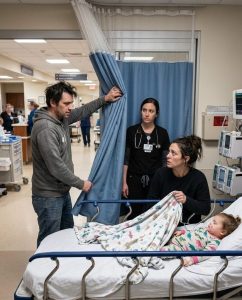
I left my hands in my lap.
“What did they say?” he asked.
The woman from the child-protection team turned her badge around properly this time. Her name was Mara Chen.
She told him our daughter was being admitted and that the medical team still needed answers about when her symptoms had started.
He looked at me first.
Then the doctor.
Then Mara.
“I already told you,” he said. “She fell around four.”
I watched the coffee tremble once against the cardboard sleeve.
The doctor asked whether she had been unusually sleepy earlier.
My husband shrugged.
“She’s almost three. She gets tired.”
I said nothing.
That was difficult.
I wanted to tell him I knew about every version written on the paper inside my bag. I wanted to ask why he had changed coloring to playing, why daycare had never happened, why he had tried to make my panic the problem instead of our daughter lying under fluorescent lights with wires taped to her skin.
Instead, I let him keep talking.
He said she had eaten lunch.
He said she had watched cartoons.
He said she had been completely normal until the fall.
The doctor wrote each statement down.
Nobody challenged him.
That seemed to relax him more than an argument would have.
Mara asked whether I wanted to sit with our daughter while they finished the next set of checks.
I stood before my husband could answer for me.
As I passed him, he caught my elbow lightly.
“Don’t let them scare you,” he said. “They have to ask these things.”
I pulled my arm free.
The hallway felt colder than the family room.
A housekeeping cart had been parked near the wall, and somebody had left a single yellow glove on top of it. I stared at that glove longer than necessary because it was easier than looking through the glass doors ahead.
My daughter was awake when I reached her.
Barely.
But awake.
Her eyes followed me when I moved to the side of the bed.
I touched two fingers to her shin instead of lifting her because the nurse had told me to keep her still.
“Mommy’s here,” I said.
Her mouth moved.
I leaned closer.
“Blue cup.”
Two words.
I laughed once through my nose and pressed my lips together.
Of course.
The blue cup.
“I know,” I whispered.
A nurse adjusted one of the leads on her chest. Her name tag said Tessa.
“You probably haven’t eaten since lunch,” she told me, putting crackers and a small bottle of water on the windowsill.
I opened the crackers anyway.
I ate one.
Then another.
They tasted like cardboard and salt.
Sometime after that, Mara came back alone and pulled a chair beside mine.
I asked the question before she could speak.
“Do you think he hurt her?”
Mara did not answer it the way I wanted.
She said the hospital was not going to guess about something it could document.
They knew the timeline he had given did not fit what the medical team was observing.
They knew he had changed details.
They knew our daughter had not gone to daycare as planned.
What they did not yet know was exactly what had happened in our apartment or why he had waited to call me.
I looked at my phone.
Daycare.
“I want to call them.”
Mara nodded.
So I did.
The front desk recognized my number, and when I asked whether my daughter had been signed in that morning, the woman paused before answering.
“No. She wasn’t here today.”
I asked whether my husband had called.
Another pause.
“Yes.”
My fingers tightened around the phone.
“When?”
“A little after eight.”
I waited while she checked their note.
Then she said, “Eight twenty-six. He told us she had a stomach bug and wouldn’t be coming in.”
I stopped chewing.
My daughter had been standing in dinosaur pajamas at 7:12, complaining about the color of a cup.
By 8:26, less than an hour and a half later, my husband had canceled daycare without telling me.
I asked the woman to repeat the time.
She did.
I wrote it on the back of a pharmacy receipt from my bag.
8:26.
Mara watched me underline it once.
I called my husband into the room after I had spoken with the doctor.
Not before.
He walked in with his phone in one hand and asked whether our daughter had said anything.
I kept my voice level.
“Why did you call daycare at eight twenty-six?”
His face changed by almost nothing.
Almost.
“She wasn’t feeling good.”
“You told me you were going to take her.”
“I was.”
“You told the hospital she ate lunch and was fine.”
“She was fine.”
“You canceled daycare before nine.”
“Because she looked tired.”
I looked at him.
I looked at his phone.
I looked back at him.
“Was she already hurt?”
“No.”
Fast.
Too fast.
He leaned toward the bed and softened his voice.
“Can we please not fight in front of her?”
I moved between him and the rail.
“We’re not fighting.”
He exhaled as though I had disappointed him.
Then he turned to Mara.
“This is what I was trying to explain. She gets locked onto things when she’s scared.”
Mara asked him to step back into the hall.
He obeyed.
Before leaving, he placed my untouched coffee beside the blue plastic pitcher near the sink.
It sat there until it went cold.
The doctor came in not long afterward.
He did not give me a dramatic speech.
He told me the scans showed an injury serious enough that they were keeping her for close observation, and that the condition they were treating did not make them comfortable accepting a four o’clock timeline without further explanation.
I asked whether she was going to be okay.
He said they were encouraged by the way she was responding, but they were not ready to promise anything yet.
I asked again whether a chair could have done it.
He said the mechanism mattered less, at that moment, than figuring out when she had first stopped acting normally and why care had been delayed.
Delayed.
I held onto that word.
My husband had called me at 4:18.
He had canceled daycare at 8:26.
Between those two times was almost an entire day I knew nothing about.
I opened my bag and took out the folded sheet Mara had given me.
For the first time, I added something myself.
8:26 — daycare canceled, “stomach bug.”
My handwriting looked unfamiliar.
A few minutes later, my phone buzzed.
It was his mother.
I nearly ignored it.
He had spent years treating every disagreement between us like something his mother could eventually smooth over with a casserole and a sentence beginning with, “You both need to remember you’re a team.”
I did not want another version of that conversation.
I opened the message anyway.
She asked how our daughter was doing.
Then another message appeared.
I read it twice.
She wrote that my husband had frightened her earlier when he called and said the little one had fallen and would not stay awake.
Earlier.
I typed with both thumbs.
“What time did he call you?”
The typing bubbles appeared.
Stopped.
Appeared again.
Finally she answered.
12:47.
I did not move.
I could hear the air vent above the bed.
I could hear Tessa opening a package at the nurses’ station.
I could hear my daughter breathing.
12:47.
More than three hours before he called me.
I asked his mother exactly what he had said.
Her response came in pieces.
He told her our daughter had climbed up near the kitchen counter.
He said there had been a fall.
He said she had cried, then become very sleepy.
His mother had told him to call me and take her in if she was difficult to wake.
He had told her he was watching her.
Then she sent one final message.
“I thought you knew.”
I took screenshots.
I showed Mara.