My sister stopped breathing halfway through dessert.
There are sentences that sound dramatic only because the truth itself is dramatic.
That one does not need anything added.
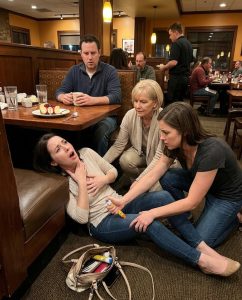
One minute Emily was sitting across from me at dinner.
The next, her chair scraped backward hard enough to turn several heads.
Her hand went to her throat.
Her face changed.
And every person at our table understood exactly what was happening.
Emily had lived with a severe almond allergy since she was nine.
We knew the signs.
She knew them better than anyone.
The strange tight look around the mouth.
The effort to swallow.
The sudden fear that comes when a person realizes their own airway is becoming unreliable.
Mark knew.
I knew.
Diane knew.
That mattered.
Mark was Emily’s husband.
Diane was his mother.
And Diane had personally brought the dessert to the table.
Cheesecake.
Berry sauce.
One plate.
Simple enough.
Emily had eaten three bites.
That was all.
Then her hand went to her throat.
Mark froze.
I wish that was an exaggeration.
It was not.
His coffee cup remained between both hands as though his body had forgotten the next instruction.
I moved before I thought.
Emily always carried an injector.
Everybody close to her knew where.
I grabbed her purse.
Found it.
Dropped to the floor beside her.
Diane reached Emily first.
Not for the purse.
Not for the injector.
She touched her.
“She probably ate something earlier, sweetheart.”
Emily could not answer.
“Don’t scare yourself.”
That sentence still makes me angry.
Not because panic helps.
It does not.
But Emily was not imagining what was happening.
Her throat was closing.
I used the injector.
Then I called 911.
The restaurant smelled like burnt sugar.
That detail stayed with me.
So did the man at the next table asking a waiter for the check while my sister fought to breathe a few feet away.
Human beings are strange in emergencies.
Some freeze.
Some stare.
Some become useful.
Some cling harder to whatever ordinary thing they were doing because accepting the crisis feels too large.
The waiter kept looking between us and the man with the bill.
Mark finally put the coffee down.
Diane crouched beside me.
She rubbed Emily’s ankle.
The gesture looked almost gentle.
That is what made the words beside it so unsettling.
“Tell them she has allergies.”
I was already speaking to emergency dispatch.
“Make sure they know we were careful.”
We.
Not the restaurant.
Not the kitchen.
We.
At the time, I heard the word and kept moving.
There was no room to analyze it.
Emily needed air.
The ambulance came.
Paramedics worked.
Questions came fast.
What allergy?
What exposure?
How long ago?
What medication?
Was the injector used?
Emily could barely speak.
I answered what I knew.
Diane answered things nobody had asked.
“She checks everything.”
“We’re always careful.”
“She sometimes gets anxious.”
The paramedics loaded Emily.
Mark went with her.
I stayed behind for less than a minute because the restaurant manager had already appeared with the ingredient binder.
His name was Luis.
He looked shaken.
Not defensive.
That difference mattered later.
“I need to see the dessert ingredients.”
He nodded immediately.
The binder came out.
Prep information.
Ingredient list.
Equipment information.
I photographed every page connected to the cheesecake.
No almonds.
No almond extract.
No shared nut equipment listed.
That did not prove everything.
It did prove something important.
The obvious explanation was no longer obvious.
At the hospital, Mark stayed with Emily.
I was still wearing the same clothes from dinner.
My coat was missing.
I realized I had left it at the restaurant.
That should have been a minor inconvenience.
Instead, it became the reason I went back.
That and Diane’s sentence.
We were careful.
I kept hearing it.
By the time I returned, the restaurant had changed.
Dinner service was thinning.
Tables were being cleared.
The energy had shifted from emergency to aftermath.
Diane was still there.
She sat at the bar.
That surprised me.
I expected her to be at the hospital.
Instead, she was talking to Luis.
I heard enough before she saw me.
Emily sometimes panicked about food.
Nobody should make accusations.
The doctors did not know what happened yet.
She spoke calmly.
Almost professionally.
As though the real danger now was somebody saying the wrong thing about the dinner.
I took my coat from where it had been left.
Then I walked to Luis.
“Please don’t clear our table.”
He hesitated.
Not long.
Just enough for Diane to turn.
“That’s really unnecessary.”
I looked at her.
She gave me the same controlled expression she had used beside Emily.
“My daughter-in-law nearly died. The last thing this family needs is drama over dirty dishes.”
Dirty dishes.
That phrasing bothered me.
Maybe unfairly at first.
But I asked again.
Luis nodded.
“I’ll take you back.”
We walked through the dining room.
Diane followed.
Luis said:
“The table hasn’t been touched.”
He believed it.
Then we reached it.
The dessert plate was still there.
Cheesecake residue.
Berry sauce.
The water glasses remained.
Mark’s coffee cup had been moved slightly but was still nearby.
I looked for Emily’s spoon.
Gone.
I checked the napkin.
Nothing.
Under the plate.
Nothing.
I looked under the chair even though that made no sense.
A spoon does not disappear beneath a chair on its own.
Diane appeared behind us.
She was holding her handbag tightly against her ribs.
“I put it with the other silverware.”
I turned.
“You moved it?”
“You were upset.”
She smiled slightly.
“I was helping.”
Helping.
Another ordinary word.
Luis glanced toward the kitchen.
I asked:
“Where would used silverware go?”
He looked uncomfortable now.
“Dish bin.”
“Show me.”
Diane immediately spoke.
“This is absurd.”
I ignored her.
Luis led us back.
Restaurant kitchens have their own weather.
Steam.
Metal.
Water.
Noise.