My Sister Got a $60K BMW—Dad Gave Me a $2 Piggy Bank, Then Called My Car Stolen
At Christmas, My Sister Got a $60K BMW and I Got a $2 Piggy Bank Then Dad Threatened to Report My Car Stolen
I sit cross-legged on the hardwood floor of my parents’ Portland living room, surrounded by torn wrapping paper and the artificial pine scent of Christmas morning, watching my sister Chelsea twirl a set of BMW keys around her manicured fingers.
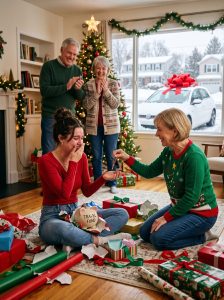
The metal catches the twinkling lights from the tree as she pirouettes like a teenager instead of a thirty-two-year-old woman.
“I can’t believe it,” she squeals, bouncing on her toes. “My own Beamer!”
Dad beams at her with unfiltered pride. Mom clasps her hands beneath her chin like she’s witnessing a miracle. The car sits in the driveway, a glossy white testament to parental devotion, complete with an enormous red bow that probably cost more than my entire Christmas.
I know this because my entire Christmas is sitting in my lap.
It’s a plastic piggy bank shaped like a cartoon character from a children’s show I outgrew twenty-five years ago. The price tag they forgot to remove reads $1.99.
“Open it,” Mom urges, gesturing toward the rubber stopper on the bottom.
My fingers feel numb as I comply. Two crisp one-dollar bills flutter out onto the wrapping paper.
“It’s the start of your future home fund, honey,” Dad announces with a wave of his hand. “You’re always so responsible with money. Not like some people.” He winks at Chelsea, who pretends to look offended, and the two of them laugh together while I sit there holding two dollars.
Mom fills the silence. “Chelsea needs reliable transportation for her new graphic design clients. Those artsy types expect a certain image, you know?”
Chelsea drops onto the couch beside me, her expensive perfume clouding the air, and pats my knee with patronizing gentleness. “Don’t worry, sis, I’ll drive you around whenever you need. Your little Toyota must be on its last legs by now.”
The Toyota that carried me through seven hours of mountain passes yesterday. The Toyota I paid off myself three years ago. The Toyota that is, at this moment, more reliable than any relationship in this room.
I can’t breathe.
Thirty-four years of moments exactly like this one crystallize in my mind with terrible clarity. This isn’t an anomaly. It’s the pattern of my entire life, finally visible all at once, like a photograph developing in front of me.
Just that morning, I had stacked their gifts under the tree. A leather briefcase for Dad that cost two weeks’ salary. The silver bracelet Mom had admired in a Seattle boutique window. The professional camera lens Chelsea had casually mentioned wanting.
All of it purchased by setting aside a little from each paycheck for months.
And I’d rehearsed my announcement during the entire drive down from Seattle. Senior structural engineer. The promotion I’d earned through nights and weekends of extra work, designing buildings that will stand for generations.
I had imagined their faces lighting up. I’d imagined being seen, finally, as something more than Chelsea’s responsible older sister.
Maybe this Christmas will be different, I’d whispered to myself at each rest stop. At each gas station. At each mile marker.
My hands tremble as I set the piggy bank on the coffee table. The plastic makes a hollow sound against the glass.
“Excuse me,” I manage, in a voice that belongs to someone else. “Bathroom.”
I walk, not run, up the familiar stairs, past the wall of family photos where Chelsea’s face dominates every frame. I lock the bathroom door and press my palms against the cold marble counter, waiting for tears that won’t come.
The pressure builds in my chest instead, like concrete hardening around my lungs.
People talk about heartbreak like it’s abstract. It isn’t. I feel each chamber of my heart contracting, blood struggling through narrowing vessels, my sternum aching like a knee is pressed against it.
This is what dying feels like, I think. Not dramatic. Just diminishing.
That night stretches endlessly. I lie awake in my childhood bedroom listening to Chelsea’s laughter drift up from downstairs as she and my parents plan her first road trip in the new car.
At 2:17 a.m., I finally sit up.
I pack quickly, taking only what matters. The faded stuffed bear my grandmother gave me. The photo album from college. The small wooden box containing my first professional blueprint. The expensive gifts I’ve given them over the years stay exactly where they are.
They were never about gratitude anyway.
The house is silent as I carry my suitcase down the stairs. My house key lies cold in my palm for a long moment before I set it on the kitchen counter, beside the coffee maker that will brew in three hours for people who will not notice I’m gone until they need something.
They made their choice. Now I’m making mine.
Streetlights blur into watery halos as I navigate empty highways. The dashboard clock reads 3:42 a.m., Christmas morning. My windshield wipers battle thickening snow while Bing Crosby croons about white Christmases from the radio, and I twist the volume knob until his voice fades to nothing.
“Have yourself a merry little Christmas,” I whisper to the empty passenger seat, and my voice breaks on the word merry.
My seven-year-old Toyota’s heater struggles against the December chill as Portland’s southern outskirts slide past. Two hundred thousand miles on this car.
It carried me through college, first jobs, promotions. It never once complained about mountain passes or tight parking spots. Unlike the gleaming machine in my parents’ driveway with its ridiculous bow, my car earned its place in my life.
Around six, my phone buzzes. Mom’s face lights up the screen. Not Are you safe. Not Please come home.
Did you remember to pay the electric bill for the cabin before you left Seattle?
The cabin they bought for weekend getaways. The cabin Chelsea uses for Instagram photo shoots.
A semi passes and sprays slush across my windshield, and for three terrifying seconds I drive blind. When the wipers clear, the memories come flooding faster than the snow.
My fifth birthday. No, Chelsea’s fifth birthday. A princess party with professional decorations, pony rides, a three-tier castle cake, thirty neighborhood kids in paper hats. My birthday the following year: a grocery store sheet cake, two friends from kindergarten, supplies from the dollar bin.
“Your sister needs the social stimulation,” Dad explained when I asked. “You’re more independent.”
Independent. Their code for: you don’t need us.
High school graduation. Valedictorian. A speech about persistence and dreams that I’d practiced into the bathroom mirror for weeks. Empty seats in the family section, because Chelsea’s junior varsity soccer team had an away game.
“We’ll watch the recording,” Mom promised. The tape sat unwatched on my dresser until I left for college.
“Your sister needs the encouragement,” Mom said. “You always succeed without our help.”
Without help. Their code for: you’re on your own.
College. Twenty-five hours a week at the campus bookstore and cafeteria. Maximum course loads to graduate early. Student loans stretched to their breaking point, while Chelsea explored “artistic inspiration” across Europe on our parents’ dime.
“Your sister needs to find herself,” Dad said during one of our rare calls. “You’ve always known exactly who you are.”
Known who I am. Their code for: you don’t deserve exploration.
My phone buzzes again. Dad this time. I let it ring out.
The first hint of dawn lightens the horizon as tears finally blur the oncoming headlights into golden streaks, and I pull onto the shoulder, hazards blinking, and press my forehead against the steering wheel.
And the whole machine reveals itself at last. Dad controlling the money, withholding from me while bankrolling Chelsea’s every whim. Mom managing the emotions, making me feel selfish for wanting even scraps. A perfect system.
One parent handling the financial favoritism. The other maintaining emotional control. Both of them calling it love.
The phone rings again, and this time it isn’t family. Monica Perez. My college roommate, my oldest friend.
“Where are you?” Her voice, warm and worried, fills the car.
“Somewhere in southern Oregon. Heading south.”
“To where?”
“I don’t know.”
The line goes quiet for a moment. Then: “Come to San Francisco. Stay with me. Family doesn’t treat family like this.”
Monica knows. She witnessed it all firsthand in college. The care packages that arrived for me containing practical necessities while Chelsea received designer clothes.
The holiday breaks I spent in the dorms because flights home were “too expensive,” the same years my parents took Chelsea to Aspen and Maui.
“I can’t impose.”
“Stop.” Her voice turns firm. “You’ve spent your whole life being the helper. Let someone help you for once.”
The words crack something open in me. Help. Such a simple concept, and so foreign. In my family, help flowed in one direction only. Toward Chelsea. Toward my parents. Never, not once, toward me.
“Okay,” I whisper, surprising myself.
“Text me your location every hour. Drive safe. I’m making up the guest room.”
By 7:30 a.m., I cross the California line. My phone shows seventeen missed calls and thirty-two texts.
With deliberate motions, I turn off notifications from Mom, Dad, and Chelsea, and the silence that follows feels heavier than any accusation.
My stomach growls. I haven’t eaten since Christmas Eve dinner. A small roadside diner appears ahead, its neon Open sign glowing in the morning light, and inside, the warmth wraps around me like an embrace.
An older waitress with silver-streaked hair approaches with a coffee pot. Her name tag reads Gloria.
“Rough night?” she asks, filling my mug without waiting for an answer.
“Rough life,” I mutter, then feel embarrassed by the melodrama.
Gloria doesn’t flinch. “Honey, I’ve been pouring coffee for forty years. I know heartbreak when I see it. Family or boyfriend?”
“Family.”
She nods and slides a menu toward me. “Blood makes you related. Love and respect make you family.” Her weathered hand rests briefly on mine. “The special’s good today. Comes with extra bacon.”
I order the special and wrap my hands around the warm mug, watching snowflakes dissolve against the window, and Gloria’s words settle into me like a verdict.
For thirty-four years, I’ve been related to the Collins family. Maybe it’s time to find out what an actual family feels like.
Three weeks later, I’m in Monica’s spare bedroom in San Francisco when my phone vibrates for the thirteenth time that morning. Dad. Again.
The first week, their messages held confusion. The second, concern. By week three they’ve evolved into something darker: manipulation dressed up as parental authority.
“Iris Elizabeth Collins.” Dad’s latest voicemail thunders through the speaker when I finally check it. “If you don’t return this car immediately, I’ll report it stolen. This childish behavior has gone on long enough.”
The Toyota. My Toyota. The one with my name on the title and seven years of payment receipts in a folder in my filing box.
He is threatening to report my own car stolen, and the audacity of it is so complete, so perfectly in character, that I laugh out loud, alone, in a terracotta-painted guest room six hundred miles from home.
Mom’s message follows. “The doctor says my blood pressure is dangerously high because of the stress you’re causing. Is that what you want? For me to end up in the hospital because you’re being selfish?”
I delete them both, though my finger hovers over the screen longer than I’d like to admit. Thirty-four years of conditioning doesn’t dissolve in three weeks.
On the dresser, my laptop displays an email I’ve rewritten fourteen times. Dear Mr. Sanderson, I’m writing to formally request a transfer to the San Francisco office, effective immediately. My finger clicks send before I can reconsider.
No family connections. No favors. Just my work record, my reputation, my worth as an engineer.
Three hours later, the approval lands in my inbox. Just like that. As if I had always been capable of building my own path, and the only thing missing had been my own permission.
“You got it?” Monica appears in the doorway, reading my face, her dark curls framing an expression of pure, uncomplicated happiness for me.
The concept still feels foreign. Someone celebrating my accomplishment without making it about themselves.
“I start Monday. Now I just need a place.”
“Already called Andrea from book club. She manages apartments in the Mission. Rent control, safe building, twenty-minute walk to your office.”
“You didn’t have to—”
“I wanted to.” She drops onto the bed beside me. “Friends help friends. No strings attached. Novel concept for you, I know.” Then she slides a business card onto my laptop. “I made you an appointment, too. Dr. Levine. Tuesday at four.”
The card reads: Elaine Levine, PhD, Family Therapy.
“I’m not crazy,” I whisper.
“No,” Monica agrees. “But you’ve been carrying something heavy for a very long time. It might help to put it down somewhere safe.”
Dr. Levine’s office smells like lemon furniture polish and old books. She wears reading glasses on a beaded chain and doesn’t rush to fill silences, just waits while I struggle to shape words that have never been spoken aloud in my life.
“Favoritism,” I finally say, and the word hangs between us like a newly discovered planet. “My entire life.”
“And how did that make you feel?” she asks.