My mom went to Europe for a month and left me with $20 when I was eleven. When they finally came back—what my mom saw made her gasp. “No. No. This can’t be happening.”
My name is Sydney, and I was eleven years old when my childhood quietly ended in the front hallway of our house.
There was no dramatic argument that morning. No slammed door. No tearful goodbye. Just my mother pulling an enormous Samsonite suitcase behind her while I stood there holding a crumpled twenty-dollar bill.
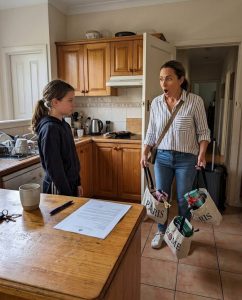
“See? You’re independent now,” she said.
She gave me one of those bright smiles that looked cheerful until you paid attention to her eyes.
“You’re not a baby anymore, Sydney. Just order food if you need to. I’m going to Europe for a month. I’ll be back before you know it.”
I stared at the money in my hand.
Twenty dollars.
I knew enough about money to understand that twenty dollars could buy dinner. Maybe a couple of cheap dinners if I was careful.
It could not buy thirty days of being eleven and completely alone.
I looked toward the kitchen, waiting for her to mention groceries. I expected her to point toward a list on the refrigerator or tell me which neighbor had a spare key.
Nothing.
There were no emergency phone numbers taped beside the fridge. No relative was scheduled to stop by. No neighbor had been told to check whether I was eating, sleeping, or even still inside the house.
My mother didn’t walk me through anything because, apparently, there was nothing to walk me through.
She was simply leaving.
I remember the sound of her heels crossing the floor more clearly than I remember her face.
Click. Click. Click.
Then the suitcase wheels bumped over the doorway and rattled down the driveway.
She didn’t come back for one last hug.
She didn’t ask whether I was scared.
The front door shut behind her with a small, ordinary click.
That was the frightening part.
Something enormous had just happened to me, and the house sounded exactly the same.
“I’ll be fine,” I whispered.
I wasn’t saying it because I believed it. I think I said it because there was nobody else there to say anything.
For several seconds, I stood in the hallway with the twenty-dollar bill pressed between my fingers.
Then I ran to the kitchen.
Maybe she had stocked the refrigerator and forgotten to tell me.
That was the explanation I wanted.
I yanked the refrigerator door open.
A carton of milk sat on one shelf. When I checked it, the smell told me immediately that it had gone bad.
There was also a jar of pickles.
That was almost everything.
I opened the pantry.
One can of creamed corn.
One dented tin of tuna.
I checked again because eleven-year-old me genuinely believed food might somehow appear if I looked carefully enough.
It didn’t.
That was when the fear stopped being an idea and became something physical.
My stomach tightened. My hands went cold.
She had actually done it.
My mother had left an eleven-year-old girl alone in a large house for a month with twenty dollars and almost nothing to eat.
The first day, I tried to behave exactly the way I imagined an “independent” person was supposed to behave.
I made plans.
I counted the money several times and flattened the bill on the kitchen counter. I thought about what food would last longest. I tried to calculate how much I could spend each day.
I didn’t really understand budgets yet, but hunger teaches math quickly.
Twenty dollars divided across thirty days was less than a dollar a day.
Even I could see the problem.
So I became careful.
Painfully careful.
Every purchase felt dangerous because once money left my hand, it wasn’t coming back.
I would stand there thinking about whether something could cover more than one meal, whether I really needed it that day, whether buying it meant I would have nothing later.
Other kids my age probably thought about homework, friends, television, or what they wanted for their birthdays.
I thought about making food last until tomorrow.
At night, the house changed.
During the day, sunlight came through the windows and I could almost pretend the situation was temporary and manageable.
After dark, every room seemed farther away from every other room.
The pipes made noises.
The floor creaked.
Cars passed outside, their headlights sliding briefly across the walls before disappearing.
Whenever I heard something near the front of the house, my heart jumped because part of me still expected the door to open.
Maybe Mom had realized this was a terrible idea.
Maybe she had reached the airport and turned around.
Maybe somebody in the family had asked the obvious question: Who is staying with Sydney?
But the door stayed closed.
Nobody came in carrying groceries.
Nobody called to ask whether I had eaten dinner.
Nobody asked whether I was frightened sleeping in that house by myself.
I began learning the difference between being trusted and being abandoned.
My mother had used the word “independent” as though it transformed everything.
As though independence meant an eleven-year-old didn’t need food waiting in the kitchen.
As though it meant nobody needed to know where she was or whether she was safe.
As though saying the word made her decision responsible.
It didn’t.
Still, I kept trying to make the money last.
The bill turned into smaller bills, then coins.
Each time I spent something, I counted what remained.
The number kept shrinking.
And every time it did, the month seemed to grow longer.
Eventually, the twenty dollars was gone.
There wasn’t a dramatic moment when I realized it. I simply counted what I had left and discovered there was nothing meaningful to count anymore.
The food disappeared too.
The little things I had managed to stretch from one day to the next were finished.
The creamed corn was gone.
The tuna was gone.