Lily came out onto the porch before Marcus finished explaining why he suddenly needed me, and the look on her face told me she had heard enough to understand exactly what he was asking of a woman three days out from eye surgery.
She was still wearing navy scrubs, and her hair was pulled back the way it always was after a long shift.
Marcus turned toward her.
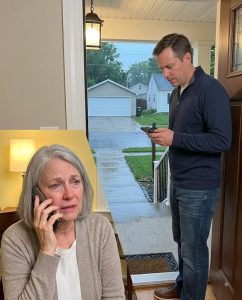
His shoulders tightened.
Lily didn’t raise her voice.
She asked, “Did you really come here asking Mom for help after telling her you couldn’t spare $3,500 to keep her from losing her sight?”
Marcus looked at me instead of answering her.
“This is different.”
Lily waited.
So did I.
Rainwater still clung to the porch railing, and the bandage near my left eye pulled slightly whenever I frowned.
Marcus finally said the lake house purchase had complicated his finances, the bank had questions, and he needed temporary family help while he got everything straightened out.
Family help.
Three days earlier, family help had apparently been something only I was supposed to understand.
“How much does Mom have in her checking account?” Lily asked him.
Marcus stared at her.
“What does that have to do with anything?”
“Answer me.”
“I don’t know.”
Lily nodded once.
“She had $412 when she called you.”
His eyes moved toward me.
For the first time since arriving, some of the force went out of his voice.
“Mom, I didn’t know it was that bad.”
“You knew I might lose my eyesight,” I said.
That stopped him.
Not for long.
Marcus had always been good at recovering when a conversation moved somewhere uncomfortable.
He had built a career out of walking into rooms full of people with more money than patience and convincing them that whatever problem stood between them and a deal could be solved.
He shifted his weight and looked past me toward the kitchen.
“But Lily handled it,” he said. “You got the procedure. You’re okay.”
Lily’s face changed.
Not loudly.
Not dramatically.
Her jaw simply tightened.
“She got the procedure because somebody else stepped in after you said no,” Lily told him.
“I didn’t say I didn’t care.”
“You hung up.”
“I was under pressure.”
“So was she.”
Marcus rubbed the back of his neck.
“You don’t understand what’s going on with the lake house.”
Lily gave a small shake of her head.
“And you didn’t understand what was going on with Mom’s eyes.”
“That’s not what I said.”
“No,” she replied. “It’s what you did.”
I had spent most of my life stepping between my children before arguments got too sharp.
When they were young, I separated them over cereal bowls, television remotes, borrowed clothes, slammed bedroom doors, and all the small unfairnesses children believe will last forever.
Even after they grew up, I still had the habit of smoothing things over.
I explained one person’s temper to the other.
I softened messages.
I made excuses.
I kept peace.
But standing there with half my face bandaged, I realized I was tired of protecting grown adults from the consequences of their own words.
“What exactly do you want from me, Marcus?” I asked.
He hesitated.
That hesitation mattered more than anything he had said since arriving.
“Just some help until things settle down.”
“Money?”
“Maybe.”
I almost laughed again, the same strange laugh that had come out of me in the clinic hallway when I saw the $3,500 estimate.
“Marcus, where do you think I would get money?”
His eyes flicked toward the kitchen table.
Toward Lily’s envelope.
I understood then why he had noticed it so quickly.
He hadn’t come inside thinking about my surgery.
He had seen evidence that money had appeared when I needed it, and somewhere in his mind that meant there might be more.
“That was Lily’s money,” I said.
Marcus looked at his sister.
“You had $3,500 sitting around?”
“I had savings.”
“Then maybe you can—”
“No.”
One word.
Marcus blinked.
Lily crossed her arms.
“I paid for Mom’s treatment. I’m not paying for your vacation house.”
“It’s not about the house.”
“You literally told her the house was why you couldn’t help.”
Marcus looked at me again.
“Mom, I’m not asking you to choose sides.”
That sentence hurt more than I expected.
Because for years I had believed not choosing sides was the same thing as being fair.
After Henry died, I tried even harder to keep the family from splintering.
I invited everyone for holidays whether they answered quickly or not.
I remembered birthdays.
I mailed cards.
I called Marcus after big work meetings because he liked having someone ask how they went.
I called Lily after night shifts because she sometimes drove home too tired to notice how exhausted she sounded.
They were both my children.
That had never been complicated to me.
Lily had been eight years old when Henry and I brought her home after her mother died, and during those first weeks she asked permission for everything.
Could she get water?
Could she sit on the couch?
Could she leave a book on the coffee table?
Could she open the refrigerator?
Henry finally taped a handwritten note to the refrigerator door that said she never had to ask before getting food in her own home.
She kept that note for years.
Marcus was older, already used to the house, already certain of where he belonged.
I sometimes wondered whether that certainty had become invisible to him.
Lily never seemed to forget what it felt like to need someone and wonder whether they would stay.
When Henry died, she didn’t make speeches about being there for me.
She showed up.
She brought groceries when I forgot to shop.
She sat at my kitchen table when the house felt too quiet.
She checked whether I had made follow-up appointments instead of assuming I had.
And when I called her about my eyes, she did not ask whether the timing was convenient.
She asked what the doctor needed.
Marcus had received love just as freely.
When he went to college, Henry and I used money we had expected to keep for retirement because Marcus said finishing without constant financial panic would give him a real start.
He promised he would repay us once his life became stable.
I never chased him for it.
Henry never did either.
There was always a reason to wait.
First he was starting out.
Then he was building his career.
Then he was getting married.
Then expenses were high.
Then property opportunities came along.
The promise simply grew older while I kept telling myself that parents were not supposed to keep score.
And maybe they aren’t.