It was my mother’s.
Her full name curved across the bottom of the page in the same careful handwriting she used on birthday cards and checks. Dr. Conner explained that the note had not canceled my treatment, but it had influenced the way my first complaints were received before the crash team completed its own assessment.
I stared at the signature until the letters blurred.
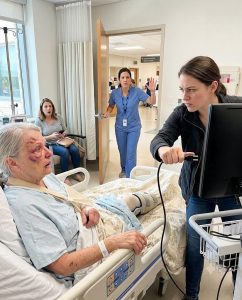
My mother had not simply watched Tessa dismiss my injuries. She had helped build the story before I was awake enough to defend myself.
Dr. Conner asked whether I wanted the note preserved with the incident report. My first instinct was the old one: protect the family, minimize the damage, survive the conversation later.
Then I remembered the monitor going dark.
“Keep it,” I said.
Those two words changed the room more than any scream could have.
The social worker returned, and I agreed to a discharge plan that barred my mother and Tessa from receiving updates or entering my room. I also asked that every statement I gave be taken without either of them present.
A few minutes later, the officer came back with a question that made my stomach tighten.
He said my mother had claimed the nurse misunderstood what happened. According to her, Tessa had only unplugged a charging cable.
The nurse was standing in the doorway when he said it.
She reached into her scrub pocket, removed the incident form she had already started, and pointed to one line.
The monitor cord had not been the only thing Tessa touched.
Just before the nurse entered, she had also moved the call button beyond my braced hand.
And the officer wanted to know whether that had happened by accident, too.
I looked at the officer, then at the call button resting against the far rail.
“No,” I said. My voice cracked, but the word came out. “It wasn’t an accident.”
Dr. Conner asked me to explain only what I remembered clearly.
I told them Tessa had complained about the noise, called me helpless, and reached across the bed while my mother watched. I remembered the tug of the blanket near my hip before the monitor went dark, but I had been too foggy to understand what she moved.
The nurse filled in the rest without dramatizing it.
She had been approaching the room when she heard Tessa say the machines were only there because I liked attention. Through the partly open door, she saw Tessa push the call button toward the opposite rail, out of reach of my braced leg and injured arm.
Then Tessa pulled the monitor cord.
The officer wrote for several seconds.
He asked whether I wanted that statement included in the report.
My mother had trained me to hear questions like that as accusations.
Do you really want to make this bigger?
Do you really want strangers involved?
Do you really want to be the reason the family breaks?
But the family had already broken something in that room.
They had broken the assumption that being related to someone meant they would protect you when you could not protect yourself.
“Yes,” I said. “Include it.”
The social worker sat beside me while the officer finished.
She did not tell me what I should feel about my mother or sister. She asked practical questions instead: who had access to my apartment, who had my spare key, whose name was listed as my emergency contact, and where I could recover without being pressured.
Every answer pointed back to my mother.
She had the spare key.
She was my emergency contact.
She knew the code to the small lockbox near my door.
Tessa knew where I kept my insurance card and had already answered questions on my behalf before I woke.
The realization settled over me slowly.
The monitor cord had been one act, but the power behind it came from years of access I had handed them because refusing felt crueler than being controlled.
I asked the social worker to remove both names from every contact list the hospital could change.
Then I asked how to document that neither woman had permission to receive information about me.
The request sounded enormous in my head.
In the room, it was a form, a signature, and a nurse placing a notice where staff could see it.
Boundaries had always been described to me as punishment.
Here, they looked like ordinary safety procedures.
My phone began vibrating on the bedside table.
I could see my mother’s name on the screen.
The first call stopped.
Then another began.
A message appeared beneath it.
Please fix this before your sister gets in real trouble.
Not before I got hurt.
Not before the monitor went dark.
Before Tessa faced consequences.
I turned the phone facedown.
The officer asked whether I wanted to speak with my mother separately.
I said no.
He asked whether I wanted to speak with Tessa.
I said no again.
Those answers were not dramatic. Nobody applauded. The room did not transform.
But each one gave me back a small piece of authority over my own body.
Dr. Conner returned to my injuries and explained the plan in plain language.
My ribs needed time and careful breathing exercises. My leg required continued support and follow-up imaging. My arm had to remain protected until the swelling eased enough for another examination.
She asked me to rate my pain.
The old word rose automatically.
Fine.
I stopped it before it left my mouth.
“Seven,” I said.
She nodded and adjusted the plan based on what I had actually told her.
It was the first proof I had that honesty did not always become ammunition.
Outside the room, Tessa raised her voice.
Even through the closed door, I could hear pieces of her argument.
She said the cord was harmless.
She said the monitor was not keeping me alive.
She said the nurse hated her from the moment she walked in.
Then she said my mother had signed the intake note, not her.
The hallway went quiet for a beat.
My mother answered in a low voice I could not make out.
Tessa spoke louder.
“You were the one who told them she does this.”
That sentence reached me clearly.
It hurt more than the signature because it stripped away the last excuse I had been trying to build for my mother.
She had not been confused.
She had not signed a blank page.
She had repeated the same story Tessa had been telling beside my bed.
The officer came back inside a few minutes later.
He did not offer conclusions or promises. He said both women had given statements and that the hospital’s documentation would be attached to the report.
He also said they had been told to leave the patient-care area.
My mother asked to say goodbye.
I refused.