“Upstairs, locked in Wade’s bedroom,” Ava said.
I moved before anyone could answer. Wade pushed himself out of the chair, one hand gripping the ice pack and the other reaching toward the staircase.
His father stepped into his path.
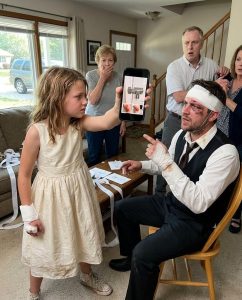
“Don’t let him near that door,” he said.
The sentence changed the room faster than the photographs had.
I took the stairs two at a time. At the end of the hall, the metal hasp from Ava’s photo was fastened across a white bedroom door. Something scraped softly on the other side.
“Tommy?” I called. “It’s me. Step back.”
Ava shouted the location of the small key from downstairs. I opened the lock and found Tommy sitting on the carpet in wrinkled wedding clothes, one shoe off, his knees pulled to his chest. His face was dry, but his breathing came in short, careful pulls.
He looked past me toward the hall. “Is Wade still mad?”
“No,” I said. “He doesn’t get to decide what happens next.”
When I brought Tommy downstairs, Diane reached for him. He flinched so hard that she stopped with both hands suspended in front of her.
Then Tommy looked at the phone in Ava’s hand and said, “Mom heard me kicking the door before the ceremony was over.”
Diane’s shoulders folded.
The officer near the front window asked who had installed the hasp.
Wade tried to speak, but his father told him to be quiet.
Diane stared at Tommy, then at Ava’s wrapped knuckles. “I did,” she whispered. “Wade said Tommy wandered at night. I knew Ava hated it. I told myself she was being dramatic.”
She turned toward the officer. “And I’ll put that in my statement.”
The officer did not congratulate her; he asked Diane to repeat the sentence slowly, then asked whether she understood that admitting she installed the outside lock would become part of the record.
Diane said yes.
Wade’s mother, Patricia, moved toward her son as if the room had turned against the wrong person. “He was trying to bring order to this house,” she said. “You people are making discipline sound like abuse.”
Wade’s father looked at her with an exhaustion that seemed older than the wedding.
“Stop protecting him,” he said.
Patricia stared at him. “You protected him too.”
“I know.”
That answer landed harder than a denial.
The officer separated the adults and asked Ava to sit where she could see me and Tommy without having Wade in her line of sight. Another officer photographed the hasp, the screws in the doorframe, and the damaged wood around the latch.
Ava handed over her phone only after she was told she could watch each photo being copied and keep the device with her.
It was a small request, but I understood why she made it.
Every adult in that house had already taken control of the story from her once.
I sat beside her while Tommy leaned against my other arm. His sock was gray from the bedroom carpet, and he kept rubbing the heel of his bare foot against the leg of my chair.
Wade tried to speak through the wire in his jaw.
“This is insane,” he managed. “She attacked me. Everyone saw it.”
“I saw the end,” Russ said from the fireplace.
Ava looked at him.
Russ swallowed. “I didn’t see how it started.”
For the first time since I arrived, he sounded less interested in defending his own opinion than in finding out what he had missed.
The officer asked Ava to describe the wedding reception from the moment she noticed Tommy was gone.
She took one breath and looked at me.
I nodded.
Ava said Tommy had been near the back of the room while the adults argued about photographs and cake. Wade had told him to stand still, smile, and stop embarrassing the family.
When Tommy disappeared, Ava checked the kitchen, the porch, and the downstairs bathroom before she heard a soft thud above the music.
She went upstairs and found Wade fastening the hasp.
Ava asked what he was doing.
Wade told her Tommy needed time to learn respect.
She demanded the key, but he ordered her downstairs, so Ava took out her phone.
That was when Wade followed her back toward the landing.
“He reached for it,” she said. “I told him I had pictures already. I told him I would show everyone.”
Wade’s eyes narrowed above the ice pack.
Ava’s voice became flatter.
“He said Mom would believe him. He said all of them would.”
She glanced at the relatives around the room.
“He was right.” Diane covered her mouth, and Ava continued.
Wade grabbed her wrist and tried to take the phone. She pulled free and ran down the stairs into the room where the guests were still gathered.
She shouted that Tommy was locked upstairs.
Wade came after her and said she was having another tantrum.
The guests saw Ava point toward the stairs. They saw Wade reach for her again.
Ava hit him. He staggered forward, and she hit him again.
After months of being told to calm down, stop exaggerating, and respect the man of the house, she did not stop when the adults started shouting.
She stopped when Wade fell and did not get back up.
The room had remembered the sight of a child striking a groom in wedding clothes.
It had forgotten what she was trying to make them see.
Fen crossed the room and crouched in front of Ava.
“I should have listened,” she said.
Ava did not answer.
Fen reached toward her wrapped hand, then stopped before touching it. “I am sorry.”
Ava looked down at the paper towel around her knuckles. “You told me I liked drama.”
“I did.”
“You told Mom not to let me ruin the wedding.”
Fen’s face tightened. “I did that too.”
The apology did not repair anything.
It did something smaller and more useful: it stopped asking Ava to carry Fen’s comfort.
Across the room, Wade’s father asked to speak.
The officer told him to wait until the initial statements were finished.
He nodded and sat with his hands clasped between his knees.
Patricia whispered at him, but he did not respond.
Diane remained near the staircase.
Every few seconds, Tommy checked that she had not moved closer.
She noticed.
Instead of asking him to come to her, she stepped back.
That was the first right decision I saw her make.
The officers did not settle every question that night.
They did not decide the final legal consequences in a living room full of wedding flowers, angry relatives, and a child with swollen hands.
They did make the immediate problem clear.
Tommy would not remain behind a door that locked from the outside.
Ava would not be removed as a dangerous child simply because the adults had described her first.
Wade would not be allowed to direct the conversation or approach either child while statements were being taken.
When the paramedics returned to move him for further evaluation, Wade looked at Diane and told her to fix this.
Diane’s face changed.
Not into courage all at once.
Into the recognition that every time he had said those words before, she had understood them as an order.
“No,” she said.
Wade stared at her.
Diane folded her hands so tightly that her new wedding ring pressed into the skin of her other finger.
“I already tried to fix it for you,” she said. “That’s how we got here.”
She did not make a speech after that.
She gave the officer the spare key to the hasp.
Then she told him where the hardware had been purchased and admitted that she had heard Tommy kicking the door before the ceremony ended.
Tommy lowered his head.
Ava reached across me and held out her uninjured hand.
He took it.