I warned them that my daughter had just returned home after a bone-marrow transplant and could not be exposed to crowds.
Mom coldly said, “Lock her upstairs.”
I agreed.
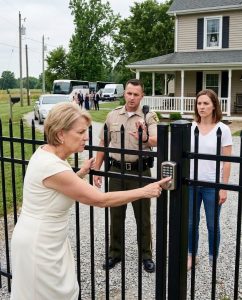
But when they arrived Saturday, the sheriff was waiting at the front gate.
When my mother told me to lock my twelve-year-old daughter upstairs so forty strangers could celebrate beneath her bedroom, something inside me became completely still.
Not angry.
Not yet.
Just finished.
My daughter Sophie had been home for nine days.
Nine.
For seven months before that, our lives had been hospital rooms, masks, blood draws, medication schedules, whispered conversations outside doors, and doctors using phrases no parent ever wants attached to their child.
Sophie had leukemia.
After treatment stopped working the way everyone hoped, she underwent a bone-marrow transplant.
The transplant itself was only part of the battle.
Coming home didn’t mean she was suddenly healthy.
It meant we were responsible for protecting a child whose immune system was still rebuilding.
Her medical team had given us strict precautions.
Limit exposure.
Avoid sick visitors.
Keep the house clean.
No large gatherings.
Call immediately if she developed a fever.
To other people, Sophie looked almost normal.
Thin.
Pale.
Her dark hair was beginning to grow back in soft fuzz.
She tired easily.
But she was home.
That was enough for me.
Our farmhouse sat on twenty-three acres outside Mill Creek, Oregon.
White siding.
Green roof.
A wraparound porch.
An old red barn behind the house.
My late husband, David, and I had bought it fourteen years earlier, before Sophie was born.
After David died in a car accident five years ago, people constantly told me the house must feel too big.
They were wrong.
It was the one place Sophie and I never felt like our family had disappeared.
My parents loved the farmhouse too.
Unfortunately, somewhere along the way, loving it became believing they were entitled to it.
My mother, Diane, treated the porch like her personal event venue.
Graduation lunches.
Thanksgiving photographs.
My father’s retirement dinner.
My sister Rachel’s engagement party.
Most of the time, I allowed it.
That was my mistake.
Permission repeated often enough can begin looking like ownership to people who don’t respect boundaries.
Three weeks before Sophie came home, Mom called.
“Your father and I have decided where we’re doing our fortieth anniversary.”
I was sitting beside Sophie’s hospital bed.
“Where?”
“The farm.”
I thought she meant a small family dinner sometime in the future.
“That could be nice once Sophie is stronger.”
“No, honey. August fifteenth.”
I looked at the calendar.
“That’s twelve days after she’s discharged.”
“I know.”
“No.”
Mom laughed.
Not cruelly.
Dismissively.
“You don’t even know what I’m planning.”
“I know enough.”
“Forty people. Caterer. Tent near the barn. Music.”
I actually pulled the phone away from my ear.
“Forty?”
“Maybe forty-two.”
“Absolutely not.”
Silence.
Then:
“Excuse me?”
“Sophie cannot be around forty people right after transplant.”
“They’ll be downstairs.”
“That isn’t how houses work.”
“Oh, Claire.”
There it was.
That tone.
The one she had used my entire life whenever I complicated something she wanted.
“You’ve become unbelievably anxious about everything.”
“My daughter’s transplant team is anxious about infection too.”
“Well, they don’t need to live.”
My hand tightened around the phone.
“Neither do forty anniversary guests.”
“This is our fortieth.”
“And Sophie is twelve.”
“What does that have to do with anything?”
Everything.
But I didn’t say that.
I simply repeated:
“You cannot host the party at my house.”
She sighed.
“We’ve already sent invitations.”
I froze.
“What?”
“The save-the-dates went out weeks ago.”
“You never asked me.”
“I didn’t think I had to.”
That sentence stayed with me.
“You didn’t think you had to ask before inviting forty people to my home?”
“It’s family property.”
“No, Mom.”
“Your father has worked on that farm for years.”
Dad had helped repair fences.
I had paid him.
He had helped repaint the barn.
I had bought the materials.
That did not make the farm his.
“I said no.”
Mom went quiet.
Then colder.
“We have people flying in.”
“Change the venue.”
“Do you know what that would cost?”
“Probably less than another hospital admission.”
She hated that answer.
“You are being dramatic.”
“Sophie just had a bone-marrow transplant.”
“I know what she had.”
“Then act like it.”
She hung up.
I hoped that ended it.
It didn’t.
Four days later, Sophie came home.
The hospital wheelchair stopped beside our porch.
She looked at the house and started crying.
Not because she was scared.
Because she could see her bedroom window.
“I thought I’d never sleep there again.”
I bent down and kissed the top of her head.
“You’re sleeping there tonight.”
For the first few days, she barely left her room except to sit on the porch when the weather was mild.
She watched our chickens through the window.
Made lists of foods she wanted “when the doctors stop ruining everything.”
At the top:
Gas station nachos.
I told her even healthy people should fear those.
She laughed.
That laugh was the best sound I’d heard in months.
Then Thursday morning, two days before my parents’ anniversary, a white catering van pulled into my driveway.
A man stepped out carrying a clipboard.
“Mrs. Bennett?”
“That’s me.”
“I’m here to confirm access for Saturday.”
My stomach dropped.
“What access?”
“Carter anniversary.”
My parents were Diane and Robert Carter.
I stared at him.
“There is no Carter anniversary event here.”
His expression changed.
“I have an agreement.”
“With whom?”
“Diane Carter.”
“She’s my mother.”
He smiled uncertainly.
“Right.”
“She does not own this property.”
His smile disappeared.
I asked to see the paperwork.
Mom had booked catering for forty.
Tables.
Linens.
A portable bar.
Two servers.
A three-course buffet.
She had listed my address as the event location.
Under property contact she had written:
Diane Carter — family owner.
Family owner.
I almost laughed.
Instead I photographed the page.
Then I told the caterer he could not enter the property Saturday.
He apologized repeatedly.
He wasn’t the problem.
An hour later, Mom called.
“You embarrassed me.”
“You lied to a vendor.”
“I didn’t lie.”
“You called yourself an owner.”
“Claire, stop with the technicalities.”
Technicalities.
A deed was now a technicality.
“The party is not happening here.”
“Yes, it is.”
“No.”
“You cannot cancel forty people two days before our anniversary.”
“You invited forty people to property you don’t own.”
She raised her voice.
“We have done everything for you.”
I looked through the kitchen doorway.
Sophie was asleep on the couch beneath one of David’s old quilts.
“Then do one more thing.”
“What?”
“Protect your granddaughter.”
Mom said nothing.
I thought maybe something had finally reached her.
Then she said:
“Lock her upstairs.”
I genuinely believed I’d misheard.
“What?”
“Put Sophie upstairs. Lock the bedroom door if you’re so worried. People can stay downstairs and outside.”
I couldn’t speak.
Mom continued.
“She’s twelve. Give her a tablet and some snacks. She’ll survive one afternoon.”
Survive.
That word.
After everything Sophie had endured, my mother used the word survive to explain why her party mattered more.
“You want me to lock my immunocompromised child in her bedroom while forty guests use our kitchen, bathroom, hallway and living room?”
“You’re twisting it.”
“No. I’m repeating it.”
“She’s not dying, Claire.”
I looked at Sophie.