The smell reached the hallway before the stretcher cleared the emergency room doors.
It was sweet, metallic, and rotten, the kind of odor that seemed to coat the back of your throat instead of disappearing when you turned away.
Fluorescent lights buzzed over the nurses’ station. Disinfectant hung in the air. Somewhere nearby, a printer kept spitting out labels for blood tubes and medication orders.
Under all of it was that smell.
I’m Dr. Sarah Jenkins, and after eight years in emergency medicine, I had learned that the worst cases did not always arrive with screaming families or blood on the floor.
Sometimes the frightening ones arrived quietly.
Marcus, one of our nurses, came toward me fast with one hand pressed over his mask.
His face was gray.
“Dr. Jenkins, now,” he said. “Eight years old. Mom says mild flu. Heart rate 140. Temperature 103.8. Blood pressure is dropping. He’s barely responding.”
He glanced toward Trauma Room 2 before adding, much more quietly, “It’s his arm.”
The sliding door opened.
The smell became almost physical.
The boy on the bed looked far younger than eight.
His lips were cracked. His cheeks were hollow. His skin had the pale, waxy look I had seen in children whose bodies had been fighting something for much longer than the adults around them were willing to admit.
His eyes were open, but they did not settle on me.
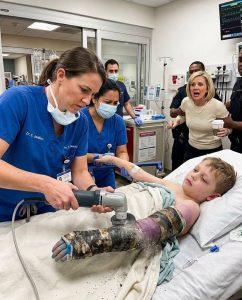
His right arm rested beside him beneath a fiberglass cast running from his knuckles to above his elbow.
It should have been the least alarming object in the room.
It wasn’t.
The cast was blackened with dirt and stained in overlapping dark rings. Fiberglass had frayed around the edges. Near his hand, the material had sunk against swollen purple skin so tightly that it looked embedded.
His exposed fingertips were blue.
I pressed one gently.
The color did not return.
“How long has this cast been on?” I asked.
His mother stood in the corner holding a paper Starbucks cup.
Martha Harris looked almost untouched by the emergency around her. Cream sweater. Pearl necklace. Smooth blonde bob. Perfect nails wrapped around the cup.
“Oh, about a month,” she said. “He’s clumsy. Always falling out of trees in the backyard. We’re only here because he felt warm this morning. Probably a seasonal bug.”
A month did not look like that.
A month did not smell like that.
I turned back to the boy and checked his arm again.
“Mrs. Harris, your son is in septic shock,” I said. “That cast has to come off immediately. He may lose his hand. He may lose his life.”
Her expression changed, but not in the way I expected.
She did not look frightened for him.
She looked irritated with me.
“No,” she said. “His orthopedic surgeon said two more weeks. Give him antibiotics, and we’ll leave.”
Clara, our veteran nurse, was already double-masked and had dabbed peppermint oil beneath her nose.
Even Clara’s hands were shaking as she wrapped the blood pressure cuff around him.
Marcus opened the pediatric IV kit beside the crash cart. The sepsis protocol sheet was clipped to the bed rail. Labels waited beside empty tubes.
Every object in that room seemed to understand the emergency before Martha did.
I had seen neglect before.
People imagine it arriving in obvious clothes, with obvious excuses, inside obviously chaotic homes.
Real neglect can look much cleaner than that.
Sometimes it wears pearls.
Sometimes it smells like expensive coffee.
Sometimes it stands beside a dying child and insists everyone else is overreacting.
I looked at those blue fingertips, and an old memory tightened beneath my ribs.
Three years earlier, I had treated another child whose caregiver offered a polished explanation for injuries that did not fit.
I had documented my concerns. I had asked questions.
But I had allowed myself to be reassured too quickly.
The child came back worse.
Some mistakes do not disappear when a shift ends.
They become rules you carry into every room afterward.
“Clara,” I said, “call security. Then bring me the cast saw.”
Martha moved before anyone else could.
She lunged toward the bed.
“You can’t touch him!” she screamed. “I’ll sue this hospital!”
Clara stepped into her path.
“Back up, ma’am.”
Two security guards appeared through the doorway moments later and moved Martha away from the bed.
She fought them hard enough to wrinkle the front of her cream sweater.
Then she saw Clara set the cast saw beside her son’s arm.
Everything about her changed.
The anger disappeared from her voice.
“Don’t open it,” she whispered.
I looked directly at her.
“Why?”
Her eyes went to the cast.
“Please,” she said. “Don’t open it.”
That was the first moment I stopped wondering whether she understood how sick her son was.
She understood something.
The question was what.
I told Marcus to continue fluids and antibiotics while Clara stabilized the boy’s arm.
The cast saw made a high mechanical whine when I switched it on.
The boy flinched weakly.
I leaned close enough for him to hear me.
“My name is Sarah,” I told him. “I’m taking this off because your arm needs help. You don’t have to do anything right now.”
His lips moved.
No sound came out.
I began cutting along the outer edge.
The first layer opened reluctantly.
The smell intensified so quickly that Marcus turned his head and gagged behind his mask.
Clara froze for half a second, then forced herself back to the bed.
Martha made a strangled sound from across the room.
“Stop,” she said.
I kept cutting.
“Stop!”
The guards held their positions.
The fiberglass separated.
Beneath it, the padding was soaked, compacted, and dark with old moisture and contamination.
When Clara gently lifted one side of the cast, several pale larvae dropped from inside the ruined padding onto the sterile floor.
One nurse near the doorway screamed before catching herself.
Another stepped backward so quickly she struck the supply cart.
For a second, even people who had worked trauma for years stared at the floor in disbelief.
Then training took over.
We moved.
I was no longer looking at the mother.
The boy’s arm demanded every second I had.
The skin beneath the cast was badly damaged and swollen, with severe infection extending beneath areas that had been trapped without air or proper care.
I will not describe every detail.
I will say only that the condition of that arm could not reasonably have appeared that morning.
This was not a child who had developed a mild fever after breakfast.
This was a child whose body had been losing a fight for some time.
“Get surgery on the phone,” I said.
Marcus nodded and moved.
Clara began helping me remove the remaining contaminated padding without putting more pressure on the boy’s compromised hand.
Martha started talking again.
“He gets dirty,” she said quickly. “He plays outside. Boys do that. He probably pushed something under there. You know how children are.”
No one answered her.
She kept going.
“He never said it hurt that badly.”
That sentence made me look up.
Not because it helped her.