Patricia Blake waited until there were witnesses before she told me nobody would remember my name.
That was her style.
She could have said it privately in her office, or caught me while I was stocking supplies, or waited until my final handoff was finished.
Instead, she leaned against the nurses’ station with her arms crossed and let her voice carry far enough for the interns to hear.
“You’re just a night-shift nurse, Rebecca. Don’t act like anyone here will remember your name.”
Her lipstick was perfect even after midnight, and the small smile at the corner of her mouth told me she had been waiting to say it.
I was near the medication cart in navy-blue scrubs with my hospital badge clipped to my chest and a dull ache running from my heels to the backs of my knees.
My shift had already included chest compressions, a frightened family, a patient who kept pulling at his IV, and a trip to the staff bathroom to scrub blood from my forearm.
Patricia had seen enough of my work over the previous three years to know exactly what nights could look like.
She simply preferred acting as though none of it counted.
“You can clean bedpans until retirement,” she added, “but don’t confuse that with being important.”
One of the interns lowered his eyes to his clipboard.
Another pretended to study something on the computer screen.
Nobody stepped into the conversation, which was fine with me.
I had stopped expecting people to rescue me from Patricia a long time ago.
My resignation had already been submitted.
This was my final shift.
That fact seemed to make Patricia bolder.
“Your resignation came at the perfect time,” she said, tapping one acrylic nail against the desk. “Some people aren’t built for pressure.”
I tightened my grip on the chart in my hand.
Three years of night shifts came back to me in a rush that had nothing to do with nostalgia.
Thanksgiving dinners from vending machines because there wasn’t time to leave the floor.
Weekends covered because somebody called out and the patients still needed nurses whether the schedule was fair or not.
My niece graduating while I stood beneath fluorescent lights checking medication doses because the unit was short-staffed.
Driving home after sunrise with my shoulders locked from exhaustion and sitting in my parked car because I needed another minute before I trusted myself to climb the stairs.
Patricia knew the schedule.
She knew the staffing problems.
She knew how often I stayed beyond handoff when a patient was unstable.
Still, she looked at me as though endurance only counted when the person doing it had a title she respected.
I met her eyes.
“Then I guess this is my last night disappointing you.”
For an instant, the smile on her face lost its certainty.
Not much.
Just enough for me to notice.
I turned away before she could answer.
The cardiac floor after midnight had a rhythm people who worked days rarely understood.
The hallways looked calmer, but calm did not mean nothing was happening.
IV pumps clicked softly from behind half-closed doors.
Monitors chirped and then settled.
Rubber soles squeaked over polished floors.
Family members slept in plastic chairs with jackets folded beneath their heads, waking instantly whenever a nurse entered the room.
The air carried the familiar mixture of antiseptic, reheated coffee, cafeteria food, and the metallic edge of fear that no cleaning product could remove.
I knew which alarms meant somebody needed to move immediately and which ones meant a patient had rolled onto a sensor.
I knew the man in Room 309 liked his blanket folded twice over his knees because once made him too cold and three times felt too heavy.
I knew Mrs. Daniels in 318 asked for water every twenty minutes even when her cup was still half full.
She was not really thirsty.
She was lonely.
Sometimes I stood there for thirty extra seconds and asked whether she wanted the television turned down or the blinds adjusted.
That was enough to make her shoulders relax.
Those moments never appeared on Patricia’s spreadsheets.
There was no column for a daughter who stopped shaking because a nurse explained what the doctor had just said.
There was no box to check for sitting beside an elderly patient who was afraid to sleep.
There was no bonus for making sure someone heard a human voice before anesthesia took over.
Patricia could decide those things were insignificant.
The patients usually did not.
At 11:47 p.m., my pager buzzed.
The message changed the entire floor in seconds.
Code trauma.
Incoming military transport.
Room 314.
Patricia straightened behind the nurses’ station.
“A military helicopter?” she asked.
Dr. Richardson was already moving down the corridor, pulling on gloves as he walked.
“Unconscious male,” he said. “Severe head trauma. Possible internal bleeding. Helicopter lands in eight minutes.”
There are moments when training takes over so completely that fear has to wait outside the room.
That was one of them.
Room 314 was one of the best private rooms available for a critical patient who needed close monitoring, and I started checking it before anyone asked me to.
Oxygen.
Suction.
IV access supplies.
Trauma cart.
Blood-pressure equipment.
Warm blankets.
Ventilator access.
Extra saline.
I checked each item once and then checked the ones that mattered most again.
Outside the building, the storm was getting heavier.
Thunder rolled across the roof and rattled the windows faintly in their frames.
Then the sound underneath it changed.
Rotor blades.
They started as a distant mechanical pulse and grew until the vibration seemed to move through the building itself.
I went to the small corridor window and saw red helicopter lights flashing through the rain.
At that point I did not know the patient’s name.
I did not know where he had been hurt or what had happened before the transport team reached him.
I knew only that somebody in his twenties was coming through our doors with severe injuries and very little time to spare.
Whenever a critical patient arrived that way, I found myself thinking the same thing.
Somebody loves this person.
Even if nobody is standing here yet, somebody is going to want us to fight for him.
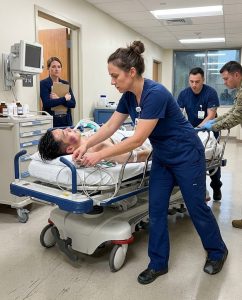
The elevator opened and the trauma team came out fast around a gurney.
The scene seemed to arrive all at once—uniforms, equipment, urgent voices, wet fabric, wheels cutting across the polished floor.
“Male, late twenties,” one of the medics called out. “Petty Officer Marcus Kim. Unresponsive at scene. Blunt-force trauma. Two fractured ribs confirmed. Abdomen rigid. Pupils reactive but sluggish.”
Marcus looked young.
That was the first thing I thought when I saw his face.
His skin was pale beneath the dried blood, and his dark hair was damp and stuck to his forehead.
One side of his jaw was already turning a deep purple.
His breathing was being supported, which made the rise and fall of his chest look mechanical in a way that always made a room feel colder.
Even so, there was something stubborn about him.
That may sound strange to say about an unconscious patient, but nurses learn to notice the difference between a body that seems to be slipping away and one that keeps forcing the numbers back toward life.
Marcus looked like he had not given up.
“On my count,” Dr. Richardson said. “One, two, three.”
We moved him from the gurney onto the bed.
I connected the monitors while another nurse started fluids.
Dr. Richardson checked his pupils again.
Someone called the operating room.