I used to believe that family meant safety. No matter how complicated life became, I thought there would always be certain lines people would never cross. I was wrong.
The first crack appeared quietly, years before everything exploded inside my living room.
Growing up, my sister was always the favorite. Everyone in the family knew it, even if nobody admitted it aloud. My parents treated her like someone delicate, someone special, someone destined for a bigger life than the rest of us.

When she made mistakes, they excused them. When she failed, they rescued her. When she demanded more, they somehow found a way to give it.
I learned early that I was expected to survive on my own.
At first, I convinced myself it did not matter. I worked harder. I stayed quiet. I built my life carefully while watching my sister drift from one disaster to another with my parents constantly cleaning up behind her.
Still, I never imagined things would reach this point.
Years passed. I got married, bought my own house, and built a stable life from the ground up. Nothing was handed to me. Every mortgage payment came from long nights, exhausting shifts, sacrifices, and years of saying no to things I wanted.
Meanwhile, my sister lived differently.
She chased luxury, expensive vacations, trendy apartments, designer clothes, and a lifestyle she could never truly afford. Every time things collapsed, my parents stepped in again.
Then one afternoon, my mother called me sounding unusually cheerful.
“Your father and I sold the house,” she said.
At first, I thought maybe they were downsizing for retirement. They were getting older, and maintaining a large property was becoming difficult. But then she told me the rest.
They used the money to buy my sister an $860,000 home.
Just like that.
No discussion. No hesitation. No concern about their future security. They handed over nearly everything to her because she “needed stability.”
I remember standing silently in my kitchen after the call ended, staring at the wall while anger slowly crawled into my chest.
Not because I wanted their money.
Not because I expected an inheritance.
But because deep down, I realized something painful. My parents were willing to sacrifice everything for one child while expecting the other child to simply understand.
Again.
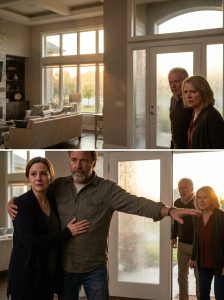
I tried to let it go.
For weeks, I told myself it was their decision. Their money. Their lives. Maybe this was what made them happy.
Then they showed up at my front door.
I still remember the exact sound of the knocking. Sharp. Confident. Almost rehearsed.
My parents walked inside carrying expressions that already made me uneasy. My mother sat down first. My father stayed standing near the doorway like he was preparing for an argument.
Then came the words that changed everything.
“We need your help,” my father said carefully.
I asked what happened.
Apparently, after buying my sister the house, they realized they had nowhere stable to live long term. Temporary rentals were expensive. Retirement savings were thinner than expected. Costs kept rising.
Then my mother said something that made my stomach tighten.
“We were thinking maybe we could move into your house.”
Not visit.
Not stay temporarily.
Move in.
I laughed at first because I honestly thought she was joking. But nobody else laughed.
The room became painfully quiet.
I explained calmly that our house was not large enough for four adults permanently. My wife worked from home. We had our routines, our plans, our own future to protect.
My mother’s face immediately changed.
“So you would leave your parents struggling?” she asked.
That sentence hit me harder than I expected.
Because suddenly, the years of imbalance, favoritism, guilt, and emotional pressure all rushed back at once. Every birthday where my sister received more. Every family gathering where her mistakes became excuses while mine became criticism.
And now this.
They had given my sister an $860,000 home, yet somehow I was supposed to sacrifice mine too.
I looked at my father hoping he would step in, maybe admit the situation was unreasonable. Instead, he avoided eye contact completely.
That silence told me everything.
Then came the real request.
My mother suggested that maybe my wife and I could temporarily move somewhere smaller while they stayed in our home “for a while.”
I honestly thought I misheard her.
They wanted us to leave our own house.
The house we paid for.
The house we worked years to afford.
The house where we built our entire life together.
Something inside me snapped.
Not loudly. Not dramatically.
Just permanently.
I stood there staring at my parents, realizing they genuinely believed this was acceptable. In their minds, my sister deserved protection while I existed to absorb consequences.
That was my role.
The dependable child.
The sacrifice.
The backup plan.
And for the first time in my life, I refused to play it.
I looked directly at them and said one word.
“No.”
The silence afterward felt enormous.
My mother blinked at me like she did not recognize the person standing in front of her. My father finally looked up, his expression caught somewhere between anger and disappointment.
“You would really do this to us?” my mother whispered.
What shocked me most was how sincerely betrayed she sounded.
As if I had committed the cruelty.
As if years of emotional imbalance had never happened.
As if giving my sister nearly a million dollars while expecting me to surrender my home was somehow perfectly fair.
I stayed calm, but inside, my heart was pounding.
I told them I loved them, but my answer would not change. They made their decisions. I was not responsible for fixing the consequences.
My mother started crying almost immediately.
She said family should help each other. She said parents sacrifice everything for their children. She said one day I would regret abandoning them.
But something about her words felt different now.
Not loving.
Not honest.
Just manipulative.
For years, guilt had controlled every family conversation. Every request came wrapped inside obligation. Every boundary became selfishness.
That day, I finally saw it clearly.
My father eventually spoke, but his voice carried frustration more than sadness.
“You’ve changed,” he said.
Maybe he was right.
Because the version of me they relied on no longer existed.
The version willing to stay silent while being treated like an emotional insurance policy was gone.
After another tense hour, they finally left.
I remember closing the front door and standing there motionless. My wife walked into the hallway and asked if I was okay.
I did not know how to answer.
Part of me felt devastated. Another part felt strangely free.
For days afterward, the messages kept coming.
Relatives called saying I should reconsider. An aunt told me my parents were “heartbroken.” My cousin accused me of being cold. Some family members acted like I had thrown elderly strangers onto the street.
Nobody mentioned the $860,000 house.
Nobody questioned why my sister could not help the parents who sacrificed everything for her.
That silence revealed another painful truth.
Families often protect the people who create problems while placing responsibility on the people who create stability.
Because stable people are easier to pressure.
But eventually, even the patient ones reach a limit.
Weeks later, I heard my parents had moved into my sister’s new house temporarily. Apparently, tensions started almost immediately. Complaints about space, finances, routines, and boundaries quickly turned the dream home into a battlefield.
I wish I could say I felt satisfied hearing that.
I did not.
Mostly, I felt tired.
Tired of decades of unequal expectations.
Tired of carrying emotional burdens that were never mine.
Tired of being treated like loyalty meant endless sacrifice.
Some nights, I still replay that conversation in my head. I wonder whether things could have gone differently. I wonder whether refusing them permanently damaged our relationship.
Maybe it did.
But protecting your peace is not cruelty.
And owning boundaries does not make you heartless.
Sometimes the hardest thing a person can say to family is a single word.
No.
Because “No” forces people to confront realities they spent years avoiding.
It exposes entitlement.
It reveals favoritism.
It breaks unhealthy patterns that survived through silence.
Most importantly, it reminds people that love and sacrifice are not the same thing.
I still love my parents.
But love should never require surrendering your entire life to repair choices you never made.
And that day, standing inside the home I worked years to build, I finally understood something that changed me forever.
The moment people become angry at your boundaries is often the exact moment those boundaries become necessary.