The pool party was supposed to make everything feel easy again.
That was what Adam told his mother when he called three days before, his voice tired beneath the rush of traffic and whatever argument he was pretending had not happened before he dialed.
‘Nothing big, Mom,’ he said. ‘Just burgers, cousins, the pool. Something normal.’
Normal was the word that got her there.
It was the word that made her stop at the store for juice boxes and paper plates.
It was the word that made her pull Maisie’s pink floaty from the garage shelf, wipe dust off the plastic, and put it in the trunk beside a folded beach towel.
At four years old, Maisie had always loved water.
Not deep water.
Not waves.
But sprinklers, bathtub bubbles, plastic kiddie pools, puddles after summer rain.
She was the kind of child who would put both hands under a faucet and laugh like the world had just performed a magic trick for her.
That was why the grandmother noticed the wrongness before anyone else wanted to name it.
The backyard was loud when she arrived Saturday afternoon.
Children ran barefoot across the patio.
The grill smoked near the fence.
The air smelled like lighter fluid, chlorine, hot concrete, sunscreen, and hamburger edges turning black while Adam tried to talk to two people at once.
A little American flag hung from the back porch railing, barely moving in the heavy summer air.
A cooler sat open beside the lawn chairs, juice boxes sweating in the ice.
Everything looked ordinary enough to fool a person who wanted to be fooled.
Maisie was sitting by the sliding glass door in a cotton dress and sandals.
Every other child was wet.
Every other child was loud.
Maisie sat with her knees pulled tight to her chest, twisting the hem of her dress until the cotton bunched like rope between her fingers.
Her grandmother crouched in front of her.
‘Sweetheart, don’t you want to swim? I brought your pink floaty.’
Maisie shook her head.
Her eyes did not go to the floaty.
They went to the pool, then to Brooke, then down at the concrete.
‘My tummy hurts,’ she whispered.
The grandmother touched Maisie’s forehead.
No fever.
But there was a clammy coolness to her skin, the kind that comes from fear, not sickness.
There are moments when a child lies and every adult in the room knows it.
There are worse moments when a child tells the truth in the only words she has, and the adults decide to call it lying.
‘Adam,’ the grandmother called lightly, because she had learned over decades that panic has to enter a room wearing manners if it wants anyone to listen, ‘Maisie says her stomach hurts.’
Adam glanced over from the grill.
His face carried the tired, careful look of a man who had been managing someone else’s mood for too long.
‘She’s fine, Mom. She just doesn’t want sunscreen.’
Brooke appeared beside him almost immediately.
That was the first thing that made the grandmother’s stomach tighten.
Brooke did not walk over like a mother concerned about her child.
She walked over like someone protecting a story.
‘Please don’t make it a thing,’ Brooke said, smiling for the guests. ‘Maisie gets tummy aches whenever she’s not the center of attention.’
Maisie flinched.
It was small.
Small enough that a stranger might have missed it.
Her grandmother did not.
It was not a pout.
It was not embarrassment.
It was the tiny recoil of a child who already knew which adult could make a room turn against her.
The grandmother looked at Adam again.
For one second, she did not see the thirty-two-year-old man with a mortgage and a spatula.
She saw the boy he had been, running across her front porch with grass stains on both knees, trusting her to clean the blood and tell him the truth.
She wondered when he had learned to stand still when his own child went quiet.
Some lessons are not taught once.
They are taught by every argument avoided, every look ignored, every uncomfortable truth traded for peace.
The grandmother asked Maisie whether she had eaten something that upset her.
Maisie’s eyes flicked toward Brooke.
Then toward Adam.
‘No,’ she whispered.
Brooke let out a small laugh.
‘Mom, she’s sensitive. If you hover, you’ll make it worse.’
Hover.
The grandmother hated the word instantly.
It made concern sound invasive.
It made noticing sound rude.
It made love sound like a boundary problem.
She stood there with her hand on the back of a patio chair and felt every old instinct in her body come awake.
She wanted to challenge Brooke in front of everyone.
She wanted to ask Adam when exactly his daughter had become an inconvenience.
She wanted to kneel in front of Maisie and say, Tell me right now.
But she had raised children long enough to understand that frightened children do not speak when the loudest adult is still watching.
So she did the only thing she could think of.
She made an excuse.
‘I’m going to use the bathroom,’ she said.
Inside the house, the party dulled behind the walls.
The air-conditioning touched the back of her neck.
The hallway smelled like lemon cleaner and damp towels.
A family photo hung crooked near the powder room.
Adam, Brooke, and Maisie smiled from inside the frame, bright and still and useless as evidence.
On the kitchen counter sat a paper coffee cup with lipstick on the lid.
Beside it was a printed swim lesson receipt dated that morning.
Maisie’s name had been circled in blue ink.
The grandmother stopped walking.
A receipt is not proof of cruelty.
A circled name is not an accusation.
But proof often starts as the small thing nobody thinks you will notice.
The time on her phone was 2:17 PM.
She remembered it because later, when she had to tell the story in order, that was where the order began.
At 2:17 PM, a four-year-old who loved water was afraid of a swimsuit.
At 2:17 PM, the mother who had paid for a swim lesson that morning was telling everyone the child only wanted attention.
At 2:17 PM, Adam was outside letting the grill smoke while his daughter sat alone by the glass door.
The grandmother stepped into the bathroom and reached for the light.
A soft shuffle came behind her.
Maisie slipped inside before the door closed.
Then she pushed it almost shut with both trembling hands, leaving a narrow crack like she had practiced making secrets look innocent.
‘Grandma,’ she whispered.
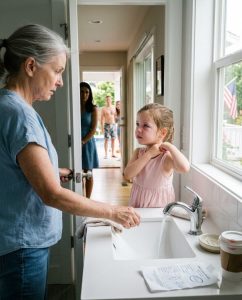
The grandmother turned the faucet on low.
The running water filled the small room with a steady sound.
‘What is it, baby?’
Maisie swallowed.
Her chin shook.
‘The truth is…’
Outside, a patio chair scraped.
Brooke’s voice rose from the backyard, bright and close enough to freeze the child in place.
Maisie looked at the door.
Then she looked back at her grandmother.
‘Mom and Dad said if I tell you…’
Her hand rose toward the zipper on the back of her dress.
The grandmother understood before she saw anything.
She understood because Maisie’s eyes were already apologizing for a truth that did not belong to her.
‘Slowly,’ the grandmother whispered. ‘You are not in trouble.’
Maisie pulled the zipper down one inch.
Then two.
The grandmother did not cry out.
That was the first mercy she gave the child.
She kept her face steady while her heart went cold.
The marks were not shown to the backyard.
They were not discussed in front of the cousins.
They were not turned into spectacle.
They were high enough to be hidden by fabric and clear enough to make the grandmother understand why a swimsuit had become terrifying.
Maisie whispered that the lesson had been that morning.
She whispered that she had cried.
She whispered that Brooke had been embarrassed.
She whispered that Adam had seen her afterward.
That was the sentence that changed the room.
‘Daddy saw.’
The grandmother zipped the dress back up with hands that wanted to shake and would not allow themselves to.
Children remember adult faces.
They remember the face that explodes.
They remember the face that laughs.
They remember the face that looks away.
So the grandmother made her face safe, even while something inside her was breaking.
She opened the bathroom door.
Brooke was in the hallway.
Not at the end of it.
Not casually passing by.
Right there.
Her smile was gone.
‘Everything okay?’ Brooke asked.
The grandmother stepped out first and kept Maisie behind her.
‘Adam,’ she called.
Her voice did not shake.
Maybe that was why the backyard quieted.
Adam appeared with the grill spatula still in his hand, grease on his T-shirt, confusion already hardening into defense before he knew what he was defending.
‘What’s going on?’
Maisie pressed her face into her grandmother’s leg.
Brooke said, ‘Your mother is making this dramatic.’
That was when the grandmother looked at Adam and saw the truth land before the words did.
He knew.
Maybe not all of it.
Maybe not with the courage to name it.
But he knew enough.
The spatula slipped from his hand and hit the hallway floor.
The sound was small.
It was also final.
The grandmother told Brooke to step back.
Brooke tried to speak over her.
The grandmother did not raise her voice.
That frightened Brooke more than shouting would have.
‘I am taking Maisie with me to be checked,’ the grandmother said. ‘Adam, you can come as her father or you can stand there and explain later why you didn’t.’
Nobody moved for a second.
Outside, a child asked where the ketchup was.
A man near the grill looked away at the fence.
One of Brooke’s cousins put a hand over her mouth.
The party did not end with a dramatic announcement.
It ended the way family disasters often end.
With paper plates still on the table.
With burgers cooling on a tray.
With children being gathered quietly because adults finally understood the house was not safe for pretending anymore.
Adam came with them.
He did not look heroic.
He looked ruined.
In the car, Maisie sat buckled in the back seat with her pink floaty still deflated beside her.
The grandmother drove because Adam’s hands would not stop trembling.
At the pediatric urgent care intake desk, the grandmother gave the time as clearly as she could.
2:17 PM was when she noticed the receipt.
A Saturday morning swim lesson was the document on the counter.
A child’s own words were not a rumor.
They were the beginning of a report.
The nurse did not gasp.
Good nurses know better.
She lowered her voice, crouched to Maisie’s level, and asked questions slowly enough for a frightened child to answer.
Adam stood near the wall with both hands over his mouth.
At one point, he turned away.
The grandmother did not comfort him.
Not yet.
There is a kind of guilt that deserves comfort after accountability, not before.
Brooke called seventeen times in the first hour.
The grandmother let every call go unanswered.
Then the messages began.
You misunderstood.
She bruises easily.
You are ruining my family.
Adam read the third message and sat down like his knees had stopped working.
‘Our family,’ he whispered.
It was the first time all day he said it like Maisie was included.
The grandmother watched him cry into his hands.
She loved her son.
She had loved him from the first breath he took.
But love does not turn a grown man’s failure into an accident.
She told him that gently.
Gently was not the same as softly.
‘You don’t get to be surprised by the damage you kept choosing not to see,’ she said.
He nodded.
Then he asked the nurse what he needed to do.
That was the first useful thing he had said since the party began.
By evening, the day had turned into paperwork.
A medical note.
An incident report.
A written timeline.
A list of who had been present at the house.
The grandmother documented what she had seen, not what she guessed.
She wrote down the receipt.
She wrote down the time.
She wrote down Maisie’s words exactly as the child had said them.
Mom and Dad said if I tell you.
Daddy saw.
Those words did not need decoration.
They were heavy enough alone.
That night, Maisie slept in the grandmother’s guest room under a quilt with tiny blue flowers.
The pink floaty sat in the corner, still folded.
Adam slept on the living room couch, if sleeping meant lying there with his eyes open until sunrise.
Brooke did not come over.
She sent one last message after midnight.
You had no right.
The grandmother looked at it for a long time.
Then she blocked the number for the night and put the phone face down.
In the morning, Adam made Maisie toast and cut it into triangles because that was how she liked it.
He set the plate down too carefully.
Maisie looked at him with the caution children should never have to use on a parent.
‘I’m sorry,’ he said.
It was not enough.
But it was a beginning.
Maisie did not answer right away.
She picked up one triangle of toast and looked at her grandmother.
Only when her grandmother nodded did she take a bite.
That was what the whole day had taught them.
A child should not have to check one adult’s face to know whether another adult is safe.
Adam filed the report he should have helped make the first time his daughter went quiet.
He moved out of the house with two duffel bags, Maisie’s favorite stuffed rabbit, and the framed family photo from the hallway turned face down in the back seat.
The grandmother did not pretend everything would heal quickly.
Trust does not return because an adult cries.
Trust returns, if it returns at all, through school pickups, doctor visits, therapy appointments, quiet breakfasts, and every ordinary moment where a child learns the truth will be believed before it has to scream.
Weeks later, Maisie asked if she could fill a plastic bowl with water on the porch.
Not a pool.
Not yet.
Just a bowl.
The grandmother brought one outside and sat beside her in the shade.
Maisie dipped her fingers in.
The small American flag on the porch lifted once in the breeze.
For the first time since that Saturday, the child smiled at water.
It was tiny.
It was not the end of the story.
But it was something normal.
And this time, nobody in that family was allowed to use normal as an excuse to look away.