The rain was coming down so hard that Adele Fairbanks almost missed the farmhouse.
She had driven that road since she was old enough to sit in the back seat with muddy sneakers and a library book on her lap, but that night the whole place looked unfamiliar through the sheet of water running over her windshield.
Then her headlights caught the yard.
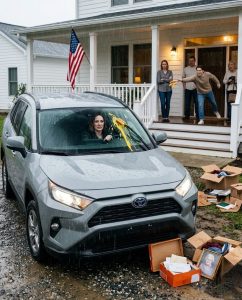
Cardboard boxes were scattered across the wet grass.
A winter coat was soaked flat near the driveway.
Books lay open in the mud, their pages swelling and curling like they were trying to breathe.
Beside the mailbox, the shoebox of old letters from Adele’s childhood bedroom had collapsed under the rain.
For a few seconds, she did not move.
She sat behind the wheel of her SUV with both hands locked around the steering wheel, listening to the wipers scrape across the glass.
The air inside the car smelled like damp upholstery, rainwater, and the bitter plastic scent of an old travel mug in the cup holder.
Outside, her life before adulthood had been dumped on the lawn like trash.
Three weeks earlier, Adele had sold Birchwood.
Birchwood had started in a rented office above a hardware store, a place so small the winter wind came through the window frame and made her invoices flutter across the desk.
She built it anyway.
She built it with cheap coffee, late-night spreadsheets, and clients who first hired her because she was less expensive than the bigger firms, then stayed because she found what other people missed.
By year four, Birchwood had become a respected forensic accounting company.
By year seven, Adele had employees, contracts, and a reputation for being the woman you called when numbers did not tell the truth unless you forced them to.
At 4:17 p.m. on a gray Tuesday, the wire confirmation arrived.
Seven million dollars.
Cash.
Clean, legal, final.
The sale agreement, closing statement, and wire transfer ledger were already printed and locked in a folder at Adele’s house.
Her family knew none of it.
Adele had told them the opposite.
She told Warren and Elaine Fairbanks that Birchwood was gone.
She told them the money was gone.
She told them she might need a few weeks to get herself steady again.
It was not her proudest moment.
She knew that.
But after years of being loved only when she was useful, admired only when there was something to brag about, and contacted mostly when someone needed a check, a recommendation, or a quiet rescue, Adele wanted one clean answer.
Would they love her if there was nothing left to take?
The answer stood on the porch before she even turned off the engine.
Her father, Warren, stepped outside with no coat and no umbrella.
Rain darkened the shoulders of his shirt almost immediately, but he seemed to enjoy that, as if standing in the weather made him look righteous.
“You’ve always been a failure,” he shouted through the rain. “Don’t make it our problem.”
The words landed with a strange dullness.
Adele had expected anger.
She had expected disappointment.
Some small foolish part of her had even expected one person to say, Come inside, we’ll figure it out.
Instead, her father had already packed her things.
Adele looked past him toward the doorway.
Her mother, Elaine, stood just inside the warm rectangle of light with her arms folded across her sweater.
She did not look surprised.
She did not look ashamed.
She looked tired in the exact way she used to look when Adele brought home an award from school and everyone else had to pause dinner to acknowledge it.
Behind Elaine, Adele’s aunt stood with an overnight bag in one hand.
The aunt stared at the boxes, then at the mailbox, then at the porch floor.
Anything but Adele.
Then Brinn came outside.
Adele’s younger sister had always been the soft spot in the family.
When Brinn forgot bills, Warren called it stress.
When Brinn quit jobs, Elaine called it searching for herself.
When Brinn borrowed money, it became a family emergency.
When Adele succeeded, it became proof she thought she was better than everyone.
Brinn was holding a paper plate.
There was a half-eaten hot dog on it, the bun split and yellow mustard smeared along the edge.
The whole scene had the strange, petty ugliness of a backyard cookout after everyone had decided one person did not belong.
Brinn looked at Adele through the rain.
Then she smiled.
Adele saw her sister lift the hot dog before she fully understood what was happening.
It hit the windshield with a soft slap.
Mustard dragged down the glass in one yellow line.
The porch went still.
Warren did not tell Brinn to stop.
Elaine did not step forward.
The aunt did not say Adele’s name.
Rain ticked against the hood, the roof, the windshield, and the broken boxes in the yard.
On the porch table, a paper plate shifted in the wind and scraped once against the wood.
Nobody moved.
For one ugly second, Adele pictured rolling down the window and telling them everything.
She pictured Warren’s face when he heard the number.
She pictured Elaine’s voice changing shape around the word sweetheart.
She pictured Brinn trying to laugh it off, trying to make the hot dog a joke, trying to pull Adele back into the old family rhythm where cruelty counted as honesty when it came from the right person.
Adele kept her window up.
She did not scream.
She did not mention the seven million dollars.
She did not tell them that she could buy the farmhouse twice before breakfast and still have enough left to never hear Warren’s voice again.
Money shows people who they are.
The lack of it only shows you faster.
Adele opened the door and stepped into the rain.
Cold water ran down the back of her neck and under the collar of her coat.
Her shoes sank slightly into the mud as she crossed the yard toward the boxes.
She did not collect everything.
Some of it was ruined beyond saving.
Old paperbacks had split at the spine.
A sweater from college was soaked through.
A jar of buttons from her old sewing kit had tipped over, scattering little white and brown circles into the grass.
Then she saw the frame.
It was face down near the bottom of one soggy carton.
Adele knew what it was before she picked it up.
Her grandmother Vivian.
In the photograph, Vivian stood on that same farmhouse porch years earlier, one hand raised against the sun, smiling at Adele like the world had not yet decided what Adele was worth.
Vivian had been the only person in that house who made love feel practical instead of conditional.
She fixed loose buttons on Adele’s coat.
She saved the heel piece of fresh bread because Adele liked it.
She sat through Adele’s school presentations even when Warren called them boring.
When Adele started Birchwood, Vivian was already frail, but she mailed her a handwritten card with twenty dollars tucked inside and a note that said, Build it anyway.
That was the trust signal Adele had carried for years.
Build it anyway.
Adele lifted the photograph from the mud and wiped the glass against her soaked shirt.
Her hands were steady.
Too steady.
Behind her, Warren laughed once.
It was not a big laugh.
It was worse.
It was the kind of short, satisfied sound people make when they think someone has finally been put back in their place.
Elaine said, “Just leave before you make this worse.”
Brinn leaned against the porch rail with the loose satisfaction of someone who believed she had won.
Adele placed Vivian’s photograph on the passenger seat.
She got back in the SUV.
She drove away with mustard still crawling down the windshield.
No one called after her.
No one apologized.
No one stepped into the rain.
The next day, the small business notice went live.
It was not dramatic.
It was not emotional.
It was a clean little announcement in the language of mergers and acquisitions.
Adele Fairbanks had sold Birchwood, her forensic accounting company, for seven million dollars.
By 10:32 a.m., her phone rang for the first time.
Warren.
Adele watched his name glow on the screen until it disappeared.
At 10:41, Elaine called.
At 10:44, Brinn called twice.
By noon, there were fourteen missed calls.
By sundown, there were thirty-five missed calls, six voicemails, and one text message from Brinn that said, “We need to talk like adults.”
Adele stared at that one for a long time.
Like adults.
Not like a sister who threw food at a windshield.
Not like a father who dumped boxes in the rain.
Not like a mother who watched and said nothing.
Like adults.
Elaine left the voicemail Adele knew would come.
Her mother’s voice was soft in it.
Too soft.
“Sweetheart, we were only ever trying to protect you. Call your mother back.”
Adele played it once.
Then she set the phone face down on the kitchen counter.
Sweetheart.
From the same woman who had watched Adele stand in the rain beside her ruined childhood and kept her hands folded.
Adele made tea because she needed something to do with her hands.
She let the kettle scream longer than necessary.
She poured the water over the bag and stood there while steam warmed her face.
Beside the mug, propped against the backsplash, was Vivian’s muddy photograph.
Adele had cleaned the glass, but dirt still clung to the frame.
She did not wipe that part away.
Not yet.
That was when a different number began calling.
A Vermont area code.
Adele did not recognize it.
She let it ring.
It stopped.
It rang again.
Then a third time.
Finally, Adele answered.
“Miss Fairbanks?” the man on the other end said.
His voice was old, careful, and shaken.
“Yes.”
“My name is Theodore Brandt,” he said. “I drew up your grandmother’s will.”
Adele’s fingers tightened around the edge of the counter.
Vivian had been dead for eight years.
For eight years, Elaine had told Adele there had been nothing for her.
Vivian’s pearls had gone to Elaine.
The china had gone into storage.
The sewing table had gone to Brinn, who used it for two months and then buried it under laundry.
Adele had been handed one photograph and the quiet understanding that she should be grateful for even that.
“I think,” Theodore said gently, “you should come to my office tomorrow morning.”
The next morning, Adele drove there at 9:06 a.m.
Theodore Brandt’s office was above a closed insurance agency on a small main street with cracked sidewalks and a diner two doors down.
Old gold lettering clung to the frosted glass.
Inside, the office smelled like paper, dust, and lemon furniture polish.
On Theodore’s desk sat a printed real estate listing.
Adele knew the porch before she read a single word.
Vivian’s farmhouse.
The birch trees.
The wet driveway where Adele’s boxes had been dumped.
The land behind the house where Vivian once let her pick blackberries in a plastic bowl.
Listed for sale at $640,000.
Adele stared at the number.
“Who listed it?” she asked.
Theodore did not answer right away.
Instead, he opened a drawer and removed a thick cream-colored envelope sealed with dark wax.
The envelope looked too formal for the little room.
Too old.
Too patient.
On the front were five words in Vivian’s handwriting.
For Adele when she’s ready.
The room seemed to narrow.
Adele could hear the old radiator clicking near the wall.
She could hear a car pass on the street below.
She could hear her phone buzzing in her purse, no doubt another call from someone who had found her valuable again.
Eight years.
That envelope had waited eight years while Elaine divided the pearls, the china, and the sewing table.
Eight years while Warren talked about family loyalty as if loyalty meant obedience to him.
Eight years while Brinn borrowed, complained, smiled, and took.
Eight years while Adele believed the only thing Vivian had left her was a muddy photograph rescued from a box.
Theodore pushed the envelope closer, but he did not touch the seal.
“Your grandmother had instructions,” he said. “Very specific instructions.”
Adele looked at him.
“Why now?”
Theodore’s face tightened.
“Because the farmhouse has been listed. And because your grandmother believed there would come a day when you needed proof more than comfort.”
Proof.
Adele knew proof.
She had built an entire company around it.
Proof was not a feeling.
Proof was a timestamp.
A signature.
A document that survived the person who lied.
She placed her fingers on the cracked wax seal and opened the envelope.
The first thing inside was a letter.
Adele saw Vivian’s handwriting and had to look away for a moment.
Not because she was crying.
Because she was angry at how quickly love could return through ink.
The second item was a notarized instruction page.
The third was a copy of a deed transfer.
At the bottom was a county clerk stamp.
The date was eight years old.
Adele read the first line once.
Then again.
Then a third time, because the words refused to behave like ordinary words.
Vivian had not left the farmhouse to Elaine.
She had not left it to Warren.
She had not left it to be sold, divided, or used as leverage over Adele.
Vivian had placed it in trust for Adele.
Theodore sat very still.
“Your mother signed an acknowledgment,” he said.
Adele looked up slowly.
“My mother knew?”
Theodore reached into the folder and removed another page.
Elaine Fairbanks’s signature sat at the bottom in blue ink.
It was unmistakable.
Adele had seen that signature on birthday cards, school forms, and checks written with resentment.
Now it sat beneath a line stating that Elaine had received notice of Vivian’s instructions and understood that the farmhouse was not hers to sell.
For a moment, Adele did not speak.
Outside the window, someone laughed on the sidewalk.
Life had the nerve to keep moving.
Then Adele’s phone buzzed again.
A text from Brinn.
A photo loaded slowly, one bar at a time.
It showed Vivian’s porch.
Someone had taken the real estate listing and edited a red SOLD sticker across it.
Below it, Brinn had written, “Dad says you don’t get to play victim anymore.”
Theodore saw Adele’s face change.
“May I?” he asked.
Adele turned the phone toward him.
The old lawyer’s expression did not become dramatic.
It became cold.
That was worse.
“Miss Fairbanks,” he said, “before you answer your family, you need to understand something.”
He turned over the last page.
It was not a letter.
It was a record of attempted sale correspondence.
Names were printed at the top.
Dates ran down the side.
There were notes about listing authority, signatures, and disclosure.
Adele read Elaine’s name.
Then Warren’s.
Then Brinn’s.
Her sister had not just laughed from the porch.
Her sister had been part of the listing.
The house they had thrown Adele away from was the house Vivian had protected for her.
The whole thing was almost elegant in its cruelty.
They had called her broke while trying to profit from what had been hers all along.
Adele thought of the boxes in the rain.
The coat.
The letters.
The split books.
The photograph in the mud.
A family can teach you to feel guilty for needing love.
Then one day a document shows you they were charging rent for it the whole time.
Adele picked up the acknowledgment page.
Her hands did not shake.
That almost frightened her.
“What happens now?” she asked.
Theodore opened a yellow legal pad.
“Now,” he said, “we document everything.”
That was a language Adele understood.
They printed the text from Brinn.
They saved the call log showing thirty-five missed calls.
They made a copy of the small business sale notice.
Adele wrote down the time of the porch confrontation as accurately as she could remember.
She described the boxes, the rain, the hot dog, the mustard, the photograph.
Theodore did not interrupt.
When she finished, he slid a tissue box toward her without comment.
Adele did not take one.
Not yet.
At 11:28 a.m., Warren called again.
This time, Adele answered on speaker.
Theodore lifted one finger, silently asking permission to listen.
Adele nodded.
“Finally,” Warren snapped. “You’ve had your little tantrum. Now we need to talk about this family.”
Adele looked at Vivian’s envelope on the desk.
“Which part?” she asked.
There was a pause.
Warren had expected crying.
He had expected begging.
He had expected the daughter he had left in the rain.
He had not expected the voice Adele used with hostile clients who thought numbers could be bullied.
“Don’t get smart,” Warren said. “You lied to us about being broke.”
“I did.”
The admission seemed to throw him off.
“So you admit it.”
“Yes.”
“Then you owe your mother an apology.”
Adele glanced at Elaine’s signature on the acknowledgment page.
“Put Mom on the phone.”
Muffled movement followed.
Then Elaine’s soft voice came through.
“Sweetheart, this has gone far enough.”
Adele closed her eyes for half a second.
There it was again.
Sweetheart.
A word used like a blanket after the house had already burned.
“Did Grandma leave anything for me?” Adele asked.
Silence.
Theodore looked down at the legal pad.
Elaine took too long to answer.
“We went through all of that years ago,” she said finally.
“That wasn’t my question.”
“Adele, don’t start.”
“Did Vivian leave anything for me?”
Another silence.
This one had weight.
On the other end, Adele heard Brinn say something she could not make out.
Then Warren barked, “This is exactly what money does to people.”
Adele almost laughed.
Not because anything was funny.
Because for the first time, she heard the fear under his anger.
“No,” she said. “Money didn’t do this. The deed did.”
Elaine inhaled sharply.
That was the sound Adele would remember later.
Not Warren yelling.
Not Brinn muttering.
Elaine breathing in like a woman who had just heard a locked door open behind her.
“What deed?” Brinn demanded.
Adele looked at Theodore.
He gave a small nod.
“Grandma’s farmhouse,” Adele said. “The one you listed for $640,000.”
No one spoke.
Then Brinn said, much quieter, “Who told you that?”
Adele picked up Vivian’s letter.
The paper felt thick under her fingers.
“Grandma did.”
Warren exploded first.
He called Theodore old.
He called the documents confused.
He said Vivian had not been in her right mind, even though he had spent eight years invoking her whenever he wanted the family to behave.
Elaine tried a different route.
“Adele,” she whispered, “your grandmother wanted peace.”
Adele looked at the muddy frame she had brought with her and placed on the edge of Theodore’s desk.
Vivian smiled from behind imperfect glass.
“No,” Adele said. “She wanted me to be ready.”
That ended the call.
Not because Adele hung up.
Because for once, they did.
The next forty-eight hours were not loud.
They were procedural.
Theodore filed notice disputing the sale authority.
Adele forwarded documents to the title company handling the listing.
She sent certified copies of Vivian’s trust documents where Theodore instructed.
She photographed the damaged boxes she had recovered.
She placed the ruined letters in a plastic storage bin, not because they could be fixed, but because proof deserved a container.
Brinn sent eleven texts.
The first was angry.
The second was insulting.
By the sixth, she was calling Adele selfish.
By the ninth, she was saying, “You know Dad gets worked up.”
By the eleventh, she wrote, “I didn’t know about the trust.”
Adele believed that exactly as much as it deserved.
Elaine left one voicemail.
She was crying in it.
Adele listened while standing in her laundry room, folding towels because ordinary tasks had become the only things that kept her body from shaking.
“I made choices I thought were best for the family,” Elaine said.
For the family.
Adele paused with a towel in her hands.
The phrase was so familiar it almost had a smell.
It smelled like casseroles after funerals, like old carpet in the hallway, like every conversation where Adele had been told to understand someone who never tried to understand her.
She deleted the voicemail.
Not because it did not matter.
Because it mattered too much to let it live in her phone.
A week later, Adele returned to the farmhouse.
This time, she did not come alone.
Theodore came with her.
So did a locksmith.
The listing had been frozen.
The sale could not proceed.
Warren’s truck was in the driveway, and Brinn’s car was parked crooked near the porch.
A small American flag hung beside the front door, damp at the edges from morning rain.
Adele noticed it because she had noticed it the night of the hot dog too.
Back then, it had looked like decoration.
Now it looked like a witness.
Warren opened the door before they knocked.
His face was red.
Elaine stood behind him.
Brinn was in the hall, arms crossed, but she did not smile this time.
That was how Adele knew they had finally read the documents.
“You can’t just take the house,” Warren said.
Adele looked at him for a long moment.
Then she looked past him at the hallway where Vivian used to keep a little table with peppermints in a glass dish.
The table was gone.
Of course it was.
“I’m not taking it,” Adele said. “I’m receiving what was left to me. There’s a difference.”
Brinn made a small sound.
Elaine covered her mouth.
Warren tried to step forward, but Theodore moved first.
The old lawyer did not raise his voice.
He did not need to.
“Mr. Fairbanks,” he said, “I strongly suggest you do not interfere with a lawful transfer.”
Warren hated that.
Adele could see it.
He hated Theodore’s calm.
He hated the folder under his arm.
He hated that the room had shifted from family rules to paper rules, because family rules had always favored him.
Paper did not care who yelled loudest.
The locksmith changed the lock on the back door first.
Then the front.
The sound of the drill filled the hallway.
Elaine cried quietly.
Brinn stared at the floor.
Warren said nothing.
Adele walked through the house while the work was done.
The rooms were smaller than she remembered.
The kitchen still had the same window over the sink.
The porch boards still creaked near the left corner.
In Vivian’s old bedroom, sunlight fell across the floor in a pale square.
Adele stood there and finally took the tissue she had refused in Theodore’s office.
She cried for the photograph.
For the boxes.
For the girl who thought being useful would eventually become being loved.
Then she wiped her face and went back downstairs.
Elaine was waiting by the front door.
“Adele,” she said.
Adele stopped.
Her mother looked smaller than she had the week before.
Not kinder.
Just smaller.
“I didn’t know how to tell you,” Elaine whispered.
Adele held the new key in her hand.
Its teeth pressed into her palm.
“You had eight years.”
Elaine flinched.
Adele did not enjoy it.
That was the part no one tells you about self-respect.
It does not always feel powerful.
Sometimes it feels like grief standing up straight.
Warren muttered from the porch, “So that’s it? You’re choosing money over family?”
Adele turned.
The same porch.
The same man.
A different daughter.
“No,” she said. “You chose money when you thought I didn’t have any. I’m choosing peace now that I know the truth.”
Brinn started to cry then.
Not loud.
Not pretty.
A broken little sound escaped her before she could swallow it.
“I was mad,” she said. “I thought you lied to make us look stupid.”
Adele looked at her sister.
For years, Brinn’s tears had rearranged every room.
They had turned consequences into comfort.
They had made everyone rush toward her with tissues and excuses.
This time, Adele stayed where she was.
“I lied,” Adele said. “And you showed me what you do when you think someone has nothing.”
No one had an answer for that.
The farmhouse did not become magic overnight.
Houses do not heal people.
Neither does money.
Adele knew that better than anyone.
But proof can open a locked room inside you.
And once that room opens, you do not have to keep living in the hallway.
Over the next month, Adele had the ruined porch boards repaired.
She replaced the mailbox.
She kept Vivian’s photograph on the kitchen counter until she found the right place for it.
Then she hung it in the front room, where morning light reached the glass.
The frame still had one tiny stain near the bottom edge from the mud.
Adele left it there.
Not as damage.
As evidence.
Warren called twice after that.
She did not answer.
Elaine wrote a letter.
Adele read it once and placed it in a folder labeled with the date.
Brinn sent a message that said, “I miss my sister.”
Adele typed three different replies and sent none of them.
Some doors do not need to be slammed.
They just need to stay closed long enough for you to hear yourself think.
On the first clear Saturday after the repairs, Adele sat on Vivian’s porch with a cup of coffee and the new key on the table beside her.
The grass was still rough in places where the boxes had been.
The driveway still held the memory of rain.
But the air smelled like cut grass and warm wood.
A truck passed on the road.
Somewhere down the street, a dog barked twice.
Adele looked at the place where she had stood in the rain beside her ruined childhood.
For years, an entire family had taught her to wonder whether she had to be useful to deserve love.
Vivian had answered in the only way that still mattered.
Build it anyway.
So Adele did.