He Cut the Ribbon on My Bakery. Then the Landlord Handed Me the Lease.
My brother cut the ribbon on my bakery.
Then my mother shoved me behind the catering trays and whispered, “Smile from the kitchen, Clara. This is Ethan’s moment.”
The mayor applauded. Cameras flashed. Ethan Parker told half of Boston that Parker Family Bakery had been his dream since childhood.
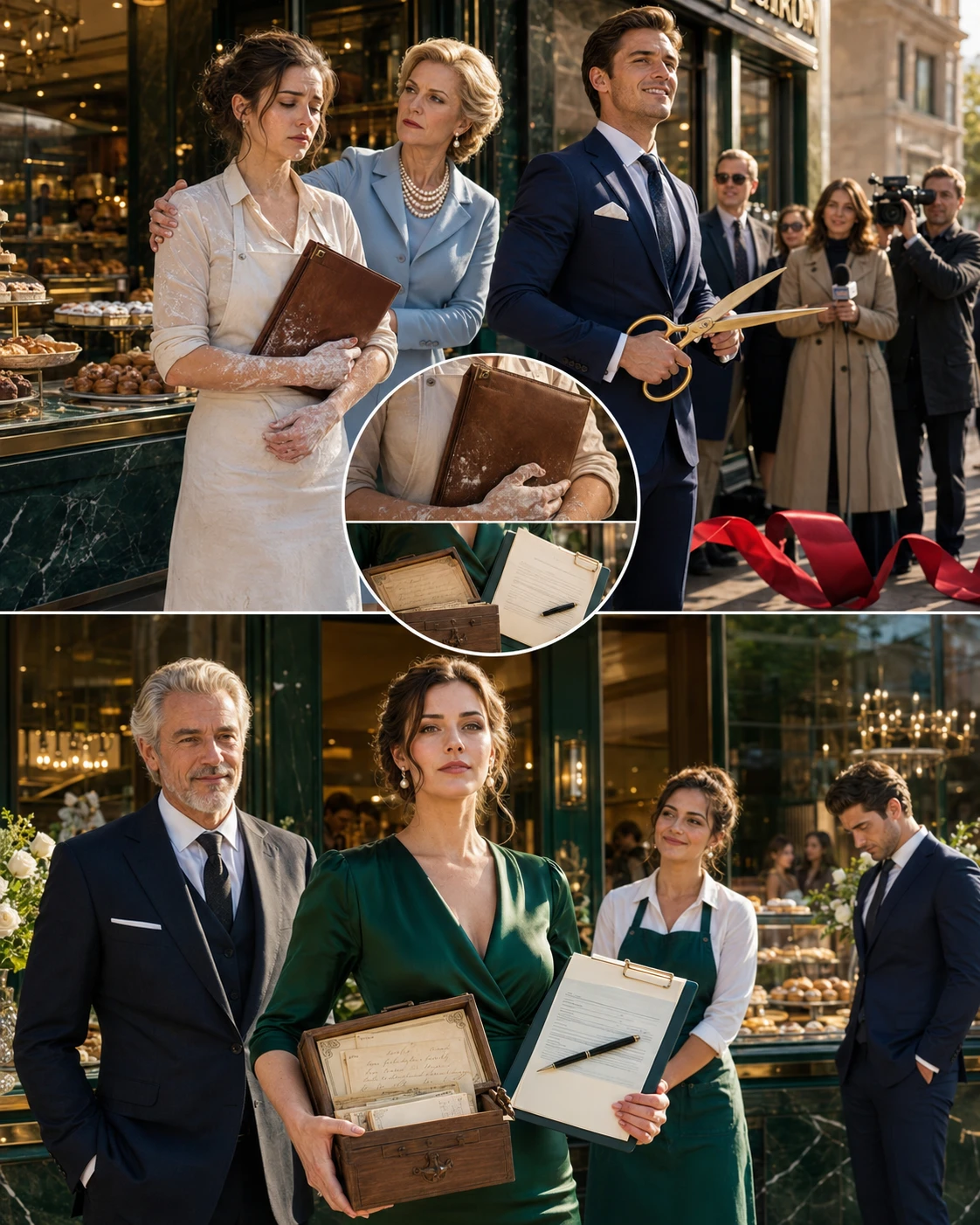
And when the landlord walked in holding the final lease renewal, he looked past my brother in his navy suit, past my parents beaming like royalty, and placed the papers directly into my flour-dusted hands.
For three seconds, nobody understood what had happened.
Then my brother’s smile cracked.
Chapter 1: The Ribbon He Never Earned
The red ribbon curled on the sidewalk like a strip of blood.
It lay between Ethan’s polished brown shoes and the front door of the bakery I had opened with burned fingers, unpaid sleep, and every dollar my grandmother had left me. Above us, a brand-new cream-and-gold sign read:
PARKER FAMILY BAKERY
My mother had chosen the font. My father had paid a designer to mock up the logo. Ethan had approved the final version on Instagram with a caption that said, Dreams rise when family believes in you.
I had been in the walk-in freezer when he posted it.
The bakery sat on a bright corner in Brookline, Massachusetts, the kind of street where strollers cost more than my first car and women in wool coats ordered almond croissants with the confidence of people who had never checked a bank balance before buying groceries. The windows were tall and arched. The counters were marble. The espresso machine was Italian, temperamental, and worth more than the truck I used for weekend farmers markets.
Everyone loved to talk about how elegant the place looked.
Nobody mentioned that, five years earlier, it had been an abandoned shoe repair shop with water damage in the ceiling, cracked tile floors, and a back room that smelled like rust. Nobody mentioned that I had scrubbed mold out of the grout myself because I couldn’t afford the extra labor. Nobody mentioned that I had slept on flour sacks during the first winter because I couldn’t pay rent on an apartment and commercial space at the same time.
Nobody mentioned me at all.
“Ethan, look this way!”
The reporter from Channel 7 lifted her microphone as my brother angled his jaw toward the morning light. He had always known where to stand. Even as a child, Ethan could find the warmest patch of attention in any room and settle inside it like it had been reserved for him.
He was thirty-two now, tall, handsome, expensive-looking in a way that made strangers assume competence. His hair was dark and perfect. His smile was practiced. His cufflinks had our grandfather’s initials engraved on them, though our grandfather had left them to me before my father quietly took them from my jewelry box and said Ethan needed them more for interviews.
I stood behind the pastry case in a white apron dusted with powdered sugar, holding a tray of lemon tarts Ethan had never learned how to make.
My mother, Beverly Parker, stood near the entrance in pearls and a pale blue coat. She smiled at the crowd like the queen of a small country. My father, Howard, kept one hand on Ethan’s shoulder, squeezing it every time the cameras turned their way.
“Tell us how this all began,” the reporter said.
Ethan laughed softly, like a man humbled by his own success.
“Well,” he said, “I come from a family that believes in hard work.”
My mother’s eyes shone.
I looked down at my hands.
There was a small burn near my thumb from pulling brioche out of the oven at four that morning. The skin had blistered, then split. I had wrapped it in gauze and kept working.
Ethan continued, “I always wanted to create a place where people felt at home. A place with warmth, with history, with love. Parker Family Bakery is really my love letter to this community.”
The crowd made a soft, admiring sound.
Behind me, my assistant baker, June, froze while piping cream into éclairs.
She glanced at me.
I shook my head once.
Not here.
Not yet.
My father stepped forward next, clearing his throat. “We’re proud of our son. Ethan took a dream and turned it into something beautiful.”
Our son.
Not our children.
Not Clara.
Not even family.
Ethan.
A woman from the Brookline Chamber of Commerce clapped. A city councilman clapped. Two influencers near the window filmed everything on their phones.
My mother dabbed the corner of her eye with a tissue.
I arranged the tarts in a perfect row because if my hands stopped moving, they would shake.
“Clara,” my mother hissed without turning around.
I looked up.
She smiled for the cameras while speaking through her teeth. “More coffee. And don’t come out front unless someone asks you.”
“I own the coffee machine,” I said quietly.
Her smile hardened. “Do not embarrass your brother.”
That was the Parker family prayer.
Do not embarrass your brother.
When Ethan forgot my tenth birthday because he had a soccer tournament, I was told not to embarrass him by crying.
When he crashed my car at twenty-one and told my parents I had lent it to him, I was told not to embarrass him by calling the insurance company.
When I couldn’t finish culinary school on time because my college fund had been “temporarily reallocated” to help Ethan recover from a failed business venture, I was told not to embarrass the family by being bitter.
Now he stood in front of the bakery I had built and thanked my parents for believing in his dream.
I poured coffee into porcelain cups and placed them on a silver tray.
My father saw me and gave a small, warning tilt of his chin toward the kitchen.
Back where you belong.
The crowd moved closer to the door for the ceremonial ribbon cutting. Ethan took the oversized scissors from the mayor. My parents stood on either side of him, proud and glowing. Someone had placed a gold ribbon across the entrance, tied between two white stands wrapped in eucalyptus.
No one invited me into the photo.
June whispered, “Clara.”
“I’m fine.”
“You’re not.”
“I’m fine enough.”
The scissors closed.
The ribbon fell.
Applause burst through the street.
Ethan lifted both hands like he had just won an election.
And then Mr. Oliver Jameson arrived.
He was seventy-one, silver-haired, old Boston money, always dressed as if lunch might become a board meeting. He owned the building. He had owned it when it was empty. He had leased it to me when I was twenty-six, exhausted, underfunded, and shaking with terror while pretending I knew exactly what I was doing.
He had not attended the ribbon cutting for Ethan.
He had come for me.
Mr. Jameson stepped around the crowd with a leather folder tucked beneath his arm. The reporter noticed him immediately.
“Mr. Jameson!” Ethan called, recovering fast. “So glad you could make it.”
He moved forward with his hand extended.
Mr. Jameson looked at Ethan’s hand.
Then he looked at me.
His eyebrows drew together, confused by the staging, the speeches, the sign, the family posing in front of a business they did not legally control.
“Clara,” he said.
The crowd quieted just enough.
My mother’s face tightened. “Mr. Jameson, we’re in the middle of photos.”
“I understand,” he replied.
He walked past Ethan.
Past my father.
Past my mother.
Past the Chamber of Commerce photographer and the mayor and the woman holding the giant scissors.
He stopped in front of me.
“I brought the renewal packet,” he said. “I thought you’d want to review it before the press leaves, given the announcement.”
My brother let out a small laugh. “Oh, you can give those to me.”
Mr. Jameson did not turn.
I wiped my hands on my apron. The room felt suddenly too bright.
“Thank you,” I said.
He handed me the folder.
Not Ethan.
Me.
The photographer lowered his camera.
My father took one step forward. “There must be some misunderstanding.”
Ethan smiled, but the corner of his mouth trembled. “Clara handles some operational paperwork. It’s a family arrangement.”
Mr. Jameson finally looked at him.
“No,” he said. “It is not.”
My mother laughed too loudly. “Oliver, really, today is not the time for technicalities.”
He opened the leather folder.
My name sat at the top of the lease renewal in black legal print.
Tenant: Clara Margaret Parker, sole proprietor of Clara Parker Baking Company LLC, doing business as Parker Family Bakery.
I heard June inhale behind me.
The reporter’s microphone slowly rose.
Ethan’s eyes moved from the paper to my face.
For the first time that morning, he looked at me as if I existed.
Not as a sister. Not as a baker. Not as the quiet person who cleaned up after his disasters.
As a threat.
I closed the folder gently.
“Let’s finish the event,” I said.
My voice was calm.
That seemed to frighten Ethan more than anger would have.
My mother came toward me, still smiling for the crowd. “Clara, put that in the office.”
“I will,” I said.
“Now.”
“No.”
One word.
Soft.
Clean.
Final.
The room changed temperature.
My father’s face flushed dark red. “Clara, don’t start.”
“I’m not starting anything.”
Ethan stepped close enough for only me to hear him. He smelled like expensive cologne and panic.
“You think this is cute?” he whispered. “You think you can humiliate me in front of everyone?”
I looked at the ribbon on the floor.
“You cut it,” I said. “I just caught what fell.”
His jaw tightened.
The mayor cleared his throat. The reporter looked delighted in the careful way reporters do when a ribbon cutting becomes something worth airing after all.
My mother touched Ethan’s sleeve. “Everyone inside. Let’s celebrate.”
And because wealthy families are skilled at pretending blood on the carpet is red wine, the crowd moved into the bakery.
People ate my pastries and congratulated Ethan.
My parents laughed too hard.
Ethan took selfies beneath my ovens.
And I stood behind the counter with the lease folder tucked under my arm, knowing that after twenty-nine years of being useful, invisible, and blamed, the truth had finally entered the room wearing a wool coat and carrying legal documents.
Chapter 2: The Daughter Who Paid in Silence
That night, long after the last influencer had posted her cappuccino and the final box of croissants had been tied with twine, I locked the front door and leaned my forehead against the glass.
Outside, the gold letters on the window glowed under the streetlights.
Parker Family Bakery.
I had agreed to the name three months earlier after a Sunday dinner at my parents’ house in Newton, a white colonial with black shutters, hydrangeas, and a front porch no one sat on because it was only there to impress neighbors.
My mother had served salmon on china and waited until dessert to corner me.
“Clara,” she said, “you need to think bigger.”
I was tired enough to be honest. “I think about payroll, rent, ovens, licensing, food costs, and whether I can afford health insurance for June. That feels big.”
Ethan smiled from across the table. He had returned from San Francisco six months earlier after his third start-up collapsed. My parents called it a strategic exit. His investors called it a lawsuit. Ethan called it a misunderstanding.
“You’re good at making things,” he said. “But branding is different.”
I had looked at him over the rim of my water glass.
“You mean business?”
He laughed. “Don’t be defensive.”
My father sighed in the way he did when I was about to become unreasonable. “Your brother has visibility, Clara. People respond to him.”
“People respond to free samples,” I said. “That’s how bakeries work.”
My mother’s fork clicked against her plate. “This is what we mean. You always make everything hostile.”
“I’m answering a question.”
“No,” she said. “You’re protecting your little corner because you’re afraid Ethan might improve it.”
Improve it.
I thought of the mornings I woke at 2:30 a.m. with my hands curled like claws from kneading dough. I thought of the first year, when I had worked seven days a week and still cried in the basement because the property tax pass-through nearly destroyed me. I thought of begging vendors for two extra weeks to pay invoices while delivering wedding cakes in the rain.
Then I thought of Ethan, who had never washed a sheet pan in his life.
“What exactly is he improving?” I asked.
My father leaned forward. “Your attitude, for starters.”
That was how they did it.
They never punched. They sanded.
Little words, patient and constant, until you doubted the shape of yourself.
Ethan lifted both hands. “Look, Clara, nobody is taking anything from you.”
Nobody ever said that unless they were already reaching.
“I don’t need a partner,” I said.
“You need family,” my mother replied.
“I needed family when the ceiling collapsed during the snowstorm.”
My father looked away.
“I needed family when the proofing cabinet broke before Easter and I had thirty-six orders due.”
Ethan rolled his eyes. “Here we go.”
“I needed family when I was sleeping in the office because I couldn’t pay myself.”
My mother’s expression chilled. “You chose that life.”
“Yes,” I said. “I chose the bakery. I didn’t choose to have everyone ignore it until it became profitable.”
Silence settled over the table.
Then my father said, quietly and cruelly, “Maybe we ignored it because you made it so unpleasant to celebrate you.”
My chest tightened.
Ethan sat back, satisfied.
My mother softened her voice, which was always more dangerous than her anger. “Your brother can help. Let him be the face of the bakery. You can focus on what you do best.”
“The baking.”
“That isn’t an insult.”
It was, but I was too tired to explain.
So I let them talk.
They proposed a rebrand. Family heritage. Parker name. Boston tradition. They said my grandmother Hazel would have loved it.
That was the only reason I didn’t walk out.
Grandma Hazel had raised me in the kitchen of her small house in Worcester while my parents drove Ethan to tournaments, interviews, private tutoring, leadership camps, college tours. She taught me how to fold butter into dough and how to spot when someone was lying because they smiled too early.
“Paper remembers,” she used to tell me, tapping her recipe cards. “People deny. Paper doesn’t.”
When she died, she left me three things: her recipe box, a pearl-handled rolling pin, and a trust that my parents had tried to convince me was selfish to keep.
“That money should help the whole family,” my mother said after the funeral.
“It was left to Clara,” Grandma Hazel’s attorney replied.
My father never forgave me for not handing it over.
But I didn’t spend it on myself.
I used it to open the bakery.
Not all at once. Not recklessly. I stretched it with a small-business loan, vendor credit, and a private line backed by my own miserable apartment savings. I found the Brookline storefront when nobody wanted it. I signed the lease alone because my parents said the area was too expensive and Ethan said bakeries were “low-margin nostalgia traps.”
For the first two years, they treated my work like a phase.
Then a local food writer named us one of Boston’s best hidden gems.
Then I landed a catering contract with a law firm.
Then a photo of my honey-lavender cruller went viral.
Then Ethan came home.
Suddenly, the bakery was a family legacy.
Suddenly, my parents had always believed in it.
Suddenly, Ethan had “consulted from the beginning.”
I let him help with social media at first. It seemed harmless. He had charm. He knew how to talk to people. He needed structure. I was still foolish enough to believe that giving him a small role might make my parents stop treating me like the locked basement of the family.
Within a month, he had changed the Instagram bio from Founded by Clara Parker to A Parker Family Tradition.
Within two, he began answering interview requests without telling me.
Within three, vendors started calling him Mr. Parker as if I were not the one signing their checks.
I corrected him quietly.
He apologized publicly and did it again privately.
My parents called it growing pains.
I called my attorney.
Her name was Denise Whitcomb, and she had the calm, expensive voice of a woman who had made very powerful men regret underestimating quiet paperwork. She had helped me set up the LLC when I first opened.
“Do not sign anything your family hands you,” she told me after reviewing Ethan’s new “expansion proposal.”
“I wasn’t planning to.”
“Clara.”
“I know.”
“No,” Denise said. “You don’t. People like your brother don’t need to own something to destroy it. They only need access and an audience.”
So I started collecting everything.
Bank statements.
Vendor invoices.
Payroll records.
Email approvals.
Lease documents.
Screenshots of captions Ethan edited.
Copies of checks I wrote from my personal account when the bakery account ran low.
Records showing I had paid the hospital balance when my mother needed surgery and my father’s insurance gap left them exposed. They told everyone Ethan handled it. I let them. My mother was sick, and I told myself dignity meant not keeping score beside a hospital bed.
But paper remembered.
I found the wire confirmation from my account to Mass General. Seventy-eight thousand dollars. My father had called it “a bridge loan from Ethan” at Thanksgiving.
I printed that too.
Not because I wanted revenge.
Because I was beginning to understand that silence, in my family, did not create peace.
It created a stage for liars.
The day after the ribbon cutting, my parents arrived at the bakery before opening.
They didn’t come through the front like customers.
They came through the back alley with Ethan, as if they were raiding a property they owned.
I was laminating croissant dough when the kitchen door opened.
June looked up from the mixer. “We’re not open yet.”
My mother ignored her. Her hair was perfect, her mouth tight. My father wore a cashmere coat over a button-down. Ethan looked hungover but furious.
“We need to talk,” my father said.
I folded the butter block into the dough. “You can schedule a meeting.”
Ethan laughed. “A meeting? With your family?”
“With anyone who wants to discuss business.”
My mother glanced at June. “Could you give us privacy?”
June did not move.
“She’s on the clock,” I said. “And this is her kitchen too.”
My father’s face darkened. “You embarrassed us yesterday.”
“I didn’t invite Mr. Jameson.”
“You let him hand you paperwork in front of the press.”
“He handed it to the tenant.”
Ethan slammed his palm on the stainless-steel table. The sound echoed against the tile.
June flinched.
I did not.
“Stop saying that,” Ethan snapped.
I dusted flour from my fingers. “Saying what?”
“Tenant. Owner. Your little legal words.”
“They’re not little.”
My mother stepped closer, voice low. “You are being selfish.”
There it was.
The word they used whenever I stopped bleeding on command.
“Ethan has worked very hard,” she said.
“At what?”
“Clara,” my father warned.
“No, I’m asking. What has he done?”
Ethan’s nostrils flared. “I got you press.”
“You got yourself press.”
“I built the brand.”
“You renamed my labor.”
My mother put a hand to her chest as if I had cursed in church. “How can you say that? After everything we have done for you?”
I looked at her.
The kitchen smelled like butter and yeast. The ovens hummed. Outside, customers were already lining up in the cold.
“What exactly have you done for me?” I asked.
My father’s eyes narrowed. “We raised you.”
“Yes,” I said. “And you have been billing me emotionally ever since.”
For a moment, nobody spoke.
Then Ethan smiled.
It was not a kind smile.
“You know what your problem is, Clara?” he said. “You can bake. I’ll give you that. But you don’t know how to be loved.”
The words landed exactly where he aimed them.
My mother did not defend me.
My father did not look away.
June’s face crumpled with anger on my behalf.
I picked up my bench scraper and cut the dough into a clean rectangle.
“That might be true,” I said. “I learned from experts.”
Ethan’s smile vanished.
My mother gasped.
My father said, “Enough. You will apologize to your mother.”
“No.”
“Excuse me?”
“I said no.”
He stepped closer, using his height the way he always had. “This bakery carries our name.”
“For now.”
My mother’s eyes sharpened. “What does that mean?”
“It means I’m reviewing options.”
Ethan laughed again, too loud. “You wouldn’t dare take Parker off the sign. You need us.”
I looked toward the front window, where customers waited in scarves and wool coats, blowing into their hands for warmth.
“No,” I said. “I needed help. I stopped confusing that with family a long time ago.”
My father grabbed the edge of the table. “You think a lease makes you powerful?”
I met his eyes.
“No,” I said. “I think truth makes people nervous.”
Chapter 3: The Family Table Was a Courtroom First
Three days later, Ethan posted a video from inside my bakery office.
He had no key to that office.
The caption read: Big expansion plans coming. Thankful to lead this family legacy into its next chapter.
In the video, he sat behind my desk.
My grandmother’s rolling pin was visible on the shelf behind him.
He touched it once while speaking.
That was when something inside me went very still.
I did not call him.
I did not comment.
I did not cry.
I texted Denise Whitcomb one sentence.
He entered my locked office and filmed himself at my desk.
She replied within a minute.
Change all access codes today. Preserve video. Do not confront him alone.
By noon, the locksmith had changed the office lock, back door code, safe combination, and POS administrator password. By two, Ethan called me sixteen times. By three, my mother sent a message in the family group chat.
Beverly Parker: Clara, you need to stop humiliating your brother.
Howard Parker: This behavior is unstable.
Ethan Parker: She locked me out of my own office.
Aunt Linda: Clara, honey, jealousy is ugly.
Cousin Marissa: Wait, I thought Ethan owned the bakery?
I stared at that message for a long time.
Then I took a screenshot.
Denise had taught me well.
The family group chat had always been a place where people said the quiet parts with confidence. They were used to my silence. They thought silence meant agreement. They did not understand that silence could also mean documentation.
That evening, my parents summoned me to dinner at the Whitestone Club.
The Whitestone was an old private club overlooking the Charles River, all dark wood, velvet chairs, portraits of dead men, and polished silver. My father had joined when Ethan was admitted to Milton Academy. He had told me at the time that it was “networking for the family.”
I had never been invited unless they needed an extra body at Christmas brunch.
When I arrived, I found not just my parents and Ethan, but my aunt Linda, my cousin Marissa, two family friends, and a banker named Graham Ellison who had once tried to talk me into refinancing my equipment loan at a rate that would have strangled the business.
They had staged an intervention.
I almost laughed.
Instead, I hung my coat on the chair and sat down.
My mother looked relieved, as if my attendance meant she still owned the softer parts of me.
“Clara,” she said gently, “thank you for coming.”
“I had a cancellation,” I said.
Ethan smirked.
My father ordered wine without asking me if I wanted any.
A waiter placed menus in front of us. No one opened them.
“Your brother has exciting news,” my mother began.
Ethan leaned back. “Graham’s bank is willing to explore financing for a second location.”
I looked at Graham. He smiled nervously.
“A second location of what?” I asked.
“Parker Family Bakery,” Ethan said.
“My bakery.”
“Our bakery,” my father corrected.
“No,” I said.
The word sat on the white tablecloth between the bread plates and the crystal water glasses.
Aunt Linda sighed. “Clara, must you always make things so tense?”
“I didn’t invite a banker to a family dinner.”
Graham shifted in his chair.
My mother folded her hands. “We want to protect you from yourself.”
I looked at her carefully. “By taking my business?”
“By giving it structure,” my father said. “You are a talented baker, but you are emotional. Ethan is better suited for leadership.”
Ethan gave a modest shrug.
“He entered my locked office,” I said.
“He had every right,” my mother said.
“No. He didn’t.”
“You’re being literal again,” Ethan said.
That was another family trick.
When truth benefited them, it was principle.
When truth exposed them, it was literal.
My father pulled a folder from his briefcase and slid it across the table. “We had Denise draft something.”
I did not touch it.
Denise had drafted nothing for them. I knew because Denise had called me an hour earlier and said, “Your father asked my office for transfer documents. I declined. Then he asked my assistant if another attorney could ‘simplify’ them. I recommend you attend dinner with your phone recording.”
My phone was in my purse.
Recording.
“What is it?” I asked.
“A restructuring agreement,” my father said. “Ethan would take controlling interest in the brand and expansion strategy. You would remain creative director.”
“Creative director,” I repeated.
My cousin Marissa looked uncomfortable now.
Ethan tapped the folder. “It’s generous.”
I looked at him. “How much equity?”
“Fifty-one percent to Parker Family Holdings.”
I almost smiled.
Parker Family Holdings.
The company Ethan had created four weeks earlier.
I knew because he had used my bakery’s address when he registered it with the Massachusetts Secretary of the Commonwealth. Denise had found the filing before he told anyone it existed.
“And who owns Parker Family Holdings?” I asked.
Ethan’s expression flickered.
My father said, “That’s not the point.”
“It is exactly the point.”
My mother’s voice sharpened. “Why are you so determined to sabotage him?”
“By not giving him my company?”
“By making him beg for a place in the family business.”
“He has a place,” I said. “Part-time marketing consultant. At a salary I pay.”
Ethan’s face reddened.
The family friends looked down at their plates.
My father leaned in. “You are making yourself look small.”
“I’d rather look small than sign away what I built.”
My mother’s eyes filled with tears.
I hated that it still worked on me.
Not enough to bend.
But enough to hurt.
“Clara,” she whispered, “when did you become so cold?”
I thought of being twelve and sitting alone in a school auditorium after winning a statewide baking competition because my parents left early to make Ethan’s basketball game.
I thought of being seventeen and getting into Johnson & Wales, then being told Ethan needed help with Columbia expenses because “his future affects all of us.”
I thought of being twenty-six and signing a lease with hands that shook while my father said, “Don’t come crying to us when it fails.”
I thought of my mother in a hospital bed, pale and frightened, holding my hand in the dark while I quietly paid the bill that would have crushed them.
Cold.
No.
I had been warm for so long they mistook my burning for light.
“I didn’t become cold,” I said. “I stopped setting myself on fire.”
Ethan laughed under his breath. “There it is. The drama.”
I turned to him. “Did you divert the St. Catherine’s School catering deposit into Parker Family Holdings?”
The table froze.
Ethan blinked.
My father’s head turned slowly. “What?”
I opened my purse and removed a folded copy of the invoice.
“The school paid a twenty-thousand-dollar deposit for the spring gala. They sent it to the payment link Ethan emailed them. That link went to Parker Family Holdings, not Clara Parker Baking Company.”
Graham, the banker, went pale.
Ethan recovered fast. “It was temporary. We were consolidating brand accounts.”
“There is no authorized consolidation.”
My mother looked at Ethan. “Is that true?”
He scoffed. “Mom, don’t start acting like she’s reasonable. She’s trying to make me look bad.”
I slid another page across the table.
Bank transfer.
Six thousand dollars to a credit card.
Four thousand to a men’s clothier on Newbury Street.
Three thousand to a private club membership balance.
The rest withdrawn in two cashier’s checks.
My father snatched the paper.
“Where did you get this?” Ethan demanded.
“From the school bursar, after they called me asking why their payment receipt had a different tax ID.”
Aunt Linda whispered, “Oh my God.”
Ethan pointed at me. “This is illegal. You can’t just pull my bank records.”
“I didn’t. The school gave me their outgoing payment confirmation. Denise subpoenaed nothing. Yet.”
That last word landed.
Yet.
My father looked smaller than he had a minute before.
My mother’s tears had stopped.
Ethan stood abruptly. His chair scraped against the floor. Several club members turned.
“You’ve been waiting for this,” he said loudly. “You’ve been waiting to destroy me because you hate that Mom and Dad love me more.”
There it was.
The truth, stripped bare and ugly.
Not that they loved him.
That he knew it.
That he had always known.
And he had used it like a credit line.
My throat tightened, but my face stayed calm.
“No,” I said. “I waited because I wanted to be wrong.”
For one heartbeat, Ethan looked uncertain.
Then my father saved him, just as he always had.
“This has gone far enough,” he said. “Ethan made a mistake.”
Graham stared at him. “Howard, misdirecting business revenue is not a mistake.”
My father ignored him.
My mother reached for Ethan’s hand. “We can fix this privately.”
Privately.
The Parker family altar.
No matter who was hurt, no matter what was stolen, no matter how many lies were told, everything could be fixed privately as long as Ethan was protected publicly.
I stood and picked up my coat.
My mother looked startled. “Where are you going?”
“Back to work.”
“We are not finished,” my father said.
“I am.”
Ethan leaned over the table. “You walk out, and I’ll make sure everyone knows what you are.”
I paused.
“What am I?”
He smiled with all his teeth.
“Ungrateful. Unstable. Bitter. A jealous little baker who couldn’t handle the business side.”
My family said nothing.
Not one person defended me.
Not my mother.
Not my father.
Not my aunt, who had eaten free birthday cakes from my ovens for ten years.
Not my cousin, who had called me crying when she needed emergency cupcakes for her daughter’s school fundraiser.
Their silence did what Ethan intended.
It told me exactly where I stood.
I buttoned my coat.
“Be careful, Ethan,” I said softly.
He laughed. “Or what?”
I looked at the table.
At the wineglasses.
At the folder meant to erase me.
At my mother’s hand still covering his.
“Or one day, you’ll tell a lie in a room where paper has already arrived.”
Then I walked out of the Whitestone Club without looking back.
By midnight, Ethan had posted a statement.
It was polished. Emotional. Cruel.
He wrote that the Parker family was navigating “a painful internal matter” caused by “a loved one’s mental health struggles.” He asked the community to respect their privacy while he continued “serving customers and preserving the Parker legacy.”
My phone flooded.
Employees.
Vendors.
Customers.
Old classmates.
A woman from Channel 7.
I did not respond publicly.
I sent the post to Denise.
Then I went into the bakery at three in the morning and made croissants.
Because dough does not care what people say about you.
It only responds to what you do with your hands.
Chapter 4: The Room Went Silent Before He Fell
The public reveal did not happen at the bakery.
It happened two weeks later in the Grand Ballroom of the Fairmont Copley Plaza, beneath chandeliers bright enough to make every lie glitter.
Ethan had arranged an expansion announcement through the Brookline Business Alliance. He called it a “community celebration.” My mother called it “a healing step.” My father called me six times to say attendance was mandatory.
I ignored the calls.
Then the official invitation arrived in my email.
Parker Family Bakery: A Legacy Rising
Special remarks by Ethan Parker, founder and CEO.
Founder.
CEO.
I forwarded it to Denise.
She called me five minutes later.
“Do you want to stop the event legally before it happens?”
I was sitting in the bakery office, looking at Grandma Hazel’s rolling pin.
“No,” I said.
Denise was quiet for a moment.
Then she said, “Good.”
The ballroom that evening was filled with people who loved a success story as long as the hard parts were edited out. There were bankers, food writers, local officials, family friends, private school parents, and women in silk dresses who had ordered my pastries for charity luncheons while calling Ethan a genius.
A stage stood at the front beneath a screen showing photos of the bakery.
My bakery.
My hands shaping dough.
My ovens.
My display case.
My grandmother’s recipes.
Ethan had cropped me out of every image.
I arrived ten minutes after the program began.
I wore a black dress, low heels, and my grandmother’s pearl earrings. My hair was pulled back. My face was bare except for lipstick the color of dried roses. I carried no purse, only a slim leather folio.
Denise walked beside me in a charcoal suit.
Mr. Jameson followed with his cane and a sealed envelope.
Behind him came June, our accountant Caroline, the bursar from St. Catherine’s School, and a quiet man named Victor Lee from HarborTrust Bank, where my business accounts had been held since the first year.
We did not enter dramatically.
We simply entered.
That was enough.
My mother saw me first.
Her face drained.
Ethan was on stage, laughing into a microphone.
“And honestly,” he said, “family businesses are never built by one person. They’re built by belief. My parents believed in me before anyone else did.”
The audience applauded.
I stood at the back of the room and let them.
Denise leaned toward me. “Are you sure?”
I watched my brother place one hand over his heart.
“Yes.”
Ethan continued. “Tonight, I’m proud to announce that Parker Family Bakery is preparing to open three additional locations across Greater Boston.”
A murmur of admiration moved through the ballroom.
My father looked radiant.
My mother’s smile was trembling now.
Ethan gestured toward the screen. A slide appeared.
PARKER FAMILY HOLDINGS EXPANSION PLAN
Under it, in smaller letters:
Founder & CEO: Ethan Parker
My vision narrowed, but my body remained still.
He had not just lied.
He had built a future on top of me and invited the city to applaud while he buried me under the floor.
Ethan lifted a folder from the podium.
“To begin this next chapter, I’ll be signing the lease renewal and expansion authorization tonight.”
Denise inhaled softly.
My mother turned in her chair and looked straight at me.
For the first time in my life, she looked afraid of what I would not do.
Ethan uncapped a pen.
“Before you sign that,” Denise said.
Her voice was not loud.
It did not need to be.
The ballroom turned.
Ethan froze.
My father stood. “This is a private event.”
Denise smiled without warmth. “No, Mr. Parker. It is a public business announcement using my client’s company, revenue history, trade name, photographs, vendor relationships, and leasehold interest.”
A ripple passed through the crowd.
Ethan recovered and laughed into the microphone. “Ladies and gentlemen, my sister Clara. Unfortunately, as some of you know, our family has been dealing with—”
“Don’t,” I said.
One word again.
The microphone caught it.
The room heard.
Ethan’s eyes flashed. “Security.”
No one moved.
Maybe because I had not shouted.
Maybe because Denise Whitcomb looked like the kind of attorney who made security guards reconsider their hourly wage.
Maybe because Mr. Jameson had stepped forward.
My father came toward me. “Clara, not here.”
I looked at him. “You chose here.”
His mouth opened.
No words came.
My mother stood too, her pearls shaking at her throat. “Please. We can talk as a family.”
I looked around the ballroom.
At the bankers.
The reporters.
The business alliance members.
The relatives who had called me jealous.
The friends who had believed Ethan’s post.
“This,” I said, “is how my family talks. In front of everyone when they want applause. In private when they want silence.”
Ethan slammed the pen down. “I’m done with this. Clara, you are not well.”
June stepped forward from behind me.
“She’s well enough to open the bakery every morning while you sleep in,” she said.
Ethan glared. “Who invited the staff?”
“I did,” I said.
He sneered. “Of course. You need witnesses for your little performance.”
“No,” Denise said. “We brought witnesses for the record.”
The word record changed the air.
Victor Lee from HarborTrust adjusted his glasses.
Caroline held a binder against her chest.
The St. Catherine’s bursar looked directly at Ethan, and he looked away.
Mr. Jameson walked toward the stage with the careful pace of an old man who had spent a lifetime owning rooms without raising his voice.
Ethan tried to smile at him. “Oliver, I’m sorry you’re being dragged into this.”
Mr. Jameson stopped beside the podium.
“I’m not being dragged anywhere.”
Denise opened her folio.
“Mr. Jameson,” she said, “for clarity, would you state who holds the lease for the property operating as Parker Family Bakery?”
Ethan laughed sharply. “This is absurd.”
Mr. Jameson did not look at him.
He looked at the audience.
“The commercial tenant is Clara Margaret Parker, through Clara Parker Baking Company LLC. The lease began on June 1, 2021. It has never been assigned to Ethan Parker, Howard Parker, Beverly Parker, or Parker Family Holdings.”
The ballroom went quiet.
Not politely quiet.
Dead quiet.
The kind of silence that exposes every swallowed breath.
My father’s lips parted.
My mother sat down slowly.
Ethan gripped the podium.
“That’s a technicality,” he said.
Mr. Jameson turned to him. “No. It is ownership.”
Denise lifted a document. “Additionally, Parker Family Bakery is a registered doing-business-as name under Clara Parker Baking Company LLC. Parker Family Holdings has no ownership interest, no leasehold rights, no intellectual property assignment, no bank authority, and no legal claim to business revenue.”
The reporter from Channel 7 had her phone out now.
So did half the room.
Ethan pointed at me. “She’s twisting this. She bakes. I run strategy.”
Victor Lee stepped forward.
“HarborTrust records show Clara Parker as the sole authorized signer on the primary operating account, payroll account, vendor account, and tax reserve account,” he said. “Mr. Ethan Parker was granted limited payroll access for marketing reimbursements in October. That access was revoked after unauthorized attempts to initiate transfers.”
A woman near the front whispered, “Oh my God.”
Ethan’s face turned a dangerous shade of red. “Unauthorized? I was moving money for expansion.”
Caroline opened her binder.
“You moved $20,000 from the St. Catherine’s School catering deposit into an account owned by Parker Family Holdings,” she said. “You also submitted reimbursement requests for clothing, club dues, and personal dining expenses as brand development.”
A laugh escaped someone in the back.
Ethan heard it.
His control cracked.
“You’re an accountant,” he snapped. “You don’t understand vision.”
Caroline’s eyes were cold. “I understand fraud.”
My mother covered her mouth.
My father said, “Ethan.”
Just his name.
Soft. Confused. Too late.
Denise placed another document on the podium.
“This is a cease-and-desist letter sent to Mr. Parker regarding his use of Clara Parker Baking Company assets in soliciting financing.”
Graham Ellison, the banker from the Whitestone Club, stood near the bar looking like he wanted the floor to swallow him.
Denise continued, “This is the registered filing for Parker Family Holdings, created by Mr. Parker using my client’s business address without authorization. This is the proposed restructuring agreement presented to Clara at the Whitestone Club, which attempted to transfer fifty-one percent control to that same company.”
The room murmured.
Ethan turned to our parents. “Say something.”
My father stared at the papers.
My mother stared at me.
Her eyes were wet now, but not the useful kind of wet she had used at dinner. This was different. This was horror arriving late.
Denise was not finished.
“And this,” she said, removing a final packet, “is a series of family group chat messages in which multiple family members represented Ethan Parker as the owner, pressured Clara Parker to surrender control, and described her refusal as jealousy, instability, and ingratitude.”
Aunt Linda, seated near the front, went rigid.
My cousin Marissa looked down.
Ethan shouted, “You saved family texts?”
I looked at him. “You wrote them.”
The crowd shifted.
A public humiliation is different when the audience realizes it has been clapping for the wrong person.
Ethan grabbed the microphone. “You want the truth? Fine. Clara has always resented me. She resented that our parents supported me. She resented that people like me. She couldn’t handle that I gave that little bakery a name people cared about.”
My father whispered, “Ethan, stop.”
But Ethan was falling now, and golden children do not know how to fall quietly. They have been caught too many times to believe the ground is real.
“She’s nothing without the Parker name,” Ethan said. “Nothing. She was hiding in a kitchen until I made people notice her.”
I felt the words hit.
Then pass through.
Because the girl who would have begged my parents to deny them no longer lived in me.
Denise looked at Mr. Jameson. “Would you please address the lease renewal packet Mr. Parker attempted to sign tonight?”
Mr. Jameson took the folder from the podium and removed the paper Ethan had been holding.
Then he turned toward the audience, his voice crisp and clear.
“Only Clara can renew. She is the tenant, the baker, and the business owner.”
The silence after that sentence was total.
It did not feel empty.
It felt like a verdict.
Ethan stared at the paper as if language itself had betrayed him.
My mother began to cry.
My father sat down hard.
The mayor, who had attended the ribbon cutting, looked at me with the stunned expression of a man replaying yesterday’s applause and realizing he had stood on the wrong side of it.
Ethan ripped the microphone from the stand. “This is my family!”
His voice cracked across the ballroom.
I stepped toward the stage.
Not fast.
Not dramatic.
Just close enough to be seen.
“No,” I said. “This is my business.”
He pointed at me. “You’re going to destroy us over a bakery?”
I looked at my parents.
My mother shook her head, silently begging now.
My father could not meet my eyes.
“It was never just a bakery,” I said. “It was the place I built because there was no room for me in your house.”
My mother sobbed once.
I turned back to Ethan.
“You are terminated from any role at Clara Parker Baking Company, effective immediately. Your access to the premises, accounts, systems, and vendors has been revoked. Any further use of the Parker Family Bakery name to solicit funds will be handled through counsel.”
Ethan’s mouth fell open.
“You can’t fire me.”
“I just did.”
My father stood again. “Clara, he’s your brother.”
I nodded.
“I know. That’s why I gave him a job after everyone else stopped trusting him.”
That hurt him.
I saw it.
Good.
Not because I wanted to be cruel.
Because truth should hurt the person who spent years using lies as a cushion.
Denise handed a packet to Ethan.
“This is a demand for repayment of misdirected funds and notice of preservation for all communications related to Parker Family Holdings.”
Ethan slapped it away. Papers scattered across the stage.
The sound was ugly.
The image was worse.
The founder and CEO of nothing, standing beneath chandeliers, surrounded by evidence he had never imagined would speak.
My mother rose unsteadily. “Clara, please. We didn’t know.”
I looked at her.
For years, that sentence would have opened a door in me.
We didn’t know.
But they had known enough.
They knew Ethan lied and called it confidence.
They knew I struggled and called it pride.
They knew I paid and called it duty.
They knew I hurt and called it drama.
“No,” I said. “You didn’t ask.”
Her face crumpled.
My father finally looked at me. “We made mistakes.”
I held his gaze.
“You made choices.”
There is a difference.
Mistakes happen in confusion.
Choices happen in patterns.
The president of the Brookline Business Alliance stepped onto the stage, pale and embarrassed. “Ms. Parker,” she said, “on behalf of the board, I apologize. We were provided inaccurate information.”
I nodded once.
“Thank you.”
The reporter approached carefully. “Clara, would you like to make a statement?”
Every camera turned.
Every person waited.
My family watched me the way they had never watched before.
Not as the extra child.
Not as the bitter daughter.
Not as the convenient pair of hands.
As the person holding the only clean match in a room full of gas.
I could have destroyed them with one sentence.
I could have spoken about the hospital bill. The college fund. The stolen credit. The years of being told love was something I could earn only by making myself smaller.
But revenge that needs shouting is still asking for an audience.
So I said only this:
“My grandmother taught me that bread rises when it is given time, warmth, and room. People are not so different. For years, I gave my warmth to people who only wanted my labor. Tonight, that ends. The bakery will reopen under its original ownership, with protections for the staff, vendors, and customers who made it real. Thank you to everyone who supported the work, even when you were told the wrong name.”
Then I turned away from the microphone.
Ethan shouted something behind me.
I did not look back.
The ballroom exploded into whispers, but I heard only my heels on the marble floor.
Steady.
Calm.
Mine.
Chapter 5: The Name Above the Door
The fallout arrived like weather.
First came the news clip.
It spread faster than any pastry photo ever had.
The headline was brutal:
Boston Bakery Founder Publicly Reclaims Business After Brother’s False CEO Claim
Then came the comments.
People who had eaten my croissants for years wrote that they had always wondered why Ethan never seemed to know what was in anything. Former employees shared stories about him arriving late, taking photos, then leaving before cleanup. St. Catherine’s School confirmed they were cooperating with my attorney.
The Brookline Business Alliance removed Ethan from all promotional material and issued a public apology.
HarborTrust froze the disputed account belonging to Parker Family Holdings.
Denise filed civil claims.
Ethan hired an attorney my father paid for.
Then, after the attorney saw the documents, Ethan agreed to settle.
He repaid the misdirected catering deposit in installments. He signed a non-disparagement agreement. He was barred from representing himself as affiliated with the bakery. Parker Family Holdings was dissolved six months later, quietly and without applause.
My parents tried to see me before that.
Of course they did.
People who benefit from your silence are always shocked when they lose access to your ears.
My mother came first.
She arrived at the bakery on a rainy Tuesday afternoon wearing no makeup, which frightened me more than her tears. Beverly Parker believed lipstick was armor. Seeing her without it felt like seeing a museum statue wrapped in a hospital blanket.
June saw her through the window and came to the office.
“Your mom is here.”
I looked at the camera feed.
My mother stood beneath the awning, holding a white box.
“She brought something,” June said.
“Probably guilt.”
June’s mouth twitched. “Want me to tell her you’re busy?”
I watched my mother look through the glass at the display case.
At the line of customers.
At the staff moving smoothly behind the counter.
At the bakery functioning without her permission.
“No,” I said. “I’ll speak to her.”
I met her outside because I did not want her crying in the place my staff had worked so hard to make peaceful.
The rain misted against the sidewalk.
She held out the box.
“I found these,” she said.
Inside were Grandma Hazel’s recipe cards.
My breath caught before I could stop it.
“I thought Dad had thrown them away,” I said.
My mother flinched.
“No. I kept them.”
“Why?”
She looked down. “Because I knew they were yours.”
That was the first honest thing she had said to me in years.
I took the box.
“Thank you.”
She began to cry.
“I am so sorry, Clara.”
The words came out small.
I had imagined hearing them so many times that the real version felt strangely thin. Not meaningless. Not false. Just unable to carry the weight of everything they were meant to repair.
“I know,” I said.
Her face lifted, hopeful.
I let the hope exist for one second.
Then I told the truth.
“But sorry does not give you access to me.”
She folded inward.
“I’m your mother.”
“I know.”
“I love you.”
I looked at her carefully.
“I believe you love me as much as you know how.”
That broke something in her.
She covered her mouth.
I did not comfort her.
That was new.
The old Clara would have moved toward her automatically. Would have softened the sentence. Would have managed her sadness for her. Would have turned my own wound into a cushion so she did not have to feel the corner of it.
I stood still.
Rain gathered in her hair.
“I didn’t know how much you paid,” she whispered. “For the hospital. Your father told me Ethan helped arrange it.”
“I paid it.”
“I know that now.”
“You could have asked then.”
Her eyes closed.
“You’re right.”
The words were quiet.
They did not heal me.
But they did enter the room like something clean.
My father came a week later.
He did not bring recipe cards.
He brought numbers.
That was his language.
He came to my apartment building in Cambridge with a folder full of old bank statements, college savings documents, and canceled checks. He stood in the lobby wearing a wool coat and the expression of a man who had discovered too late that his authority had expired.
“I owe you money,” he said.
I almost laughed.
Not because it was funny.
Because money was the only apology he trusted.
“Yes,” I said.
His jaw tightened at my agreement. Some part of him had expected me to wave it away so he could feel noble for offering.
I did not.
We sat in the lobby beneath bad lighting while tenants walked past carrying groceries.
He opened the folder.
“When Ethan’s first company failed, I used funds from your education account.”
“I know.”
He looked startled. “You knew?”
“I found the paperwork when I applied for the bakery loan.”
He swallowed.
“You never said anything.”
“I was tired of begging people to admit what they did.”
He looked older than his sixty-four years.
“I told myself Ethan needed it more.”
“I know.”
“That doesn’t excuse it.”
“No.”
His hands shook as he pushed a cashier’s check across the table.
It did not cover everything.
No check could.
But it covered the documented amount, adjusted for what Denise called reasonable interest and what my father called punishment.
I took it.
He watched me, waiting.
For forgiveness.
For absolution.
For me to say, It’s okay, Dad.
I did not.
“Thank you for returning what was mine,” I said.
Pain crossed his face.
“I miss you,” he said.
I looked at the man who had taught me that love could be conditional and still call itself protection.
“You miss being forgiven before you changed,” I said.
He closed his eyes.
Maybe that was cruel.
Maybe it was overdue.
“I’m trying,” he said.
“I hope you keep trying.”
“Will you come for Thanksgiving?”
“No.”
The answer came easily.
That surprised both of us.
He nodded slowly. “Christmas?”
“No.”
“Ever?”
I looked toward the glass doors of the lobby, where the city moved in wet silver streaks beyond the streetlights.
“I don’t know.”
He accepted that because he had no choice.
That became the shape of my healing.
Not dramatic.
Not cinematic.
No slammed doors.
No screaming phone calls.
Just locked accounts. Changed keys. Legal boundaries. Quiet mornings. Therapy on Thursdays. Dinner with people who asked how I was and stayed for the answer.
Three months after the ballroom, Mr. Jameson called me into his office downtown.
His office overlooked the Public Garden and smelled faintly of leather, old paper, and peppermint tea. Denise came with me. I expected another lease amendment.
Instead, Mr. Jameson placed a purchase agreement on the desk.
“I’m selling the building,” he said.
My stomach dropped.
He smiled. “To you, if you want it.”
For a moment, I could not speak.
The bakery building.
The old shoe repair shop I had turned into warmth.
The brick walls.
The cracked basement.
The back door where I had cried into my apron.
The front windows where strangers had begun to know my name.
“I can’t afford it,” I said automatically.
Denise glanced at the document. “Actually, with the corrected revenue valuation, settlement repayment, and the grant you received after the Business Alliance issued its apology, you can pursue financing.”
Mr. Jameson tapped the paper.
“I leased to you when no bank wanted to take you seriously,” he said. “I have watched you pay early when business was good and communicate honestly when it wasn’t. I have watched people underestimate you and then eat what you made with their mouths full of praise. I would rather sell to the person who loved the building before it was beautiful.”
My eyes burned.
I looked away.
Not because I was ashamed to cry.
Because kindness still surprised me when it did not ask for anything afterward.
Six weeks later, I signed the purchase agreement at Denise’s law office.
This time, no one stood behind me pretending to own what my signature carried.
The sign came down on a cold March morning.
A small crowd gathered, though I had not announced it publicly. Customers noticed the ladder. Staff came outside holding coffee. June stood beside me with her arms crossed, smiling like she had been waiting for this longer than I had.
The workers removed the gold letters one by one.
P.
A.
R.
K.
E.
R.
For a strange second, I felt grief.
Not for the name itself.
For the girl who had thought putting her family above the door might finally make them walk through it with love.
Then the new sign went up.
Cream background.
Deep green lettering.
Simple.
Beautiful.
True.
HAZEL & CLARA’S BAKERY
June cried first.
Then I did.
Not loudly.
Not brokenly.
Just enough.
The first customer under the new sign was a little girl in a yellow raincoat who pressed her hands to the glass and asked for “the swirly chocolate thing.”
I gave her a pain au chocolat and told her it was on the house.
Her mother said, “Are you Clara?”
I braced out of habit.
Then she smiled.
“My daughter wants to be a baker because of you.”
For a moment, I could not answer.
Then I crouched to the girl’s height.
“Then you should know the most important rule,” I said.
Her eyes widened. “What?”
“Always write your recipes down.”
Her mother laughed.
I smiled.
“Paper remembers.”
That spring, I started a scholarship fund for culinary students who had been told their dreams were impractical. I named it after Grandma Hazel. The first recipient was a seventeen-year-old from Dorchester who sent me a thank-you email so earnest I cried in the bakery office.
I framed it beside the old lease.
Not because I needed to prove anything anymore.
Because I liked seeing evidence of good things too.
Ethan moved to Chicago.
My mother told me through a letter, not a call. She had learned not to demand immediate access. Her letters came once a month now, handwritten, careful, sometimes clumsy. She wrote about therapy. About volunteering at a hospital billing advocacy group after learning how close her own medical debt had come to ruining us. About recipes she remembered from Grandma Hazel.
I read them when I was ready.
Sometimes weeks later.
Sometimes not at all.
My father sent quarterly repayments for an old expense we had not included in the first check. He labeled every envelope clearly. No notes. Just accountability.
That was his version of growth.
Ethan sent one email.
No apology.
Just a long explanation about pressure, expectations, family roles, and how I had “benefited from the controversy.”
I forwarded it to Denise.
She replied:
Do not engage. Filed.
I didn’t.
That was freedom too.
A year after the ribbon cutting, we held an anniversary celebration at Hazel & Clara’s.
No mayor.
No oversized scissors.
No family members arranged like decorations.
Just staff, customers, neighbors, vendors, students from the scholarship program, and Mr. Jameson seated by the window with a cup of tea and a lemon tart.
June made a small speech even though she swore she wouldn’t.
“I’ve watched Clara build this place twice,” she said. “Once with her hands. Once with her backbone.”
Everyone laughed.
I cried again.
I cried easily now, which surprised me.
For years, I had mistaken control for not feeling. Now I understood control was letting feelings pass through without letting them hand the keys back to people who hurt you.
After closing, I stayed alone in the bakery.
The counters were clean. The ovens cooled. The city outside glowed soft and blue. I took Grandma Hazel’s recipe box from the shelf and opened it.
Her handwriting leaned to the right, decisive and graceful.
On the back of her biscuit recipe, in faded blue ink, she had written something I had not noticed before.
A good rise requires patience. Don’t rush what is becoming.
I sat on the floor behind the counter and held the card against my chest.
For most of my life, I had wanted my family to look at me and finally see everything I had carried.
Now some of them did.
But the miracle was that I no longer needed their seeing to make me real.
The bakery was quiet.
Mine.
Not because a lease said so.
Not because a lawyer proved it.
Not because a ballroom went silent and my brother finally ran out of lies.
It was mine because I had stopped abandoning myself in the hope that someone else would choose me.
Conclusion: Warm Bread, Locked Doors, and Peace
People always ask what happened to my family after that night.
They want a neat ending.
They want me to say my parents changed completely, Ethan apologized publicly, we all sat around a Thanksgiving table, and forgiveness arrived like a holiday movie snowfall.
But real healing is quieter than that.
My parents regret what they did. I believe that.
Their regret does not erase it.
Ethan lost the image he stole. He lost access to my work, my money, my name, and the audience he thought belonged to him. Whether he ever becomes honest is no longer my responsibility.
And me?
I wake before sunrise.
I unlock a building I own.
I turn on the ovens.
I make coffee strong enough to survive a New England winter.
I teach young bakers how to fold dough without crushing it.
I sign my own checks.
I answer to my own name.
Sometimes, when the first trays come out and the windows fog with warmth, I think about that red ribbon on the sidewalk. How everyone clapped when Ethan cut it. How my parents smiled as if my silence had finally become permanent.
Then I remember Mr. Jameson walking through the crowd with the lease in his hand.
I remember the way truth entered quietly.
I remember that I did not have to scream for the room to hear me.
The bell above the door rings every morning.
Customers come in from the cold.
They look up at the green letters above the counter.
HAZEL & CLARA’S BAKERY
And for the first time in my life, the name over the door does not ask me to disappear.
It welcomes me home.