He Brought His Pregnant Mistress to Our Daughter’s Hospital Room.
He Forgot I Owned the Name on the Door.
My husband was not trying to leave me for his mistress.
He was trying to use her pregnancy to take our daughter’s trust.
Grant Ashford left custody papers on my desk and called them temporary.
Madison Vale, standing beside him with one manicured hand resting on her stomach, called them peaceful.
His mother, Celeste, adjusted her pearls and called them necessary for the family.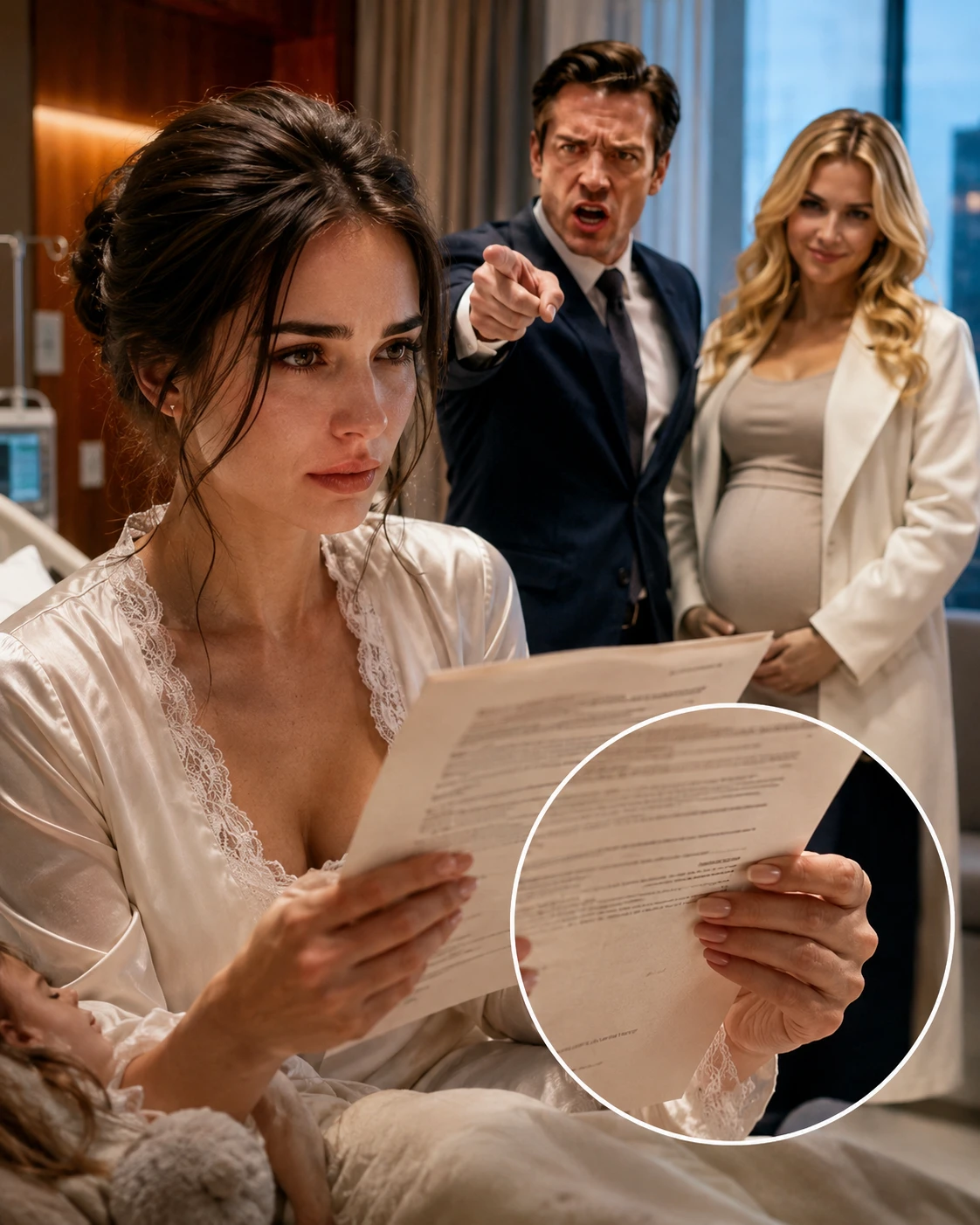
I read the last paragraph once.
Then I read it again, slower.
The room was silent except for the soft hiss of oxygen coming from my daughter’s hospital bed.
Lily was seven years old, asleep under a white blanket at St. Cecilia’s Medical Center in Manhattan, her lashes still wet from crying.
My husband had brought another woman into her room while she was recovering.
Not to apologize.
Not to confess.
Not even to ask forgiveness.
He came with legal papers, a pregnant mistress, and a plan.
I looked up at him.
Grant’s suit was charcoal, his jaw clean-shaven, his wedding ring still on his finger because men like him never removed a symbol until they had stolen everything it protected.
“You should sign, Vivian,” he said quietly.
Madison smiled like she had already picked out curtains for my life.
Celeste touched my shoulder with two cold fingers.
“You’re exhausted, dear,” she said.
“Let us carry this for you.”
I looked down at the final paragraph again.
If I signed, Grant would become Lily’s temporary custodial guardian.
And if Grant became Lily’s temporary custodial guardian, he would control her twenty-seven percent voting power in the Ellison Trust.
That was when I finally understood the affair.
Madison was the smoke.
The baby was the match.
My daughter’s inheritance was the house they were trying to burn down.
I set the pen on the desk.
Then I smiled.
Not because I was happy.
Because my father had taught me that predators only relax when they think you are prey.
PART 1 — THE HOSPITAL ROOM WITH MARBLE FLOORS
St. Cecilia’s did not look like a hospital if you were rich enough to bleed in the right wing.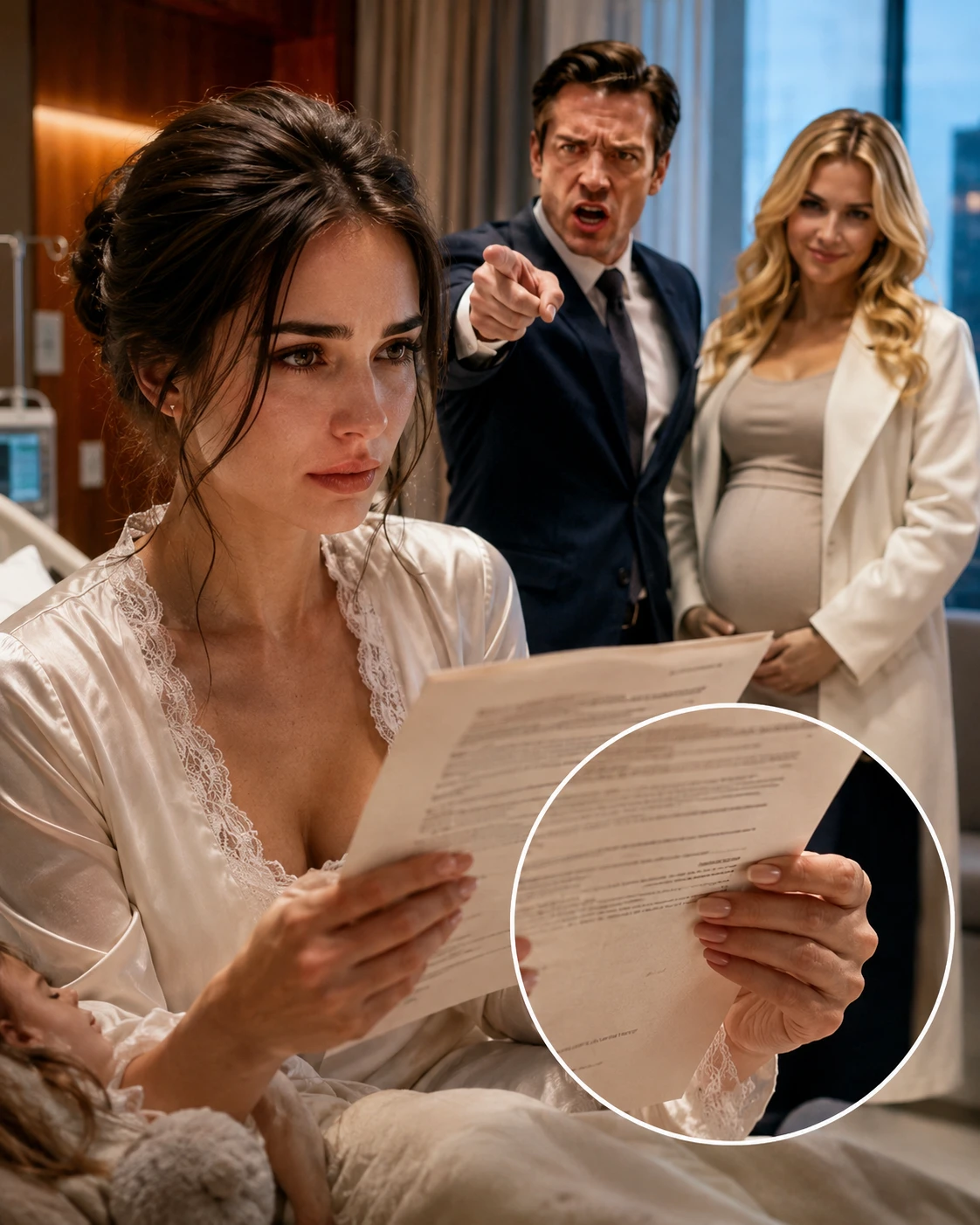
It looked like a private hotel with nurses.
The floor outside Lily’s suite was polished Carrara marble, the walls were the color of warm cream, and every flower arrangement was replaced before a single petal had the courage to die.
That morning, my daughter’s room smelled like lilies, disinfectant, and betrayal.
Lily had collapsed at school two days earlier after a severe asthma attack during recess.
By midnight, every motherly instinct in my body had been peeled raw.
I had slept in a chair beside her bed wearing a silk blouse from the day before, my hair twisted into a loose knot, my heels abandoned beneath the sofa.
Grant arrived at 9:17 a.m.
I remember the exact minute because the monitor beside Lily’s bed beeped twice, and I looked at the clock before I looked at the door.
He did not come alone.
Madison Vale walked in behind him wearing a white cashmere coat and a diamond tennis bracelet I recognized because it had once been on my Christmas list.
She was twenty-eight, soft-voiced, and beautiful in the polished way women become when they learn men will pay for the illusion of innocence.
Her blond hair fell over one shoulder.
Her stomach was just rounded enough to announce itself without asking permission.
Celeste Ashford entered last.
Grant’s mother had never walked into a room.
She arrived like a verdict.
Her pearls were perfect, her silver hair sculpted, her expression arranged into something the outside world might mistake for concern.
“Vivian,” Celeste said.
She kissed the air beside my cheek.
I did not move.
Grant closed the door behind them.
That was the first warning.
The second was the leather folder in his hand.
The third was the fact that he did not look at our daughter.
Not once.
He looked at me.
“I didn’t want to do this here,” he said.
That was Grant’s favorite kind of lie.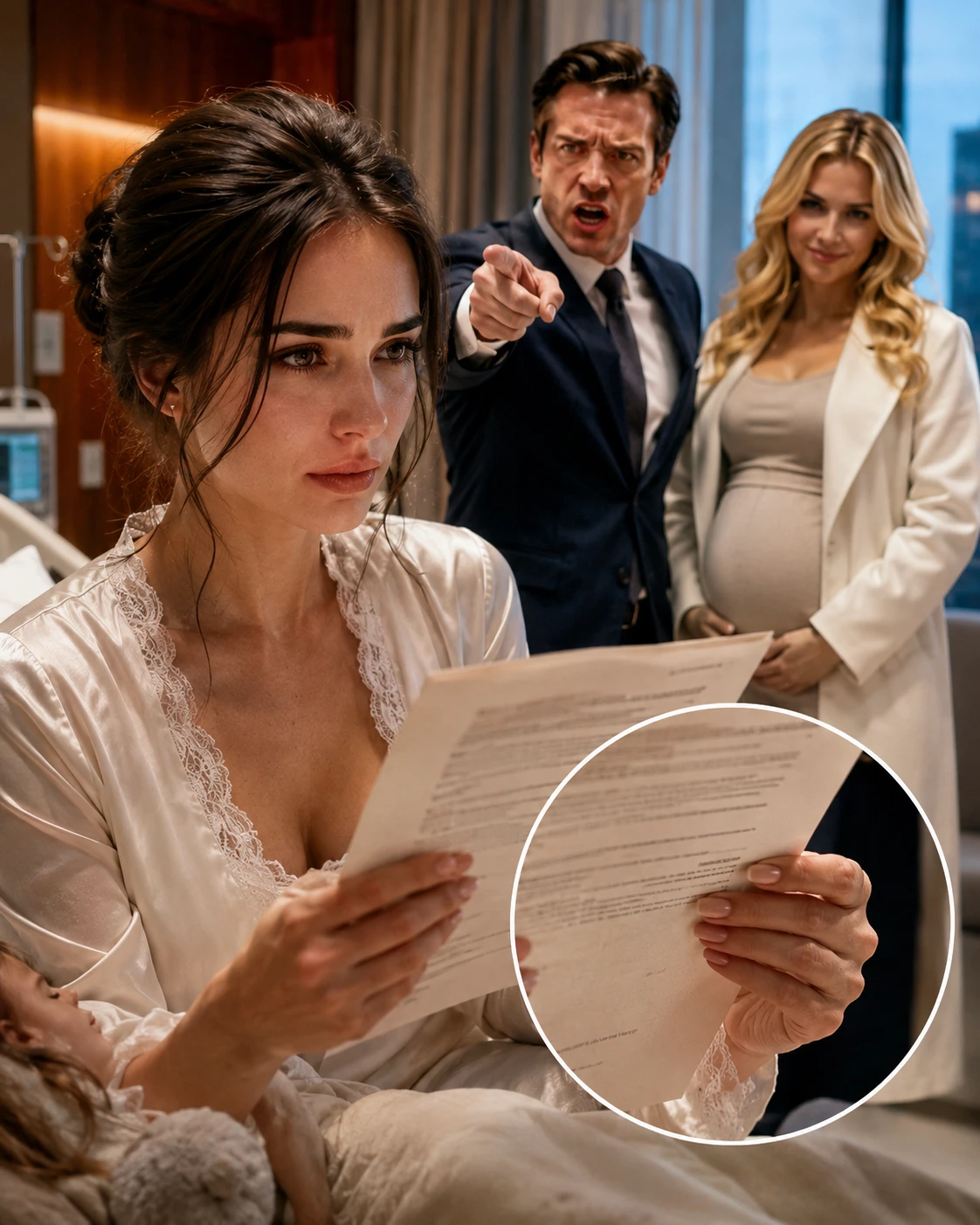
The kind that pretended pain was an accident.
I stood slowly, careful not to wake Lily.
“She’s in the hospital,” I said.
“I know.”
“No, Grant,” I said.
“You know where she is.”
“That isn’t the same as knowing what that means.”
Madison’s lips parted slightly, as though she had just witnessed something impolite.
Celeste’s eyes hardened.
Grant placed the leather folder on the desk near the window.
Outside, Manhattan glittered beneath a hard blue sky.
From the fifteenth floor, the city looked expensive enough to forgive anything.
“It’s temporary,” Grant said.
“Just until things settle.”
“What things?”
He inhaled.
“The separation.”
I almost laughed.
Not because it was funny.
Because the human body sometimes reaches for the wrong response when the truth is too ugly to hold.
I looked at Madison.
She dropped her gaze, then placed her hand on her stomach.
The gesture was delicate, rehearsed, and cruel.
“There are circumstances now,” Grant said.
“New responsibilities.”
“My daughter is in a hospital bed,” I said.
“Our daughter,” he corrected.
For the first time in three days, I felt something colder than fear.
I felt clarity.
Grant only said our daughter when there was an audience.
Madison took a small step forward.
“Vivian, I know this is painful,” she said.
Her voice was sweet enough to rot teeth.
“But Grant and I want this to be peaceful.”
I looked at her cashmere coat.
Then her diamonds.
Then her face.
“Madison, the only peaceful thing you can do in this room is stop speaking.”
Her smile trembled.
Grant’s jaw tightened.
Celeste sighed as if I had disappointed generations of dead Ashfords.
“This is exactly why we’re concerned,” she said.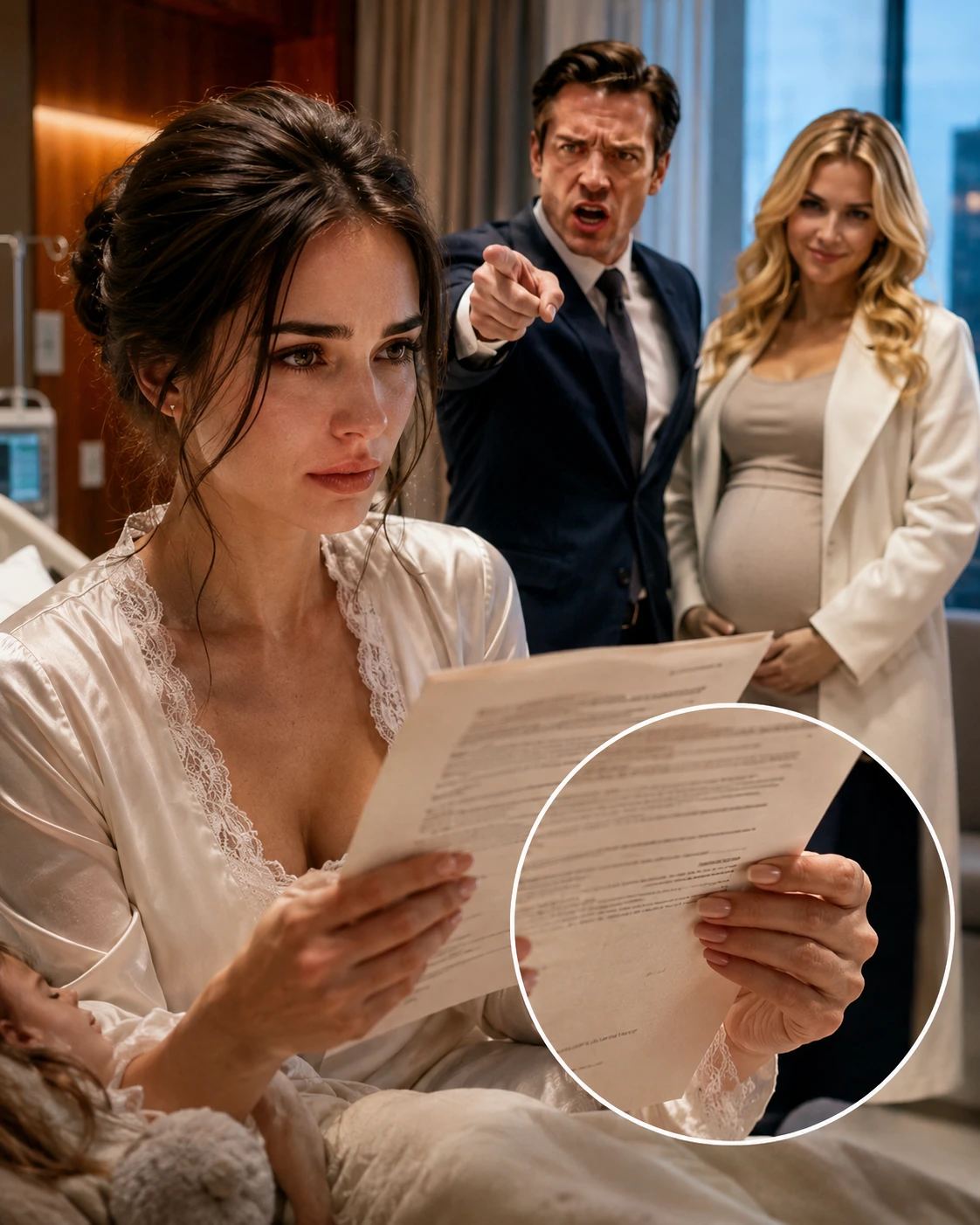
“You’re reactive.”
“I’m standing in a hospital room while my husband introduces his pregnant mistress to my sleeping child,” I said.
“I think I’m doing beautifully.”
Grant opened the folder.
Inside were custody papers clipped with a silver pen.
Of course it was silver.
Grant had never brought a knife unless he could make it shine.
He slid the documents toward me.
“I’m asking for temporary primary custody,” he said.
I stared at him.
“You’re asking?”
“I’m trying not to make this worse.”
“You brought Madison.”
His eyes flicked to her.
“She’s part of my life now.”
“And Lily?”
“She needs stability.”
I felt the words enter me like cold water.
Stability.
That was what powerful men called control when they wanted a judge to approve it.
Celeste stepped closer.
“The family believes Lily would be better served at the Ashford estate for a while.”
“The family,” I repeated.
“Yes.”
“My father’s family or yours?”
Silence.
There it was.
A hairline crack in the porcelain.
Grant recovered first.
“This isn’t about the Ellisons.”
I looked down at the papers.
Page one was clean.
Page two was polite.
Page three was full of phrases designed to sound gentle while removing a mother from her child’s daily life.
Temporary physical custody.
Shared medical decision-making.
Residential stability.
Transitional family plan.
Then I reached the last paragraph.
The language changed there.
It became denser, more precise, and far more expensive.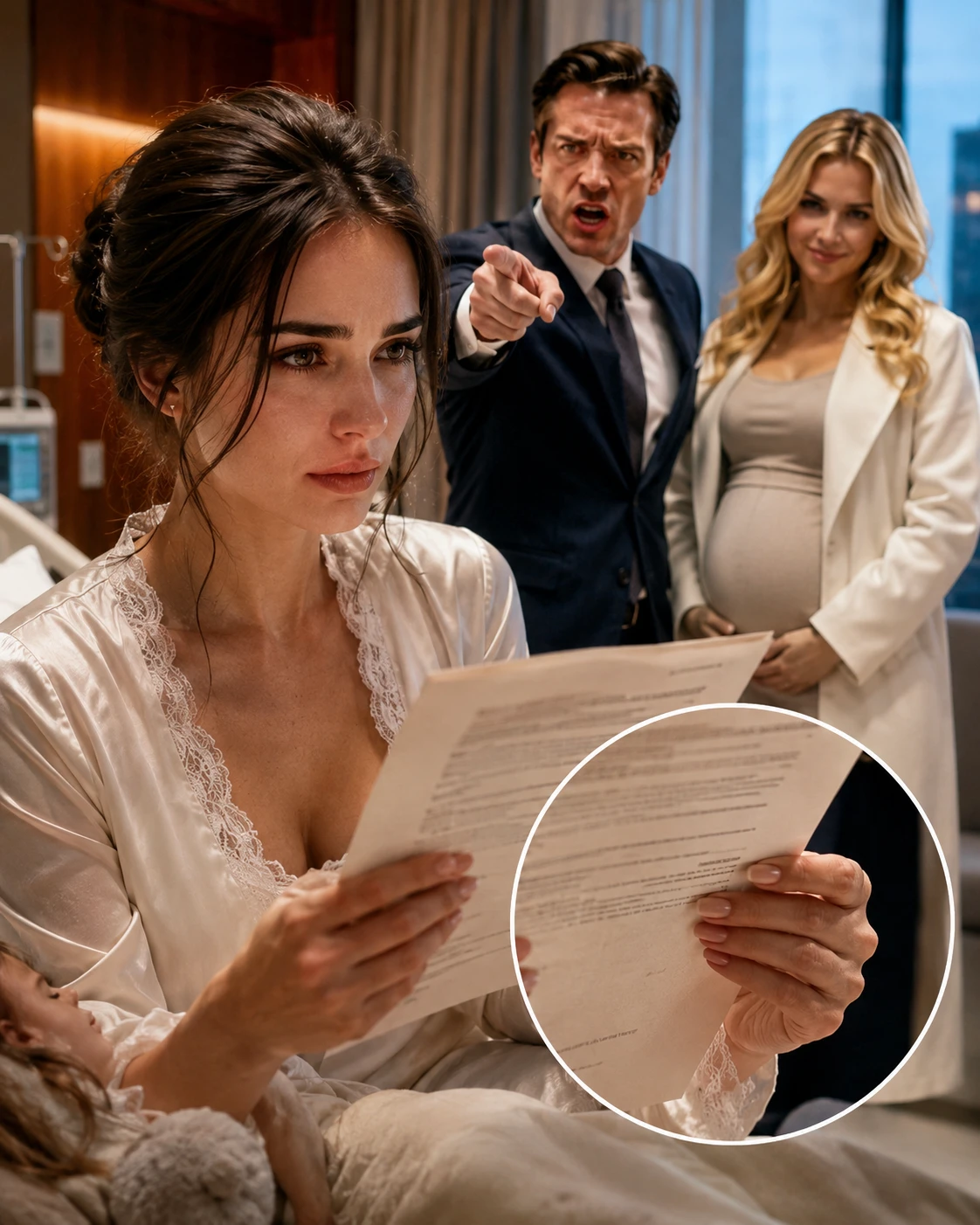
During the period of temporary custodial guardianship, Grant Whitaker Ashford shall exercise all parental proxy rights connected to the minor child’s active trust interests, including but not limited to voting, consent, appointment, removal, or approval powers attached to the Ellison Legacy Trust.
I read it once.
Then again.
Then I looked at Grant.
For ten years, I had been married to a man who kissed my temple in public and studied my family’s bylaws in private.
For ten years, he had waited for a weak moment.
A hospital room.
A sick child.
A mistress with a convenient pregnancy.
A mother-in-law with pearls and venom.
I touched the edge of the paper.
“Temporary,” I said.
Grant nodded.
“Exactly.”
“And peaceful,” I said, looking at Madison.
She smiled.
“Yes.”
“And necessary for the family,” I said, looking at Celeste.
Celeste’s chin lifted.
“It is.”
I picked up the pen.
Grant exhaled.
Madison’s smile widened.
Celeste’s hand relaxed around her purse.
Then I clicked the pen closed and placed it back on the desk.
“No.”
Grant blinked.
“Vivian.”
“No.”
His voice dropped.
“Don’t turn this into a war.”
I leaned closer, lowering my voice so Lily would not wake.
“You walked into my daughter’s hospital room with your mistress, your mother, and custody papers designed to steal her trust.”
His face went still.
I smiled again.
“Grant, the war started before you opened the door.”
Lily stirred behind me.
Her small voice floated across the room.
“Mommy?”
Every adult froze except me.
I crossed to the bed and took her hand.
Her fingers curled around mine.
Grant finally looked at her.
Madison looked away.
Celeste looked at the papers.
That told me everything.
Lily blinked slowly.
“Is Daddy here?”
I brushed hair from her forehead.
“Yes, baby.”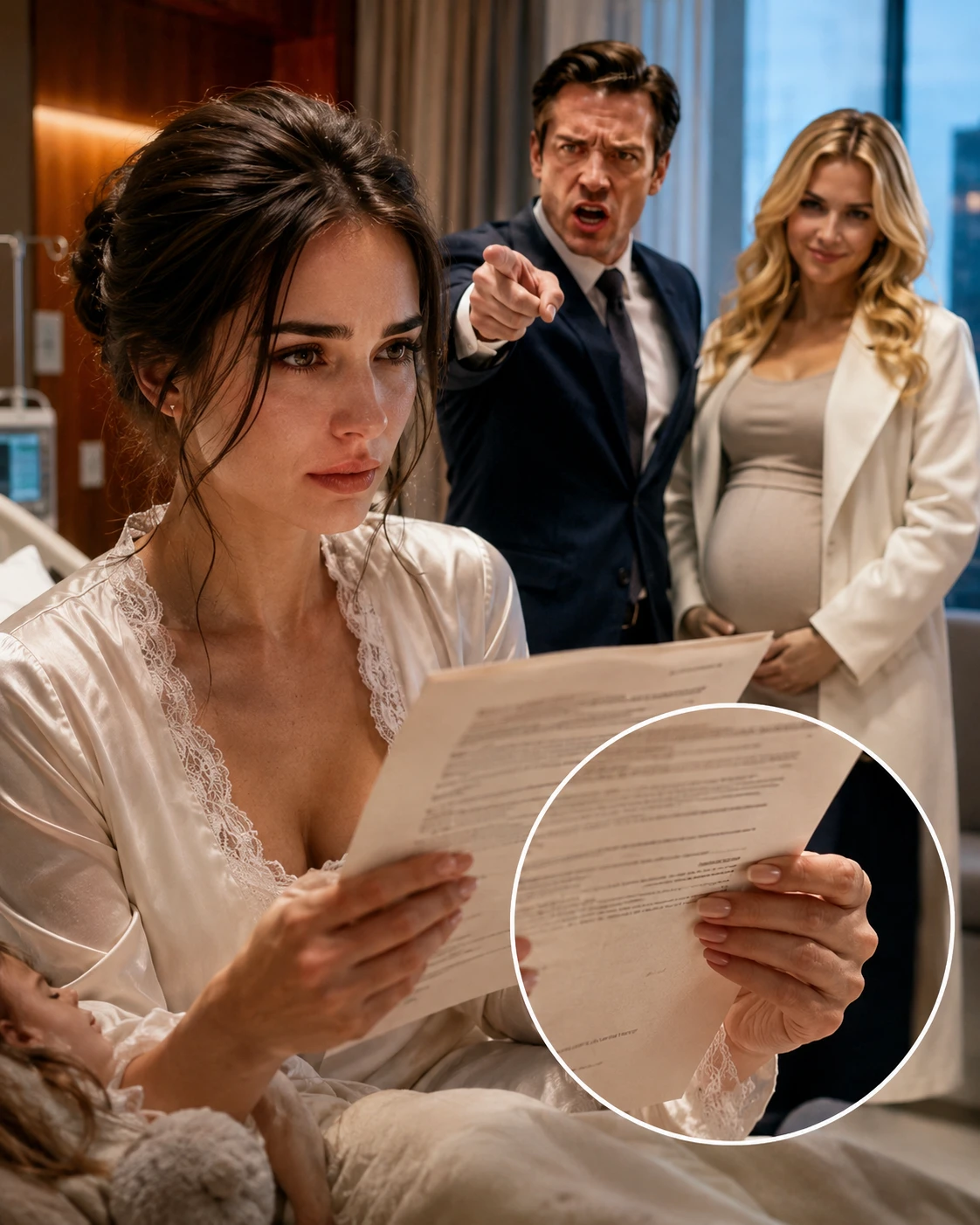
“Is he mad?”
I felt my heart crack in a place no lawyer would ever be able to document.
“No,” I said.
“He’s confused.”
Grant flinched.
Lily’s eyes drifted shut again.
I stayed beside her bed until her breathing steadied.
When I turned back, Grant was holding the folder.
His expression had changed.
The husband was gone.
The opponent had arrived.
“You’ll regret humiliating me,” he said.
I stepped away from Lily’s bed, elegant and quiet in yesterday’s blouse.
“No, Grant.”
I looked at Madison’s stomach.
“Humiliation is walking into a hospital room thinking a pregnancy makes you untouchable.”
Madison’s face flushed.
Celeste’s mouth tightened.
Grant tucked the folder under his arm.
“We’ll file,” he said.
“Do that.”
“And Vivian?”
He paused by the door.
“You are not as protected as you think.”
I glanced at the brass plaque outside Lily’s room.
The Ellison Pediatric Recovery Suite.
My father had funded the wing after my mother died.
My name was on the donor board downstairs.
So was Lily’s.
I looked back at my husband.
“Neither are you.”
PART 2 — THE GALA WHERE EVERYONE WATCHED ME BLEED
Three nights later, Grant took Madison to the Ashford Foundation Gala.
He wore a tuxedo.
She wore champagne silk.
I wore black.
Not funeral black.
Not abandoned-wife black.
A sculpted, off-the-shoulder Dior gown with a slit sharp enough to draw blood.
My hair was smooth.
My diamonds were old.
My lipstick was a deep red that made Celeste Ashford stare at my mouth as if it had insulted her ancestors.
The gala was held at the Metropolitan Club on Fifth Avenue, where the chandeliers glittered like frozen lightning and every waiter moved as if silence had been included in his training.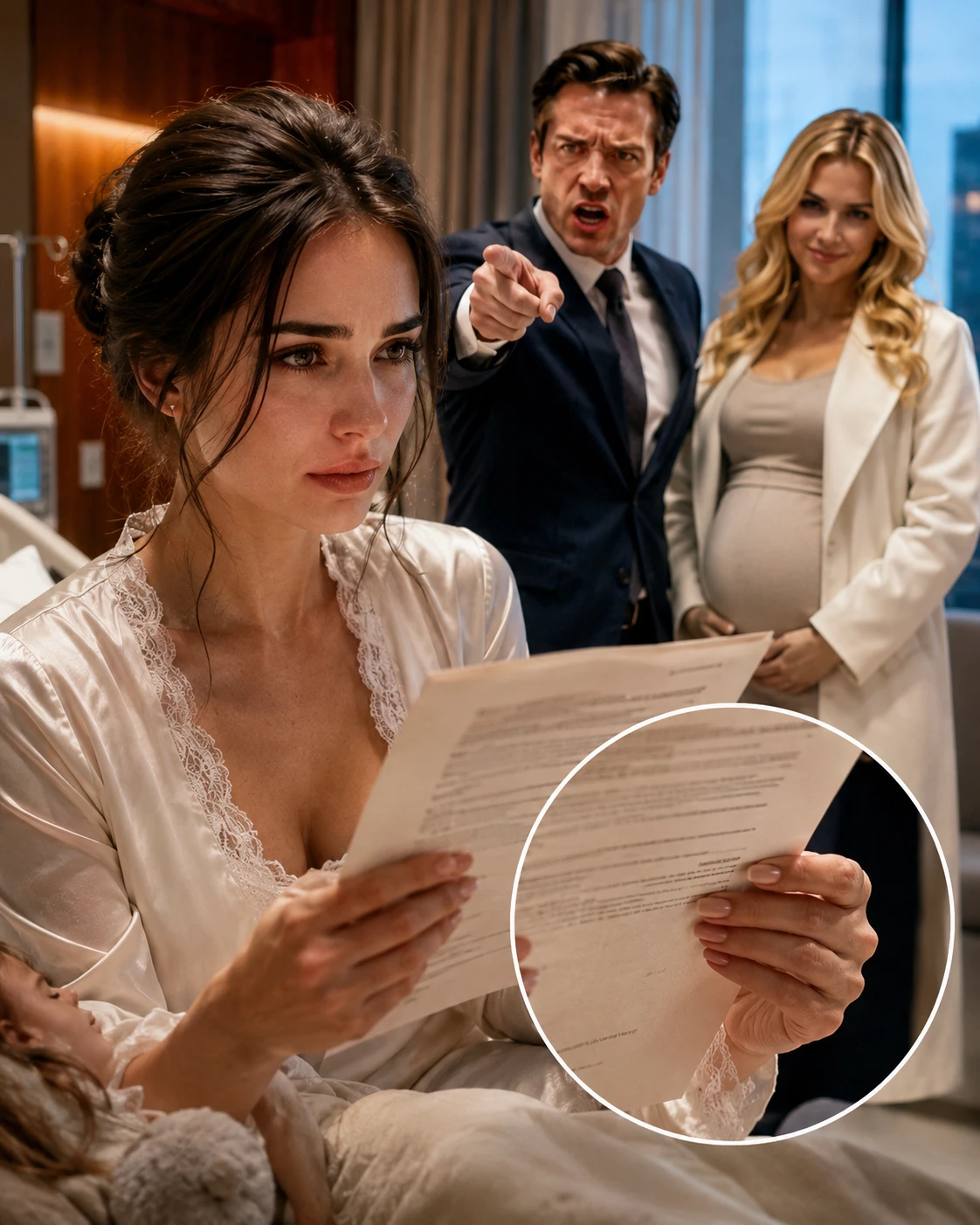
By then, the story had already been released to the right people.
Not officially.
Never officially.
Families like the Ashfords did not gossip.
They briefed.
Vivian has been under so much stress.
Grant has tried to help her.
There are concerns about Lily’s routine.
Madison is expecting, and everyone is trying to be civilized.
Civilized.
Another beautiful word for a knife with a clean handle.
When I entered the ballroom, conversations softened.
Heads turned.
Women who had once asked for my florist now studied me with pity disguised as sympathy.
Men who had borrowed money from my father’s company looked away.
That was the thing about public humiliation.
It was never just about pain.
It was theater.
And Grant had always loved a stage.
He stood near the grand staircase with Madison at his side.
His hand rested on the small of her back.
Not casually.
Possessively.
Like he wanted the whole room to see the shape of his replacement life.
Madison saw me first.
Her smile arrived before her eyes did.
“Vivian,” she said.
“You look stunning.”
“Madison,” I said.
“You look confident.”
Her smile faltered for half a second.
Grant leaned in and kissed my cheek.
The room watched.
His lips barely touched my skin.
“Don’t make a scene,” he murmured.
I smiled for the guests.
“I never make scenes.”
I turned my face slightly toward him.
“I collect them.”
He stepped back.
Celeste appeared with a glass of champagne in one hand and murder in her posture.
“Darling,” she said.
“How brave of you to come.”
“I was invited.”
“We weren’t sure you’d feel up to it.”
“I’ve found humiliation is easier to survive with good lighting.”
Celeste’s smile thinned.
Madison laughed softly, a little too late.
Grant’s hand tightened around his glass.
Across the ballroom, my attorney arrived.
Everett Walsh was not loud, not flashy, and not impressed by old money.
He was forty-one, tall, composed, and silver-eyed in the way men become when they have seen too many powerful people lie under oath.
His father, Henry Walsh, had been my father’s attorney for thirty years.
Everett had inherited the firm, the files, and the rare ability to make silence sound expensive.
He crossed the ballroom without hurry.
Grant saw him and stiffened.
Good.
Everett stopped beside me.
“Vivian.”
“Everett.”
His gaze touched Grant, Madison, then Celeste.
“Beautiful evening for a public mistake.”
I almost smiled.
Grant did not.
“I didn’t know you handled domestic matters,” Grant said.
Everett’s expression did not change.
“I handle predators who hide behind domestic matters.”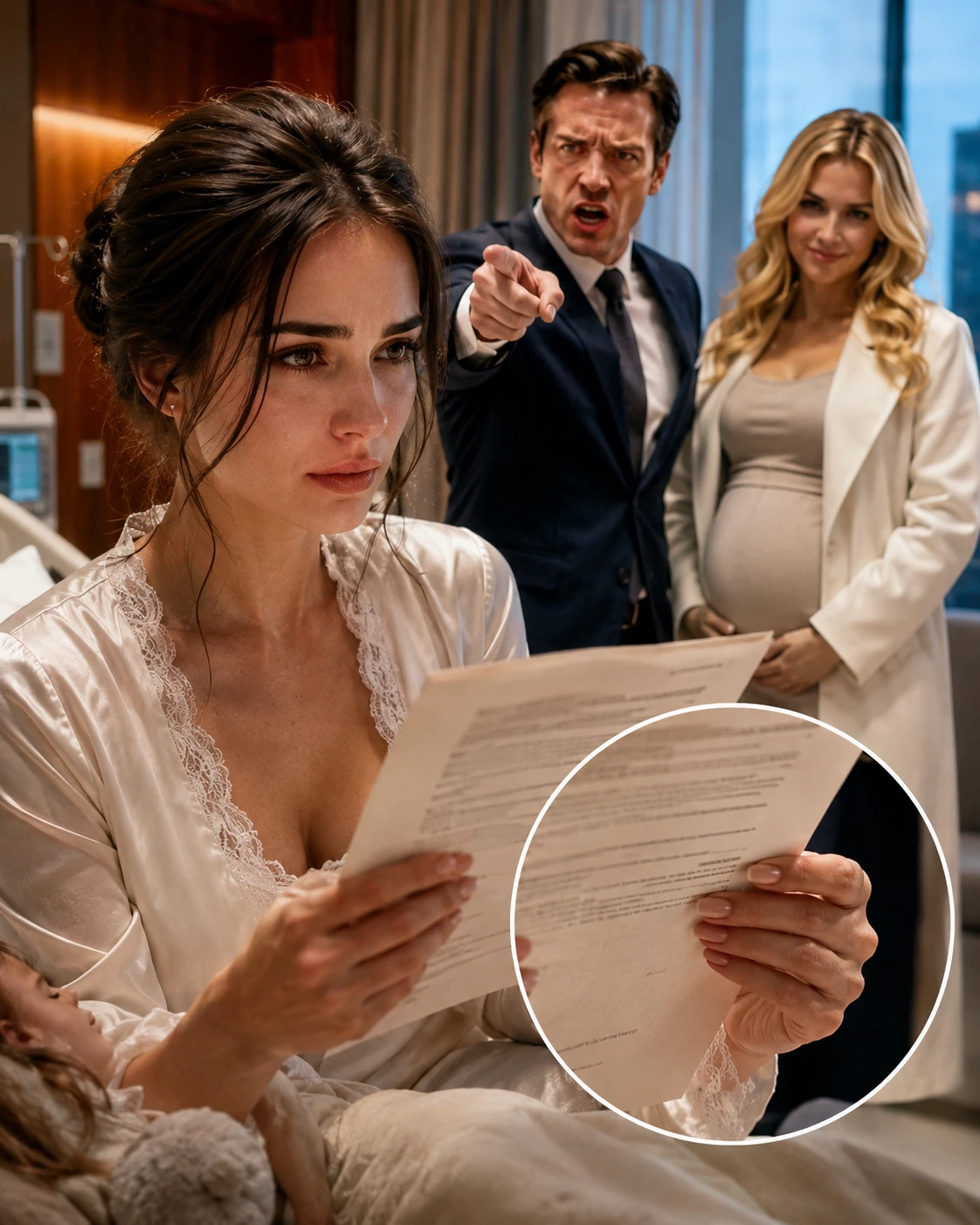
Madison looked between them.
Celeste’s nostrils flared.
Before Grant could respond, the orchestra softened.
A board member stepped onto the small stage to announce the foundation’s new maternal health initiative.
Maternal health.
I almost admired the audacity.
Grant escorted Madison forward.
The crowd parted for them.
He knew exactly what he was doing.
By standing beside his pregnant mistress under the Ashford crest, he was not just announcing the affair.
He was rewriting the moral frame.
He was the responsible father.
Madison was the glowing future.
I was the unstable past in couture.
Then Grant took the microphone.
A hush fell.
“Thank you all for being here,” he said.
His voice carried warmth like a fireplace in a house you did not know was burning.
“This foundation has always been about family.”
Celeste lifted her chin.
Madison lowered her eyes, modest as a saint in silk.
Grant continued.
“This year has reminded me that family is not always simple.”
A few people glanced at me.
I stood still.
Not rigid.
Not wounded.
Still.
There is a difference.
“Sometimes protecting children requires hard decisions,” Grant said.
“Sometimes love means choosing stability over pride.”
The room went quiet in that hungry way rooms do when scandal is being served on crystal.
Everett leaned close.
“You can stop him.”
“No,” I said.
“Let him finish.”
Grant’s eyes found mine across the ballroom.
He expected tears.
A tremor.
A broken exit.
Something useful.
I gave him nothing.
Then Madison stepped beside him.
Grant placed a hand over hers.
“We’re grateful for the grace our family has shown during this transition,” he said.
“Our family is growing.”
Applause rose.
Not from everyone.
But from enough people to make it cruel.
Madison smiled.
Celeste dabbed one dry eye.
The cameras flashed.
That was the image they wanted.
The heir.
The mistress.
The abandoned wife watching from below.
Everett’s jaw tightened.
“Vivian.”
“Now,” I said.
He handed me a cream envelope.
My name was written on the front in my father’s handwriting.
Not printed.
Handwritten.
I had not seen that slanted V in eight years.
For one impossible second, the ballroom disappeared.
My father, Charles Ellison, had been the kind of man who could make a boardroom go silent by removing his glasses.
He built Ellison Global from a bankrupt shipping company into a private empire that owned ports, medical tech patents, and enough real estate to make senators return phone calls.
He had loved only three things without strategy.
My mother.
Me.
And later, Lily.
He had never trusted Grant.
He had been polite about it.
But politeness in my father’s hands was just suspicion wearing a tailored suit.
I opened the envelope.
Inside was a single page from the Ellison Legacy Trust.
A clause I had never seen.
Everett spoke softly.
“Your father sealed it until a triggering event.”
“What triggering event?”
“A spouse attempting to obtain legal control of Lily for trust-related voting authority.”
My eyes moved over the words.
There it was.
Predatory Claimant Provision.
If any parent, spouse, guardian, or affiliated party sought custody, guardianship, or parental proxy rights primarily to access, influence, transfer, leverage, pledge, or vote the minor beneficiary’s trust assets, all such voting rights would freeze immediately and transfer temporarily to the independent trustee pending review.
Below that was another line.
Any spouse participating in such an attempt shall forfeit all marital claims connected to Ellison-derived assets under the prenuptial agreement.
I looked at Everett.
“My father knew.”
“Your father suspected.”
Grant’s voice continued through the speakers.
“Stability is the greatest gift we can give a child.”
I looked back at the stage.
Madison’s hand rested on her stomach.
Celeste smiled like an empress blessing a battlefield.
The crowd watched them glow.
No one noticed the trap closing.
Everett handed me a second page.
“Your father also updated the trust after Lily was born.”
I read it.
My breath stopped.
Lily’s twenty-seven percent was not the only vote Grant wanted.
It was the swing vote.
Ellison Global was facing a private acquisition offer from Ashford Meridian, Grant’s family firm.
Without Lily’s voting power, the deal could not pass.
With it, Grant and Celeste could force a merger, strip the company, and bury Ashford Meridian’s debt under Ellison assets.
I looked up.
Grant did not want a divorce.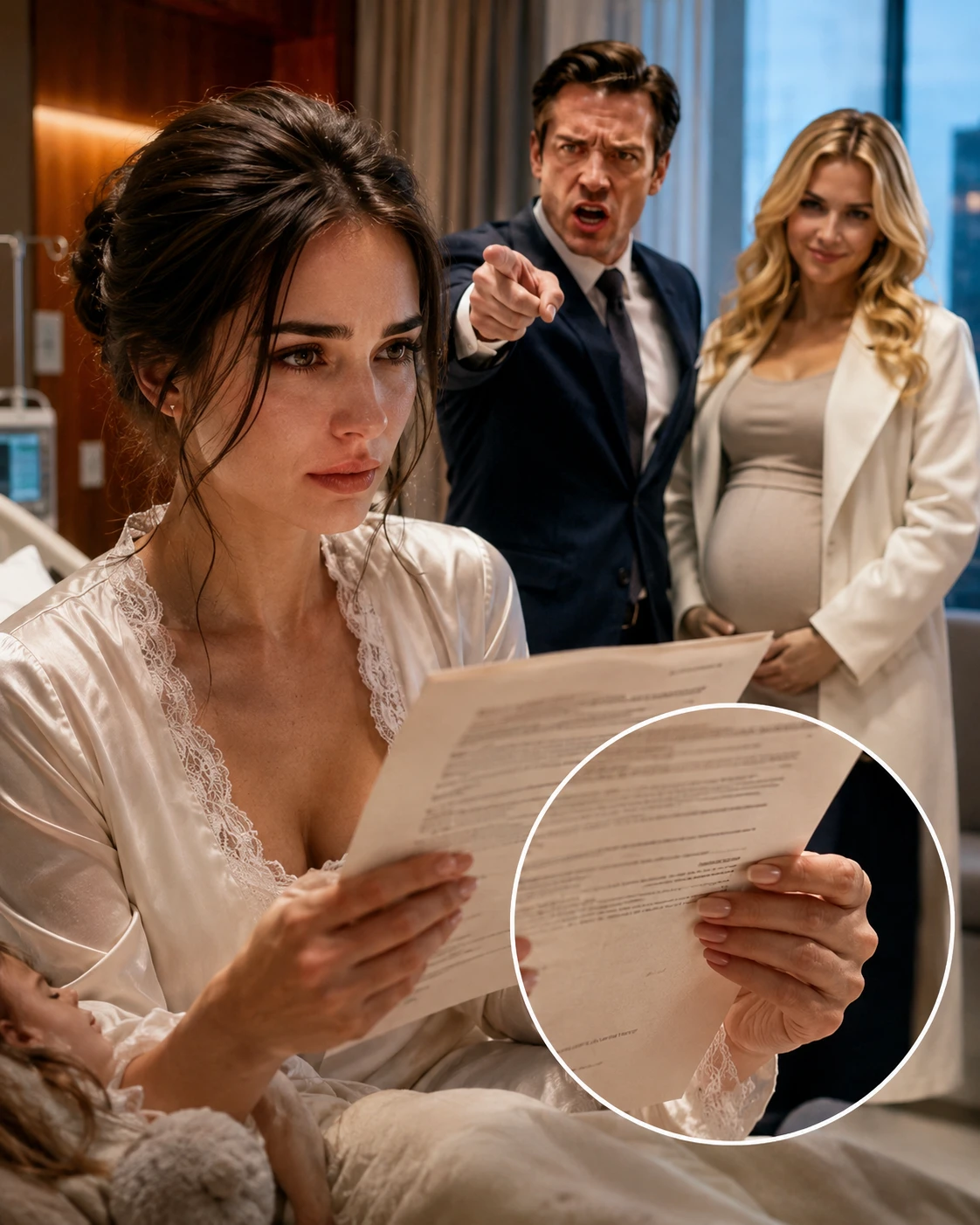
He wanted a bailout.
Madison was not his escape.
She was his costume change.
The applause faded.
Grant returned the microphone.
Madison kissed his cheek.
The cameras caught it.
And then she looked straight at me.
Her expression was smug, shining, certain.
Poor Vivian, it said.
You lost.
I smiled back.
Not wide.
Not warm.
Just enough for her to feel the temperature drop.
Everett followed my gaze.
“What do you want to do?”
I watched Grant descend the staircase toward me, adored by people who would have sold their souls for a better table.
“I want him comfortable,” I said.
Everett’s mouth almost curved.
“For now?”
“For now.”
Grant approached with Madison and Celeste at his side.
A small circle formed around us.
Of course it did.
Rich people can smell blood through perfume.
“Vivian,” Grant said.
“I hope we can be adults about this.”
I folded the envelope and slipped it into my clutch.
“Adults don’t bring mistresses to hospital rooms.”
Madison’s face tightened.
Celeste laughed once.
A brittle sound.
“You always did enjoy sharp little lines.”
“And you always did mistake silence for surrender.”
Grant’s eyes narrowed.
“I’m trying to protect Lily.”
“No,” I said.
“You’re trying to access her trust.”
The small circle went absolutely still.
Grant’s smile stayed in place, but his eyes went flat.
Madison blinked.
Celeste’s champagne glass trembled, just once.
There it was again.
A crack.
“You’re emotional,” Grant said.
“You should go home.”
I looked around at the guests.
Then I looked at him.
“I am home, Grant.”
My voice was soft.
“My father paid for half the hospitals in this city and most of the museums you use for charity events.”
A camera flashed.
I stepped closer.
“You brought your mistress into my daughter’s hospital room because you thought grief would make me obedient.”
Grant’s cheek twitched.
“You’re embarrassing yourself.”
“No.”
I glanced at Madison’s stomach.
“I’m being introduced to the cast.”
The circle inhaled.
Madison whispered, “How dare you.”
I looked at her.
“Careful.”
“For what?”
“For thinking a starring role means you wrote the script.”
Everett touched my elbow.
That was enough.
I turned and walked away before anyone could see my hands shake.
Because they did.
Not from weakness.
From rage.
The kind of rage that does not scream.
The kind that memorizes.
Behind me, I heard Grant say my name.
I did not turn around.
That night, every gossip account in New York posted the same photo.
Grant Ashford with his pregnant girlfriend.
Vivian Ellison Ashford in black, smiling like a woman about to become a headline for all the wrong reasons.
They were half right.
I was about to become a headline.
Just not the kind Grant had paid for.
PART 3 — THE MANSION, THE MISTRESS, AND THE TEST
The Ashford estate in Greenwich had twelve bedrooms, two kitchens, a reflecting pool, and a chapel.
Not a prayer room.
A chapel.
Celeste had imported the stained glass from a ruined church in France and told guests it gave the property history.
I had always thought it gave the property arrogance.
On Sunday afternoon, Grant asked me to come there to discuss Lily’s transition plan.
His words.
Transition plan.
As if my daughter were a corporate department being moved between floors.
Lily had been discharged that morning.
She was safe at my apartment on Park Avenue with her nurse, my housekeeper, two security guards, and Everett’s investigator posted discreetly in the lobby.
Grant did not know about the investigator.
Grant believed women became careless when hurt.
That was one of his smaller mistakes.
I arrived at the estate at four.
A storm pressed low over the lawns, turning the sky the color of pewter.
The front doors opened before I knocked.
Celeste’s butler led me through the marble foyer into the blue drawing room, where every chair looked too expensive to forgive comfort.
Grant stood near the fireplace.
Madison sat on the sofa with a cup of tea.
Celeste stood beside the window, watching me arrive as if I were a package she had not ordered.
There was another man in the room.
Julian Cross.
Grant’s attorney.
He had a narrow face, a navy suit, and the dead-eyed calm of someone who billed in six-minute increments for ruining lives.
“Vivian,” Grant said.
“You came.”
“You summoned.”
His lips tightened.
Madison rubbed her stomach.
Celeste’s gaze followed the movement.
There was hunger in it.
Not grandmotherly love.
Dynastic hunger.
The kind that saw babies as continuation, women as vessels, and companies as bloodlines.
Julian Cross placed a fresh stack of papers on the coffee table.
“We’ve revised the custody proposal.”
“How generous.”
Grant ignored that.
“The court will look favorably on cooperation.”
“The court will look at evidence.”
Julian smiled.
“Evidence can be interpreted.”
“Yes,” I said.
“And sometimes it can be played.”
No one spoke.
Madison looked at Grant.
Celeste looked at Julian.
Grant recovered first.
“You’re making this ugly.”
I sat in the chair opposite Madison.
I crossed one leg over the other.
I had chosen a cream wool dress for the meeting, simple pearl studs, and my mother’s watch.
Not armor.
A reminder.
“I didn’t make it ugly,” I said.
“I simply stopped pretending it was beautiful.”
Madison leaned forward.
“Grant loves me.”
I looked at her.
The room waited for me to flinch.
I did not.
“Possibly.”
She blinked.
That was not the answer she wanted.
“You don’t care?”
“I care about my daughter.”
Her hand tightened around the cup.
“I’m carrying his child.”
“Are you?”
The cup struck the saucer too hard.
Grant’s head turned.
Celeste went pale in a way powder could not hide.
Julian’s pen stopped moving.
Madison laughed once.
It was bright and false.
“What is wrong with you?”
“That question has funded several of Grant’s legal drafts,” I said.
“But I’ll answer yours first.”
I opened my purse and took out a sealed document.
Grant stared at it.
Madison stared harder.
Celeste did not move at all.
“Three weeks ago,” I said.
“Madison visited Fairhaven Prenatal Diagnostics in Stamford.”
Madison stood.
“You had me followed?”
“Yes.”
Her mouth fell open.
I looked at Grant.
“After my husband brought you to my daughter’s hospital room, I became curious about your scheduling priorities.”
Julian stepped forward.
“My client’s medical privacy—”
“Relax,” I said.
“I did not obtain medical records illegally.”
I placed the envelope on the table.
“Madison did something much less private.”
Madison’s face changed.
Just a flicker.
But I saw it.
Grant saw me see it.
“Madison submitted a voluntary prenatal paternity acknowledgment packet to Ashford Meridian’s family office,” I said.
“Apparently Celeste insisted on proof before adding the baby to the private inheritance schedule.”
Celeste’s eyes flashed.
Grant turned to his mother.
“You told me that wasn’t final.”
Celeste said nothing.
Madison whispered, “Grant.”
I kept my eyes on him.
“The family office forwarded the document to Henry Walsh by mistake because the Ellison-Ashford marital agreements require disclosure of any claimed heir who could affect shared estate planning.”
Everett had called it a clerical miracle.
I called it God finally enjoying the opera.
Grant took one step toward the table.
I placed my hand over the envelope.
“No.”
His face darkened.
“Vivian.”
“No grabbing.”
Julian cleared his throat.
“Mrs. Ashford, if you intend to introduce questionable documents—”
“They’re not questionable,” I said.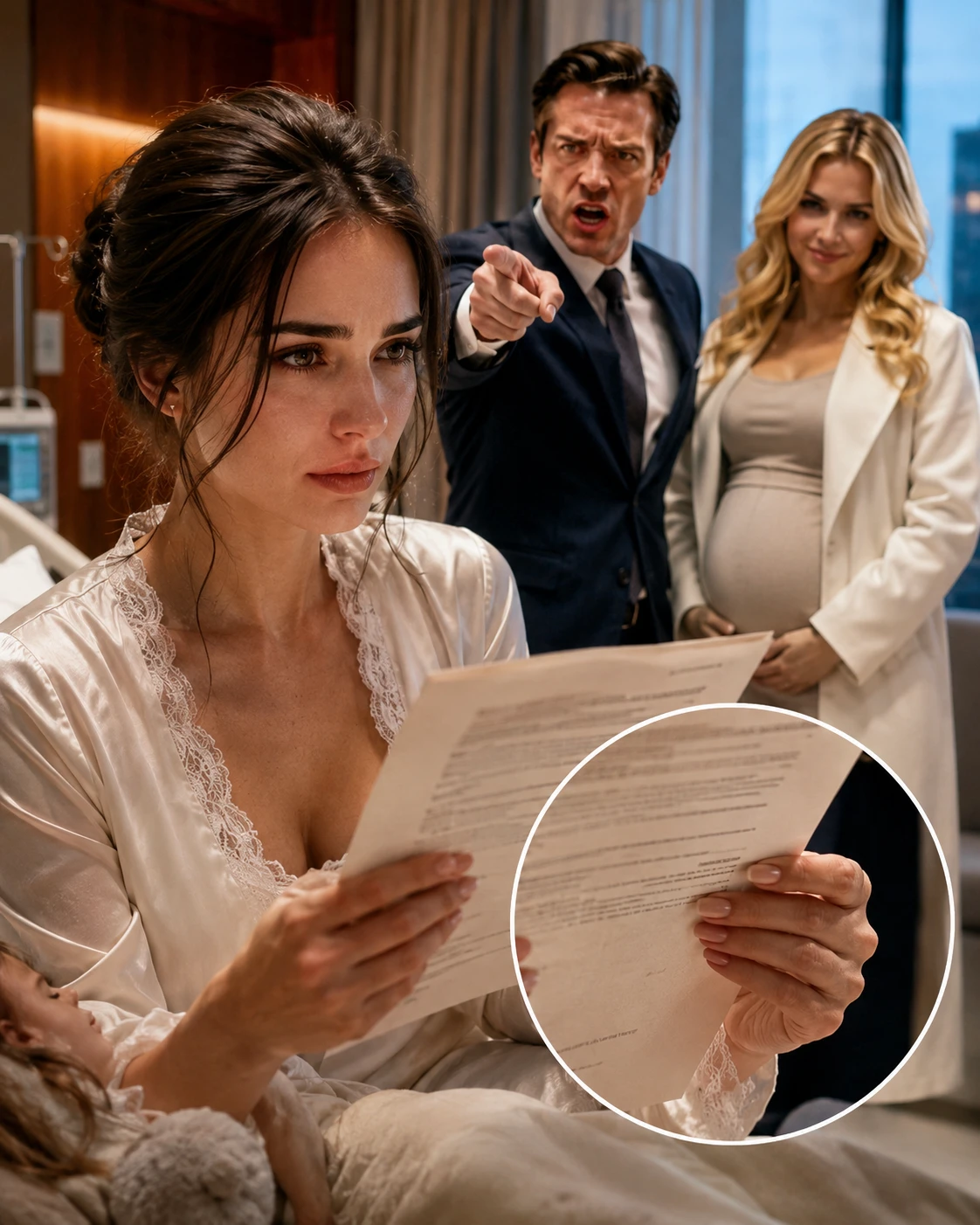
“They’re copies of a document your client’s family requested.”
Madison’s eyes filled with tears.
But they were not wounded tears.
They were calculating tears.
“Grant, she’s lying.”
I looked at her.
“Then you should enjoy hearing the result.”
The thunder outside rolled over the house.
For a moment, the chapel bells chimed somewhere deep in the estate.
I opened the envelope.
“The test excluded Grant Ashford as the biological father.”
Silence.
Complete.
Perfect.
Even the storm seemed to hold its breath.
Grant looked at Madison.
Madison looked at Celeste.
Celeste closed her eyes.
Julian Cross whispered something I could not hear.
Grant’s face went white, then red.
“Who?” he asked.
Madison’s lips trembled.
“Grant, it isn’t—”
“Who?”
Her silence answered before her mouth did.
I pulled out the second page.
“The likely biological father is Rowan Ashford.”
Grant’s cousin.
Celeste’s favorite nephew.
The man she had always called the spare heir with a smile sharp enough to cut a ribbon.
Grant turned to his mother.
“You knew?”
Celeste opened her eyes.
“I suspected.”
Madison began crying then.
Real tears, perhaps.
Or better acting.
It did not matter.
“You said Grant wouldn’t care if we fixed the timing,” Madison said to Celeste.
Grant went still.
There are moments when a lie breaks so loudly that everyone in the room hears their own part in it.
Celeste whispered, “Be quiet.”
Madison pointed at her.
“No.”
Her mascara had begun to run.
For the first time since I had known her, Madison looked less like a mistress and more like an employee who had realized the contract did not include severance.
“You told me the baby only had to look possible until the custody hearing.”
Grant stared at her.
“What did you say?”
Madison covered her mouth.
Celeste spoke sharply.
“She is hysterical.”
“No,” I said.
“She’s informative.”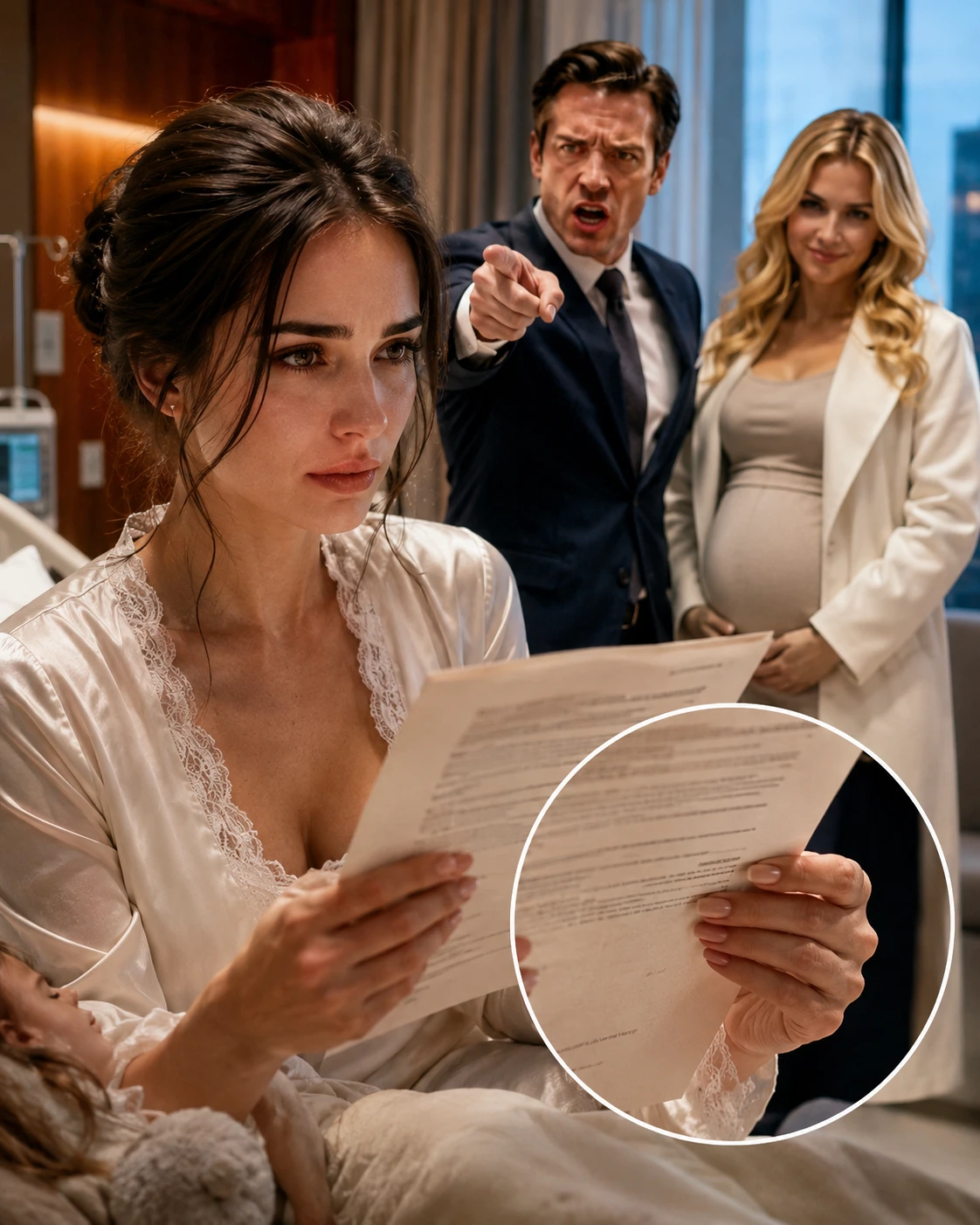
Grant faced Celeste.
“You used me?”
Celeste laughed softly, bitterly.
“Don’t be dramatic.”
“That baby isn’t mine.”
“The baby was useful.”
Madison flinched.
Grant looked sick.
I almost pitied him.
Almost.
Then I remembered Lily asking if Daddy was mad.
And the pity died.
Julian Cross snapped his folder shut.
“This conversation is over.”
“No,” I said.
“It’s just becoming useful.”
Grant turned to me.
His eyes were wild now.
“You planned this.”
“You did.”
I rose.
“I only brought a mirror.”
Madison wiped her face.
“You think you’re better than me?”
I looked at her for a long second.
“No.”
That surprised her.
“I think you were willing to humiliate a seven-year-old’s mother in a hospital room because you believed proximity to power was the same thing as having it.”
Her lips trembled.
“That was a mistake.”
Celeste stepped forward.
“You self-righteous little—”
“Careful, Celeste.”
The voice came from the doorway.
Everett Walsh entered the room with two uniformed officers and a private security supervisor behind him.
Grant’s face twisted.
“What the hell is this?”
Everett glanced at me.
“Your wife texted me when Madison began discussing a scheme involving a custody hearing.”
Julian Cross stepped in front of Grant.
“No one consented to a recording.”
Everett’s expression remained calm.
“The estate security system records the blue drawing room.”
Celeste froze.
I looked at the small black dome in the corner of the ceiling.
I had noticed it years ago.
Celeste had installed cameras after a maid allegedly stole a Cartier bracelet.
The bracelet had later been found in Celeste’s travel case.
Celeste had kept the cameras.
Predators love surveillance until they become the footage.
Grant followed my gaze.
“Mother.”
Celeste’s face was stone.
Everett turned to Julian.
“We will subpoena the recordings.”
Julian said nothing.
Madison sat down hard on the sofa.
Grant looked at me with something like hatred.
“You think this saves you?”
“No,” I said.
“My daughter saves me.”
He stepped closer.
Everett moved before I did.
Not dramatically.
Just enough.
Grant stopped.
His voice dropped.
“You want ugly, Vivian?”
I held his stare.
“I want honest.”
His mouth curved.
It was the cruelest expression I had ever seen on him.
“Fine.”
He looked at Everett, then Celeste, then Madison.
Then back at me.
“Tell them the truth about Lily.”
My pulse slowed.
Not stopped.
Slowed.
There are threats you fear because they are surprises.
And there are threats you recognize because you have been expecting them for years.
Grant smiled.
“Tell them she isn’t mine.”
Madison gasped.
Celeste looked away.
Julian’s eyes sharpened.
Everett’s face did not change, but I felt him shift beside me.
Grant’s smile widened.
“That’s right.”
He pointed at me.
“She built this entire saintly mother act on a lie.”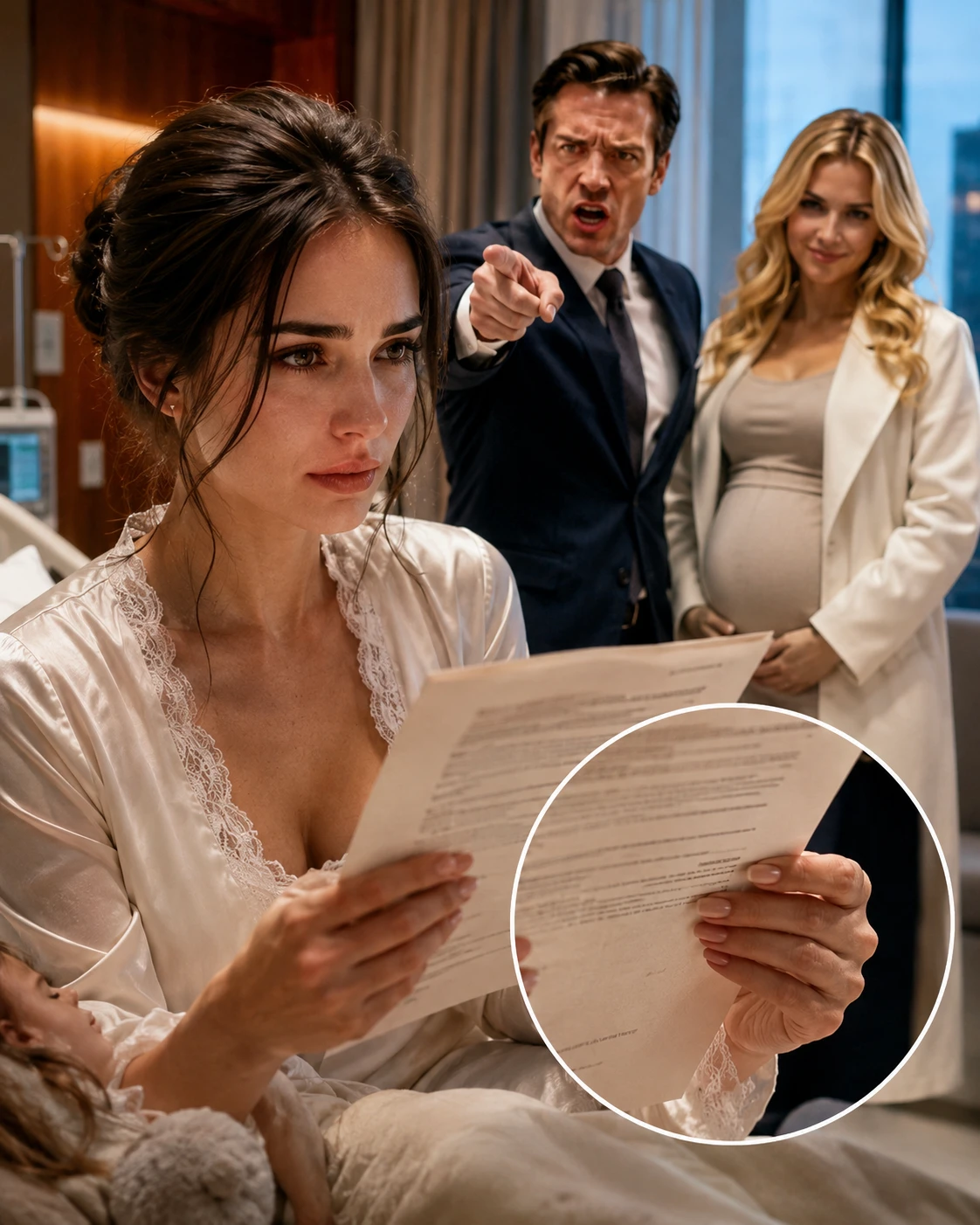
I heard Lily’s monitor in my memory.
Her small hand in mine.
Her voice asking if Daddy was mad.
I breathed once.
Then I reached into my purse and removed a second folder.
Grant’s smile faded.
“I wondered when you’d use that,” I said.
He stared at the folder.
“What is it?”
“The truth.”
I opened it.
“Eight years ago, after two failed rounds of IVF, you received a diagnosis at Columbia Presbyterian.”
Grant said nothing.
“Severe male-factor infertility.”
Celeste’s eyes closed again.
Madison looked from him to me, confused.
I continued.
“You signed consent for donor sperm.”
Grant’s jaw clenched.
“You signed legal parentage documents before the embryo transfer.”
I placed the papers on the table.
“You signed Lily’s birth certificate.”
Then I looked at him.
“You held her before I did.”
For the first time that day, my voice almost broke.
I did not let it.
“You knew exactly who Lily was.”
Everett picked up the thread.
“And under New York law and the marital agreement, Mr. Ashford is Lily’s legal father.”
Julian Cross looked at Grant with open fury now.
Not moral fury.
Professional fury.
The kind attorneys reserve for clients who have just detonated their own case.
I turned a page.
“The prenup also includes a non-disparagement clause specifically protecting children born through assisted reproduction.”
Grant swallowed.
“If either spouse attempts to delegitimize the child publicly or legally to gain financial advantage, that spouse forfeits remaining marital property claims connected to Ellison assets.”
Celeste whispered, “Charles.”
My father’s name sounded like a ghost entering the room.
I looked at her.
“Yes.”
Grant stared at the papers.
“My father knew you would try to make Lily’s existence feel like shame.”
My voice went colder.
“So he made your cruelty expensive.”
Outside, the storm broke.
Rain hit the windows like thrown gravel.
Madison cried quietly.
Celeste sat down for the first time.
Grant looked at me as if he had never seen me before.
Maybe he had not.
Maybe he had only seen the wife.
The mother.
The polished woman beside him at galas.
The Ellison daughter who smiled on cue.
He had never met the girl my father raised in boardrooms.
The one who understood that love could be gentle and still keep records.
I gathered the documents.
“We’re done here.”
Grant’s voice was hoarse.
“Vivian.”
I stopped at the doorway.
He looked smaller beneath the chandelier.
For ten years, I had mistaken height for strength.
“What?” I asked.
His eyes flickered toward the papers.
Toward the officers.
Toward Everett.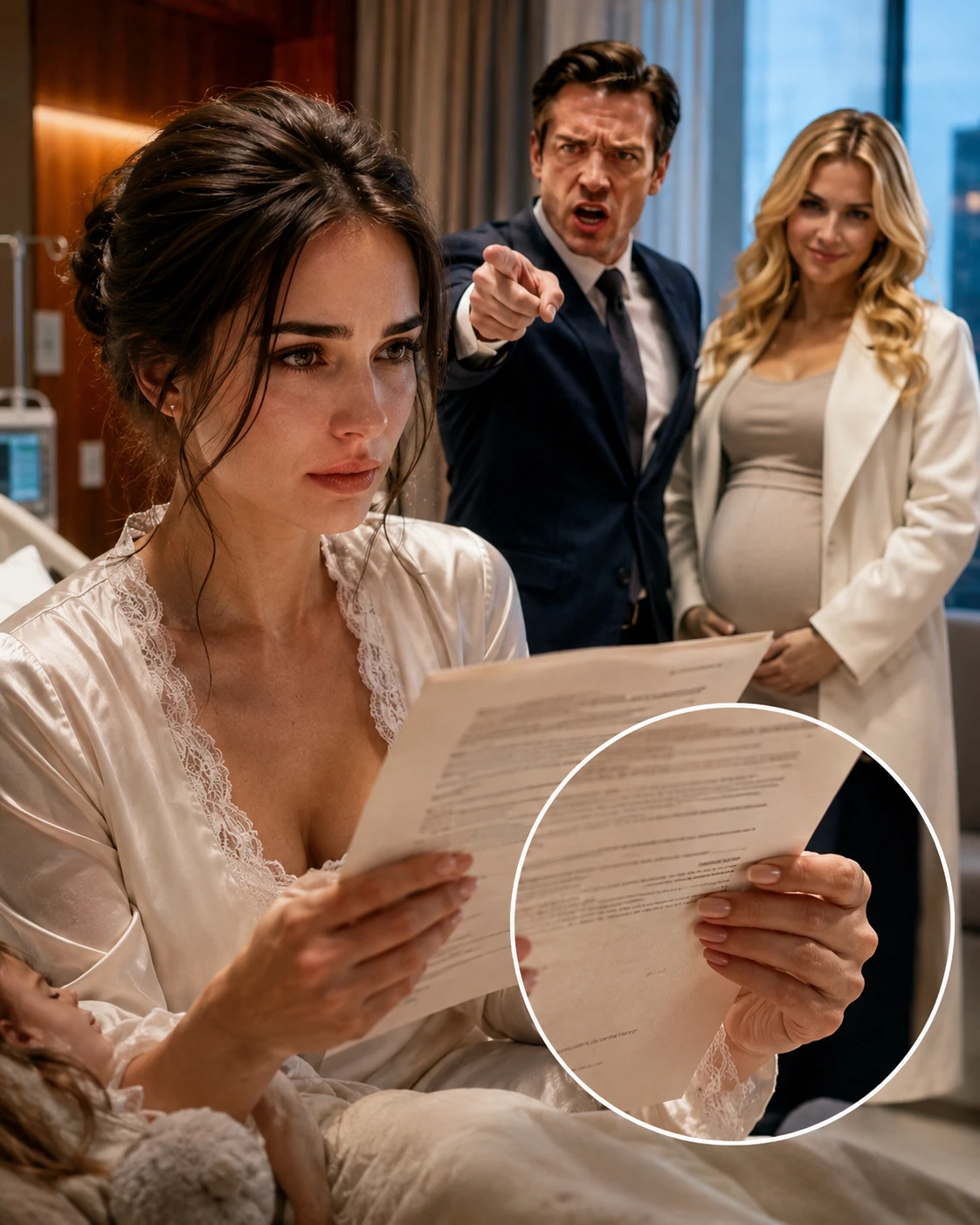
Toward the ruined future he had tried to finance with my daughter’s name.
“I loved you once,” he said.
I believed him.
That was the most terrible part.
“I know,” I said.
“Then you found something you loved more.”
His face tightened.
“What?”
“Access.”
I walked out before he could answer.
The rain soaked the steps outside.
Everett held an umbrella over me as we crossed the gravel drive.
For a moment, neither of us spoke.
Then he said, “Are you all right?”
I looked back at the mansion.
In the upper window, Celeste stood watching me.
Grant was nowhere to be seen.
“I will be,” I said.
That was not hope.
It was a decision.
PART 4 — THE COURTROOM WHERE HIS MOTHER STOPPED SMILING
Family court did not care about chandeliers.
That was one of its better qualities.
The courtroom was plain, beige, and badly lit.
The judge’s bench had scratches along the edge.
The chairs were uncomfortable.
The air smelled faintly of paper, coffee, and consequences.
Grant arrived with Julian Cross and a new tie.
Celeste arrived in navy wool and pearls.
Madison arrived in pale gray, no longer glowing, no longer smug, but still beautiful enough to make photographers lift their cameras outside.
The case had leaked by then.
Not all of it.
Enough.
Ashford heir scandal.
Pregnant mistress.
Custody battle.
Ellison trust war.
The kind of phrases that made strangers on the internet believe they understood your pain because they had seen a fifteen-second clip of your face.
I wore a charcoal suit.
My hair was pulled back.
No dramatic sunglasses.
No widow veil.
No costume.
Just a woman who had slept beside her daughter’s bed and come to court with evidence.
Lily was not there.
That was my first victory.
Everett had fought hard to keep her out of the spectacle, and the judge agreed.
Children did not belong in rooms where adults tried to weaponize love.
Grant’s petition argued that I was emotionally unstable, vindictive, and unable to provide a calm environment.
His affidavit mentioned my sharp remarks at the gala, my refusal to sign temporary custody papers, and my decision to have Madison followed.
It did not mention the trust paragraph.
Funny how paper could lie by omission and still wear a notary stamp.
Julian Cross stood first.
He spoke smoothly.
He painted Grant as a concerned father.
He painted Madison as an unfortunate complication.
He painted Celeste as a devoted grandmother.
Then he painted me as a woman undone by jealousy.
He did not raise his voice.
He did not need to.
Men like Julian understood that a whisper in court could bruise harder than a shout.
“Mrs. Ashford’s behavior has become increasingly erratic,” he said.
“She confronted Ms. Vale at a public gala.”
The judge looked at him over her glasses.
“After Mr. Ashford brought Ms. Vale to the hospital room of the parties’ minor child?”
Julian paused.
“Yes, Your Honor, but—”
“Continue.”
He continued less confidently.
Everett did not object often.
That was his style.
Let them build the house.
Then show the judge the foundation was sand.
When it was our turn, Everett stood.
“Your Honor, this petition is not about a child’s stability.”
His voice was calm.
“It is about voting control.”
Grant stared straight ahead.
Celeste’s face remained composed.
Madison looked at the table.
Everett submitted the custody proposal Grant had given me at the hospital.
He directed the court to the last paragraph.
The judge read it.
Her expression changed by exactly one degree.
That one degree was enough.
“Mr. Cross,” she said.
“Why would a temporary custody arrangement include trust voting authority?”
Julian stood.
“Standard protective language, Your Honor.”
The judge looked at him.
“In a family custody agreement?”
Julian hesitated.
“The minor child holds significant trust interests.”
“Yes,” the judge said.
“I can read.”
Someone coughed behind me.
Everett submitted the acquisition proposal from Ashford Meridian.
Then the debt schedule.
Then board correspondence showing Grant and Celeste had pushed for a merger requiring Lily’s trust vote.
Grant’s hands tightened.
Celeste still did not move.
Everett continued.
“Two weeks before filing for custody, Mr. Ashford’s family firm missed a private debt covenant.”
Julian objected.
The judge allowed the document for limited purpose.
Everett turned a page.
“Three days after that, Mr. Ashford’s counsel drafted custody papers giving him proxy control over Lily Ashford’s twenty-seven percent voting power.”
The judge looked at Grant.
Grant looked like a portrait of a man discovering the frame was on fire.
Then came the recording.
Celeste fought it.
Julian objected.
Everett argued the estate had continuous disclosed internal security monitoring and that statements were not privileged.
The judge listened.
Then she allowed the relevant portion.
The courtroom speakers crackled.
Madison’s voice filled the room.
You told me the baby only had to look possible until the custody hearing.
Grant’s head lowered.
Celeste closed her eyes.
The recording continued.
Celeste’s voice came next.
The baby was useful.
A sound moved through the courtroom.
Not a gasp exactly.
Something smaller and uglier.
Recognition.
The judge’s face became unreadable.
Madison began crying.
This time, no one comforted her.
Everett submitted the paternity acknowledgment packet.
The judge reviewed it privately, then looked at Madison.
“Ms. Vale, are you contesting the authenticity of this document?”
Madison shook her head.
Her attorney whispered to her.
She swallowed.
“No, Your Honor.”
Grant stared at the table.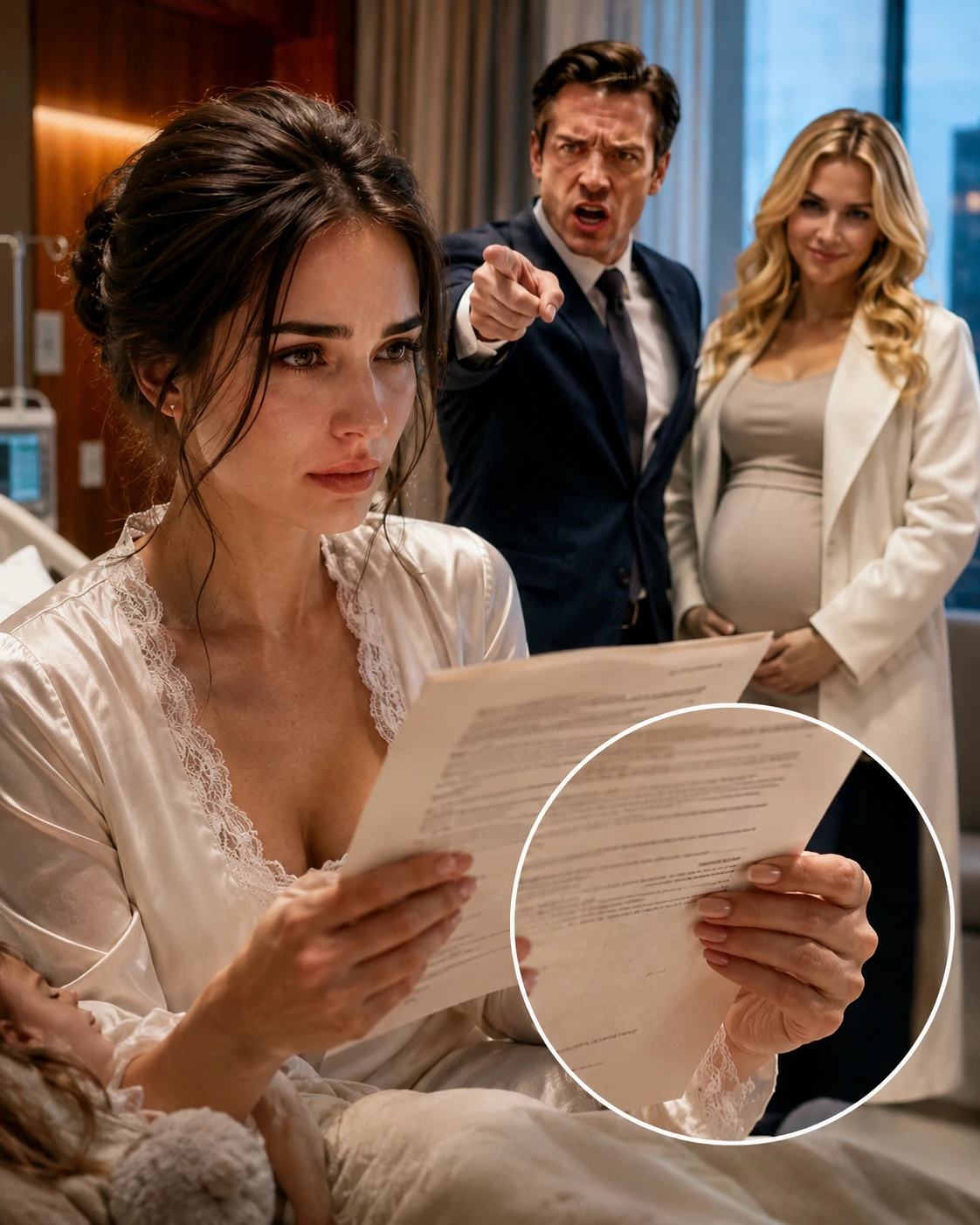
Julian Cross looked like a man mentally calculating malpractice exposure.
Then Grant did the thing cornered men do when the door disappears.
He reached for the child.
“Your Honor,” he said suddenly.
Julian grabbed his sleeve.
Grant pulled away.
“There is another issue.”
The judge looked at him.
“Mr. Ashford, speak through counsel.”
“No.”
His voice cracked.
“I have a right to say this.”
The judge’s eyes narrowed.
“You have a right to control yourself.”
Grant stood.
“Lily is not biologically mine.”
The courtroom went completely silent.
I felt every eye move toward me.
There it was.
The blade he had saved.
The one he believed would cut deepest because it was dipped in shame.
I sat still.
Everett stood slowly.
“Your Honor—”
Grant kept going.
“She used donor sperm.”
Julian whispered, “Stop.”
Grant did not stop.
“She has lied to everyone for years.”
The judge looked at me.
“Mrs. Ashford?”
I rose.
My knees did not shake.
That felt like a miracle.
“Your Honor, Grant and I used donor sperm after a medical diagnosis made natural conception impossible.”
Grant’s face twisted.
“He knew.”
I handed Everett the folder.
“He signed every consent form.”
Everett submitted the clinic documents, the parentage acknowledgment, the birth certificate, and the prenup clause protecting Lily from exactly this attack.
The judge read in silence.
A minute passed.
Then another.
No one moved.
Finally, she looked at Grant.
“Mr. Ashford, did you sign these documents?”
Grant did not answer.
The judge’s voice sharpened.
“Did you sign them?”
“Yes.”
“Did you understand you were accepting legal parentage?”
Grant swallowed.
“Yes.”
“Did you raise this child as your daughter?”
His mouth opened.
Closed.
“Yes.”
The judge leaned back.
“Then I suggest you consider very carefully what kind of father attempts to humiliate his child’s conception in open court to gain leverage over her mother.”
Grant sat down.
The words landed harder than any gavel.
Celeste’s face was no longer composed.
Her mouth had thinned into a pale line.
For the first time since I had known her, she looked old.
Not elegant old.
Tired old.
Exposed old.
The judge turned to Everett.
“Continue.”
Everett did.
He presented the predatory claimant provision.
He presented the prenup forfeiture clause.
He presented the trust freeze notice filed by Henry Walsh that morning.
Then he presented the final document.
A sealed letter from my father to the independent trustee.
The judge allowed it.
Everett read only the relevant portion.
If Grant Ashford ever seeks control of Lily’s inheritance through Vivian’s pain, assume he is not acting as a father.
Assume he is acting as a man who has run out of doors and found a child-sized window.
I closed my eyes.
For one second, I was not in court.
I was thirteen years old in my father’s office, sitting on the carpet with homework while he told a CEO twice his size that desperation was not a strategy.
I missed him so violently that grief felt physical.
Then Everett’s voice steadied me back into the room.
The judge issued her ruling that afternoon.
Grant’s petition for temporary primary custody was denied.
His parental access would be supervised pending further review.
He was barred from exercising any proxy, voting, appointment, or consent rights connected to Lily’s trust.
Celeste Ashford was ordered not to contact Lily outside approved channels.
The trust voting rights were frozen and transferred to the independent trustee during investigation.
The court also referred the matter for review based on potential coercive financial motive.
Grant looked stunned.
Celeste looked furious.
Madison looked relieved and ruined at the same time.
I did not celebrate.
Celebration felt too loud for a day like that.
I simply breathed.
Outside the courthouse, reporters shouted my name.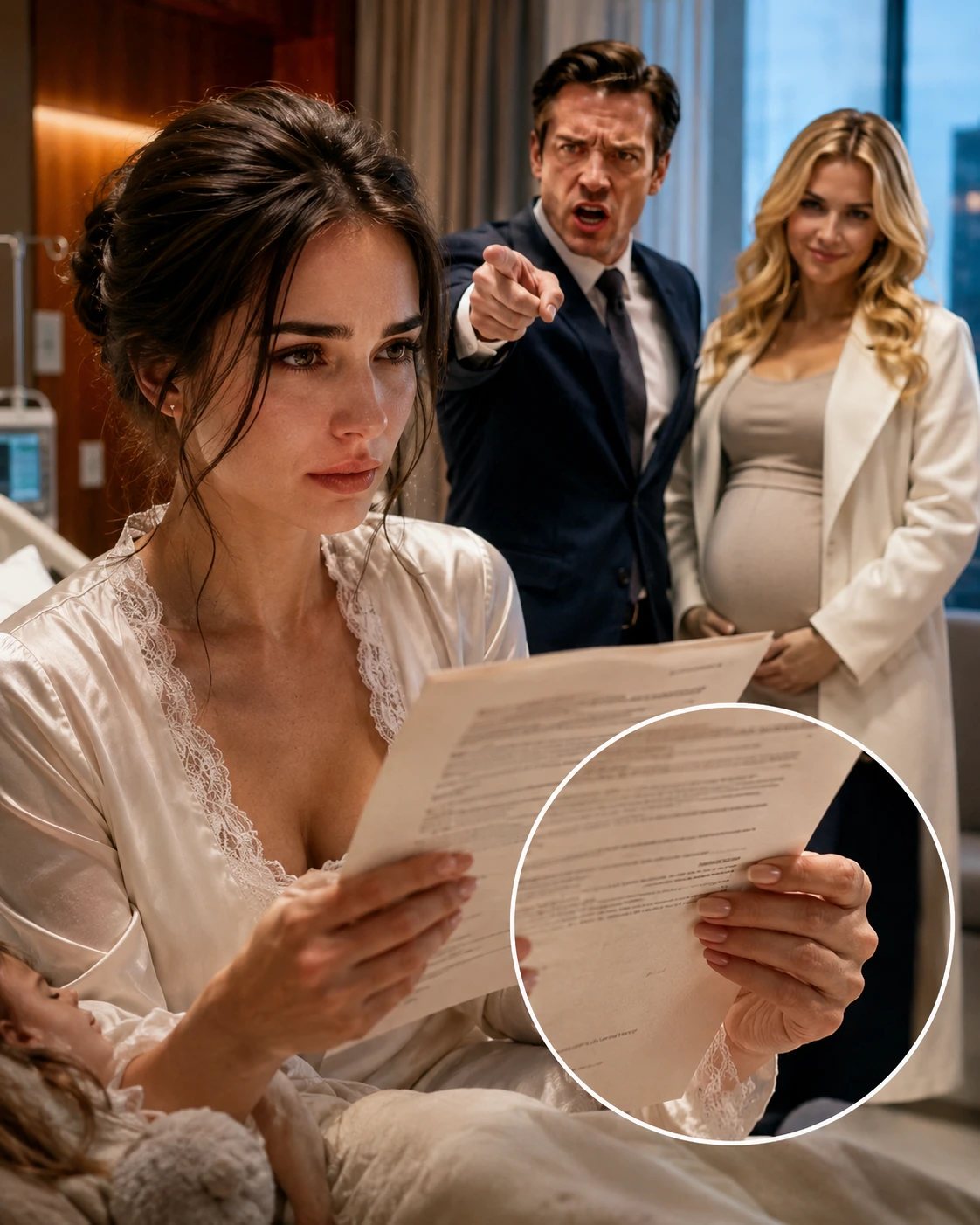
Vivian, did you know about the affair?
Vivian, did Grant try to steal the trust?
Vivian, are you divorcing him?
Vivian, what do you say to Madison?
I walked down the steps with Everett beside me.
The air was cold.
Camera flashes cut through the afternoon.
Grant appeared behind us.
For one second, the crowd surged.
He looked at me over the heads of strangers.
His face was hollow.
“Vivian,” he called.
I stopped.
Not for him.
For the version of myself who once would have.
He came down two steps.
The cameras loved it.
“Please,” he said.
That word.
At last.
Not spoken in our kitchen.
Not beside Lily’s hospital bed.
Not before the gala.
Only here, where he had run out of leverage.
“Please what?” I asked.
His eyes reddened.
“Don’t destroy me.”
I looked at the man I had loved.
The man who had known the sound of my laugh in the dark.
The man who had held my hand during embryo transfer and whispered that we were already a family.
The man who later tried to turn that same child into a voting instrument.
I felt sadness then.
Not longing.
Not weakness.
Sadness.
A clean, distant kind.
“I’m not destroying you, Grant.”
My voice was quiet enough that the microphones leaned in.
“I’m returning what belongs to you.”
He stared at me.
“What?”
“Consequences.”
I turned away.
By evening, the clip had gone viral.
Not because I cried.
Because I did not.
PART 5 — THE BOARDROOM WHERE THE TRUST CHOSE BLOOD
The Ellison Global boardroom sat on the forty-eighth floor of a glass tower overlooking Bryant Park.
My father had designed the room to be intimidating without being vulgar.
No gold.
No velvet.
Just walnut walls, black leather chairs, a long table, and windows that made powerful people remember they were still very small compared to the city.
Grant had always hated that room.
He said it was cold.
My father said that was because Grant kept expecting warmth from things he had not earned.
The emergency board meeting began at 8:00 a.m. the morning after court.
Grant arrived at 7:58.
So did Celeste.
They had no right to attend after the court’s order, but people like the Ashfords often confuse doors opening with permission.
Security stopped them at reception.
I watched it happen on the monitor in the boardroom.
Grant argued first.
Celeste threatened second.
Security remained polite.
That was the beautiful thing about trained professionals.
They did not care about surnames.
Everett stood beside the screen.
Henry Walsh sat at the table, eighty-two years old, immaculate in a dark suit, his white hair combed back, his cane resting beside his chair.
He had come out of semi-retirement for this.
When he saw Grant on the monitor, he sighed.
“Charles should have let me draft the first prenup in blood.”
I looked at him.
“He wanted to be civilized.”
Henry snorted.
“Your father was never civilized.”
“He just had excellent stationery.”
For the first time in days, I laughed.
It surprised me.
The sound was small, but real.
At 8:05, the independent trustee, Margaret Sloan, called the meeting to order.
Margaret was sixty, severe, and allergic to nonsense.
She had managed trust assets for families who would rather lose a kidney than lose control.
My father adored her.
So did I.
She placed the court order on the table.
“Lily Ashford’s voting rights are frozen under the predatory claimant provision.”
One board member shifted.
Another avoided my eyes.
Several had supported the Ashford merger quietly, not because they liked Grant, but because people often mistake speed for certainty when markets get nervous.
Margaret continued.
“However, the trust instrument includes an emergency continuity clause.”
I had read it at midnight.
Then again at two.
Then again at four while Lily slept curled beside me in my bed, her inhaler on the nightstand and her stuffed rabbit tucked beneath her arm.
Under the clause, if a predatory claim was established or credibly alleged, the frozen voting rights could not be used for sale, merger, pledge, transfer, or restructuring.
They could, however, be used defensively by the independent trustee to prevent dilution, hostile acquisition, or asset stripping.
My father had not just locked the door.
He had left a guard dog inside.
Margaret looked down the table.
“The Ashford Meridian merger is therefore rejected.”
No one spoke.
“Additionally,” she said.
“Based on evidence submitted in court and materials uncovered during preliminary internal audit, Grant Ashford is removed from all Ellison Global advisory and operational roles effective immediately.”
There it was.
The end of the illusion.
Grant had never owned Ellison Global.
He had occupied it.
Like a guest who stayed long enough to learn where the silver was kept.
The doors opened.
Security entered with Grant and Celeste behind them.
Grant looked disheveled in a way his tailoring could not hide.
Celeste looked furious enough to power the building.
“You cannot do this,” Celeste said.
Margaret did not look up.
“It is already done.”
Grant’s eyes found mine.
“You called this meeting before the hearing.”
“Yes.”
“You knew.”
“I prepared.”
He laughed bitterly.
“You always were your father’s daughter.”
I stood.
“I used to think that was a burden.”
I looked around the boardroom.
“At this moment, it feels like inheritance.”
Celeste stepped forward.
“Do not speak to my son as if you are above him.”
I turned to her.
“Celeste, you used a pregnant woman, a sick child, and a family court petition to rescue a failing firm.”
Her face went white.
“I think above him is the kindest place I could stand.”
Grant slammed his hand on the table.
“Enough.”
The room jumped.
I did not.
Grant pointed at Henry.
“You old bastard.”
Henry smiled faintly.
“I have been called worse by richer men.”
“You planned this with Charles.”
“No,” Henry said.
“Charles planned this because he understood men like you mistake kindness for negligence.”
Grant looked at me.
“I gave ten years to this family.”
“You took ten years from it.”
“I was your husband.”
“You were my liability.”
His face twisted.
Maybe the words hurt him.
I hoped they did.
Not because I wanted revenge.
Because truth should hurt when it has been ignored too long.
Celeste turned to the board.
“This is a family matter.”
Margaret finally looked at her.
“No, Mrs. Ashford.”
Her voice was crisp.
“This became a corporate matter when your family attempted to leverage a minor beneficiary’s trust to force a merger.”
Celeste opened her mouth.
Margaret lifted one finger.
“Do not interrupt me.”
Celeste closed her mouth.
It was perhaps the most satisfying silence of my adult life.
Everett distributed the internal audit summary.
The Ashford side had hidden debt through a chain of entities with names like clean linen.
Harbor North.
Linden Capital.
Whitegate Advisory.
Behind them were defaults, bridge loans, and one desperate acquisition proposal dressed as family unity.
Grant’s emails were there.
So were Celeste’s.
One line stood out.
Once Vivian signs the temporary custody agreement, Lily’s vote solves the merger problem.
Grant stared at the page as if it had betrayed him by existing.
Madison had provided the email.
That was the next surprise.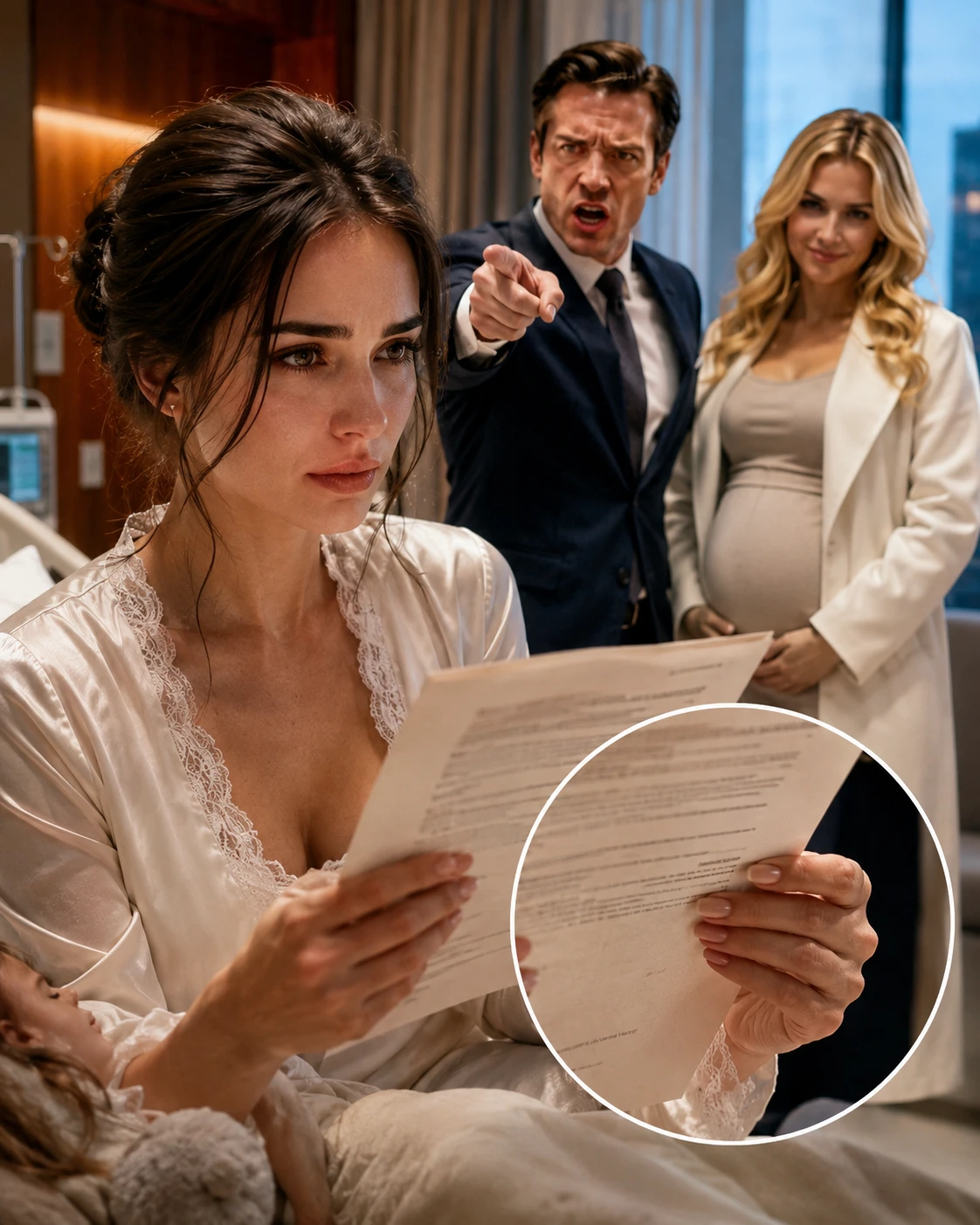
After court, her attorney contacted Everett.
Madison wanted protection.
She wanted distance from the Ashfords.
She wanted to keep Rowan’s name out of the tabloids until she decided whether the baby would be a scandal or a settlement.
I did not admire her.
But I understood survival when I saw it.
The board voted.
Unanimous rejection of the merger.
Unanimous removal of Grant.
Unanimous referral of Ashford Meridian materials to outside counsel.
By 9:12, it was over.
No shouting.
No champagne.
Just signatures.
That was how empires ended most of the time.
Not with fire.
With paperwork.
Grant remained standing after everyone else left.
Celeste had been escorted out by then, pearls trembling with every step.
Henry and Margaret withdrew to the side office.
Everett stayed near the door.
Grant looked at the city beyond the windows.
For a moment, he seemed younger.
Or maybe simply less decorated.
“You know what the worst part is?” he asked.
I said nothing.
“I did love Lily.”
The words entered me carefully.
I believed them, too.
That was the tragedy of Grant.
He was not empty.
He was divided.
And when forced to choose between love and hunger, he fed the hunger first.
“Then you should have protected her from yourself,” I said.
His eyes closed.
“I thought I could fix everything.”
“No.”
I picked up the audit folder.
“You thought you could own everything.”
He turned.
“And Everett?”
I frowned.
“What about him?”
Grant’s smile was bitter.
“He’s been waiting, hasn’t he?”
It was such a small, ugly thing to say in such a large ruined room.
I almost pitied how predictable it was.
“Even now,” I said.
“You think the only reason a man would stand beside a woman is because he wants to possess her.”
Everett’s expression did not change.
Grant looked away first.
I walked to the door.
Then I stopped.
There was one thing left.
“Grant.”
He turned.
I removed my wedding ring.
It was a flawless emerald-cut diamond set between two tapered stones.
He had chosen it because it looked like legacy.
I had worn it through dinners, pregnancies that failed, one that became Lily, hospital nights, holidays, and every polished lie.
I placed it on the boardroom table.
The sound was very soft.
But Grant heard it like a gunshot.
“My attorney will send the divorce papers.”
He stared at the ring.
“Vivian.”
I looked at him one last time as my husband.
Not with hatred.
Hatred would have kept him close.
I wanted distance.
Clean, permanent distance.
“You came for Lily’s trust,” I said.
“You lost mine.”
Then I walked out.
The next weeks were ugly in the way wealthy divorces are ugly.
Quietly.
Through filings.
Through leaks.
Through people choosing sides over lunches where the wine cost more than most people’s rent.
Grant tried to fight the prenup.
He failed.
Celeste tried to file for grandparent visitation.
The judge denied emergency access and ordered evaluation first.
Ashford Meridian lost two lenders and one reputation.
Rowan Ashford disappeared to Palm Beach until the internet found him anyway.
Madison gave one interview through her attorney.
She said she regretted being used.
She did not apologize to me.
I did not wait for it.
Closure is not a debt other people pay on time.
Sometimes you write it off and protect your peace.
Lily asked about Grant less than I feared and more than I wanted.
Children understand absence before they understand betrayal.
At night, she slept with her stuffed rabbit and asked if Daddy was busy.
I told her the truth in pieces small enough for her hands.
Daddy made some bad choices.
Daddy needs help making better ones.
You are loved.
You are safe.
None of this is your fault.
She accepted the last sentence the way children accept medicine.
Reluctantly.
But she swallowed it.
One evening, a month after the board meeting, Lily found me in my closet holding the black Dior gown from the gala.
“Is that the dress from the night Daddy was on TV?” she asked.
I looked at the dress.
Then at her.
“Yes.”
“Did you feel sad?”
I sat on the floor beside her.
The closet lights glowed softly over rows of shoes, silk, wool, armor.
“Yes,” I said.
“I felt very sad.”
“Did you cry?”
I smiled.
“Later.”
She climbed into my lap.
I held her carefully, as if she were still connected to wires and monitors.
“Why not there?” she asked.
I kissed her hair.
“Because sometimes people want your tears so they can prove they hurt you.”
She thought about that.
Then she said, “That’s mean.”
“Yes.”
“What do you give them instead?”
I looked at the dress again.
Then at my daughter’s bright, serious face.
“Nothing they can use.”
She nodded as if this were a lesson worth keeping.
Maybe it was.
CONCLUSION — THE HOUSE WE BUILT AFTER THE FIRE
Spring came slowly that year.
Not gently.
Slowly.
The trees along Park Avenue bloomed like they had forgiven winter but not forgotten it.
Lily returned to school with a new inhaler plan, a new backpack, and a security detail she thought was just Mr. Paul who liked crossword puzzles in the lobby.
I returned to Ellison Global as interim chair.
The press called it a comeback.
That made me laugh.
Women are always called dramatic when they survive quietly, then miraculous when the world finally notices they are still standing.
I was not coming back.
I had never left.
Grant moved out of our townhouse in April.
The movers arrived before sunrise.
I watched from the upstairs window as they carried out his suits, his golf clubs, his framed awards, and the leather chair he had bought for a study he never used to read in.
There was no grand final conversation.
No rain-soaked apology.
No cinematic collapse on the front steps.
Real endings are often much less theatrical than betrayals.
He sent one text.
I am sorry for what I did to Lily.
Not to me.
To Lily.
That was the only apology I needed him to understand first.
I did not reply immediately.
When I did, I wrote one sentence.
Then spend the rest of your life becoming someone who would never do it again.
I blocked him for the night.
Not forever.
Just long enough to sleep.
Everett stayed my lawyer until the final divorce decree.
Nothing more happened between us.
Not then.
I know that disappoints people who want every broken woman handed a better man by the final chapter.
But I was not a vacancy.
I was a house after a fire.
Before anyone could be invited in, I needed to learn which walls still held.
On the day the divorce was finalized, I took Lily to the Central Park Conservatory Garden.
She wore a yellow coat and ran ahead of me between the hedges.
The sky was bright.
The air smelled like tulips and rain.
My phone buzzed once.
Everett had sent a message.
It is done.
Below that, another line.
Your father would be proud.
I stood beneath an arch of blooming branches and let myself feel it.
Not victory.
Not revenge.
Relief.
A quiet, shaking relief that moved through me like light entering a locked room.
Lily ran back and slipped her hand into mine.
“Mommy, are we okay now?”
I looked down at her.
Her cheeks were pink from the cold.
Her eyes were my father’s shade of blue.
Her trust, her name, her future, all still hers.
I squeezed her hand.
“Yes,” I said.
“We’re okay.”
She smiled.
Then she tugged me toward the fountain.
Behind us, the city kept moving.
Headlines faded.
Gossip shifted.
The Ashford name lost its shine and found other rooms to haunt.
Madison had her baby in August, far from cameras.
Rowan eventually signed the papers.
Celeste sold the Greenwich estate two years later.
The chapel windows went to auction.
I almost bought them.
Then I decided some things are more beautiful when they belong to someone else’s ruin.
As for Grant, he saw Lily under supervision until he earned more.
Slowly.
Painfully.
Without access to her trust, her votes, or my forgiveness.
He learned that fatherhood is not a title you use in court.
It is a thousand ordinary choices made when no one is applauding.
Some days, Lily came home happy.
Some days, quiet.
I held space for both.
Children do not heal on adult schedules.
Neither do mothers.
But we healed.
Not perfectly.
Not quickly.
But honestly.
On Lily’s eighth birthday, we held a party in the rooftop garden of our building.
There were fairy lights, vanilla cake, pink lemonade, and a magician who somehow made twenty children scream with joy over a foam rabbit.
Henry Walsh came with a cane and a gift wrapped in silver paper.
Margaret Sloan sent a first-edition copy of The Secret Garden.
Everett stopped by for exactly twenty minutes and stayed for two hours because Lily challenged him to chess on the patio.
He lost.
Badly.
I suspected on purpose.
That night, after everyone left, Lily and I sat barefoot on the terrace under a soft blanket.
The city glittered around us.
She leaned against my shoulder.
“Grandpa Charles gave me the trust, right?”
I looked at her.
“He helped protect it for you.”
“Is it money?”
“It is responsibility.”
She wrinkled her nose.
“That sounds like homework.”
“It is a little like homework.”
She looked out at the skyline.
“What do I have to do with it?”
I brushed a crumb of cake from her sleeve.
“Grow up kind.”
She waited.
“And smart.”
She nodded.
“And never let anyone convince you that love means handing them the keys to everything you are.”
She looked up at me.
“Even if they say please?”
I smiled.
“Especially then.”
She rested her head on my arm again.
Below us, Manhattan shimmered like broken glass arranged into something beautiful.
I thought about the hospital room.
The leather folder.
Madison’s white coat.
Celeste’s pearls.
Grant’s hand on the pen.
I thought about how close I had come to signing because I was tired, scared, and desperate for peace.
Then I thought about my father’s letter.
Assume he is acting as a man who has run out of doors and found a child-sized window.
I understood something then.
Protection is not always loud.
Sometimes it is a clause written years before the betrayal.
Sometimes it is a mother reading the last paragraph.
Sometimes it is a woman smiling coldly in a room full of people waiting for her to break.
Lily fell asleep against me before the candles burned out.
I carried her inside and tucked her into bed.
On her nightstand sat the stuffed rabbit from the hospital, worn soft at the ears.
Beside it was the birthday card Grant had mailed.
She had read it twice, then placed it there without comment.
Healing leaves room for complicated things.
I turned off her lamp and stood in the doorway for a while.
My daughter slept peacefully.
No monitors.
No oxygen.
No lawyers.
Just breath.
In and out.
Her own.
I walked downstairs and found the old leather folder in my office safe.
The custody papers were still inside.
I kept them not because I needed the pain.
But because one day, when Lily was old enough, I would show her the document that taught me the difference between peace and surrender.
I would tell her that betrayal often arrives well-dressed.
That greed can speak in the language of family.
That a woman does not have to scream to be dangerous.
And that the most powerful word in any room is sometimes the quietest one.
No.
Then I would show her the final page.
The paragraph Grant thought would make him rich.
The paragraph that made me wake up.
The paragraph that saved her future because I finally understood the truth.
My husband was never trying to leave me for his mistress.
The mistress was the distraction.
The trust was the prize.
And my daughter was never his to spend.
I can reshape this into a shorter “Part 1 in comments” FB/Reels serial version with stronger cliffhangers per section.