My Brother Blamed Me for the Fire. The Camera Remembered What My Family Chose to Forget.
Chapter 1: Smoke on the Lawn
My brother blamed me for the house fire in front of two hundred people wearing pearls, navy suits, and charity smiles.
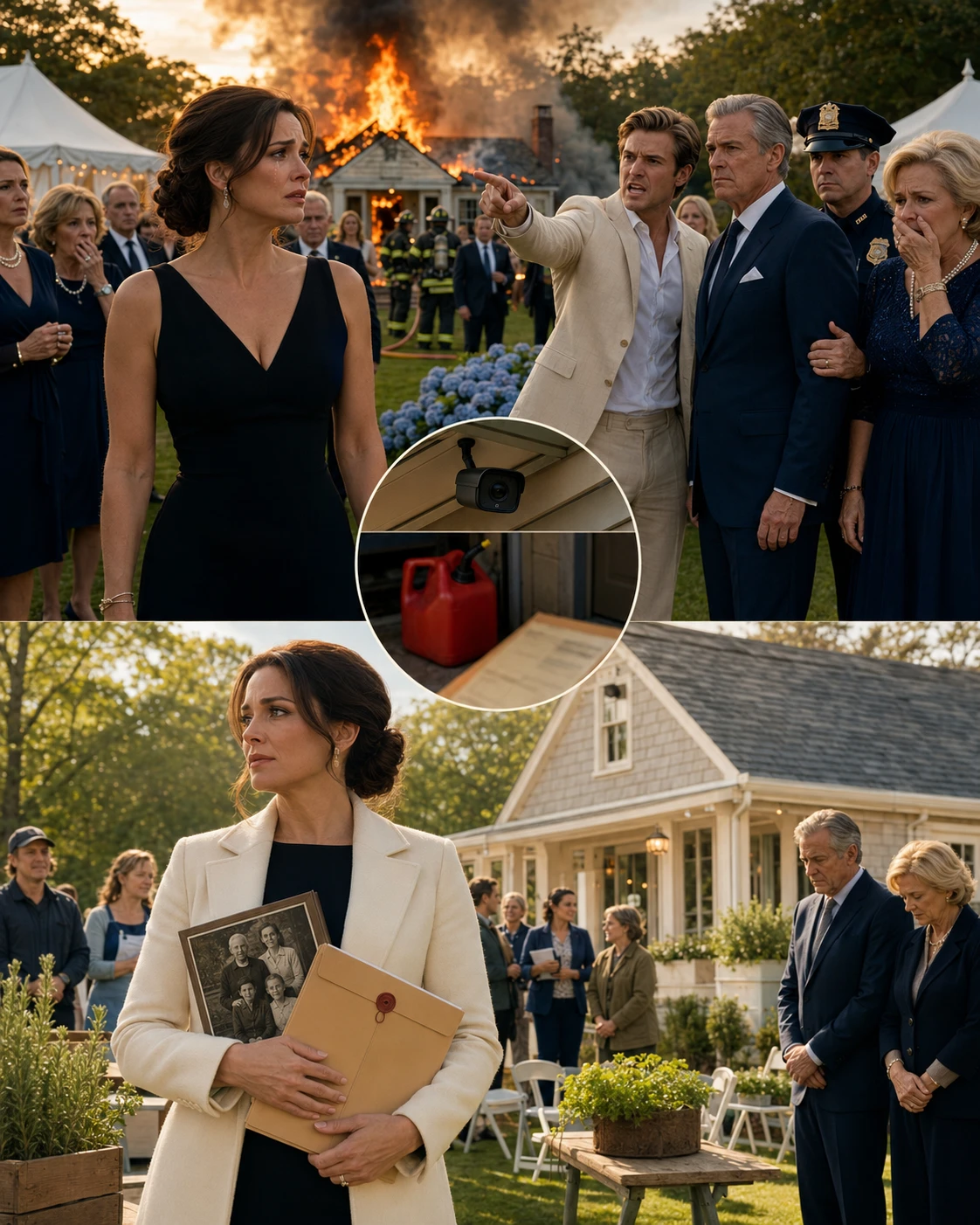
The old guesthouse behind my parents’ Greenwich estate was still smoking when Wesley Whitmore pointed at me across the manicured lawn and said, “Claire was near the garage. I saw her.”
My mother covered her mouth like she had been waiting all her life to be wounded by me in public.
My father did not ask one question.
He simply turned to the police officer beside him and said, “Our daughter has always been… unstable.”
That was how I learned a family could burn you without striking a match.
The Whitmore Summer Benefit had been planned for six months. White tents on the lawn. Crystal glasses. Champagne towers. Donors from Manhattan. Old friends from Yale. Local judges, school board members, bankers, a senator’s wife, and half the people in Connecticut who believed wealth was the same thing as virtue.
My mother, Elaine Whitmore, had chosen pale blue hydrangeas because she said they photographed well against the stone house.
My father, Charles Whitmore, had hired a string quartet.
Wesley had arrived late in a cream linen suit, smiling like the sun had been invented for him.
And I had been standing near the dessert table, quietly replacing the place cards my mother had “accidentally” printed without my married name, when someone screamed that there was smoke behind the east hedge.
By the time we reached the back lawn, flames had already chewed through the roof of the guesthouse.
The guesthouse was old, cedar-sided, and beautiful in the sad way old family buildings become beautiful when no one loves them enough to repair them. My grandmother had lived there during the last six months of her life, after she decided the main house was “too full of people and too empty of kindness.”
I was the one who visited her every night.
I was the one who brought her medication, changed her bedding, argued with Medicare, sat with her through pain, and held her hand when she was too proud to say she was afraid.
My family called it “helping out.”
My grandmother called it “proof.”
But none of that mattered while the guesthouse burned.
Firefighters dragged hoses across the lawn. Guests whispered behind champagne flutes. My mother cried into a monogrammed handkerchief. My father stood still, his jaw tight, looking less concerned about the fire than about the people watching it.
Then Wesley began to cry.
Not gently. Not privately.
He put one hand over his face and staggered backward as if the flames had personally betrayed him. People moved around him. A woman from my mother’s garden club rubbed his shoulder. Someone said, “Poor Wesley.”
He looked at me through the gaps in his fingers.
And I knew.
Before he spoke, I knew.
“Claire,” he said, loud enough for the nearest donors to hear. “Why were you by the garage?”
The world narrowed.
I could hear water hitting flame. I could smell smoke and wet grass and my mother’s expensive perfume. I could feel every eye turning.
I looked at my brother, the golden son of the Whitmore family, heir apparent to Whitmore Development, favorite child, favorite grandchild, favorite story at every dinner table.
“What are you talking about?” I asked.
My voice came out calm.
That seemed to disappoint him.
Wesley’s face twisted. “Don’t do that. Don’t act like you weren’t there. I saw you near the garage ten minutes before the fire started.”
“I was inside,” I said. “With the caterer. Ask Denise.”
My mother made a sharp sound. “Claire.”
Not my name as a question.
My name as a warning.
Wesley shook his head. His eyes were wet, but there was something dry and bright behind them. “Mom, she was angry. She was upset about the seating chart. She said nobody respected her here.”
I almost laughed.
Not because it was funny, but because it was so small.
A seating chart.
That was what he chose.
The old family method was always the same. Take one tiny truth, place it inside a large lie, and let everyone pretend the lie had roots.
Yes, I had been upset.
My mother had put me at table nineteen with the junior accountants and my cousin’s teenage daughters, while Wesley sat at the head table beside my parents, the mayor, and the chairman of First Harbor Bank.
Yes, I had noticed.
No, I had not set a building on fire.
But my father was already looking at me the way he used to look at broken vases, failed report cards, and overdue bills.
As if I had done it by existing too close to the damage.
“Claire,” he said, low and hard, “tell the truth.”
“I am telling the truth.”
Wesley wiped his face. “Dad, she’s been jealous for years. Ever since Nana changed the estate plan. Ever since—”
“Enough,” I said.
It was the first sharp word I had spoken.
Everyone heard it.
My mother flinched like I had slapped her.
Wesley stepped back. “See?”
My father’s face darkened. “You will not raise your voice at your brother while he is trying to protect this family.”
Protect this family.
That phrase had raised me.
It had sent me home from college on weekends to sit beside my grandmother while Wesley attended investor retreats. It had made me co-sign emergency business loans “just temporarily” while Wesley posed in magazines as the future of the company. It had convinced me to pay my mother’s private hospital invoices after her cardiac surgery because my father said liquidity was complicated and Wesley was under pressure.
Protect this family.
I had protected them until protection became my assigned personality.
The firefighters got the blaze under control after forty minutes. By then, half of Greenwich had watched my brother accuse me of arson.
Police took statements near the tennis court.
Wesley gave his with shaking hands and perfect timing.
My parents stood beside him.
I stood alone.
A young officer asked me where I had been. I told him the truth. Inside the main house, speaking with Denise, the catering manager, about the missing dessert plates. Then in the powder room. Then on the west terrace with my aunt Pamela, who had asked whether I was “still doing that nonprofit thing,” meaning my actual job as a legal aid director.
The officer wrote it down.
My father watched as if I were embarrassing him by having an alibi.
The next morning, the story had already spread.
Not in newspapers. The Whitmores knew how to keep shame out of newspapers.
It spread in text messages, group chats, private calls, and the polished cruelty of people who began sentences with, “I probably shouldn’t say this, but…”
By noon, my cousin Lila sent me a screenshot from the family chat.
Aunt Pamela: Does anyone know if Claire is safe? I’m worried about her mental state.
Uncle Robert: Charles said she’s being difficult.
My mother: We are handling this privately. Please pray for Wesley. He’s devastated.
Wesley: I never wanted this to happen. I still love my sister. I just hope she gets help.
I stared at his message for a long time.
Then I turned off my phone.
Not because I was afraid.
Because I knew if I kept reading, I might start wanting the kind of revenge that ruined your own hands.
And I had spent too many years cleaning up other people’s messes to become one.
That afternoon, I drove back to the estate to collect the medical files and personal letters I had stored in the guesthouse after Nana died. I knew the fire had taken most of it, but I needed to see what remained.
The gates opened slowly.
The security guard, Paul, would not meet my eyes.
My father was waiting on the front steps.
He wore charcoal trousers and a white shirt with the sleeves rolled up, the uniform of a wealthy man pretending he had been doing hard work.
“You shouldn’t be here,” he said.
“This is still my family home.”
His mouth tightened. “That depends on how this investigation goes.”
I looked past him toward the blackened skeleton of the guesthouse.
“My grandmother’s letters were in there,” I said.
“And whose fault is that?”
The words landed quietly.
There are sentences that do not feel loud until years later, when you realize they broke something permanent.
I looked at my father, the man whose business I had helped save twice. The man whose wife I had nursed through recovery. The man whose son had missed every difficult day and still received every public thank-you.
“I did not start that fire,” I said.
He stepped closer. “Then why would Wesley say he saw you?”
Because he needed someone to blame.
Because he knew you would believe him.
Because you always do.
I said none of that.
I said, “You should ask him.”
My father laughed once, coldly. “Your brother has done nothing but bring pride to this family.”
Behind him, the front door opened.
Wesley came out carrying a silver coffee mug.
He looked rested.
Too rested.
His eyes moved from my face to my car, then to the burned guesthouse. “Claire,” he said softly. “You shouldn’t make this worse.”
I smiled, but there was no warmth in it.
“For whom?”
His jaw flickered.
My mother appeared behind him, wrapped in a cream cardigan though it was August. “Please don’t start,” she whispered. “Not here. Not with the investigators coming.”
I turned to her. “Investigators?”
My father’s expression shifted before he could hide it.
“Insurance,” Wesley said quickly. “Standard process.”
Insurance.
Of course.
The old guesthouse had been insured for more than it was worth because it sat on protected historical land and had original architectural details my mother liked to mention at luncheons but refused to maintain.
“How much?” I asked.
My father stiffened. “That is not your concern.”
“It might be.”
Wesley laughed. “Why? Planning to sue us?”
“No,” I said, looking at him. “Planning to listen.”
A black SUV came up the driveway twenty minutes later.
The man who stepped out was not impressed by the estate, the hydrangeas, the family name, or Wesley’s wounded performance.
He was in his early fifties, lean, with gray hair and a navy blazer that looked chosen for durability, not admiration. He introduced himself as Martin Hales, senior investigator with North Atlantic Mutual.
He shook my father’s hand.
Then my mother’s.
Then Wesley’s.
Then mine.
When he took my hand, his eyes stayed on my face for one extra second.
“Ms. Whitmore,” he said. “I understand you were accused of being near the garage shortly before the fire.”
My father said, “That’s correct.”
I said, “That is what my brother claimed.”
The investigator nodded. “Good. Then we’ll be thorough.”
Wesley’s smile thinned.
Martin Hales asked to see the garage first.
The garage sat fifty yards from the guesthouse, a four-bay stone building that housed my father’s vintage Mercedes, two golf carts, lawn equipment, and whatever expensive hobby Wesley had abandoned that year.
We followed the investigator across the lawn.
My mother kept whispering to Wesley, telling him he did not have to relive anything.
No one whispered that to me.
Near the garage door, Martin crouched and looked at dark marks on the gravel.
“Gasoline?” my father asked.
“Possibly,” Martin said.
Wesley wrapped his arms around himself. “This is awful.”
Martin glanced at him. “It usually is.”
Then he turned toward the neighboring property.
Beyond the east hedge stood the old Caldwell house. Its owner, Thomas Caldwell, was a retired federal judge who hated my father, disliked my mother, ignored Wesley, and had always been kind to me.
Martin pointed to a small black camera mounted above Caldwell’s garage, angled toward the shared driveway.
“Is that camera active?” he asked.
My father said, “I wouldn’t know.”
I said, “Judge Caldwell keeps everything active.”
Wesley went still.
Only for a second.
But I saw it.
So did Martin Hales.
The investigator looked at my brother, then back at the camera.
“Well,” he said, “then I suppose we’ll ask.”
Chapter 2: The Favorite Son
The Whitmore family did not become cruel overnight.
Cruelty, in wealthy families, is rarely dramatic at first. It begins as preference. Then tradition. Then a story repeated so often that everyone mistakes it for truth.
Wesley was born first.
That alone might have been enough.
But he was also beautiful in the way adults reward boys for being beautiful. Blond hair, charming grin, easy confidence, clean report cards earned by tutors, trophies earned by teammates, apologies accepted before they were finished.
I was born four years later during a difficult winter when my father’s first major real estate project nearly collapsed and my mother developed postpartum depression no one in the family named.
Nana Eleanor once told me that when I came home from the hospital, my mother cried because I would not stop crying.
Wesley, five years old and already trained for applause, stood beside the bassinet and said, “Maybe we should send her back.”
Everyone laughed.
Family legends are built from the first laugh.
By the time I was seven, Wesley was “sensitive” and I was “difficult.”
If he broke something, he was curious.
If I asked why rules changed for him, I was argumentative.
If he forgot Mother’s Day, he was busy.
If I forgot to smile during a Christmas photo after being told my dress made me look pale, I ruined the holiday.
My father wanted a son to inherit Whitmore Development. My mother wanted a daughter who reflected well on her.
I became neither.
I was too serious, too observant, too unwilling to flatter Wesley just because everyone else did. I liked books, records, facts, old houses, and people who said what they meant. At thirteen, I began volunteering at a women’s shelter for a school project and kept going after the grade was given.
My mother called it “morbid.”
My father called it “a phase.”
Wesley called it “Claire’s rescue complex.”
Nana called it “character.”
She was my father’s mother, Eleanor Whitmore, the woman who built half the family fortune before anyone admitted women could build anything. She had inherited a small contracting firm from her father and turned it into Whitmore Development with taste, discipline, and a terrifying ability to read people across a conference table.
By the time my father took over, the company was already respected.
By the time Wesley joined, it was already fragile.
By the time I discovered how fragile, everyone had decided I was the problem.
The first loan came when I was twenty-eight.
I had just started working at a legal aid clinic in Bridgeport. My salary was modest. My apartment was small. My life was mine.
Then my father called.
He never called for conversation.
“Claire,” he said, “your mother has had a cardiac episode.”
I drove to Greenwich Hospital so fast I barely remembered the highway.
My mother was pale and frightened in a private room, wires on her chest, her wedding ring loose on her finger. Wesley was not there. He had a “critical investor dinner” in Miami.
My father stood by the window, rubbing his forehead.
“There are costs,” he said.
I thought he meant medical.
He meant everything.
Whitmore Development was overextended. A waterfront condo project in Stamford had stalled. Wesley had pushed for luxury finishes, private elevators, imported stone, and a marketing campaign that looked impressive on Instagram and disastrous in ledgers.
My father said the banks were nervous.
My mother needed surgery.
Liquidity was complicated.
“You have excellent credit,” he said, not looking at me.
That was the first time I signed.
Not for the company directly. Never officially. Whitmores knew how to blur responsibility. It was a bridge loan through a family trust, temporary, my father said. Wesley would handle refinancing. I would be repaid within ninety days.
I was repaid three years later, after Nana threatened to change her will.
By then, there had been other emergencies.
A tax penalty.
A contractor lawsuit.
A quiet settlement with a former employee Wesley had blamed for a budgeting error he had created.
I paid pieces of them because my father asked with pride swallowed like glass, and because my mother cried, and because Nana told me, “Do not set yourself on fire for them, Claire.”
I did not listen.
That is the danger of being the family scapegoat.
You spend so long being accused of selfishness that generosity becomes your defense.
When Nana became ill, Wesley visited for photographs.
He would arrive in a cashmere coat, kiss her forehead, take calls in the hallway, then post something tasteful about legacy and family.
I came after work with soup.
I learned the medication schedule.
I argued with the insurance company over a denied claim for her infusion therapy. I paid the private nursing agency when my father forgot, then paid again when he “forgot” to reimburse me.
Nana noticed everything.
Three months before she died, she asked me to drive her to her attorney’s office in New Haven.
“Don’t tell your father,” she said.
I looked over at her in the passenger seat. She was eighty-six, thin as paper, wearing red lipstick and pearls like armor.
“Nana.”
“Claire.”
That was all.
We went.
Her attorney, Margaret Bell, had an office above a bookstore and the kind of face that revealed nothing unless she chose it.
I sat in the waiting room while Nana met with her.
When they called me in, Nana was holding a folder.
“I am changing certain things,” she said.
My stomach tightened. “Please don’t make me part of family drama.”
“My dear,” Nana said, “you were born into it. I am giving you armor.”
I refused to hear details.
I told her I did not want money to become another reason my family hated me.
Nana looked at me for a long time.
Then she said something I would not understand until after the fire.
“They already resent what you are. Let them one day learn what you own.”
After her funeral, my father announced that Nana’s estate had been settled privately.
Wesley gave a speech at the reception in the church hall about legacy, stewardship, and carrying the Whitmore name forward. My mother cried. People applauded him.
I stood beside the coffee urn, holding a stack of condolence cards.
Margaret Bell caught my eye from across the room.
She gave the smallest shake of her head.
Not here.
So I waited.
Then my mother’s health worsened again. Then my nonprofit lost a major grant. Then my father said Wesley was under enormous pressure and could not be distracted by “old paperwork.”
Time passed, as it does when families are skilled at using crisis as a curtain.
I did not learn the full truth of Nana’s estate until six months before the fire.
Margaret Bell called me into her office and placed three documents on the table.
The first was a deed.
The guesthouse and the east three acres of the Whitmore estate had not belonged to my parents for years. Nana had transferred them into the Eleanor Whitmore Preservation Trust, with me as sole trustee and eventual owner upon her death.
The second was a block of voting shares.
Thirty-four percent of Whitmore Development had been placed in trust for me, giving me enough authority to block major asset sales, mergers, or debt restructuring.
The third was a letter.
Claire,
You have been treated as a spare part in a house you kept standing. I cannot make your parents love you fairly. I cannot make Wesley honest. I can only make sure that when the day comes, you are not empty-handed in front of people who emptied you.
Do not use this to punish them.
Use it to stop them.
I read that letter in Margaret’s office and felt no triumph.
Only exhaustion.
Because inheritance, in families like mine, is not a gift.
It is a match dropped near dry grass.
I told no one.
Margaret advised patience. The trust documents had been recorded properly, but certain notifications had been delayed during probate because my father’s attorneys had challenged technical points. Those challenges failed quietly. The final confirmations arrived in July.
Three weeks before the fire.
One week before Wesley asked me, at a family dinner, whether I would “be reasonable” and sign off on a development easement for the east acres.
I said no.
He smiled across the table.
“You don’t even live here, Claire.”
“No,” I said. “But Nana did.”
My father slammed his glass down. “This family cannot be held hostage by your sentimentality.”
My mother whispered, “Your brother is trying to save the company.”
Wesley leaned back, eyes cold. “She doesn’t care about the company. She cares about finally feeling important.”
That night, I drove home shaking.
Not because they were wrong.
Because they still thought importance was what I wanted from them.
I wanted peace.
I wanted distance.
I wanted my grandmother’s last home not to become six luxury townhouses named Eleanor Row by people who had ignored Eleanor when she was dying.
Then the guesthouse burned.
And Wesley cried on the lawn.
And my parents believed him before the smoke cleared.
Chapter 3: The Footage
Judge Thomas Caldwell did not invite people into his home often.
When he did, he made them feel as if they were entering a courtroom where the furniture had better upholstery.
His house stood beyond a stone wall and a row of old maples, gray-shingled and dignified, with a view of Long Island Sound that my mother had envied for twenty years.
Martin Hales, the insurance investigator, requested the footage formally.
Judge Caldwell requested coffee first.
We sat in his library the morning after the fire: Judge Caldwell, Martin Hales, my father, Wesley, me, and Margaret Bell, who had arrived after I called her from my car with my hands steady and my heart doing something violent behind my ribs.
My mother refused to come. She said the stress was affecting her heart.
Wesley wore a navy blazer and grief.
My father wore impatience.
Margaret wore black, opened a leather notebook, and said nothing.
Judge Caldwell connected his security system to a large monitor mounted beside shelves of federal reporters.
“The camera in question faces the shared drive and the Whitmore garage,” he said. “It records continuously and stores to cloud backup.”
Wesley gave a small laugh. “With respect, Judge, cameras at that angle can be misleading.”
Judge Caldwell looked at him.
“Mr. Whitmore, I spent thirty-one years deciding whether things were misleading.”
The room cooled.
Martin Hales stood near the monitor. “We’ll begin at 4:30 p.m.”
The footage appeared.
The driveway, sunlit. The side of the Whitmore garage. The hedge. A corner of the gravel path leading toward the guesthouse.
Guests arrived in the distance like bright insects.
At 4:42, I appeared briefly at the edge of the frame.
Not near the garage.
Near the west path, walking toward the main house with Denise, the catering manager, both of us carrying boxes of dessert plates.
Martin paused the video.
“Is that you, Ms. Whitmore?”
“Yes.”
He looked at Wesley.
Wesley smiled tightly. “I said she was near the garage later.”
The footage continued.
At 4:56, Wesley appeared.
Alone.
He walked quickly from the direction of the main tent toward the garage. He looked over his shoulder once.
My father leaned forward.
Wesley said, “I was checking on the golf carts. The valet had asked—”
“No one asked you anything yet,” Judge Caldwell said.
The room went silent.
On the screen, Wesley opened the side door of the garage using a keypad.
He disappeared inside.
Four minutes passed.
Then he came out carrying a red plastic gas can.
My father made a sound in his throat.
Wesley’s face drained of color, then recovered with astonishing speed.
“That’s for the generator,” he said. “Dad, tell them. The old guesthouse generator has been unreliable.”
My father did not answer.
On the footage, Wesley walked toward the guesthouse.
The camera did not show the guesthouse door. Only the path. Only my brother’s back. Only the gas can swinging from his hand.
At 5:08, he returned without it.
At 5:11, he came back again, carrying nothing, moving faster.
At 5:14, smoke appeared beyond the hedge.
At 5:15, Wesley ran toward the tent.
At 5:17, I appeared on the opposite side of the frame, running with several guests from the main house toward the smoke.
Martin paused the video.
No one spoke.
Not even my father.
There are silences that feel like falling snow.
This was not one of them.
This silence felt like a door locking.
Wesley stood so quickly his chair scraped the floor. “This is insane. You’re all acting like I burned down my own family’s property.”
Margaret Bell finally spoke. “Technically, Wesley, not all of it was your family’s property.”
He turned toward her. “What does that mean?”
My father looked at Margaret, then at me.
I saw realization move slowly across his face, but not guilt yet.
Never guilt first.
Calculation first.
“Claire,” he said, “what have you done?”
I almost smiled.
There it was.
Footage of Wesley carrying gasoline toward the guesthouse minutes before the fire, and my father’s instinct was still to ask what I had done.
Margaret opened her folder.
“Mrs. Eleanor Whitmore transferred the guesthouse and east acreage into a preservation trust before her death,” she said. “Claire is the trustee and vested beneficiary. The final probate challenge was dismissed in July.”
Wesley stared at her.
My father’s voice dropped. “That matter was not finalized.”
“It was,” Margaret said. “Your attorneys received notice.”
Wesley looked at me. “You hid this?”
I held his gaze. “Nana hid it from you. There is a difference.”
His mouth twisted. “You think you’re so noble.”
“No,” I said. “I think the camera is still paused.”
Martin Hales pressed play again.
The room watched the rest.
Firefighters arriving.
Guests running.
Wesley crying.
Wesley pointing.
Me standing still while my family turned on me.
It looked different on video.
In memory, humiliation fills the whole world. On camera, it becomes evidence. A body here. A gesture there. A lie entering the air.
Martin Hales closed his laptop after making a copy.
He informed my father that North Atlantic Mutual would suspend the claim pending a full investigation into suspected arson and insurance fraud.
My father turned pale.
The insurance policy on the guesthouse had recently been increased.
By Wesley.
Using documents submitted through a family office administrator who, according to Martin, had already said she processed the change at Wesley’s request.
Margaret asked for copies.
Martin said he would provide them through legal channels.
Wesley began talking quickly.
The gas can was innocent.
The footage was incomplete.
The generator had problems.
Claire had motive.
Claire knew about the trust.
Claire wanted control.
Claire had always resented him.
His words piled up like furniture against a door already broken open.
Judge Caldwell listened without expression.
Then he said, “Mr. Whitmore, I advise you to stop speaking until you have counsel.”
Wesley laughed. “I don’t need counsel. I didn’t do anything.”
My father closed his eyes.
For the first time in my life, I watched him look tired of his son.
It should have felt good.
It did not.
It felt like arriving at a hospital after the patient had already died.
Outside, on Caldwell’s front steps, Wesley grabbed my arm.
His fingers dug into my skin.
“Don’t you dare,” he whispered.
I looked down at his hand.
He released me as if burned.
My father saw it.
So did Margaret.
So did Martin Hales.
Wesley stepped back and smiled at them. “We’re family. Emotions are high.”
I said, “No, Wesley. Evidence is high.”
His eyes flashed.
“You have no idea what you’re doing,” he said. “If this goes public, Dad loses the bank line. The company collapses. Mom’s foundation loses donors. You’ll destroy everything.”
I looked at the house behind him, at the estate beyond the hedge, at the place where my grandmother had died and my brother had carried gasoline.
“No,” I said quietly. “I’m done being the reason your consequences don’t arrive.”
My father flinched.
Not much.
Enough.
That afternoon, my phone came back to life like a haunted thing.
My mother called seventeen times.
Then texted.
Claire, please come home.
Then:
We need to discuss this as a family.
Then:
Your brother made a mistake, but you cannot let strangers handle our private pain.
Then:
Do not punish your father.
Then:
I know you are hurt, but you have always been strong enough to understand complicated situations.
That message was the one that made me set the phone down.
Strong enough.
Another family phrase.
It meant: We can wound you because you survive.
I did not answer.
Margaret advised me to prepare for pressure.
She was right.
By evening, Aunt Pamela sent a voice message, breathless with moral concern. She said Wesley had always been impulsive but my taking legal action would be “spiritually ugly.” Uncle Robert offered to mediate, which meant make me compromise. Cousin Lila sent only three words.
Burn them legally.
I saved that one.
The next day, my father requested a private meeting at Harrington & Lowe, the family’s Manhattan law firm.
I went.
Not alone.
Margaret came with me.
So did a forensic accountant she recommended, a quiet woman named Priya Shah who carried a laptop and looked at financial statements the way surgeons look at scans.
The conference room at Harrington & Lowe had a marble table, a skyline view, and the emotional temperature of a freezer.
My father sat at the head.
My mother sat beside him, small and elegant in gray silk.
Wesley sat across from me, jaw tight.
Two family attorneys sat near the windows.
One of them began by saying, “This is an unfortunate misunderstanding.”
Priya opened her laptop.
Margaret said, “No.”
The attorney blinked. “Excuse me?”
“No,” Margaret repeated. “We are not naming recorded arson evidence, insurance irregularities, and a false public accusation a misunderstanding.”
My mother’s eyes filled. “Claire, please.”
I looked at her.
She had cried for Wesley on the lawn. She had cried for the donors. She had cried for the guesthouse when photographers might see her.
She had not cried when my father called me unstable.
Now her tears came because the truth had teeth.
My father folded his hands. “Wesley admits he made an error in judgment.”
Wesley snapped, “I admit I carried fuel. That’s all.”
Margaret’s gaze sharpened. “For what purpose?”
“The generator.”
“The fire marshal found no fuel in the generator tank,” Margaret said. “But accelerant traces were found near the guesthouse porch.”
Wesley’s mouth closed.
My mother whispered, “Oh, Wesley.”
It was not accusation.
It was grief for him.
Even then.
My father looked at me. “What do you want?”
There it was.
Not, I am sorry.
Not, We failed you.
What do you want?
As if justice were a shopping list.
I took a breath.
“I want the false statements corrected,” I said. “In writing. To every person you told I was responsible.”
My mother looked horrified. “Claire, people will talk.”
“They already are.”
“I want Wesley removed from any position allowing him access to Whitmore Development funds, insurance policies, trust assets, or family office accounts pending investigation.”
Wesley laughed. “You don’t have authority to demand that.”
Priya turned her laptop around.
Numbers filled the screen.
“I believe she does,” Priya said. “Through the voting shares held in the Eleanor Whitmore Trust. And there is more.”
My father stared at the spreadsheet.
Priya’s voice remained calm.
Over eighteen months, Wesley had authorized payments from a family business operating account to shell vendors that shared addresses with a consulting LLC he controlled. He had drawn advances against future distributions. He had pledged anticipated insurance proceeds from the guesthouse as collateral for a private loan. He had attempted to increase the policy again two weeks before the fire, but the insurer required inspection first.
The room changed shape around us.
My father looked ten years older.
Wesley looked at Priya with hatred so open it became almost honest.
“That’s confidential company information,” he said.
Priya nodded. “Yes. And very concerning.”
My mother turned to my father. “Charles?”
He did not answer.
Because somewhere in those numbers, he saw what he had protected.
Not a misunderstood son.
A liability.
Still, when he looked at Wesley, his face collapsed with sorrow.
When he looked at me, it hardened.
“Claire,” he said, “you should have come to me privately.”
The laugh that rose in me was small and quiet.
“I did,” I said. “For years.”
He looked away.
Chapter 4: The Gala of Glass
My mother believed scandal could be starved if no one fed it.
She had lived her whole life that way. Silence at breakfast. Pearls at funerals. Smile for photographs. Never explain. Never apologize where a donation might do.
So when the Whitmore Family Foundation’s annual Legacy Gala approached in September, she insisted it would go on.
“It shows stability,” she told everyone.
What it showed was denial wearing diamonds.
The gala was held at the Harbor Club in Manhattan, on the top floor of a building with glass walls and a view of the river. The foundation supported children’s hospitals, art education, and preservation projects, which was ironic enough to taste metallic.
This year’s program included a tribute to Wesley.
My mother had planned it months earlier: Wesley Whitmore, Visionary of the Next Generation.
After the fire, she refused to remove it.
“Canceling would look suspicious,” she told my father.
My father said nothing.
By then, the insurance company had formally denied the initial claim pending investigation. The fire marshal’s report cited accelerant patterns inconsistent with electrical malfunction. North Atlantic Mutual had referred the matter to law enforcement for potential fraud.
Wesley hired a criminal defense attorney from a white-shoe firm and stopped crying in public.
Instead, he became charming.
Dangerously charming.
He told relatives he had been framed by a bitter sister and an overzealous investigator. He told family friends the fire marshal was pressured by insurers looking to avoid payout. He told my mother that stress could worsen her condition and that Claire’s vendetta might kill her.
My mother called me after that.
For once, I answered.
Her voice trembled. “Are you trying to put your brother in prison?”
“I’m trying to stop him from putting me there.”
“He would never.”
“He already tried.”
She inhaled sharply. “That is a cruel thing to say.”
“No,” I said. “It is an accurate thing to say.”
Silence.
Then, softer, “You used to be kinder.”
I looked around my small office, at the donated furniture, the case files, the photo of Nana tucked into the corner of my bookshelf.
“I used to be useful,” I said. “You called it kindness.”
She hung up.
Two days before the gala, Margaret received an anonymous email.
No message.
Only attachments.
Screenshots from the Whitmore family group chat.
Bank transfer confirmations.
A scanned letter with my signature on it.
Except I had never signed it.
The letter authorized Wesley to negotiate development rights involving the east acreage and guesthouse trust.
The signature was close, but not perfect.
My name leaned differently when I signed quickly. The C was wrong. The spacing between Claire and Whitmore was too wide. Whoever forged it had copied me from legal documents, not from life.
Priya traced one of the bank confirmations to a payment Wesley made to a private lender in Palm Beach.
Then another.
Then another.
Wesley was not merely reckless.
He was drowning.
The private loan he had taken was due in October. He had pledged expected insurance proceeds as part of a repayment plan. Without the fire payout, he had no plan.
The guesthouse had not burned because Wesley hated me.
It burned because Wesley needed money.
He blamed me because that had always worked.
The anonymous email came from a temporary account, but Margaret suspected it was sent by someone inside the family office. Someone afraid. Someone tired.
The final piece arrived the morning of the gala.
A courier brought a padded envelope to my office.
Inside was a flash drive and a note.
Ms. Whitmore,
I should have spoken sooner. I processed the insurance increase because Wesley said your father approved it. He also asked me to backdate a maintenance invoice for the guesthouse generator. I refused. He told me I was replaceable.
I am done being afraid.
—Marissa Kline
Marissa had worked in the family office for twelve years. She had sent Christmas cards to my mother. She had once slipped me photocopies of hospital billing statements when my father claimed there were none.
The flash drive contained emails.
Wesley asking about policy limits.
Wesley asking whether “accidental fire due to faulty generator” would affect payout timing.
Wesley sending a draft statement naming me as a possible witness near the garage.
Dated three days before the fire.
Not after.
Before.
Margaret read the email twice.
Then she looked at me.
“Claire,” she said, “the gala is tonight.”
“I know.”
“You do not have to attend.”
“I know.”
She studied me. “But you are going to.”
“Yes.”
“Because?”
I looked at the printed program my mother’s assistant had mailed to me by mistake.
Wesley Whitmore: Visionary of the Next Generation.
“Because he is still standing on a stage built from my silence,” I said. “And I am taking the stage back.”
The Harbor Club looked like a jewel box that evening.
Gold light. White orchids. Floor-to-ceiling windows reflecting women in satin and men in black tie. Champagne moved through the room on silver trays. A pianist played near the entrance. My mother stood beneath the foundation crest, greeting donors with the exhausted grace of a woman who believed suffering beautifully made her innocent.
When I entered, conversations bent around me.
I wore a black gown Nana had bought me for a law school event fifteen years earlier. Simple. Sleeveless. Perfectly cut. My hair was pinned low. No dramatic jewelry. No red lipstick. No armor anyone could accuse of being costume.
Margaret walked beside me.
Priya followed.
Marissa Kline came too, pale but steady.
Near the bar, Aunt Pamela whispered something to Uncle Robert.
Wesley saw me from across the room and smiled.
He was standing with three board members, laughing softly, one hand in his pocket. His tuxedo fit him like a promise no one had yet broken. My mother had placed him in the center of everything again, beneath a banner reading LEGACY IS LOVE IN ACTION.
He crossed the room.
“Claire,” he said warmly, as if cameras were already on him. “I’m glad you came.”
“I’m sure.”
His smile tightened. “Don’t embarrass Mom tonight.”
I looked at him. “You burned down our grandmother’s last home.”
His eyes flickered toward the donors nearby.
Then he leaned closer.
“You can’t prove intent.”
I did not move.
He whispered, “And even if you could, Dad will never let you destroy the company. You’ll fold. You always do.”
For a moment, I saw him at eight years old, holding the broken blue vase and telling my mother I had been running in the hallway.
I saw myself at twelve, grounded for a month.
I saw him at twenty-two, drunk after a party, my father telling me to pick him up because the police might recognize the Whitmore name.
I saw him at thirty-eight, carrying gasoline across a lawn, already certain I would be the smoke.
“You’re right about one thing,” I said.
He smirked.
“I used to fold.”
His smile vanished.
Dinner began at eight.
My father gave the opening remarks.
He spoke about resilience. Family. Commitment. The importance of standing together in difficult times.
He did not look at me.
My mother introduced a video montage of foundation projects. Sick children smiling beside murals. Restored school libraries. Young artists painting in sunlit classrooms.
Then came Wesley’s tribute.
My mother walked to the podium.
Her hand shook slightly as she unfolded her notes.
“Our son Wesley,” she began, voice breaking just enough to move the room, “has carried the Whitmore legacy with vision, courage, and devotion. In recent weeks, our family has faced pain that I will not discuss tonight. But Wesley has shown grace under pressure.”
Applause rose.
My brother lowered his eyes modestly.
My mother continued. “There are people who build, and there are people who tear down. Wesley has always been a builder.”
That sentence moved through me like a blade.
Margaret touched my wrist beneath the table.
Not to restrain me.
To remind me I was not alone.
My mother looked directly at me.
“And tonight,” she said, “we choose love over resentment.”
The room applauded harder.
That was when I stood.
Not quickly.
Not dramatically.
I simply rose from my chair.
The applause faltered near our table, then spread into confusion.
My mother froze at the podium.
Wesley’s face went still.
My father said my name under his breath.
“Claire.”
I walked toward the stage.
Every step felt strangely quiet.
The event coordinator moved as if to stop me, but Margaret followed with the kind of expression that made staff remember liability.
I reached the podium.
My mother whispered, “Don’t do this.”
I looked at her.
“For once,” I said softly, “I am not doing this to you.”
Then I turned to the room.
“My name is Claire Whitmore,” I said into the microphone. “Most of you know me as Charles and Elaine’s daughter. Some of you heard, after the fire at our family estate, that I was unstable, jealous, reckless, or responsible.”
My mother closed her eyes.
Wesley stood.
I continued.
“I was publicly accused by my brother, Wesley, before the investigation had begun. My parents believed him. Many of you believed him too.”
A low murmur passed through the ballroom.
I clicked the small remote Margaret handed me.
The screen behind me changed.
Caldwell’s security footage appeared.
Gasps moved like wind.
There was Wesley, walking from the garage with the gas can.
Wesley shouted, “This is edited.”
Margaret stepped forward. “It is certified footage obtained from Judge Thomas Caldwell’s security system and provided to the insurer and fire investigator.”
The room went silent.
Not quiet.
Silent.
The kind of silence money cannot buy its way out of.
On the screen, Wesley carried the gas can toward the guesthouse.
A woman near the front whispered, “Oh my God.”
Wesley’s attorney rose from a table near the back, face rigid.
My father gripped the edge of his chair.
I clicked again.
A slide appeared showing the insurance policy increase, the date, the amount, and Wesley’s authorization.
Then the private loan documents.
Then the email asking about accidental fire payout timing.
Then the draft statement naming me as a possible witness before the fire had even happened.
The room watched Wesley become smaller.
Not physically.
Socially.
Morally.
Publicly.
The golden son, the builder, the visionary of the next generation, stood beneath a chandelier while his own words burned cleaner than flame.
My mother stumbled back from the podium chair.
“Wesley?” she said.
It was the voice she should have used on the lawn.
Wesley looked at her, then at my father, then at the donors, searching for the old rescue.
No one moved.
So he turned on me.
“You vindictive little—”
“Stop,” my father said.
One word.
Late by thirty-six years.
But it stopped him.
Wesley’s face reddened. “Dad, she’s destroying us.”
My father looked at the screen.
For the first time, he did not correct the world for Wesley.
“You did that yourself,” he said.
The humiliation broke something in my brother.
His charm cracked open and what lived underneath came out.
“You all loved it when I was the future,” he snapped. “You loved the deals. You loved the interviews. You loved telling everyone I was taking over. But when I needed time, when I needed money, suddenly everyone acts shocked?”
My mother whispered, “You blamed your sister.”
Wesley laughed, ugly and desperate. “Because everyone would believe it. You taught me that.”
There it was.
The truth beneath the truth.
My mother covered her mouth.
My father looked at me then.
Really looked.
Not at the difficult child. Not at the problem. Not at the spare part.
At the daughter who had stood alone on a lawn while her family chose the lie that fit.
His face broke.
“Claire,” he said.
I did not let him finish.
I clicked the remote one last time.
The final slide was Nana’s letter.
Not all of it. Only one paragraph.
You have been treated as a spare part in a house you kept standing. I cannot make your parents love you fairly. I cannot make Wesley honest. I can only make sure that when the day comes, you are not empty-handed in front of people who emptied you.
My voice did not shake.
“My grandmother placed the guesthouse, east acreage, and thirty-four percent of Whitmore Development voting shares in trust under my control. Effective immediately, I am exercising those rights.”
The board members at Wesley’s table turned toward one another.
My father stared.
“Wesley Whitmore is removed from any operational role involving company funds, insurance policies, vendor contracts, or development rights pending civil and criminal investigation. The foundation board will receive copies of the evidence tonight. So will law enforcement. Marissa Kline has agreed to testify regarding the forged maintenance invoice request and policy documents.”
Marissa stood near the back.
Her hands trembled.
But she stood.
Wesley shouted, “You can’t do this!”
I looked at him.
Calmly.
Completely.
“I already did.”
The room remained silent.
And in that silence, power changed hands.
It did not feel like victory.
It felt like setting down a coffin I had been carrying since childhood.
My mother began to cry openly. “Claire, please. We are still your family.”
I stepped away from the podium.
“Yes,” I said. “That is why this took me so long.”
Chapter 5: What the Ashes Proved
The next morning, the story was everywhere.
Not because I leaked it.
Because two hundred wealthy people trapped inside one silent ballroom with a scandal will become a media company by breakfast.
Wesley Whitmore’s name appeared in local news first. Then business journals. Then the New York outlets picked it up because “prominent Connecticut developer accused in arson insurance scheme” had the kind of rhythm editors enjoy.
The foundation removed his tribute from its website.
Whitmore Development announced an internal review.
North Atlantic Mutual filed a civil action to void coverage and recover investigative costs.
The police requested a formal interview.
Wesley’s attorney issued a statement denying intent.
No one believed it the way they had believed him on the lawn.
That was the first consequence.
Belief left him.
He did not know how to live without it.
My parents tried to see me three days after the gala.
They came to my office in Bridgeport without calling, which was the kind of thing they considered humble because they had driven themselves.
My assistant, Maya, appeared in my doorway with wide eyes.
“Your parents are here,” she said quietly.
I looked at the custody petition on my desk.
“Put them in conference room B.”
Conference room B had no view, no leather chairs, and one fluorescent light that flickered in winter. It was where we met clients who were frightened, angry, exhausted, or broke.
My parents sat side by side at the table when I entered.
For once, they looked uncomfortable in a room that did not rearrange itself to honor them.
My mother wore navy. No jewelry except her wedding ring.
My father held a folder.
I sat across from them.
Not beside.
Across.
My mother’s eyes filled immediately. “I don’t know how to begin.”
“The truth usually works,” I said.
She flinched.
My father opened the folder and pushed several papers toward me.
“We’ve issued written corrections,” he said. “To family members, foundation board members, major donors, and everyone present at the benefit who received misinformation.”
I glanced at the papers.
Formal. Careful. Legally acceptable.
Not warm.
But public enough.
My father continued. “I have also notified the company board that Wesley is suspended indefinitely.”
My mother let out a soft sob.
He looked at her, then back at me. “His access to family office accounts has been removed.”
“That is appropriate.”
The words sounded like Margaret.
Maybe dignity is partly borrowed until it becomes yours.
My mother reached across the table.
I did not take her hand.
She withdrew it slowly.
“Claire,” she whispered, “I am sorry.”
Two small words.
I had imagined them so many times as a child that hearing them as an adult felt almost unreal. I had imagined crying. Running into her arms. Becoming the daughter she loved because she finally understood.
Instead, I felt sad.
Only sad.
“I know you are,” I said.
Hope flashed across her face.
I hated that I had to extinguish it.
“But sorry is not a bridge you get to cross immediately after burning one.”
She closed her eyes.
My father’s face tightened. “We were wrong.”
“Yes.”
“We failed you.”
“Yes.”
He looked down.
I had never seen him accept a sentence without editing it.
My mother cried harder. “I thought I was protecting the family.”
“You were protecting Wesley,” I said. “And your image. Sometimes Dad. Sometimes yourself. But not the family.”
She shook her head. “I loved you.”
The sentence hit a place I thought had scarred over.
I breathed through it.
“I believe you loved the version of me that needed very little and gave a lot,” I said. “I don’t think you knew what to do with the rest.”
My father’s eyes reddened.
“I don’t expect forgiveness today,” he said.
“That’s good.”
He nodded once, accepting the blow.
My mother looked terrified. “Does this mean you’re leaving us?”
I almost laughed, but gently this time.
“I left years ago,” I said. “You’re only noticing because I stopped holding the door open.”
They stayed for twenty-seven minutes.
My father explained practical matters. Company governance. Legal cooperation. Preservation of documents. The board meeting scheduled for Monday.
My mother asked whether I would come to Sunday dinner.
“No,” I said.
“Thanksgiving?”
“No.”
“Christmas?”
“We will talk about that when I know whether talking to you costs me my peace.”
She folded into herself.
I did not comfort her.
That was the hardest part.
Not the footage. Not the gala. Not Wesley’s hatred.
Not comforting my mother felt like cutting a wire inside my own chest.
But I let it stay cut.
After they left, I sat in conference room B until Maya came in with coffee.
She placed it in front of me.
“Do you want me to say something supportive or insulting about rich people?”
I smiled for the first time in days.
“Surprise me.”
She thought about it. “Your family has the emotional depth of a golf course pond.”
I laughed.
It hurt.
It helped.
The legal process moved slowly, as truth often does once it enters paperwork.
Wesley was arrested in October on charges related to arson, insurance fraud, and falsifying business records. His attorney negotiated aggressively. My parents paid for his defense, because love and consequence are rarely clean in families like mine.
But my father did not lie for him.
That mattered.
Not enough to fix the past.
But enough to prove the present had changed.
During preliminary proceedings, the prosecution presented the Caldwell footage, accelerant analysis, emails to Marissa, and financial records showing Wesley’s debt. The forged authorization letter became part of a separate civil claim. Priya’s forensic report revealed more than we expected: vendor kickbacks, unauthorized advances, and debt hidden under “strategic consulting expenses.”
The board removed Wesley permanently.
My father stepped down as CEO six months later.
Not because I forced him.
Because the bank did.
The company restructured under a professional management team. My voting shares became the difference between liquidation and survival. For once, I did not rescue my family by erasing myself.
I negotiated.
Coldly.
Clearly.
The east acreage would be placed under permanent conservation easement. The guesthouse would be rebuilt according to Nana’s original architectural plans, not as a luxury rental, not as townhouses, not as a monument to family vanity.
As a residence for women aging out of emergency housing programs.
Four suites. A shared kitchen. Legal counseling office. Garden.
The Eleanor House.
My mother thought it was “too public.”
I said, “So was accusing me of arson.”
She stopped objecting.
The groundbreaking took place the following spring.
Not with champagne.
With coffee, folding chairs, local reporters, nonprofit partners, construction workers, my staff, Judge Caldwell, Margaret, Priya, Marissa, and six women from the shelter who helped choose paint colors for rooms they would one day sleep in without fear.
My parents came.
They stood near the back.
My mother cried quietly when the first shovel entered the earth.
This time, I did not resent her tears.
I simply did not organize myself around them.
After the ceremony, my father approached me.
He looked older outside the architecture of power. Smaller without a podium, boardroom, or Wesley beside him.
“Nana would have liked this,” he said.
“Yes,” I replied. “She would have corrected the landscaping, but she would have liked it.”
A smile moved across his face and disappeared.
“I found something,” he said.
He handed me an envelope.
Inside was a photograph.
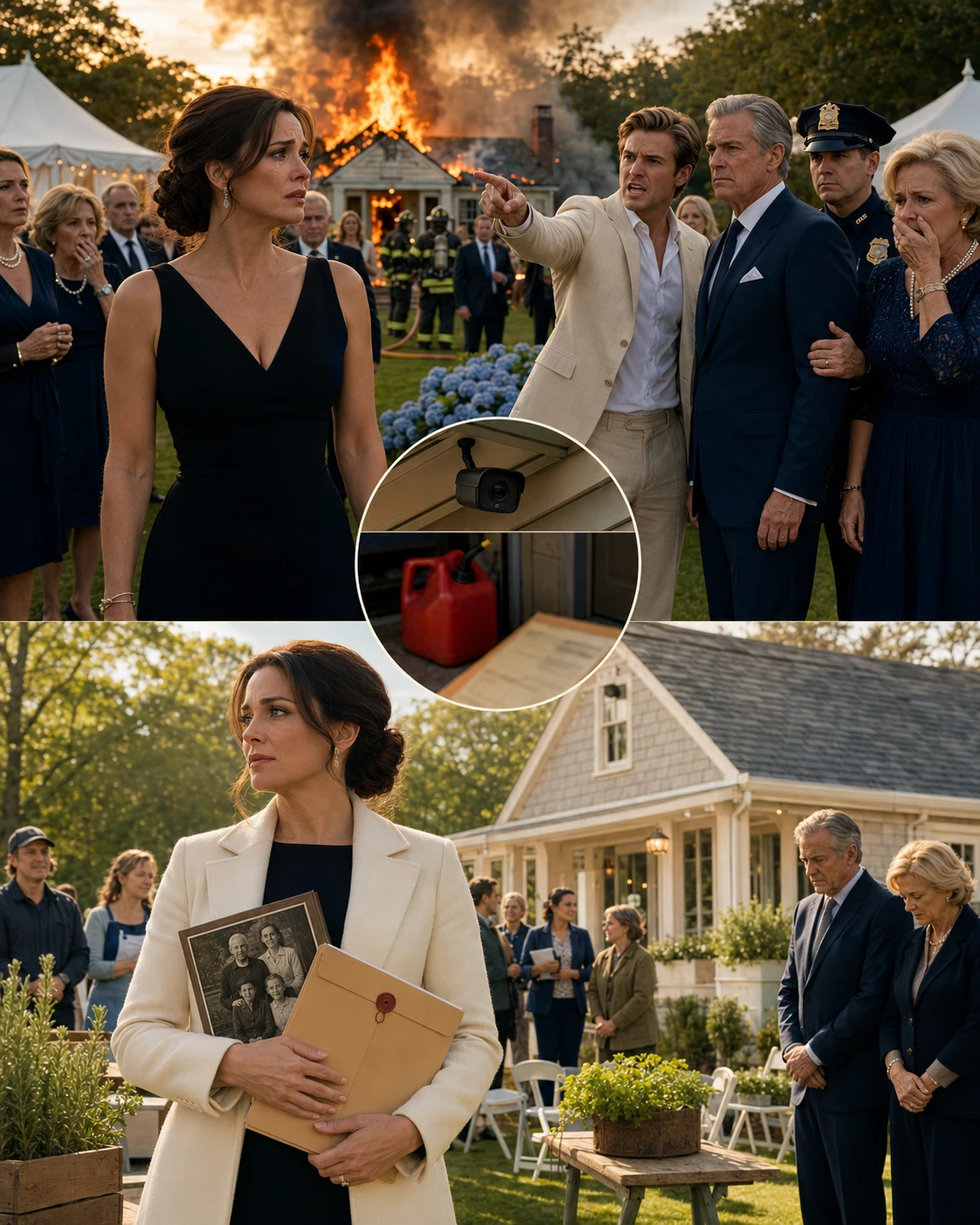
I was nine years old, sitting beside Nana on the guesthouse porch, both of us holding lemonade. I had dirt on my knees. Nana was looking at me, not the camera, with fierce tenderness.
On the back, in her handwriting:
Claire sees what others avoid. That will be lonely until it becomes her freedom.
I read it twice.
Then I held the photograph to my chest.
“Thank you,” I said.
My father nodded.
He seemed to want to say more.
Maybe another apology. Maybe an explanation. Maybe a request to be forgiven in the warm spring air because the setting was beautiful and people like my father trusted beautiful settings to soften hard things.
I did not help him.
Finally, he said, “Will you let us try?”
I looked across the lot where the burned guesthouse had once stood.
The air smelled like fresh-cut lumber and rain.
“You can try,” I said. “But I’m not coming back to who I was.”
He swallowed.
“No,” he said. “I suppose you’re not.”
My mother came over then.
For once, she did not reach for me dramatically.
She stood beside my father and looked at the photograph in my hand.
“She loved you very much,” she said.
“I know.”
My mother’s face crumpled slightly. “I wish I had known how.”
It was the closest she had come to telling the full truth.
I looked at her, this woman who had taught me that love could be present and still unsafe, beautiful and still selfish, real and still not enough.
“I do too,” I said.
Then I walked away to join the others.
Conclusion: The House That Did Not Burn
Eleanor House opened in November.
The first resident was a seventy-two-year-old retired school librarian named Mrs. Alvarez, who had spent eight months sleeping in her car after medical debt swallowed her savings. She cried when she saw the built-in bookshelves.
The second was a woman named Tanisha who kept touching the bedroom door because it had a lock only she controlled.
The third was Ruth, who planted rosemary by the porch and told me the house felt like someone had argued with sadness and won.
On opening day, we placed Nana’s photograph in the entryway.
Not a formal portrait.
Not the oil painting from the main house where she looked stern and wealthy and far away.
The porch photograph.
Lemonade. Dirt on my knees. Her eyes on me.
Under it, a small brass plaque read:
Eleanor Whitmore believed homes should protect the people inside them.
The first time I stood in that entryway alone, I thought I would feel the fire again.
I did not.
I smelled lemon oil on the floors. Fresh paint. Coffee from the kitchen. Rosemary from the porch.
I heard laughter upstairs.
A house can remember pain without becoming a shrine to it.
So can a person.
Wesley eventually pleaded guilty to reduced charges after the financial evidence made a trial too dangerous. He received prison time, restitution, and the unbearable punishment of being known accurately.
My parents visited him.
I did not.
Not out of hatred.
Out of freedom.
There were letters from him at first. Angry ones. Then pleading ones. Then one that said, You ruined my life.
I mailed it back unopened after reading only that line through the fold.
No, Wesley.
I stopped letting you ruin mine.
My relationship with my parents became something quieter than reconciliation and more honest than estrangement. We spoke sometimes. We met in public places. They learned not to summon me. They learned not to use illness, guilt, reputation, or Wesley’s pain as a leash.
Some days, I believed they were changing.
Some days, I remembered that change does not refund childhood.
Both things were true.
On the first anniversary of the fire, I drove to Greenwich alone.
The main estate was still there beyond the hedges, grand and cold, with its stone facade and perfect lawn. But my car did not turn toward the mansion.
It turned toward Eleanor House.
The porch lights were on.
Inside, Mrs. Alvarez was leading a book club. Ruth had made soup. Tanisha had hung paper stars in the hallway because she said every safe house deserved a little sky.
I stood outside for a moment, looking at the rebuilt guesthouse.
The fire had destroyed cedar, glass, wiring, furniture, and old letters.
It had not destroyed proof.
It had not destroyed Nana’s love.
It had not destroyed me.
For years, my family had called me unstable because I refused to balance their lies on my back.
They called Wesley successful because he knew how to smile while taking what was not his.
They called my silence loyalty.
They called my pain strength.
They called my sacrifice duty.
But on the night the ballroom went silent, when the footage played and the truth stood taller than the Whitmore name, I finally understood something my grandmother had tried to teach me.
Dignity is not loud.
It does not need to beg.
It does not need to convince people determined to misunderstand.
Sometimes dignity is a woman in a black dress pressing a button.
Sometimes it is a signed trust document.
Sometimes it is a bank record, a camera angle, a witness who finally stops being afraid.
Sometimes it is walking away while the people who taught you to carry them realize they no longer know how to stand.
I opened the front door of Eleanor House.
Warm air reached for me.
Someone in the kitchen called my name.
Not like an accusation.
Not like a warning.
Like welcome.
And for the first time in my life, I entered a Whitmore house without bracing myself to be blamed for whatever was broken.
The house had burned.
The lie had burned with it.
And I was still standing.