PART 2
Preston came back at 11:42 the next morning wearing the same tuxedo shirt, a lipstick stain near his collar, and the satisfied smile of a man who expected to be forgiven before he apologized.
He pulled up to the Breakwater Estate in the Aston Martin, only to find the front gate already open.
That should have bothered him.
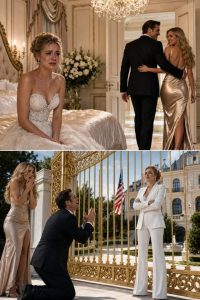
In our world, open gates meant one of two things: a party or an evacuation.
He parked carelessly in the circular driveway, stepped out, and looked toward the house. From the outside, the estate still appeared perfect. Gray stone walls. Clipped hedges. Tall windows flashing with sunlight. A mansion built by a shipping tycoon in 1897 and restored with Whitmore money until every inch of it whispered old American wealth.
Then he opened the front door.
The silence hit him first.
No housekeeper. No chef. No butler asking if he wanted coffee. No classical music playing from hidden speakers. No scent of breakfast from the kitchen.
Just empty air.
“Eleanor?” he called.
His voice echoed.
That echo was the first crack.
He walked into the foyer and stopped.
The Persian runner was gone. The antique mirror was gone. The silver umbrella stand was gone. So were the oil paintings, the marble console table, the chandelier crystals from the side hall, and the massive arrangement of white lilies that had stood beneath the staircase since the wedding rehearsal.
Room by room, his face changed.
The formal dining room was stripped down to its bare table because the table had belonged to the estate, not me. Every chair around it had vanished.
The wine cellar was locked.
The kitchen refrigerator held one bottle of water and half a lemon.
The staff wing was deserted.
On the grand piano in the living room, I had left two things.
A black card cut neatly in half.
And a handwritten note.
Preston picked it up.
I imagine he expected rage. Maybe poetry. Maybe a desperate plea.
Instead, there were only eleven words.
If you can keep the life you stole, keep it.
He read it three times.
Then he laughed.
That was Preston’s great flaw. When afraid, he laughed first. It gave him an extra few seconds to pretend he was still in control.
“Cute,” he muttered, crumpling the note. “Very cute, Eleanor.”
From my office on the forty-fourth floor of Whitmore Holdings in Boston, I watched him through the estate security feed.
Malcolm stood beside me holding a tablet.
“He still believes it is marital drama,” he said.
“Good.”
On the screen, Preston tried calling me.
My personal number had been disconnected before dawn.
He called again.
Then again.
By the fifth attempt, the laughter had left his face.
At 12:09 p.m., he called Brielle.
I could not hear her voice, but I saw his posture. Irritated at first. Then stiff. Then disbelieving.
Malcolm glanced at his tablet. “Her card was declined at Saks.”
I smiled faintly. “Of course she called him before he called a lawyer.”
Preston threw his phone onto the sofa, then immediately picked it back up. Pride had no stamina when bills started screaming.
At 12:30 p.m., the Aston Martin was towed from the driveway.
He ran outside like a man chasing a stolen child.
“Hey! That’s my car!”
The repossession agent did not raise his voice. “The vehicle is registered under Whitmore Holdings’ executive asset program. Usage authorization has been revoked.”
“I’m the president of Whitmore Atlantic Development!”
“Not according to the system, sir.”
That sentence did more damage than any insult could have.
Preston stood in the driveway while the car disappeared down the hill.
No driver. No card. No staff. No breakfast. No wife.
Just the mansion he thought symbolized his triumph, suddenly too large to survive in.
I turned away from the monitor.
“Send the memo,” I said.
At 1:00 p.m., every employee at Whitmore Holdings received the same message.
Effective immediately, Preston Caldwell’s executive authority is temporarily suspended pending internal audit review. All signing rights, expense approvals, project access, and corporate account privileges are revoked.
The official termination would wait.
I wanted him to walk into the building first.
He arrived at Whitmore Tower at 2:18 p.m. in a rideshare, wearing yesterday’s wedding tuxedo with the jacket missing. That alone would have sent half the lobby whispering, but no one dared.
Preston carried himself like a king returning from battle. Chin raised. Shoulders squared. Eyes sharp enough to threaten anyone who looked too long.
He strode to the private executive elevator and tapped his card.
Red light.
Access denied.
He tried again.
Red.
Again.
Red.
A young security officer stepped forward. “Mr. Caldwell, that elevator is restricted.”
Preston turned slowly. “Do you know who I am?”
“Yes, sir.”
“Then move.”
“I’m sorry, sir. Your credentials were suspended this morning.”
The lobby froze.
The silence was exquisite.
For three years, Preston had lived on admiration like oxygen. He loved the way employees straightened when he passed, the way junior managers laughed too quickly at his jokes, the way vendors called him sir even when he made them wait for hours.
Now every person in that lobby had just watched a red light tell him the truth.
He was not powerful.
He had merely been permitted.
Upstairs, I stood behind tinted glass overlooking the lobby.
“Let him up,” I told Malcolm.
“To your floor?”
“No. Employee elevator. Thirty-sixth floor.”
Malcolm’s mouth twitched. “Cruel.”
“Educational.”
Preston stepped into the crowded employee elevator surrounded by people he had once ignored, insulted, overworked, or threatened. No one spoke. Their silence packed the air tighter than laughter ever could.
When the doors opened on thirty-six, he stormed toward the president’s office.
The brass nameplate was gone.
The glass doors were sealed with audit tape.
His assistant, Lauren Pike, stood from her desk with both hands folded.
“Mr. Caldwell, this office is under legal review. You are not permitted inside.”
His face went scarlet. “Lauren, open the door.”
“I can’t.”
“I said open it.”
She swallowed, but her voice held. “I work for Whitmore Holdings, sir. Not for you.”
People later said that was the moment Preston’s mask slipped.
He lifted his hand as if to slam it on her desk, but his phone rang before he could.
Brielle again.
This time, he answered.
I saw his mouth form the words: What now?
Then he stopped moving.
Malcolm’s tablet lit with incoming data. “Brielle just found out the Miami condo is frozen.”
Preston looked around the hallway, suddenly pale.
Good.
Let him understand hunger first. Then humiliation.
Now money.
A minute later, he shoved past two security guards and charged toward the main boardroom.
“Where is Eleanor?” he shouted. “Tell my wife to stop hiding!”
Inside the boardroom, twelve senior executives sat around a long walnut table. A digital screen behind me displayed a map of shell companies, false invoices, luxury purchases, and wire transfers.
I looked at Malcolm.
“Open the doors.”
They swung wide.
Preston lunged in, breathing hard.
Then he saw me seated at the head of the table.
Not crying.
Not abandoned.
Not hiding.
Every executive stood.
“Chairwoman Whitmore,” they said.
The word struck him harder than a slap.
His eyes moved from them to me, and for the first time since I had known him, Preston Caldwell looked truly afraid.
I opened the black folder in front of me.
“Welcome back from your wedding night,” I said. “We were just discussing the seven point eight million dollars you stole.”
PART 3
Preston tried to laugh, but no sound came out.
He looked at the executives first, then Malcolm, then me, searching for a crack in the room. Some sign that this was theater. Some friendly face willing to wink and tell him the joke had gone far enough.
No one moved.
“You’re insane,” he said.
I tapped the folder. “No. I am prepared.”
“This is about Brielle.” His voice rose. “You’re jealous, so now you’re dragging the company into our marriage.”
“Brielle is a symptom,” I said. “Fraud is the disease.”
The screen behind me changed.
Invoice 8841-A: Coastal hospitality consulting.
Amount: $212,000.
Vendor: Harbor Bright LLC.
Beneficiary: Brielle Monroe.
Preston’s skin tightened across his cheekbones.
The next slide appeared.
A diamond bracelet. $88,000.
Charged to client entertainment.
Then a Mercedes registered to Brielle’s cousin.
Then a Miami condo purchased through a shell entity.
Then wire transfers broken into small amounts just below internal review thresholds.
Then three contracts awarded to Caldwell & Sons with inflated material costs.
Then internal emails with Preston’s digital signature.
By the tenth slide, his breathing had changed.
By the fifteenth, his arrogance had become sweat.
“You had no right to investigate me,” he said.
“I own the company.”
His mouth opened. Closed.
“My father owns Whitmore.”
“My father stepped down eighteen months ago.” I leaned back. “He made me chairwoman privately during the restructuring. You would have known that if you had ever listened when I spoke about anything other than your needs.”
A few executives lowered their eyes.
Preston stared at me as if I had become a stranger. But I was not a stranger. I was the woman who had been sitting across from him for three years while he mistook silence for ignorance.
“You set me up,” he whispered.
“No, Preston. I watched you choose.”
He stepped closer to the table. “Eleanor, listen to me. I made mistakes. Fine. But you don’t want this public. Think about your name. Think about your father. Think about our marriage.”
“Our marriage ended at 10:16 last night.”
His expression twisted. “Because I checked on a friend?”
“Because you left your wife on her wedding night for your mistress after using stolen corporate funds to finance her life.”
“That’s not what happened.”
“Then explain it.”
He looked at the screen.
For the first time all day, he had nothing.
Malcolm placed a second folder on the table. “Mr. Caldwell, this contains handover documents, asset surrender notices, and acknowledgement of suspended executive authority.”
Preston did not touch it.
I said, “Sign them.”
“And if I don’t?”
“Then the full audit package goes to federal investigators today.”
His eyes flashed. “You wouldn’t dare.”
I stood.
The room seemed to shrink around us.
“Preston, last night you walked out of our wedding suite believing I was too weak to survive embarrassment. This morning you returned to an empty mansion. By noon your cards were dead. By two o’clock your office was sealed. Do I look like a woman bluffing?”
His phone rang.
The name on the screen made his face change.
Dad.
He answered with trembling impatience. “Not now—”
His father’s voice exploded so loudly the entire boardroom heard it.
“What the hell did you do?”
Preston froze.
“Whitmore cancelled every contract! The banks are calling our loans! Suppliers are demanding cash! Eleanor’s people just notified us that Caldwell & Sons is in breach on three major projects!”
Preston turned slowly toward me.
I watched understanding crawl over his face like frost.
His family company had been living on my oxygen too.
And I had just stopped breathing for them.
His phone slipped from his hand and hit the floor.
I signed the resolution in front of me.
“Escort Mr. Caldwell out.”
Two guards entered.
This time, Preston did not fight immediately. Shock had made him heavy. But as they reached for his arms, panic awakened him.
“Eleanor,” he said sharply. “Wait. We can talk.”
I closed the folder.
“We did talk. You told me you loved Brielle.”
“I was angry.”
“No. You were honest.”
He looked at the executives, humiliated by their silence. “Tell her this is ridiculous. Someone say something.”
Nobody did.
Because people do not rescue a sinking man when the woman holding the lifeboat is still watching.
When the guards took him out, he twisted back toward me.
“You’ll regret making an enemy of me.”
I almost smiled.
“You were never important enough to be my enemy.”
By 4:00 p.m., Preston was outside Whitmore Tower with no car, no office, no authority, and no allies. His father had stopped answering his calls. His mother sent one text: Come home only if you can fix this.
Brielle, meanwhile, was packing.
Malcolm showed me the security footage from her luxury apartment in Back Bay. She moved quickly, no shaking hands, no anxiety attack, no fragile collapse. She wore oversized sunglasses and the cream cashmere coat Preston bought her with money disguised as a vendor reimbursement.
“She booked a flight to Los Angeles,” Malcolm said.
“Send Preston the footage.”
He glanced at me. “You want him to stop her?”
“I want him to see what he chose.”
Thirty minutes later, Preston arrived at Brielle’s building in a borrowed car from a college friend who would later text him: Do not involve me again.
He ran into the lobby just as Brielle dragged two designer suitcases toward the exit.
“Brielle!”
She turned, and the performance left her face instantly.
Not slowly.
Instantly.
The soft eyes vanished. The trembling mouth vanished. The helpless little bird he had protected for years was replaced by a furious woman whose escape had been interrupted.
He grabbed her suitcase handle. “Where are you going?”
“Let go.”
“You know what Eleanor did. She’s trying to destroy me.”
Brielle stared at his wrinkled shirt, his empty wrist where his watch had been, his desperate eyes.
“Preston,” she said coldly, “she already did.”
He blinked as if she had slapped him.
“We can fix it,” he said. “I just need time.”
“With what money?”
His hand tightened around the suitcase.
Her laugh was small and vicious. “Did you honestly think I loved you for your personality? You were married, arrogant, and exhausting. But you had access. Now you don’t.”
The lobby camera captured every second.
Preston’s face collapsed.
“You said you needed me.”
“I needed the life you paid for.”
“With my wife’s money,” he whispered.
Brielle leaned closer. “Exactly. Even you knew whose money it was.”
He lunged for the suitcase. She screamed. He shouted. Security rushed in. Residents pulled out phones.
By sunset, the video was everywhere.
The disgraced executive. The runaway mistress. The wedding-night betrayal. The lobby fight.
People watched Preston Caldwell lose his wife, his company, his mistress, and his dignity in less than twenty-four hours.
But humiliation made men like Preston dangerous.
That night, from a cheap motel outside Providence, he opened a laptop and wrote the first lie.
My rich wife is destroying me because I helped a sick friend on our wedding night.
Then he pressed post.
PART 4
By morning, half the internet had chosen a side, and most of them had chosen wrong.
Preston’s post spread like fire through gossip pages, business forums, and accounts that fed on wealthy people’s scandals. He wrote it beautifully, which almost impressed me. He did not mention Brielle’s name. He did not mention the Miami condo, the shell companies, the stolen funds, or the fact that he had told his bride he loved another woman.
In his version, he was a devoted husband punished for compassion.
I was the cold heiress.
The spoiled wife.
The corporate tyrant.
The woman who had destroyed a man’s life because he visited a sick friend for one night.
By 9:00 a.m., strangers who had never seen my face were calling me heartless.
By 10:00, people were praising Preston for surviving “financial abuse.”
By 10:30, a former college acquaintance of his posted: Preston always wanted to build something on his own. Sad to see old money crush him.
I read that one twice and nearly laughed.
Men love claiming they built something on their own while standing on a woman’s foundation.
Malcolm entered my office with the public relations director, Naomi Chen. Naomi looked as if she had slept badly or not at all.
“Chairwoman, this is escalating,” she said. “The story is moving beyond gossip. It could affect investor confidence if we don’t respond.”
“We will.”
“When?”
I looked at the clock.
“Eleven.”
Naomi hesitated. “Why wait?”
“Because he is still editing his second post.”
Malcolm’s phone buzzed. He checked it and gave a grim little nod.
Preston had posted again.
This time, he attached a wedding photo. I stood beside him beneath the flower arch, composed and unsmiling. He had cropped it so his lowered head made him look wounded, trapped, noble.
Caption: Some marriages are cages built from money.
Naomi swore under her breath.
I looked at the photo for a long time.
That was the danger of silence. People could project anything onto it. Pride. Cruelty. Guilt. Coldness.
They never guessed survival.
At exactly 11:00 a.m., Whitmore Holdings released a statement.
It was not emotional.
It did not insult him.
It simply presented a timeline.
10:16 p.m. — Preston Caldwell leaves Breakwater Estate on his wedding night.
10:49 p.m. — Vehicle arrives at Brielle Monroe’s apartment building.
11:03 p.m. — Security footage captures Caldwell entering with Monroe.
11:57 a.m. next day — Caldwell leaves Monroe’s residence.
Attached were blurred but unmistakable images.
Then came the financial documents.
A luxury vehicle.
Jewelry.
Private travel.
A Miami property.
Payments routed through shell companies.
False invoices approved under Preston’s executive credentials.
Finally, the legal notice: Whitmore Holdings had submitted evidence of suspected embezzlement, fraud, and breach of fiduciary duty to federal authorities.
The internet turned like a school of fish sensing blood.
People deleted their sympathetic comments.
The same accounts that had called me cruel now called him shameless.
Someone stitched his victim post beside the lobby video of Brielle abandoning him.
Someone else circled the timestamp on his wedding-night arrival at her building.
By noon, Preston Caldwell was no longer a wounded husband.
He was a punchline with legal exposure.
At 12:20, he called Malcolm.
Malcolm placed the phone on speaker.
Preston’s voice sounded destroyed. “Let me talk to Eleanor.”
I nodded.
“She’s listening,” Malcolm said.
There was a long silence.
Then Preston breathed my name like it cost him blood. “Ellie.”
I said nothing.
“I panicked,” he said. “The post was stupid. I was cornered.”
“By consequences.”
“I’ll sign the divorce papers. I’ll leave Rhode Island. I won’t ask for money. Just pull back the criminal complaint.”
“No.”
His breath hitched. “You can’t do this.”
“I already did.”
“We’re husband and wife.”
“You remembered too late.”
His voice cracked. “Do you want me dead?”
I leaned back in my chair, staring at the Boston skyline beyond the glass. “No. I want you accountable. You are confusing the two because you have never experienced either.”
He started crying then.
I had once thought hearing Preston cry would break me. It did not. Maybe because the tears were not for me. They were for himself. For the watch he lost, the title he lost, the mistress who ran, the family company about to collapse.
“Eleanor, please,” he whispered. “I loved you.”
“No,” I said. “You loved what standing beside me gave you.”
Then I ended the call.
For several minutes, my office was silent.
Naomi did not speak. Malcolm did not move.
I opened the next folder. “Where is Brielle?”
“JFK,” Malcolm said. “Booked under her middle name. Los Angeles first, then possibly Vancouver.”
“Notify the authorities.”
“Already done.”
By late afternoon, Brielle Monroe was detained at the airport wearing sunglasses, a silk scarf, and the pale terror of someone who had packed too quickly to hide the truth.
Her statement was predictable.
I thought they were gifts.
I didn’t know anything.
Preston said he was leaving his wife.
I’m a victim too.
Investigators showed her messages instructing Preston to split payments.
They showed her bank records.
They showed her cousin’s name on the Miami condo.
By evening, she stopped crying and asked for a lawyer.
That should have been the end of the day.
It was not.
At 8:15 p.m., Preston’s mother arrived at my father’s Boston townhouse.
Margaret Caldwell had once told me, with a wineglass in her hand, that powerful men needed “emotional outlets” and good wives learned not to embarrass the family.
Now she stood in my father’s living room with swollen eyes and shaking hands.
“Eleanor,” she pleaded, “he made a mistake.”
I looked at her carefully. “A mistake is forgetting a birthday. Not stealing millions.”
“He’s still young.”
“He is thirty-four.”
“If he goes to prison, his life is over.”
I folded my hands in my lap. “If I forgive him to protect your comfort, mine is.”
She sobbed then, loud and ugly.
I felt sorry for her in a distant way. Not enough to change my mind.
After she left, my father came out of his study.
Charles Whitmore had built his empire with a quiet voice and merciless eyes. For most of my life, he had praised my older brother, Graham, for boldness while calling my precision cold.
Tonight, he looked older.
“Are you sure you can finish this?” he asked.
“I have to.”
He nodded slowly. “Then don’t stop with Preston.”
I looked up.
My father set a folder on the table.
On the tab was my brother’s name.
Graham Whitmore.
My blood turned cold.
“He was connected?” I asked.
My father’s jaw tightened.
“I was hoping he wasn’t.”
The next morning, I walked into the secure audit room beneath Whitmore Tower.
Twelve employees waited in silence.
At the far end of the room, the door opened.
Graham entered in a gray suit, smiling like a prince interrupted by peasants.
“Ellie,” he said. “Haven’t you made enough of a mess?”
I placed his folder on the table.
“Actually,” I said, “we were just getting to yours.”
PART 5
Graham’s smile stayed on his face for two seconds too long.
That was how I knew he was afraid.
He looked around the audit room, taking in the finance managers, project directors, internal counsel, and two outside forensic accountants seated beneath the cold white lights. This was not a family breakfast. There was no mother to smooth things over, no father to change the subject, no old uncle to laugh and say siblings should not fight over business.
There was only evidence.
“Whatever this is,” Graham said, “you’re overreaching.”
I opened the folder.
“The North Pier redevelopment. The Ashton Harbor hotel renovation. The Providence medical campus expansion.” I slid three documents toward him. “All subcontract packages approved through Preston. All inflated. All connected to a company registered under your college roommate’s name.”
His eyes hardened. “Careful.”
“No. You be careful.”
The room went utterly still.
For years, Graham had enjoyed being the Whitmore son. The obvious heir. The golden boy in navy suits who slapped men on the back and called recklessness vision. When he interrupted people in meetings, they called it leadership. When I corrected financial models, they called me difficult.
He had mistaken inheritance for immunity.
I touched the next page. “Seven hundred thousand dollars moved through an offshore account and returned through a private investment fund linked to your former assistant.”
He laughed once. “You investigated your own brother?”
“I investigated theft.”
“I am family.”
I looked directly at him. “So was my husband yesterday.”
That landed.
Graham leaned forward. “You are letting humiliation make you dangerous.”
“No. Humiliation made me observant.”
The door opened behind him.
My father entered with Malcolm at his side.
Graham’s face changed instantly. “Dad, tell her to stop. She’s burning the whole company down because one man cheated on her.”
My father stared at him with a disappointment so heavy it seemed to bend the air.
“One man cheated,” he said. “Many men stole.”
Graham went pale.
“I gave you chances,” my father continued. “More than Eleanor ever received. And you used them to feed from the company your grandfather built.”
“Dad—”
“You are suspended from every position at Whitmore Holdings pending legal review.”
For the first time in my life, I saw my brother look small.
Not humbled.
Small.
The forensic audit broke open after that.
People who had been silent for years started talking all at once. A finance director admitted Preston pressured him to approve false invoices, then confessed to taking kickbacks. A project manager cried until mascara streaked her face, swearing she only signed because she feared losing her job. An operations officer tried blaming everyone except himself until Malcolm displayed bank transfers to his wife’s boutique account.
I listened to each confession without satisfaction.
Revenge, I discovered, was not hot.
It was sterile.
It smelled like printer ink, coffee, fear, and conference room carpet. It sounded like lawyers turning pages and guilty people saying they had no choice.
But they had all made choices.
So had I.
By the end of the week, Whitmore Holdings had removed fourteen employees, suspended six executives, referred four cases to law enforcement, and recovered enough documents to reconstruct three years of rot.
Preston was arrested two nights later outside a motel in Warwick.
Brielle was charged as an accessory after investigators traced funds through her relatives.
Caldwell & Sons entered emergency receivership.
Three days after my wedding night, the company Preston’s family had bragged about for generations was sold for parts to a regional construction group that kept the workers and stripped the Caldwell name from every project sign.
That was the part that finally broke him.
Not losing me.
Not losing Brielle.
The name.
When the news reached him, Preston called from county holding. He had used his one allowed call not for his parents, not for a lawyer, but for me.
I did not take it.
The divorce papers were filed the next morning.
Reporters camped outside Whitmore Tower for days. I gave only one statement.
“I will not use marriage to hide a crime.”
That sentence became a headline.
Some people praised me. Some called me ruthless. Some said I had waited too long. Others said I had destroyed him too fast. The public loves judging women’s pain by a clock they never had to live inside.
I stopped reading comments.
There was too much work to do.
Two months later, the trial began at the federal courthouse in Boston.
I wore a black suit, pearl earrings, and no wedding ring.
Preston sat at the defense table, thinner than I had ever seen him. His hair had been cut short. His eyes were hollow. He looked nothing like the man who had adjusted his bow tie in the mirror and told me another woman needed him more than his bride did.
Brielle sat three rows away from him.
They did not look at each other.
That told the whole story.
The prosecutor laid out the evidence with brutal calm. False vendor contracts. Inflated invoices. Luxury purchases disguised as business expenses. Wire transfers. Messages. GPS records. Security footage. The Miami condo. The Mercedes. The bracelet. The wedding-night timeline.
When Brielle’s attorney suggested she had been manipulated by Preston, Preston snapped.
“She knew,” he said, standing halfway before his lawyer pulled him down. “She told me to use her cousin’s account.”
Brielle burst into tears. “You promised you were divorcing her! You said the money was yours!”
In the victim’s section, I watched the two people who had once treated me as an obstacle tear each other open in public.
There was no love left between them.
Maybe there never had been.
Only appetite wearing perfume.
On the second day, Graham’s testimony sealed several internal links. He looked at me once before taking the stand. There was hatred in his eyes, but beneath it something worse—shame. My father did not attend that day. I understood. Watching one child testify against another is a special kind of grief.
When the judge asked Preston if he wished to speak before sentencing, he stood slowly.
His hands shook.
“Eleanor,” he said.
The courtroom shifted toward me.
I did not move.
“I know it’s too late. I know saying sorry doesn’t fix anything.” His voice broke. “I used to think you had power because you were born with it. I thought I earned what people gave me. But I didn’t. I was standing on everything you built, and I hated you for being the reason I mattered.”
For one brief moment, the old wound stirred.
Not love.
Memory.
The version of me who once waited for him at midnight wanted to ask why he had not known that before.
The woman I had become already knew the answer.
Because some people only recognize your value when losing you becomes expensive.
“I am sorry for leaving you that night,” he said. “I am sorry for making you feel like nothing.”
I stood.
My voice was steady.
“I accept your apology, Preston. But I will not confuse apology with repair. You broke our marriage. You damaged my company. You humiliated me publicly and privately. I give your regret back to you. I have no use for it anymore.”
His head bowed.
The judge sentenced him the following morning.
Preston Caldwell was convicted of embezzlement, fraud, and breach of fiduciary duty. He was ordered to pay restitution to Whitmore Holdings. Brielle received a reduced but still severe sentence for knowingly receiving and concealing illicit assets. Graham avoided prison through cooperation but was permanently barred from leadership within Whitmore-affiliated companies and forced to surrender his gains.
When the gavel fell, I felt no triumph.
Only quiet.
A deep, clean quiet.
After court, I returned alone to Breakwater Estate.
The house had been emptied, cleaned, and prepared for sale. Sunlight poured through the bridal suite windows. The bed was bare. The roses were gone. The champagne had been removed. Nothing remained from that night except memory.
I stood before the mirror where Preston had adjusted his bow tie.
Then I opened a small velvet box.
Inside was my wedding ring.
I placed it on the vanity beside the finalized divorce decree.
For a long time, I looked at the woman in the mirror.
She was not abandoned.
She was not ruined.
She was not the cold heiress from the headlines or the heartbroken bride from the gossip pages.
She was Eleanor Whitmore.
Still standing.
I turned and walked out of the suite without looking back.
PART 6
Six months later, Breakwater Estate sold to a retired surgeon and his wife from Connecticut.
I signed the final papers in my office without sentiment. The realtor seemed surprised that I did not ask to keep any furniture, any portrait, any crystal fixture.
“Nothing?” she asked gently.
“Nothing,” I said.
Some houses are not homes. They are stages where you learned the cost of staying too long.
The money from the sale went into a foundation I created under my mother’s name. It funded legal support for women trapped in marriages where money, reputation, and family pressure had become cages. I did not announce it with a dramatic speech. I simply signed the charter and let the work begin.
Whitmore Holdings changed too.
The months after the scandal were brutal. Investors demanded reassurance. Employees wanted stability. Competitors circled like sharks. Every newspaper wanted a profile, every podcast wanted tears, every business magazine wanted to turn my divorce into a brand.
I refused almost all of them.
I rebuilt quietly.
I promoted people who had done honest work without needing applause. I cut divisions that had survived on relationships instead of results. I made every executive reapply for signing authority. I sat in meetings until midnight reviewing systems that should have protected us long before love made me generous and silence made others bold.
My father watched from a distance.
He no longer corrected my tone.
He no longer asked whether I was being too cold.
One evening in November, he came to my office carrying two cups of coffee. That alone nearly made me laugh. Charles Whitmore did not bring coffee. People brought coffee to him.
He set one cup on my desk.
“You look like your mother when you’re tired,” he said.
I looked up from a contract. “That sounds dangerous.”
“It is.” He sat across from me. “She was the strongest person I ever underestimated.”
The confession was so unexpected that I had no defense ready.
He looked toward the city lights. “I underestimated you too.”
I said nothing.
“I thought giving you control privately would protect you from the uglier parts of the business until you were ready.” He smiled sadly. “Turns out you were ready before any of us were.”
My throat tightened.
For so long, I had wanted praise from him. Not because I needed permission to be powerful, but because daughters remember every room where their brothers were applauded louder.
“Thank you,” I said quietly.
He nodded.
Then, after a pause, he added, “I am sorry about Graham.”
“So am I.”
“He blames you.”
“I know.”
“Does that hurt?”
I thought about it.
“Yes,” I said. “But not enough to make me wrong.”
For the first time in weeks, my father smiled.
“That,” he said, “is leadership.”
The following spring, Whitmore Holdings held its annual investor summit in Chicago. We chose the venue deliberately: not Newport, not Boston, not some gilded family ballroom, but a modern glass convention center overlooking the river. New place. New chapter.
I stood backstage in a white suit while Naomi adjusted my microphone.
“Nervous?” she asked.
“No.”
She smiled. “That was fast.”
“I used to be nervous when I needed people to believe I deserved the room.” I looked through the curtain at hundreds of investors, employees, partners, and reporters. “Now I know I do.”
The applause began before I reached the podium.
Not polite applause.
Real applause.
I saw my father in the front row. Beside him sat Malcolm, Naomi, and several employees promoted after the audit. People who had kept the company alive while men with louder titles tried to hollow it out.
I began with numbers.
Revenue stabilized. Debt reduced. Compliance rebuilt. New contracts secured in Chicago, Denver, Atlanta, and Seattle. Employee retention up. Fraud exposure down. Governance restructured.
Then I paused.
The room quieted.
“For many months,” I said, “people have tried to describe what happened to this company as a family scandal, a marriage scandal, or a revenge story.”
Cameras flashed.
“It was none of those things. It was a test. Of systems. Of leadership. Of whether we would protect comfort or protect truth.”
My eyes moved across the room.
“I learned something during the hardest year of my life. Betrayal is loud when it happens in public. But corruption usually grows quietly, in the places people are too polite, too afraid, or too comfortable to examine. We examined ours. We removed it. And we are stronger because we refused to pretend.”
When I finished, the room stood.
For a moment, I could not move.
Not because I was overwhelmed.
Because I remembered another room.
A bridal suite full of white roses.
A man at the mirror.
A phone glowing with another woman’s name.
I remembered the version of myself sitting on that bed, quiet enough to be mistaken for broken.
I wished I could reach back through time and touch her shoulder.
I would tell her: Do not beg. Do not collapse. Do not measure your worth by the man walking out.
Let him leave.
The door he closes will show you the empire you forgot was already yours.
After the summit, I stepped outside onto the riverwalk alone. Chicago wind moved sharply off the water. The city glittered around me, alive and indifferent in the best possible way.
My phone buzzed.
A message from an unknown number.
I almost deleted it, then opened it.
It was from Preston.
I heard about the summit. You looked strong. I hope one day I become the kind of man who understands what I destroyed. I am sorry, Eleanor.
I stared at the message for a long time.
Then I deleted it.
Not with anger.
Not with sadness.
With peace.
Some apologies arrive after the fire has already burned the house down. You do not have to move back into the ashes just because someone finally admits they lit the match.
That night, I returned to my hotel suite overlooking the river. On the desk was a stack of documents for the next morning. Contracts. Expansion plans. Foundation reports. Work that mattered. Work that did not ask me to shrink.
I removed my earrings, washed off my makeup, and looked into the mirror.
For the first time in years, I did not see a daughter trying to be taken seriously, a wife trying to be loved correctly, or a woman trying to prove she was not cold.
I saw myself.
Whole.
Unowned.
Free.
And that was more beautiful than any wedding gown I had ever worn.
THE END