The first thing my mother did was touch the blanket instead of my hand.
It let her look concerned without actually touching me.
“My poor baby,” she said, too loud for a hospital room. “You scared us half to death.”
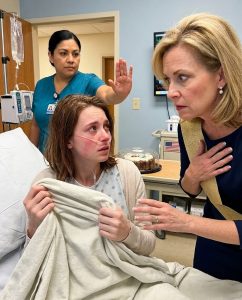
I looked at her birthday makeup, still perfect after the party she had stayed to finish. My body was exhausted, but my mind had stopped trying to protect her.
“I scared you?” I asked.
Her face folded into injury.
“Of course you did. One minute you were upset, and the next Eric was shouting like the house was on fire.”
Eric straightened. “She was gasping for air.”
My father stepped in fast. “We understand that now.”
“Do you?” I asked.
The monitor kept counting what my family had never counted: breath, pulse, proof.
My mother glanced toward the hallway and lowered her voice. “Amber, today was my birthday. There were people watching.”
There it was.
The real wound.
Not that I had been scared.
Not that I had been loaded into an ambulance in front of relatives and neighbors.
That people had seen her fail me.
Jake shifted near the table. “You have to admit the timing was insane.”
I turned my head slowly. “My lungs did not check your schedule.”
For once, he had no joke ready.
My father moved closer, using that low warning voice that had trained me since childhood. “Do not get smart. Your mother was trying to keep the party together.”
“She told me to clean while I was saying I could not breathe.”
The room went still.
My mother whispered, “I did not know it was real.”
“You did not care whether it was real.”
The sentence left my mouth before fear could stop it. Instead of apologizing, I felt the hospital sheet under my hands and heard the doctor’s words again: safer environment.
My mother drew back as if I had slapped her.
“After everything I have done for you?”
There it was, too.
The receipt book of motherhood. In my family, care was never just care. It was a debt they collected whenever I got too close to telling the truth.
Then Nurse Marisol stepped into the room.
She had been just outside the door, close enough to hear the shape of the conversation. Her face was calm, but there was nothing soft about the way she looked past my parents and straight at me.
“Amber,” she said, “do you feel safe continuing this visit?”
My mother’s mouth opened.
“Excuse me?”
Marisol did not answer her. She kept her eyes on me.
No one in my family had ever asked that question like my answer could change the room.
My hands tightened around the blanket. Every habit in me rose at once. Protect Mom’s image. Protect Dad’s pride. Protect Jake from consequences. Make the nurse comfortable. Make Eric less angry. Make the room easy again.
But I saw the sink.
The dirty glasses.
The spilled shard of glass near my shoe.
My mother’s voice telling me to quit faking while my chest closed like a fist.
“No,” I said.
One word.
It was not loud.
It did not need to be.
My mother began crying instantly, the kind of crying that used to pull a whole room toward her. “Amber, how can you say that? We’re your family.”
Marisol stepped toward the door. “The visit is over. The patient needs a low-stress environment.”
My father stiffened. “This is family business.”
“It became medical business when she arrived here by ambulance,” Marisol said.
Eric looked down for one second, and I realized he was trying not to smile. Not because anything was funny. Because somebody had finally said the simple thing out loud.
Jake muttered, “This is ridiculous.”
Marisol opened the door wider. “Now.”
No guard dragged them out that first time. They had to walk out under their own power while a nurse held the door and a witness watched.
My mother paused at the threshold.
“You are going to regret this when you calm down.”
I did not answer.
The door closed.
Then my body started shaking so hard the blanket moved.
Eric stepped forward. “Amber?”
“I’m okay,” I said, though I was not.
What I was, for the first time in my life, was unguarded by their approval.
That night, the hospital quieted around me. My phone kept buzzing on the table, face down, each vibration like a hand knocking from the old life.
I already knew the order.
Anger first.
Then guilt.
Then a careful half-apology designed to make me apologize back.
I left it there until morning.
A hospital counselor came in after breakfast, a woman with silver glasses and a voice that never rushed. She asked what had happened at home, and the polished version rose automatically. We argue sometimes. They mean well. It was stressful.
I almost said it.
Then I remembered the nurse asking whether I felt safe, and how the room had changed when I answered honestly.
So I told the truth.
I told her about being eight years old with bleeding palms after falling off my bike, standing in the downstairs bathroom because my mother had mouthed not now and my father had called it a production. I told her about birthdays where I cleaned more than I celebrated, dinners where I laughed at insults so nobody could accuse me of ruining the mood, and all the little ways a person can disappear while still standing right there.
The counselor listened, then asked what words I heard in my head when I tried to ask for help. The answer came too fast: stop being dramatic, you’re too sensitive, don’t ruin this for everyone. Spoken aloud, they stopped sounding like truth and started sounding like commands my family had installed.
Eric came later with vending machine tea and found me writing on a hospital notepad: a list of things I was not carrying anymore. At the top, I wrote that guilt was not proof of love.
My phone buzzed again.
This time I turned it over: thirty-seven missed calls and seventy-two messages.
Most were from my mother. Some were from Jake. One was from my father, short enough to hurt on purpose.
You embarrassed your mother. Fix this.
I read it twice.
The old Amber would have called immediately, explaining and apologizing until the mess got smaller by making herself smaller.
I handed the phone to Eric.
“Can you help me screenshot everything?”
His jaw tightened. “For what?”
“For the next time they tell me I imagined it.”
That was the beginning of the real revenge.
Documentation.
Distance.
The truth kept somewhere my guilt could not edit it.
The next afternoon, Marisol suggested a short walk to the common area. My legs felt weak, but I wanted sunlight and a chair that was not my bed.
Eric walked beside me, close enough that I knew I would not hit the floor alone if my knees changed their minds.
The common area had wide windows and tired plants. I sat near the sunlight and breathed slowly.
Then I heard Jake.
“Unbelievable,” he said from the hallway. “She gets a hospital vacation and we’re the villains.”
My spine went cold.
Eric’s shoulders stiffened.
Jake rounded the corner first, with my mother behind him and my father a few steps back. They must have convinced someone at the desk that they were there to apologize, because all three of them wore careful witness-ready faces.
“Amber,” she said softly. “We need to talk as a family.”
Marisol looked up from the nurses’ station and started toward us.
My father lifted one hand. “No one is here to upset you. We just want you to be reasonable.”
Reasonable.
In my family, that word meant silent.
Jake rolled his eyes. “Can we stop acting like you almost died? Eric overreacted, and now Mom’s birthday is ruined forever.”
Something in me became very still. Not numb. Ready.
I stood slowly, one hand on the chair.
Eric murmured, “You do not have to do this.”
“I know,” I said.
That was why I could.
I looked at Jake first. “You called my breathing emergency a hospital vacation.”
His expression changed when he realized other patients and nurses could hear.
“I didn’t mean it like that.”
“Yesterday you told a cousin I always make things about me. When I fainted during finals week, you told everyone I wanted attention. My pain has been your favorite joke for years.”
The common area went quiet.
No joke came back.
I turned to my father. “You called me lazy while I was fighting for air. You texted me that I embarrassed Mom and needed to fix it. You did not ask if I was afraid.”
His face hardened, but his eyes moved toward the nurses. Witnesses had always made him careful.
Finally, I looked at my mother.
“You told me to clean.”
Her hand flew to her chest. “I was overwhelmed.”
“So was I. But I was the one who could not breathe.”
Her tears came then, but the room did not rush to save her from them. For years, her tears had been a fire alarm and my pain had been background noise. Now the truth was still standing.
Marisol reached my side. “Amber, would you like them removed?”
My mother whispered, “Please do not do this in public.”
I almost laughed.
“You humiliated me in front of thirty people while I was begging for air. This is not public. This is accountability.”
My father pointed at Eric. “You put her up to this.”
“No,” I said. “You did.”
Security came that time because my family could not stop attacking a recovering patient in a hospital common area.
My father turned red. Jake looked at the floor. My mother kept crying, but the guard did not negotiate with her tears. They were escorted back down the hall while nurses, patients, and Eric watched the family that had spent years calling me unstable become the people removed for causing distress.
When they disappeared through the doors, my knees weakened.
Eric caught my elbow.
“You okay?”
“No,” I said honestly. “But I am freer than I was yesterday.”
The next morning, I was discharged with instructions and a folder that made my experience official in a way my family never had. Severe panic response. Physical symptoms. Stress-related triggers. Reduced exposure to conflict.
I read that last line until the words stopped shaking.
Eric offered to drive me to my apartment. Not to my mother’s house. Not to the scene of the party. My apartment, where my dishes could sit in the sink without becoming evidence against me.
My family was waiting near the exit anyway.
My mother stood in front, pale and exhausted. My father was behind her, jaw locked. Jake leaned against the wall with his arms crossed, looking like a boy forced to apologize after being caught.
For one second, the old version of me almost stepped forward.
She wanted to hug my mother because crying women made people stare. She wanted to say it was okay so the lobby would relax. She wanted to make the air easy for everyone except herself.
Then my phone buzzed in my pocket, and I remembered the screenshots.
My mother stepped closer. “Can we talk without all these people around?”
“No,” I said. “We can talk here.”
Her eyes filled. “I’m sorry if I made you feel unsupported.”
If.
That little word tried to slide a door back open.
“You did not make me feel unsupported,” I said. “You were unsupportive.”
My father muttered, “This is unnecessary.”
“You’re right,” I said. “It should never have been necessary.”
Jake pushed away from the wall. “Look, I said dumb stuff. I didn’t know it was serious.”
“You did not need to know it was serious to be kind.”
He looked down.
My mother reached into her purse and pulled out a small envelope. “I wrote you a letter.”
For one second, hope flickered.
Then she added, “I do not want people thinking I’m a bad mother.”
There it was.
Not remorse.
Image repair.
I did not take the envelope.
“I am not coming to Sunday dinner,” I said. “I am not answering the family group chat. I am not attending the next birthday, holiday, or gathering where I am expected to be useful instead of loved. I am going low contact. If you ignore that, it becomes no contact.”
My father’s eyes widened.
Consequences looked strange on him.
My mother covered her mouth. “You would cut off your own mother?”
The sadness hit then, real and heavy, but it did not move me backward.
“You created the distance every time I asked for care and got criticism,” I said. “I am only making it visible.”
Then I opened the discharge folder and held up the page with the doctor’s instructions.
“I am following medical advice.”
The silence that followed was almost beautiful.
For years, they had called me dramatic, unstable, too emotional, too sensitive. Now a doctor’s note had turned my boundary into something they could not mock without showing everyone exactly who they were.
My mother reached for my arm.
I stepped back.
Just one step.
It broke something in her face.
Not because she had lost me completely.
Because she had lost access to the version of me who always came back before consequences could settle.
I walked out with Eric beside me. The morning air was cool and ordinary, and it felt like proof that the world could keep going even if I stopped managing my family’s feelings.
In the car, the group chat exploded.
Apologies.
Accusations.
Misunderstandings.
Forgiveness.
How far I was taking things.
I blocked the group chat. I muted my mother. I blocked Jake for thirty days. I saved my father’s messages in a folder labeled proof.
Then I turned the phone over and looked out the window.
Revenge did not feel the way I thought it would.
It did not feel sharp. It felt quiet, like coming home to myself and locking the door.
Over the next weeks, I started therapy. I bought groceries for my own apartment. I left a mug in the sink overnight and nothing bad happened. I slept through Sunday dinner for the first time in years and woke up with sunlight on my face instead of dread in my stomach.
Eric checked in, but he never pushed. Marisol called once about a follow-up appointment and told me she was glad I had chosen myself.
My mother sent one message from an unknown number saying she missed her daughter. I stared at it for a long time, grieved the mother I had needed, and blocked that number too.
Maybe one day they would change. Maybe they would only miss the convenience of me. I could not build my healing around a maybe anymore.
The last time I saw them for months, my father drove my mother past my apartment building and slowed near the curb. I watched from behind the curtain, heart aching but steady, and for a moment I imagined opening the door. Then I remembered the sink, the dirty glasses, and the doctor saying safer environment. I stepped away from the window, made tea, and opened my therapy workbook.
They had not lost me because of one birthday.
They had lost me because one birthday finally gave the truth witnesses.
And the daughter they called dramatic did the calmest thing of all.
She stopped being available for harm.