The backyard looked ordinary enough to make me doubt myself for the first five seconds.
There was a grill smoking beside the fence, a cooler under the table, folded lawn chairs on the patio, and my mother moving through it all with the bright hostess smile she saved for neighbors.
Haley held my hand and bounced once on her toes because she smelled burgers and thought the day might be normal.
I had almost turned the car around twice because my mother had guilted me into coming with texts about how people were noticing I kept distance from the family.
She called it distance because it sounded cleaner than protection, and she called my childhood “nonsense” because that sounded cleaner than years of being punished while Rachel was protected.
Still, I walked through that gate with Haley because a small part of me wanted one afternoon where my child ate a burger and did not learn anything about the people who raised me.
Rachel came out through the sliding door in a designer romper, sunglasses pushed into her hair, her smile already sharpened.
She looked at Haley the way a person looks at something left on the clearance table.
“Still doesn’t dress her like a girl that matters,” she said.
Haley’s hand went still inside mine.
I felt my jaw lock, but I did not answer.
My mother laughed, not because it was funny, but because Rachel expected backup.
“That’s what happens when you don’t pick the right men,” Mom said, and then she added the sentence I still hear when the house is quiet.
“Trash breeds trash.”
Haley looked down at her sneakers.
There are moments when you can feel your child borrowing your face to decide whether she is safe.
I made mine calm.
I squeezed her hand and told her we would get food soon.
My father came up behind me, used my childhood nickname like it belonged to him, and said maybe I would not have ended up a single mother if I had tried being more feminine growing up.
The sentence was old poison in a new cup, but Haley was watching my face.
I told Haley to sit near the patio edge where I could see her while I made her plate.
She asked if she could watch the water.
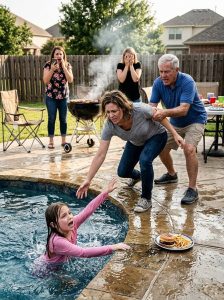
The pool was only a few steps away, blue and bright under the afternoon sun, and I told her yes because I thought watching water was safer than standing beside Rachel.
I turned my back for five seconds.
Five seconds can become a lifetime when the wrong person has been waiting for an audience.
I heard the slap of water before I saw her fall.
When I turned, Rachel was standing behind Haley with one hand still out, and my daughter was gone under the surface in her hoodie, jeans, and socks.
The splash ran across the concrete and touched my shoes.
For one beat, the whole yard froze.
Then Haley’s hair spread under the water like black ink.
I screamed her name and ran.
My father caught me from behind before I reached the edge.
His arm locked across my throat, hard and hot, and his other hand dug into my shoulder while he dragged me backward.
“Stop,” he barked into my ear.
I clawed at him.
He tightened his grip.
“She needs to learn,” he said, and then came the line that made every excuse I had ever made for him die at once.
“If she can’t survive water, she doesn’t deserve life.”
Rachel laughed.
My mother stood beside her with a drink in her hand.
Haley kicked once beneath the water and then seemed to fold in on herself.
That was the turn.
A family that makes you beg for safety has already stopped being family.
I drove my heel backward into my father’s shin with everything I had.
He swore, shifted his weight, and that half-second was enough.
I tore loose and threw myself into the pool with my shoes still on.
The cold shocked the breath out of me.
Haley’s eyes were open underwater, huge and searching, and her hands moved without direction because panic had stolen the map.
I caught her under the arms, kicked upward, and broke the surface with her against my chest.
She gasped once, then coughed so hard her whole body shook.
I pushed her toward the edge and climbed out after her, my knees scraping concrete, my wet clothes dragging me down.
She folded into me, coughing water onto my shirt.
I held her while she shook.
Dad adjusted his collar like I had embarrassed him.
Rachel’s smirk stayed in place, but one corner twitched.
Mom rolled her eyes.
“Drama queen,” she said.
“Over one dip.”
I did not shout back.
I did not call Rachel what I wanted to call her.
I did not ask my father how he could put his arm around his daughter while his granddaughter sank.
I reached for my phone with one wet hand and called 911.
My mother told me to put it down.
I gave the operator the address.
My father said I was making a scene.
I told the operator my daughter had been pushed into a pool and I had been restrained when I tried to rescue her.
That sentence changed the air in the yard.
Not because my parents felt shame.
Because witnesses heard it said plainly.
The operator told me to keep Haley warm and turn her on her side.
I stripped off my wet overshirt and wrapped it around her.
Her lips were pale, and every breath she took sounded like it had to fight its way out.
Rachel stepped back from the pool.
Mom finally put down her drink.
Dad started talking about misunderstandings before the sirens even reached the block.
The paramedics arrived fast, though it felt like an hour, and they did not laugh or call it a dip.
They wrapped Haley in emergency blankets, checked her oxygen, listened to her lungs, and moved with a seriousness that made my knees go weak.
One paramedic looked at my throat and asked who grabbed me.
My father’s face changed, not with guilt, but calculation.
I pointed at him.
The police came because the call involved a child and an assault.
At the hospital, Haley slept in a warm bed with monitors clipped to her while I answered questions in a small room that smelled like sanitizer and coffee.
They asked who pushed her, who saw it, who stopped me, and what exactly my father said.
I had spent my entire life editing the truth so my family could remain comfortable, but that night I stopped editing.
The nurse photographed the marks on my throat, the doctor documented Haley’s coughing, and a social worker sat across from me without blinking when I described my mother’s laugh.
“I am making the call that needs to be made,” she said.
I nodded because if I spoke, I was afraid I would break open.
We did not go home.
I took Haley to a motel near the hospital, the kind with thin towels and a vending machine humming outside the office.
She slept with one fist wrapped around my sleeve.
I sat on the edge of the bed and watched the door until morning.
CPS called at dawn, and the caseworker arrived with a folder, calm eyes, and no appetite for family theater.
She explained an emergency safety plan in plain words: no unsupervised contact, school notification, a confidential pickup code, and police coordination if anyone tried to approach Haley.
Every item sounded bureaucratic, but to me it sounded like oxygen.
I had spent years begging my parents to be decent.
Now paper was doing what begging never could.
The caseworker asked whether there was a pattern, and I opened my phone.
There were texts from my mother calling Haley a mistake, voicemails from Dad calling me poisonous, and messages from Rachel joking that I raised Haley to be weak.
I had saved them without knowing why, and now every ugly message had a place to go.
She took copies.
The police took formal statements, and two cousins admitted they had seen Rachel’s hand on Haley’s back.
One said Mom laughed after Haley went in, and another heard Dad say something about survival but had looked away because he did not want trouble.
The school principal called before lunch and said Haley’s file had been updated so nobody could release her to my parents, Rachel, or anyone claiming family permission without written confirmation from me.
I thanked her three times.
Then I sat on the motel bathroom floor and cried where Haley could not hear me.
Those were not revenge tears.
They were the grief of realizing protection had been possible all along, just never from the people who owed it first.
My lawyer was a friend of a friend who specialized in family safety and custody issues.
She listened to the facts, not the family mythology.
She prepared an emergency petition tied to the police report, the hospital record, the witness statements, and the pattern of messages.
She told me not to threaten, not to argue, and not to answer bait.
“We are building a door that closes from the outside,” she said.
That was the only line from that week I wrote down.
The next few days were quiet in the way storms are quiet when they are moving over another town.
My parents called from blocked numbers, Rachel sent one message saying I was ruining her life over a joke, and I did not answer.
I changed Haley’s emergency contacts, changed my locks, changed the address for school mail, and gave her dance teacher a strict release list.
Small forms became bricks.
Small policies became a wall.
Haley did not ask to see them.
She asked if she had done something wrong by sinking.
That question made me hate them more than the shove.
I told her the water was not her fault, fear was not her fault, and adults who watched a child struggle were the ones who had failed.
Then I signed her up for private swim lessons, and by the fifth lesson she floated on her back with my hand under her shoulder blades.
One week after the barbecue, the caseworker called and said we could retrieve Haley’s things from my parents’ house with an officer present.
I almost said no.
Then Haley asked for her sketchbook and the stuffed rabbit she slept with when she was sick.
So I went.
Not alone.
The caseworker stood on one side of me, and the officer stood on the other.
My father’s truck was in the driveway.
My mother’s curtains moved before we reached the porch.
Dad opened the door with a half-smile, the kind he used when he thought everyone else was about to remember his authority.
“This is ridiculous,” he said.
The officer said we were there to retrieve a child’s belongings.
Mom appeared behind him and looked me up and down.
“You love drama more than air,” she said.
The officer did not look at me.
“Ma’am, this is not a negotiation.”
Rachel came down the stairs in workout clothes, already rolling her eyes.
“She’s not taking anything from my niece’s room without me watching,” she said.
The caseworker lifted one hand.
“You are not involved in this process.”
Rachel froze because nobody in that house had ever spoken to her like a rule applied.
I went upstairs.
Haley’s room at my parents’ house was really a storage room with a twin bed, but her things were there.
I packed the rabbit, the sketchbook, pajamas, hair ties, a purple backpack, and the little box of dance stickers she kept in the dresser.
When I came downstairs, Dad was talking to the officer in the tone he used on waiters and mechanics.
He said family matters were being exaggerated.
He said I had always been unstable.
He said Haley needed discipline because I was raising her soft.
Then he looked at me and laughed.
“You cannot keep our granddaughter from us forever.”
For the first time in my life, I looked straight at him without lowering my eyes.
“You will never have access to my child again.”
He opened his mouth to laugh harder.
The officer reached into his folder.
That was the moment the house finally stopped belonging to their version of events.
The officer handed Dad the emergency no-contact order papers.
He explained that my father, my mother, and Rachel were not allowed within three hundred feet of Haley, her school, her activities, or our home.
He explained that attempts to contact her through relatives could be documented as violations.
He explained it in the same calm tone people use when a thing is already real.
Dad stared at the papers.
Mom stepped closer, saw her name, and stopped breathing through her nose.
Rachel said, “What did you do?”
Nobody answered her.
The question had finally turned in the correct direction.
Dad’s face went pale first around the mouth, then all at once.
He looked at the officer, then at the caseworker, then at me, as if one of us might admit this was a performance.
It was not.
It was filed.
It was active.
It had a case number.
The man who had put his arm around my throat while my child sank was now reading the distance the law required him to keep from her.
Mom began to cry, but not the way people cry when they are sorry.
She cried like an audience had been taken away.
Rachel whispered that I had destroyed the family.
I zipped Haley’s backpack.
“No,” I said.
“I finally protected the part of it that was mine.”
That was the final twist they never saw coming.
I did not expose them online or scream on the lawn.
I used every quiet system they had always assumed belonged to people like them: hospital notes, police reports, school procedures, CPS forms, witness statements, and an order with their names on it.
Their power had always depended on private rooms, family silence, and me being too ashamed to say the sentence plainly.
Once I said it plainly, strangers with clipboards did what relatives with blood ties refused to do.
They believed the child, protected the child, and wrote it down.
I walked out with Haley’s backpack over my shoulder.
The caseworker walked beside me.
The officer stayed behind long enough to make sure nobody followed.
My mother called my name once from the doorway.
I did not turn around.
Haley was waiting at my friend’s apartment when I got there, and that night she slept with the stuffed rabbit tucked under her chin.
For the first time in years, my phone stayed silent because the silence had a legal boundary around it.
My parents tried to send messages through relatives until the relatives learned I forwarded everything to my lawyer, and Rachel lost the easy audience she had mistaken for loyalty.
Haley is ten now, wears hoodies when she wants to, and swims only when she says yes.
They thought they had thrown a child into a pool to teach me my place.
Instead, they handed me the one thing I had never had in that family.
Proof.
And once I had proof, they did not lose an argument.
They lost us.