The text from my mother arrived while Lena was practicing her birthday line in the hallway mirror.
Black tie optional, Mom wrote, then added, No sneakers, even for the little ones.
I stared at the message long enough for my husband to ask if someone had died.
“No,” I said, locking my phone. “Just my mother’s idea of fun.”
Lena didn’t notice my face.
She was six, all curls and careful hope, standing on a stool so she could see herself in the mirror.
“Happy birthday, Grandma,” she said, then shook her head because she thought it sounded too quiet.
She tried again.
The second time, she smiled at herself like she had passed a test.
I wanted to believe that mattered.
Lena had been my daughter for almost a year by then, though in my heart she had been mine from the day she put her small hand in mine at the agency office and did not let go.
She had come to us with a trash bag of clothes, a bear with one flat eye, and the skill of making herself small in every room.
Adults had left her before.
Adults had come back late before.
Adults had made promises and then turned into weather.
So when she asked if Grandma liked yellow, I said, “Grandma is going to love it.”
The lie tasted like metal.
The birthday dinner was at a restaurant with chandeliers, white flowers, and a private room full of relatives who knew how to perform warmth.
Mom stood near the head table in navy satin and pearls, glowing like she had been waiting sixty years to be admired correctly.
She kissed Mark’s boys on their heads.
She told one of them he was getting so tall.
When Lena stepped forward with the card, Mom touched her shoulder with two fingers.
“Hi, sweetheart,” she said, already looking past her.
Lena beamed anyway.
Children who have waited for crumbs know how to celebrate one.
Lena sat at the kids’ table with Mark’s boys and tried to keep up with their jokes.
She colored a purple flower on the menu.
Every few minutes, she looked toward Mom.
Every time Mom laughed at another table, Lena sat a little straighter.
My husband, Daniel, leaned toward me.
“She’s doing okay,” he whispered.
I nodded, though my throat felt tight.
Then Mom lifted her glass.
The room softened into attention.
Forks paused.
Chairs scraped.
Someone dimmed the music, and a waiter stepped back with a bottle in his hand.
Mom smiled around the room like a queen receiving weather reports from loyal towns.
“Everyone,” she said, “just family for a moment.”
I turned toward the kids’ table.
Lena’s chair was empty.
Her cardigan hung over the back.
Her cup was half full.
The birthday card was gone.
For a second, the room made no sound I could understand.
Then I was standing.
Daniel looked at me.
“Bathroom?” he whispered.
“She would tell me,” I said.
I moved between tables, past relatives who pretended not to see the change in my face.
I checked the restroom door.
I checked the dessert cart.
I checked the corner behind the buffet.
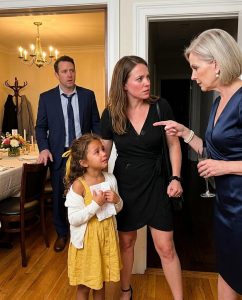
Then I saw her through the open doorway.
Lena stood by the coat rack, both hands wrapped around the card, yellow dress bright against the beige hallway wall.
Her eyes were red.
She was not crying loudly.
That was worse.
I knelt in front of her.
“Baby, what happened?”
She stared at the card.
“Grandma said I can come back when they’re done.”
My skin went cold.
“When who’s done?”
She swallowed.
“Family.”
The word was tiny.
It still landed like a slap.
I pushed the hair from her cheek.
“Did she say that to you?”
Lena nodded.
“She said I might feel awkward.”
Then her mouth trembled.
“Did I do something bad?”
I pulled her into my arms before she could see my face.
“No,” I said. “You did nothing wrong.”
She whispered the question that still visits me at night.
“Are you sending me back?”
I held her tighter.
“Never.”
The toast was still going when I walked back in with Lena’s hand in mine.
My mother saw us and gave that familiar sigh, the one that made every room believe I was the problem before I opened my mouth.
“Natalie,” she said softly, “don’t make a scene.”
“Why was my daughter in the hallway?”
A few heads turned.
Mark looked down at his plate.
My father set his glass on the table.
Mom’s smile stayed in place.
“We just thought the little ones might get restless.”
“The other children are still at the table.”
She adjusted her bracelet.
“They’re older.”
“She is six.”
“Exactly,” Mom said. “We didn’t want her confused about where she fits.”
Lena’s hand tightened around mine.
Something inside me went quiet.
For years, I had mistaken quiet for weakness.
This quiet was different.
It had edges.
“We’re leaving,” I said.
Daniel was already standing.
My father gave a short laugh.
“Over this?”
I looked at him, then at my mother, then at the people who had eaten meals I paid for and called my child a complication.
“Yes,” I said. “Over this.”
Lena cried in the car only after we were two blocks away.
She held the birthday card in her lap, bent down the middle, and kept saying she had been good.
Daniel drove with both hands on the wheel.
I sat in the back beside her because she asked me to.
Every streetlight crossed her face like a question.
At home, she put the card on her dresser instead of throwing it away.
That broke me more than if she had torn it up.
Children save evidence that they tried.
After she fell asleep, Daniel found me at the kitchen table with my laptop open.
The family reunion spreadsheet glowed on the screen.
Lake weekend was three weeks away.
Every cabin deposit was under my name.
Every grocery prepayment had come from my account.
Every year, my mother posted photos and thanked “the family” for keeping tradition alive.
The family was me.
Daniel sat across from me.
“You don’t have to do it this year.”
“I know.”
“Then cancel it.”
I looked toward the stairs.
“No,” I said. “I’m going to make it honest.”
The next morning, I sent one message to the group chat.
This year’s lake weekend is still happening, but only for people who treat Lena as family.
The typing bubbles appeared immediately.
I added one more line before anyone could soften it.
If what happened at Mom’s party felt acceptable to you, tell me now so I can free your cabin.
Then I put the phone face down and made coffee.
Mom called first.
I let it ring.
Dad called second.
I let that ring too.
Mark texted, We’re not taking sides in your drama.
I wrote back, Silence is a side, then deleted it.
Instead, I opened the spreadsheet and removed his cabin.
By noon, half the family had declared themselves neutral, offended, confused, or suddenly unable to attend.
I freed every cabin attached to those words.
Daniel’s sister took one, and the parents of Lena’s classmate took the smallest cabin near the dock.
Mom finally texted, You’ll regret humiliating your own mother.
I stared at the message.
Then I blocked her for the weekend.
The lake was quiet when we arrived.
Not tense quiet.
Clean quiet.
By sunset, Lena was barefoot, sticky with marshmallow, and laughing so hard she hiccuped.
Nobody made Lena earn her chair.
Nobody used the word real like a weapon.
For the first time in years, I felt what reunion was supposed to mean.
Family is the place that stops the leaving.
On the last night, Lena fell asleep on Daniel’s lap beside the fire.
Her face was orange in the glow, soft and unguarded.
I should have felt victory.
Instead, I felt the pressure drop before a storm.
Three days after we came home, Mom texted from a new number.
You didn’t listen.
Then another message arrived.
This is what consequences look like.
Daniel read it and said, “Ignore her.”
I wanted to.
The next morning, there was a knock at the door.
A woman stood on the porch with a badge, a clipboard, and the practiced calm of someone who had learned not to react before entering a house.
“Mrs. Whitaker?”
“Yes.”
“I’m with Child Protective Services. We received a report.”
Behind me, Lena froze on the stairs.
Her bear slipped from one hand and bumped down two steps.
The worker said it was routine.
Routine is another word people use when their fear is not the one being measured.
I let her in because refusing would have looked worse.
She checked the refrigerator, Lena’s bedroom, and the books stacked beside her bed.
She asked about school, meals, sleep, adoption history, and support systems.
She asked if I had been under unusual emotional stress.
I answered evenly.
I could feel Lena watching every movement from the hallway.
When the worker asked to speak to her, Lena sat on the edge of the couch with her feet not touching the floor.
The woman asked if she felt safe.
Lena looked at me first.
I nodded.
She whispered, “Yes.”
When the worker asked if anyone had threatened to send her away, Lena’s eyes filled.
“Grandma said I wasn’t family,” she said.
When she left, she said we would hear from the office after review.
The door closed.
Lena climbed into my lap like she had when she was five.
“Are they taking me?”
I said no.
I said it with the confidence of a mother and the terror of a woman who knew paperwork could become a weapon in the wrong hands.
That night, I opened every account my parents had ever touched.
Not theirs legally.
Mine.
The family reunion account.
The travel fund.
The emergency card Mom used for “just this once” purchases that repeated every season.
The shared payment profile for Dad’s medication gap, Mark’s boys’ camp deposits, Mom’s retirement trip, and the house repairs that always became my problem.
I downloaded statements until my printer hummed.
I made a ledger.
No drama.
No insults.
Just dates, transfers, cabins, flights, deposits, repairs, and quiet rescues lined up in black ink.
Then I sent one email.
All financial support ends immediately.
No greeting.
No explanation.
No love, Natalie.
Within an hour, Mark called.
I did not answer.
Dad called.
I did not answer.
Mom left a voicemail so soft it made my stomach turn.
“We only did what any real family would do,” she said. “If you calm down, we can all move forward.”
Move forward.
As if she had spilled wine on a tablecloth, not terror into my daughter’s bedroom.
Two days later, they came to my house.
Mom wore pearls.
Dad wore his golf jacket.
Mark stood behind them, hands in his pockets, pretending this was unfortunate instead of unforgivable.
I opened the door but kept the chain on.
Mom smiled.
“Natalie, sweetheart, this has gone too far.”
“You called CPS on me.”
Dad frowned.
“We asked for a wellness check.”
“You filed a report claiming my home was unsafe.”
Mom’s mouth tightened.
“You were acting unstable.”
I laughed once.
The sound had no humor in it.
“Because I wouldn’t let you exclude my child?”
“Because you cut off your own family,” she snapped, and there she was at last.
Not soft.
Not worried.
Just angry that the machine had stopped giving.
I closed the door, slipped the chain free, and opened it again.
In my left hand was the county notice that had arrived that morning.
No further action required.
In my right hand was the support ledger.
Mom saw the envelope first.
Her face changed.
“What is that?”
“The state is done with your report.”
Mark looked up.
Dad stopped frowning.
I held up the ledger.
“And this is what I am done with.”
Mom tried to step inside.
I stayed in the doorway.
She looked at the first page.
Cabin deposits.
Then the second.
Retirement trip payments.
Then the third.
House repairs, medical gaps, camp fees, grocery transfers, hotel rooms, emergency flights.
Her eyes moved faster.
Her hand began to tremble.
“You printed private family matters?”
“No,” I said. “I printed my bank records.”
Dad reached for the pages.
I pulled them back.
“You told my daughter she wasn’t family while spending money I earned for this family.”
No one spoke.
“Then you tried to scare me into obedience by risking the one thing you knew would hurt her most.”
Mom’s color drained so quickly I thought she might sit down.
Mark whispered, “Mom?”
She did not look at him.
She looked at the ledger like it had betrayed her.
“We were worried,” she said.
“No,” I said. “You were in charge.”
Her mouth opened.
Nothing came out.
That was the first honest thing she had given me in years.
I set the ledger on the porch between us.
“The reunion account is closed. The travel fund is closed. The emergency card is closed. Anything in my name is finished today.”
Dad’s jaw tightened.
“You can’t just abandon your parents.”
From behind me, Lena’s voice said, “She didn’t.”
We all turned.
She stood at the foot of the stairs in pajamas, bear tucked under her arm.
Daniel was behind her, one hand hovering near her shoulder, but he let her speak.
Lena looked at my mother.
“Grandma did.”
Mom flinched.
Not dramatically.
Just a small recoil, as if the words had touched something tender she preferred to keep covered.
I stepped back inside.
“Goodbye, Mom.”
“Natalie,” she said, and for once my name sounded like a plea.
I closed the door.
This time, I did not shake afterward.
The next summer, the lake weekend was smaller.
It was also better.
Lena helped make name tags with fish on them.
She put one on her own shirt before anyone else arrived.
It said Lena Whitaker.
Underneath, in smaller letters, she wrote family.
I had to go into the bathroom for a minute.
Not because I was sad.
Because relief can be loud too.
My parents did not come.
They did not get a cabin invitation.
They did not get the deposit link.
They did not get the quiet daughter who made problems disappear with a transfer and a smile.
I did not feel triumphant.
That surprised me.
I thought revenge would taste sharper.
Mostly, it tasted like clean air after leaving a room with bad perfume.
Lena is seven now.
She runs into rooms faster.
She asks fewer questions before sitting down.
She still keeps the bent birthday card in a box under her bed, but now there are other things in the box too.
Lake stones.
A photo of Daniel lifting her from the dock while she shrieked with laughter.
Sometimes she asks about my mother.
I tell her the truth in pieces she can carry.
Grandma made choices that hurt people.
We made choices that kept our home safe.
Both can be true.
As for my mother, I hear she still tells people I tore the family apart.
Maybe that is easier than saying she found a little girl in a yellow dress, pointed to the hallway, and called it tradition.
Maybe it is easier than admitting the money stopped because the silence stopped first.
I do not correct her anymore.
I have a daughter to raise.
I have a lake weekend to plan.
And this year, every chair at the table already has a name.