The first thing Brooke Lawson remembered later was the sound of glass breaking on the kitchen tile. Not Travis’s voice. Not the siren. Not even the pain, though the pain came fast enough to fold her over the counter. It was the tiny bright crash of a water glass leaving her hand while her husband stood ten feet away adjusting his tie for his mother’s birthday dinner.
They lived in Phoenix, in a house with pale walls, desert plants by the front walk, and a doorbell camera Travis had installed after a package disappeared in May. Brooke had laughed at him then because he acted like he was securing a bank vault. That same camera would become the reason he stopped smiling months later in a conference room with two lawyers watching him.
But in the kitchen that evening, Travis still thought he was in control.
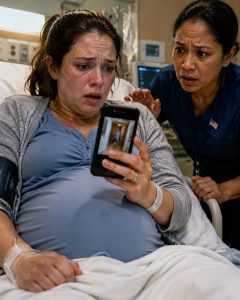
Brooke was thirty-eight weeks pregnant. Her doctor had been careful with her for the last month because her blood pressure kept creeping high. At the final appointment, the doctor had given Travis the plain version. Severe pain, dizziness, bleeding, or anything that felt wrong meant hospital. No debate. No waiting for dessert. Travis had squeezed Brooke’s hand in that exam room and said, “Of course.”
Promises sound clean under fluorescent lights.
At home, wearing a navy suit and checking his silver watch, he sounded like a different man.
“Brooke, not tonight,” he said when she told him something was wrong.
The contraction that followed took her breath so completely she had to hold the counter with both hands. She could feel the baby shift low and hard. The broken glass glittered near her bare feet. Travis did not step toward her. He looked toward the hallway, toward the jacket on the chair, toward the life where his mother Diane’s moods still mattered more than his wife’s fear.
“I think the baby is coming,” Brooke said.
“You still have time.”
“I need the hospital.”
That was when irritation moved across his face. Not panic. Not love. Irritation, as if she had chosen the timing to embarrass him.
“Every time my family has something important, you turn it into a crisis,” he snapped.
Brooke stared at him. It was strange how clear a cruel sentence can sound when the body is falling apart. She remembered the smell of his cologne. She remembered one piece of glass caught under the cabinet light. She remembered thinking that if he could just look at her for two full seconds, he would come back to himself.
He did not.
“My mother turns sixty-five once,” he said. “You have been pregnant for months. You can wait a few hours.”
Then he left.
For a moment after the front door shut, Brooke stayed frozen. She listened for the engine. She waited for the door to open again because some part of her still believed shame would catch him on the walkway and drag him back inside. Instead, his car started. The doorbell camera made its soft little chime from the hallway tablet as it detected motion. His taillights swept across the window and disappeared.
She called him. He declined. She called again. He declined again. The third call rang once, then stopped. By the fourth, another contraction had taken her to the floor.
Brooke crawled with one arm across the tile, careful not to put her palm in the broken glass. Her phone slipped once. She picked it up and called 911.
The dispatcher had a steady voice. She asked Brooke how many weeks pregnant she was. She asked if there was bleeding. She asked if Brooke could unlock the front door.
“My husband left,” Brooke said, because the fact still did not feel real until she said it to a stranger.
“I am here with you,” the dispatcher answered. “Can you reach the lock?”
Brooke crawled to the smart panel near the entry. The first time her finger missed. The second time, she hit the wrong number. The third time, the lock clicked open, and she cried with relief so sharp it almost sounded like laughing.
The doorbell camera recorded the paramedics arriving seven minutes later. It recorded Ana from next door running across the yard in slippers, hair wrapped in a towel, one hand over her mouth when she saw Brooke on the stretcher. It recorded the orange medical bag, the open door, and Brooke’s voice saying, “Please, my baby.”
It also recorded what Travis would later swear never happened.
At the hospital, the triage room moved quickly around Brooke. A nurse named Elena wrapped a cuff around her arm and called out the blood pressure number in a voice that made another nurse step closer. Brooke heard “possible distress,” “doctor now,” and “call labor and delivery.” The words floated above her, not quite landing.
Someone asked for her emergency contact.
“Travis Lawson,” Brooke said automatically.
Then she saw his declined calls on the screen. Four of them. Beneath those, one text from him: Stop making tonight about you.
She looked at Nurse Elena and changed the answer.
“Not him,” she whispered. “Please put my neighbor Ana for now.”
Elena did not make a face. She had the gift some nurses have of accepting ugly truths instantly and moving to protect the person in front of them. She nodded, changed the chart, and asked Brooke if her husband was allowed updates.
Brooke closed her eyes through another contraction. “Not unless I say.”
Her phone buzzed on the blanket.
For one wild second, she thought Travis had finally understood. But the alert was from the house. Motion at the front door.
Brooke opened the live clip with shaking hands. The first frame showed the inside entry camera, the one Travis had connected to the same system as the doorbell. A woman in a pale coat stepped into the hallway. She was not Ana. She was not a paramedic. She was young, pretty, and carrying a small overnight bag.
The woman knew the code.
Brooke’s mouth went dry. The hospital room narrowed to the phone in her hand.
The woman turned on the hallway light and spoke into her own phone. The audio was grainy but clear.
“I’m inside,” she said. “He said she would be gone by now.”
Nurse Elena saw Brooke’s face drain and took the phone before it slid off the blanket. She watched three seconds, then looked at Brooke with a kind of calm that felt stronger than sympathy.
“Do you want hospital security notified that your husband is not allowed back unless you approve it?”
Brooke had loved Travis for six years. She had defended him when he left dinners early to answer Diane’s calls. She had told herself he was anxious, not selfish. She had told herself fatherhood would settle him into the man he kept promising he wanted to be. But there, with their daughter fighting her way into the world and a stranger standing inside their house, Brooke stopped negotiating with the story she had invented to survive him.
“Yes,” she said.
Forty-three minutes after he left her on the kitchen floor, Travis called.
The sound behind him was not traffic. It was restaurant noise. Silverware, laughter, a woman singing off-key. Diane’s voice rose in the background, delighted and loud.
“Where are you?” Travis asked.
Brooke did not answer that.
“Who is in our house?”
The restaurant noise seemed to vanish. Travis breathed once into the phone.
“Brooke.”
That was all he said before the baby’s monitor changed and every person in the room moved. The doctor came in fast. Elena put the phone with Brooke’s ring and earrings in a plastic bag. Brooke signed what she had to sign with a hand that would not stop shaking. She remembered asking if her baby would be all right. She remembered Elena squeezing her fingers and saying, “We are moving now.”
Their daughter was born by emergency delivery just after nine that night.
Brooke heard the cry through a wall of exhaustion. It was small and furious and alive. She did not see Travis. She saw a nurse carry a tiny red-faced girl under warm lights. She saw Ana crying in the doorway because hospital security had called the emergency contact Brooke chose. She saw Elena glance toward the hall and then quietly close the curtain.
Brooke named the baby Clara June.
Travis arrived twenty-six minutes later with Diane beside him. Diane still had a corsage pinned to her dress. Travis had loosened his tie. He looked scared, but Brooke could not tell whether he was scared for her, for the baby, or for himself.
“I didn’t know it was serious,” he said before he said anything else.
That sentence did more damage than an apology would have repaired.
Brooke was pale, stitched, medicated, and holding their daughter against her chest. Ana stood beside the bed. Nurse Elena stood near the door.
“You declined four calls,” Brooke said.
“My phone was on silent.”
“You texted me.”
His eyes flicked to Diane. Diane stepped forward like she was entering a room she owned.
“This has been a very emotional night,” she said. “No one needs to punish anyone.”
Elena’s face did not change, but her hand moved to the call button.
Brooke looked at Travis. “Who is Natalie?”
He went still.
That was how she learned the woman’s name before he admitted it. Natalie worked with him. Natalie had been told the marriage was “basically over.” Natalie had been told Brooke was dramatic, dependent, and using the baby to trap him. Natalie had not been told Brooke was in active labor when Travis left the house. She had been told Brooke would be at the hospital “for a few days” and that Travis would come back after the birthday dinner.
Natalie had been given the code to Brooke’s front door.
Travis tried to say it was not what it looked like. He tried to say Natalie had only come by to pick up a work file. He tried to say Diane had nothing to do with it. Then Elena, with Brooke’s permission, handed Ana the sealed bag containing Brooke’s phone. Ana opened the saved doorbell clip and played the audio again.
“I’m inside. He said she would be gone by now.”
Diane’s expression shifted first. Not guilt. Annoyance.
“Turn that off,” she said.
Brooke looked from Diane to Travis, and the last little thread of hope in her finally gave way.
Security escorted Travis and Diane out when Travis raised his voice. He did not see Clara again that night. The next morning, a hospital social worker helped Brooke document the timeline: the doctor’s warning from the prenatal visit, the 911 call, the declined calls, the text message, the doorbell videos, and the fact that an unrelated woman had entered the marital home using a code while Brooke was in emergency care.
Brooke did not make a scene. She did not post the video. She did not call Diane names or throw Travis’s clothes onto the lawn. She lay in a hospital bed with her newborn sleeping against her and made one quiet decision after another.
Ana brought Brooke’s hospital bag. She also brought the tablet from the hallway, the one with all the alerts saved. Brooke’s sister Maya flew in the next day. By the time Travis came back with flowers and a speech about stress, Maya was standing outside Brooke’s room with security.
“She is resting,” Maya said.
“I’m her husband.”
“For now.”
That was the first time Travis looked truly afraid.
The divorce filing came three weeks later. Travis expected anger, and because he expected anger, he prepared for the wrong fight. He told his attorney Brooke was unstable after delivery. He said she had misunderstood a harmless visit from a coworker. He said he had never abandoned her because he “believed she was exaggerating normal labor pain.”
Then Brooke’s attorney played the 911 call.
The room went quiet.
They heard Brooke breathing on the kitchen floor. They heard the dispatcher asking if anyone was with her. They heard Brooke say, “My husband left for his mother’s birthday.” They heard the smart lock chime. Then they watched the first doorbell clip: Travis walking out while Brooke’s voice, faint through the open hallway, called his name.
Travis stared at the table.
The attorney played the second clip. Paramedics arrived.
Then the third. Natalie entered.
Travis’s attorney asked for a break.
There are betrayals that can be explained badly, and there are betrayals that come with timestamps. Travis had chosen the second kind.
Temporary custody was cautious. Travis was allowed supervised visits while the court reviewed the circumstances. Diane was not allowed to be present without Brooke’s written permission. Travis hated that condition most of all. Brooke knew because he sent one long message about family, forgiveness, and “not poisoning a child against her grandmother.”
Brooke saved it and did not answer.
Natalie contacted Brooke once through the attorney. She claimed Travis had told her he and Brooke were separated in every way but paperwork. She said Diane knew about her and had encouraged Travis to “start fresh.” She sent screenshots because, in her words, “I don’t want to be the only woman he lied to.”
One screenshot did what even the doorbell video had not.
It showed a message from Diane to Travis sent at 6:52 p.m., minutes before he walked out:
If she starts drama, leave anyway. Natalie can wait at the house.
Below it, Travis had replied:
She is saying hospital. I am coming to dinner.
Diane’s answer was only four words.
Good. Let her learn.
Brooke read that message once. Then she put the phone down and picked up Clara, because rage was not the thing that needed feeding.
The final divorce terms were signed before Clara’s first birthday. Brooke kept the house for a while, then sold it because every room remembered too much. She moved into a smaller place with a blue front door, no hallway tablet, and a doorbell camera she controlled alone.
Travis did become a father, but not the kind he could perform at parties. He learned parenthood in supervised rooms first, under the eyes of people who wrote down whether he showed up on time. Diane sent gifts that were returned unopened. Natalie left the company. Ana became Clara’s honorary aunt and still tells people she has never run faster in slippers.
Brooke does not describe that night as the night her husband left. That part is too small now. She describes it as the night strangers came when she called, a neighbor crossed the yard, a nurse believed her without proof, and a newborn girl arrived furious enough to pull her mother back into the world.
Years from now, Clara may ask why her parents are not together. Brooke will not show her every clip. Children do not need to inherit every wound. But she will tell the truth in a way a child can hold.
She will say her father made a choice.
She will say her mother made one too.
And if Clara ever asks about the front door, Brooke will tell her that a camera caught the lie, but it did not save them by itself. The saving started when Brooke stopped calling the man who had left and called for help instead.