The first thing Brent did when he landed in Miami was post a picture of the ocean.
The first thing I did after seeing it was check whether my daughter was still breathing.
I was three days postpartum, which meant my body still felt like it belonged to a storm I had barely survived.
Every step pulled somewhere tender.
Every noise made Ivy twitch in her sleep.
Every ordinary thing, a kettle clicking off, a chair scraping the floor, a phone vibrating on wood, felt too loud for the new life beside me.
Molly moved around her kitchen without asking me useless questions.
She warmed soup I did not eat.
She set towels near the door for my wet clothes.
She found an old bassinet in her attic, wiped it down, and placed it beside the radiator as if she had been waiting years for the chance to make room for us.
That was my sister.
She did not say, I told you so.
She did not say she had never liked Brent.
She only looked at Ivy and said, “She is safe here.”
I believed her because Molly had always been the person who meant what she said.
Brent had always been the person who meant what he could use.
Redwood Crest was mine before Brent ever slept under its roof.
I bought it after years of late nights, careful risks, and a winter when payroll mattered more than pride.
The house was stone and glass on a quiet road in Boulder, with high windows and a kitchen full of morning light.
I loved it before anyone else called it impressive.
Brent loved it after other people did.
When we married, my attorney insisted on a prenuptial agreement.
Brent smiled through it.
Diane did not.
After the wedding, she began calling Redwood Crest the family home.
Not my home.
Not our home.
The family home.
That phrase did a lot of quiet work.
It let her host dinners without asking.
It let Kara bring friends through the front door and give tours.
It let Brent stand beside the fireplace at business parties and say the estate had good bones, as if he had chosen them.
I corrected him the first few times, and he laughed as if I had spoiled a joke.
By the time Ivy was born, Brent had blurred the truth so often that I answered questions with a tired smile.
That is how entitlement grows.
Not all at once.
Just one uncorrected sentence at a time.
On the third day after we brought Ivy home, I had a pediatric appointment at two in the afternoon.
Brent said he had a call.
He kissed Ivy on the forehead without lifting her from the bassinet.
He kissed me on the cheek without looking at my face.
Then he said he might take his mother to lunch because she was stressed.
I almost laughed.
Diane was stressed because the baby had my last name as a second middle name.
Diane was stressed because I had said no visitors for a week.
Diane was stressed because motherhood had made me less available for her little performances.
I drove myself to the appointment because Brent said the call might run long.
I remember buckling Ivy into the car seat and moving slowly, one hand against my abdomen, the other on the car door.
I remember wondering why marriage could make you feel lonely in a house full of things.
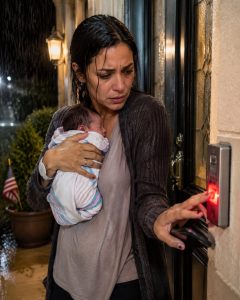
When I came home, my code no longer worked.
At first, I thought my hand had slipped.
Then I thought the keypad was wet.
Then I saw the porch camera turn toward me and knew someone inside the system was watching.
The old me would have called Brent twelve times.
The old me would have explained my pain to people who had planned it.
The old me would have begged for a door I paid for to open.
Motherhood did something strange to me in that moment.
It did not make me softer.
It made me exact.
I called Joanna.
If Molly is the person who catches me, Joanna is the person who sharpens the blade without making a sound.
She had worked beside me for eight years and knew every file better than some attorneys knew their own clients.
When I said, “Sell it,” she did not ask whether I was emotional.
She asked whether the title was clean.
That is why I trusted her.
Emotion shows the wound, but paperwork shows the power.
By midnight, Joanna had pulled the deed, the mortgage satisfaction letter, the prenup, the security logs, and every tax record connected to Redwood Crest.
By two, I was nursing Ivy in Molly’s guest room while two people on speaker discussed the sale of the house where my husband thought he had stranded me.
The private buyer had appeared months earlier.
At the time, I had ignored it because I still believed a home could be repaired if the people inside it tried hard enough.
The buyer wanted privacy.
The buyer wanted speed.
The buyer wanted the furnishings included, which made Molly snort from the doorway and say they could keep every chair Diane had ever judged.
Brent called once at 8:13 the next morning.
I did not answer.
He texted that he hoped I had calmed down.
Then he texted that his mother felt disrespected.
Then he texted that he would deal with me when he got back.
I sent every message to Elliot.
There is a special kind of peace in refusing to argue with evidence while it gathers itself.
Diane texted me at noon.
She wrote that a good mother does not create instability.
I looked at Ivy asleep in a borrowed bassinet, under my sister’s roof, because Diane’s son had locked her out in the rain.
I almost answered, but Molly took the phone from my hand and placed it on the dresser.
Sometimes love is not a speech.
Sometimes love is a hand removing the match before you set yourself on fire.
The offer arrived at 6:42 that evening.
It was clean.
It was legal.
It was serious, clean, and fast enough to feel like the universe had been waiting.
Elliot walked me through every line.
I asked about Brent.
He asked whether Brent’s name appeared on the deed.
I said no.
He asked whether community funds had paid the mortgage.
I said no, and Joanna supplied the records.
He asked whether the prenup carved out Redwood Crest as separate property.
I said yes.
Then he said the sentence that steadied me.
“He can be angry, Tessa, but anger is not ownership.”
I signed.
The first signature made my hand shake.
The second felt easier.
By the fifth, something inside me had gone very still.
Not numb.
Still.
Like a lake after the wind dies.
Brent came home early because control hates silence.
The security alert hit my phone while Ivy was sleeping on Molly’s chest.
On the camera, Brent stood under the porch light, tan from Miami and annoyed by weather he had not planned for.
He tried the old code.
It failed.
He tried another.
It failed.
Then Diane came into frame with a suitcase and an expression I had seen across dinner tables for years.
It said someone else would fix this.
Brent pressed the doorbell camera.
“Open the door,” he said.
I did not move.
Molly did.
She stepped closer to the phone, jaw tight, but Elliot was already speaking from the call.
“Record him.”
So I did.
Brent looked straight into the lens and threatened to take Ivy from me before morning.
I felt my body go cold in a clean way.
Fear is messy when you have nowhere to put it.
Evidence gives fear a folder.
Elliot told me he was adding a custody attorney.
Joanna told me the buyer’s team had just arrived at Redwood Crest for the final walkthrough.
That was the car pulling into the driveway behind Brent.
It was not police.
It was not a friend.
It was a black town car, followed by a white SUV and a woman in a navy raincoat holding a leather portfolio.
Brent turned, irritated, ready to perform.
Then he saw her face.
The camera caught the exact moment his mouth opened and nothing came out.
Joanna whispered, “Oh.”
I said, “Who is that?”
Elliot was quiet for half a second too long.
“That,” he said, “is the buyer.”
Her name was Mara Ellison.
I knew the name.
Mara ran the investment group Brent had been chasing for six months, the one he said could move him into the next circle, the one he had flown to Miami to impress.
He had told me it was a vacation with his mother.
It was not.
It was a pitch.
And according to the email Joanna found later, Brent had sent Mara photos of Redwood Crest and described it as his Colorado residence available for private investor retreats.
My house had been bait.
My recovery had been an inconvenience.
My daughter and I had been moved out of the frame so he could sell the picture better.
Mara stood on the porch and looked from Brent to Diane to the locked door.
Her assistant spoke to someone on the phone.
Brent smiled too wide and said something I could not hear.
Diane adjusted her coat as if rich women were watching, because one was.
Then Mara lifted one hand, not high, just enough to stop him.
She did not shout.
Power rarely does when it is real.
Elliot’s phone rang a moment later.
He answered, listened, and then looked at me through the video call.
“Mara is asking whether you want to proceed after the threat he just made on camera.”
I looked at Ivy.
She had woken and was blinking at the ceiling with serious newborn confusion.
“Yes,” I said.
My voice did not shake.
“Proceed.”
The closing happened the next afternoon.
It happened through secure signatures, wire confirmations, notarized pages, and the calm machinery of a world Brent had mistaken for decoration.
Mara bought Redwood Crest through her foundation’s trust.
I learned that only after the final page cleared.
The foundation created temporary housing for mothers leaving unsafe homes.
When Joanna told me, I sat down on Molly’s bed and cried so hard Ivy startled.
Not because the house was gone.
Because for the first time since the porch, I understood it had not been wasted.
Redwood Crest would still hold mothers and babies.
It would just stop holding men who confused access with ownership.
Brent found out at 4:09 p.m.
I know because my phone began lighting up like a storm warning.
First came calls.
Then messages.
Then voice notes.
Then Diane.
Then Kara.
I answered none of them.
Elliot sent one formal response to Brent’s attorney, who apparently existed only after Brent realized charm does not open a sold front door.
The response was short.
The property had been separate.
The title had been clean.
The sale had closed.
Any further threats regarding Ivy would be forwarded to custody counsel.
Brent came to Molly’s house three days later.
He did not get past the sidewalk.
Elliot had already sent notice that all communication had to go through counsel, and Molly had a doorbell camera of her own.
He looked smaller on that screen.
Maybe men like Brent always do when there is no house behind them making them look powerful.
He said he wanted to see his daughter.
He said this had gone too far.
He said his mother was devastated and that we could still fix it if I stopped punishing everyone.
I watched from the hallway while Molly spoke through the speaker.
“Leave.”
One word.
Clean as a lock turning.
He left because the camera was recording and because consequences had finally become visible.
The custody process was not easy, but the video made it simple enough for the judge to understand.
Temporary custody went my way, and Brent’s visits became supervised.
Months passed.
I moved into a smaller house with a porch that creaked and a kitchen window over the sink.
It did not impress anyone.
That was one of its best qualities.
Ivy grew cheeks.
She learned to smile.
She learned to grip my finger with the kind of trust that makes you want to become worthy.
Sometimes I missed Redwood Crest.
I missed the morning light.
I missed the view.
I missed the version of myself who thought building something beautiful meant people would treat it with respect.
But grief is not always a sign you made the wrong choice.
Sometimes grief is the echo of a door you had to close.
Mara invited me back once, six months after the sale.
I almost said no.
Then she told me a mother and her two-week-old son were staying in the east guest room because her husband had hidden her car keys.
I went.
The foyer looked different.
Warmer.
Less staged.
There were baskets near the stairs now, blankets folded on chairs, a coffee station, a shelf of donated diapers, a small sign by the back hall asking visitors to keep their voices gentle.
No one called it an estate.
No one used the word family like a weapon.
A young woman sat in the kitchen holding a baby against her shoulder.
She looked exhausted.
She looked scared.
She looked like I had looked in Molly’s kitchen, trying to understand how a life could split in one night.
Mara introduced me only by my first name.
The woman thanked me for the house.
I told her the truth.
“It was waiting for you.”
On my way out, I stood for a moment by the front door.
The keypad had been replaced.
I liked that more than I expected.
Some doors should not remember old hands.
Brent eventually moved into a rental near his office.
Diane told mutual friends I had destroyed the family.
Kara posted one quote about forgiveness and then deleted it when Molly commented that forgiveness does not come with a garage code.
I did not respond.
I had spent years feeding their version of reality by arguing with it.
I was done serving meals to a lie.
The final twist came in a letter from Mara’s office.
Inside was not a check.
It was a photograph of Redwood Crest in spring, with a small bronze plaque beside the new doorbell.
The plaque did not have my name on it.
It had Ivy’s.
The Ivy Room.
I held the photo for a long time.
Then I placed it in a frame above my desk.
One day Ivy will ask about it.
I will tell her that when she was three days old, someone tried to leave us outside a house I owned.
I will tell her that I was scared.
I will tell her that I cried later, because brave people are not stone.
But I will also tell her that a home is not proven by who stands inside smiling.
It is proven by who opens the door when someone vulnerable is left in the rain.
And when she is old enough, I will tell her the part that still makes me breathe easier.
Her father thought changing a code made him powerful.
He forgot the woman outside still held the key that mattered.