The first thing I remember about the cliff was not the fall.
It was Michael’s hand on my shoulder, warm through my coat, familiar enough that my body trusted it for one fatal second.
I was nine months pregnant, swollen, exhausted, and angry in the ordinary way wives become angry when their husbands lie badly and expect gratitude for it.
The anger had started the night before, when I found the folder behind his golf bag.
It was not hidden well.
That was the insult that came before the horror.
The folder held an accidental-death policy with my name printed cleanly across the top, and beneath it was a clause that made the room tilt.
If I died before giving birth, and the baby died with me, Michael received fifty million dollars.
I sat on the nursery floor with that paper in my lap while the blue blanket on the rocking chair seemed to glow in the lamp light.
Our son kicked under my ribs.
Michael came home at midnight smelling like expensive cologne and cold air.
I asked him why my death had a number on it.
He took the folder from my hands and said every successful man protected his family with paperwork.
Then he knelt in front of me and touched my stomach with the kind of tenderness that used to make me forgive him too quickly.
“You are emotional,” he said. “Tomorrow I will take you somewhere quiet, and we will talk like adults.”
I got in the SUV because part of me still believed a man could be cruel and frightened without becoming evil.
We drove west under a sky the color of tin.
The city fell away behind us, then the houses, then the last gas station with a flickering sign.
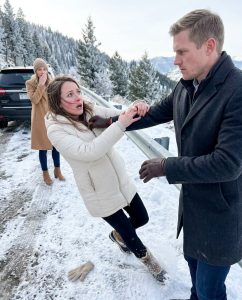
At the overlook, the world was white and empty.
Snow pressed down on the pines, and the wind came hard off the ridge.
I stepped carefully because my balance had become a negotiation with gravity.
Michael walked ahead with his hands in his coat pockets.
“We should go back,” I said.
I looked past him and saw the second shape near the road.
Ashley stood beside the SUV in a camel coat, her blonde hair tucked under a knit cap, her face turned away from the wind.
“Michael,” I said, “take me home.”
He smiled.
That was the moment I understood the folder had not been a secret.
It had been a rehearsal.
He stepped close, and his hands settled on my shoulders.
For one second, my body remembered every good day we had ever had.
Then he shoved.
The cliff took the sound out of me.
The sky flipped once, then the rail disappeared, then all I could see was snow and rock rushing up in pieces.
I struck a ledge hard enough to split the world open.
Pain flashed through my ribs and wrist.
Something hot spread under my coat, and for one terrible second I thought it was the baby.
I curled over my stomach.
“Daniel,” I whispered. “Stay with me.”
There was no answer except wind.
Then, under my palms, one small movement pressed back.
It was not much.
It was enough.
Above me, Michael’s voice drifted down through the snow.
“Can you see her?” Ashley asked.
“No,” he said.
“Is she dead?”
Michael laughed softly.
“For fifty million, she’d better be.”
Ashley said something about freezing.
Michael answered, “The policy pays more if they both go together.”
That sentence did what the fall had not done.
It broke the last living piece of my marriage.
I wanted to scream.
I wanted to curse him so loudly the mountain would carry my voice back into his clean, living face.
Instead, I pressed my fist to my mouth and stayed silent.
If he knew I was alive, he might climb down and finish what the cliff had not.
Their footsteps faded.
The wind covered them.
I was alone with my son and the sound of my own breath tearing in and out.
The cold moved into my legs first.
Then my fingers.
Then the thoughts at the edge of my mind began to loosen.
“You and me,” I whispered. “You and me, sweetheart.”
The sky had begun to blur when the sound came.
At first I thought it was another memory.
Then light swept across the cliff face.
Helicopter blades hammered the snow into a wild white circle.
I turned my face away as a figure dropped from the aircraft on a cable.
He landed with the steadiness of a man who trusted both the rope and himself.
“Ma’am, stay with me,” he called.
His voice changed when he got close enough to see my face.
He froze.
Then he pulled off his goggles.
Silver hair.
Blue eyes.
A scar at the edge of his left brow.
I knew that face because my mother had hidden his photograph in a cedar chest and refused to say his name.
“Emma,” he whispered.
His voice broke on my name.
“I finally found you.”
I tried to ask who he was, but my breath folded in half.
He clipped a harness around me and spoke into his radio with a calm that sounded practiced over panic.
“Pregnant female, severe exposure, possible fractures, fetal distress.”
Then, softer, to me, he said, “I am Richard Hale.”
The name meant nothing and everything.
He saw the confusion in my eyes.
“Your mother wrote to me,” he said. “Too late, but she wrote.”
The ledge tilted as they lifted me.
I remember the harness biting under my arms.
I remember seeing the top of the cliff, where Michael’s tire tracks were already filling with snow.
I remember Richard’s hand braced over mine on my stomach, steady and sure.
Inside the helicopter, the medic strapped a monitor around me.
Daniel’s heartbeat galloped through the cabin, fast at first, then uneven.
Richard looked at the monitor and all the color left his face.
“No,” he said. “Not after this.”
When I woke, my stomach was flat.
For three seconds, I died in a cleaner, quieter way.
Then a nurse leaned over me and said, “Your son is in the NICU, and he is fighting.”
I cried so hard the stitches pulled.
That was when Richard stepped beside me.
He had changed clothes, but his hair was still damp from melted snow.
He held a plastic evidence bag.
Inside was the policy folder.
“Where did you get that?” I asked.
“From your house,” he said.
“Your mother sent me a letter before she died,” he said. “She told me she had lied to both of us.”
My mother had been dead for four years.
Grief can make old betrayals feel rude for arriving late.
Richard explained it carefully: he had never known my mother was pregnant, and her letter had reached him only three weeks before Michael pushed me off the cliff.
“How did you find me on the mountain?” I asked.
He looked through the nursery glass at Daniel.
“The policy did,” he said.
Michael had not bought the policy from an ordinary company.
He had bought it through a private underwriter connected to Hale Aviation, Richard’s rescue and risk firm.
The amount was too high.
The timing was worse.
A pregnant wife, a sudden accidental-death rider, and a husband pressing for immediate approval had triggered a quiet review.
Richard had seen my name on a file he was already hunting for.
Then he saw Michael’s planned mountain reservation and the weather alert.
He sent a helicopter before anyone called for help.
For the first time, I understood that Michael had not miscalculated because he was careless.
He had miscalculated because he thought I had no one.
That is the lie cruel people love most.
The funeral was Michael’s idea.
Of course it was.
No body, no closure, but plenty of performance.
He wanted a memorial before the weather changed and before anyone could ask why his grief looked like impatience.
Deputy Morales wanted to arrest him quietly.
Richard did not.
“He will deny the shove,” Richard said. “He will say grief made him confused. He will say my daughter wandered.”
My daughter.
The words landed inside me like a hand reaching back through my whole life.
“What do you want?” I asked him.
“I want him to speak while he thinks he has won.”
So we let Michael plan my funeral.
Richard offered his arm.
I took it anyway.
We waited in a side hall while Deputy Morales stood near the sound booth with a recorder running.
Through the cracked door, I heard people murmuring my name in the past tense.
Then I heard Michael.
He was not crying.
He was laughing under his breath at something Ashley said.
“They both froze,” he told someone near the front. “That useless woman got exactly what she had coming.”
Richard’s hand tightened around the handle of Daniel’s bassinet.
I touched his wrist.
“Not yet,” I whispered.
“My only comfort is that she and the baby did not suffer long.”
Richard opened the chapel doors.
Cold air rolled down the aisle.
Every head turned.
I stepped inside with one hand on the bassinet and one arm around my ribs.
For a heartbeat, nobody moved.
Then Ashley dropped her lilies.
Michael’s face did not change all at once.
First his smile stayed in place because his body had not caught up.
Then his eyes dropped to my hospital bracelet.
Then to the bassinet.
Then to Richard standing behind me.
The color drained from his face so completely that he looked carved out of wax.
“Emma,” he said.
It was the first honest thing he had said in years because it held only fear.
I walked until I reached the front row.
Daniel made a small sound in the bassinet.
It was not loud.
It owned the whole room.
Michael stepped back from the casket.
“This is not what it looks like,” he said.
Deputy Morales moved from the side aisle.
Richard did not speak.
He only set the insurance folder on the casket, the plastic evidence bag shining under the chapel lights.
I looked at Michael and said the only line I had carried from the mountain to that room.
“You sold our lives before you buried us.”
The room went silent.
Michael looked at Ashley.
Ashley looked at the floor.
That was when I knew they would not protect each other for free.
Deputy Morales read Michael his rights in front of the flowers he had ordered for me.
Ashley began talking before they reached the back doors.
She said Michael planned the trip.
She said he told her the policy would make them untouchable.
She said he chose the overlook because the weather would make the fall look like a tragic accident.
Michael called her a liar.
She answered with the one thing he had not expected.
She had recorded him.
Not the shove.
Not the fall.
But the call he made afterward from the lodge, when he told her to stop panicking because “the cliff did its job.”
The claim was frozen that afternoon.
Michael’s accounts were frozen two days later.
Michael took a plea before trial.
Ashley took a deal and testified.
I did not go to every hearing.
Some days Daniel needed me more than justice did.
Some days my body remembered the fall before my mind did, and I would wake with both arms locked around my stomach even though he was sleeping safely beside me.
Richard came every morning with coffee he did not know how to make and toys too old for a newborn.
He was awkward in the way late fathers are awkward when love has arrived before history.
He never asked me to call him Dad.
That is why, one night in the NICU, I did.
He turned away so fast I pretended not to see him cry.
In the bottom drawer of the dresser, beneath tiny socks and unopened pacifiers, I found one more envelope.
It was from my mother.
My name was written on it in the shaky handwriting from her last year.
Inside was the other copy of the photograph.
On the back, she had written the truth she had never managed to say while alive.
Richard never left us. I did.
The final twist did not come in a courtroom or a chapel.
It came years later, when Daniel was old enough to ask why his grandfather always looked at him like he was a sunrise.
Richard took him to the hangar where the rescue helicopter was kept.
On the inside of the door, someone had painted a small name in blue letters.
EMMA.
I stared at it.
Richard cleared his throat.
“I named it before I found you,” he said.
He had bought that helicopter the week my mother’s letter arrived.
He had told his crew he was looking for a missing daughter, and until he found me, every rescue run would carry my name into the sky.
Michael thought the mountain had erased me.
But before he ever touched my shoulders, my father had already put my name on the machine that would bring me home.