My mother called two weeks before Christmas and said, “We don’t have space for your kids this year.”
I remember the exact way the tape stuck to my thumb when she said it.
I remember the half-wrapped presents spread across my bed, the ribbon curling off the comforter, and the dry heat from the vent pushing through the room like it was trying to keep everything normal.
I remember my brother laughing in the background before I even had a chance to breathe.
“Yeah,” he said. “Just bring yourself. They’re too loud anyway.”
There are sentences that do not sound violent until they land on your children.
That one did.
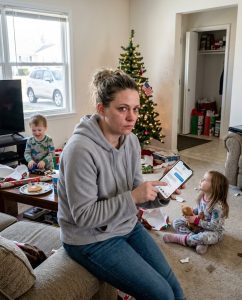
My kids were in the living room decorating our little fake Christmas tree.
The bottom branch had been bent since the year my son tried to drag the whole tree closer to the TV.
The silver star had gone missing after we moved apartments, so my daughter had made one out of cardboard, foil, and more glitter than any reasonable human being should own.
They loved that tree anyway.
They were arguing over candy cane ornaments, asking whether Grandma would make cinnamon rolls again, asking if their cousins were still sleeping in the den, asking if they could bring their matching pajamas.
I had already told them yes.
Because I believed it.
My mother kept talking on the phone.
She used soft words.
Crowded.
Hectic.
Too much going on.
Words people use when they want a decision to sound practical instead of cruel.
There was room for my brother’s wife’s family.
There was room for his friends who might “stop by.”
There was room for folding tables, coolers, extra desserts, and piles of presents for his boys.
But suddenly there was no room for my children.
Her grandchildren.
I waited for my mother to correct my brother after he called them loud.
I waited for her to say, “Don’t talk about them that way.”
I waited for anything that sounded like love.
She said nothing.
She just breathed into the phone and waited for me to make it easy.
That was my job in the family.
Making things easy.
I was the daughter who picked up Dad’s prescriptions when the pharmacy called.
I was the daughter who remembered Mom liked the good cranberry sauce, not the canned one my brother grabbed at the last second.
I was the sister who paid for the rental car every holiday so my sister could come home and then listen to her complain about the drive.
I bought batteries, wrapping paper, paper plates, stocking stuffers, and whatever toy a child suddenly needed because another adult forgot.
I was not treated like the center of the family.
I was treated like its extension cord.
Useful when plugged in.
Annoying when noticed.
So when my mother waited, I gave her what she expected.
“Okay,” I said.
Then I hung up.
I sat there for a second with the tape still on my thumb.
The house smelled faintly like pancakes from dinner because my son had begged for breakfast food that night.
In the living room, my daughter laughed at something her brother said.
I walked in and lied gently.
“Plans changed,” I told them. “We’re going to do our own special Christmas at home.”
My son looked confused.
My daughter’s smile faded just a little.
“Are the cousins still going?” she asked.
I swallowed.
“I think so.”
She looked down at the ornament in her hand.
“Oh.”
That one little word was worse than crying.
Children know when they are being left out.
Even when you wrap it in soft language.
Even when you smile.
Even when you say special.
They know.
I went back to my bedroom and looked at the presents on my bed.
The worst part was not just that my kids had been uninvited.
The worst part was that I had already delivered Christmas to my parents’ house.
A week earlier, I had loaded my car with gifts for my nephews.
A Nintendo Switch for the youngest.
A refurbished iPhone for the oldest.
Lego sets.
Puzzles.
Action figures.
Craft kits.
Books.
Candy.
Dinosaur socks because one of them loved dinosaurs.
I had wrapped every box myself.
I had curled every ribbon.
I had written every tag in careful handwriting because I knew the boys liked seeing their names.
I even added extra stocking stuffers because my sister always forgot the small things and then acted like small things did not matter.
Back then, I still thought generosity meant something.
That night, I put the kids to bed and could not sleep.
I kept hearing my mother.
“We don’t have space.”
Then my brother.
“They’re too loud anyway.”
Around 10:30 p.m., I got out of bed.
I put on my coat, grabbed my keys, and drove across town.
The streets were quiet in that strange December way, when every house looks warm from the outside and you know some of them are not.
Christmas lights glowed on roofs.
Inflatable snowmen waved in front yards.
A pickup truck near the corner had a plastic wreath tied to the grille.
When I pulled into my parents’ driveway, the house was dark except for the porch light.
The mailbox still had the little American flag decal my dad had stuck on it years ago and never replaced.
I had a spare key.
Of course I did.
I was the emergency daughter.
The reliable one.
The one trusted with the key, the alarm code, the grocery list, the pharmacy instructions, the bills nobody wanted to talk about, and the holiday work nobody wanted to call work.
The house smelled like pine candles and furniture polish when I stepped inside.
I closed the door softly behind me.
I did not turn on the big light.
I walked straight to the dining room.
And there they were.
All the gifts I had brought.
Stacked in the corner.
Untouched.
Not arranged under the tree.
Not mixed with anyone else’s presents.
Just piled there like donations waiting to be sorted.
I looked at the tags.
For Tyler.
For Mason.
For Eli.
For the boys.
Then I looked around for my children’s names.
Anything from Grandma.
Anything from my brother.
Anything from my sister.
One stocking.
One small package.
One cheap little candy cane with their names written in marker.
There was nothing.
Not one gift.
Not one stocking.
Not one sign that anybody had thought of them at all.
That was the moment the truth finally stood up in front of me.
They did not forget my kids.
They counted on me to forget them too.
They expected me to bring the gifts, cook the food, solve the problems, and smile while my own children stayed home wondering what they had done wrong.
They wanted my hands.
Not my heart.
And certainly not my children.
For one ugly second, I imagined making noise.
I imagined turning on every light in the house.
I imagined calling my mother and letting my voice become every Christmas I had swallowed.
I imagined leaving a note on the kitchen counter so sharp they would still be reading it after New Year’s.
But rage is expensive when your children still need you calm in the morning.
So I did something quieter.
I started picking up the presents.
One by one.
The Switch.
The iPhone.
The Lego sets.
The puzzles.
The action figures.
The candy.
The books.
Every ribbon I had tied.
Every tag I had written.
Every piece of proof that I had loved louder than they deserved.
I carried them to my car in bags and boxes.
No slammed doors.
No note.
No scene.
Just removal.
By 11:12 p.m., my trunk was full.
I locked my parents’ front door behind me and left the house exactly as I had found it, except for the absence they had created first.
When I got home, I carried the bags into the hallway closet.
I sat on the floor beside them until the ache in my chest became something harder.
Then I whispered, “No more.”
Christmas morning came soft and cold.
My kids woke me before sunrise.
They opened their gifts in pajamas.
They ate pancakes at the coffee table.
They played music too loudly in the living room.
For once, I did not tell them to be quiet.
Let them be loud.
Let them fill every corner of our home.
At exactly 7:10 a.m., my phone buzzed.
My sister.
All caps.
“WHERE ARE THE PRESENTS? THE BOYS ARE CRYING.”
I stared at the message.
Then another one came.
“DID YOU MOVE THEM?”
Then my brother.
“WHAT THE HELL DID YOU DO?”
I looked across the room at my children.
My son was laughing at the TV.
My daughter was wearing the fuzzy socks from her stocking.
They looked safe.
Wanted.
That mattered more than any tradition I had been bleeding to protect.
So I typed one sentence.
“I brought myself, remember?”
Then I put my phone face down.
The calls started three minutes later.
My mother.
My sister.
My brother.
Then my mother again.
Then voicemails.
I ignored all of them.
Because they did not want a conversation.
They wanted the old me back.
The one who would panic over crying children.
The one who would drive across town and fix the holiday she was not allowed to share with her own kids.
By 8:02 a.m., my mother texted, “Fix this.”
By 8:17 a.m., my sister sent a photo of my nephews beside the tree.
Behind them was the empty corner where my gifts had been.
That was what finally confirmed it.
They knew exactly which presents came from me.
They had not thought to include my children, but they had planned to depend on my money, my wrapping, my effort, and my silence.
At noon, my mother texted again.
“You really hurt the kids.”
I almost laughed.
As if mine did not count.
As if only certain grandchildren were allowed to cry and have it matter.
Instead of answering, I made hot cocoa.
My daughter fell asleep against my shoulder during the second movie.
My son asked if next year we could stay home again.
I kissed the top of his head and said, “Absolutely.”
The next day, the silence from my family was too clean.
No apology.
No shame.
No one said my children should have been there.
No one said my brother should not have laughed.
No one asked whether my kids were okay.
That was when I understood they were not sorry.
They were stunned.
So I started making a list.
Not on paper at first.
In my head.
The secondary card my parents used for groceries and gas.
The rental car I paid for every holiday so my sister could come home.
The money I sent when Dad’s prescriptions were suddenly “a little too much this month.”
The taxes I filed.
The forms I printed.
The last-minute babysitting.
The birthday gifts.
The food.
The invisible work.
Every single thing I had handed over while they treated my children like extra chairs nobody wanted to unfold.
On December 26 at 9:40 a.m., I opened my banking app.
I turned off the secondary card.
At 10:05 a.m., I emailed my sister the rental car cancellation confirmation.
At 10:22 a.m., I texted my mother that Dad’s prescriptions were his responsibility to arrange going forward and that I would not be sending money for them unless I was asked respectfully and directly.
I did not write a speech.
I did not accuse anyone.
I documented what I was changing, kept screenshots, and saved the receipts in a folder on my laptop labeled “Family Expenses.”
People who survive being used learn to keep proof.
Not because they want war.
Because users love rewriting history the second you stop being useful.
My mother answered first.
“Are you really going to let this family fall apart over Christmas?”
I read it twice.
Then I turned off my phone.
Because they thought the missing presents were the punishment.
They had no idea.
The presents were just the first thing I took back.
Over the next week, the truth came in small, ugly pieces.
My sister texted that I was being selfish.
My brother said I had ruined the boys’ Christmas.
My mother said she was embarrassed.
Not embarrassed that she had excluded my children.
Embarrassed that other people had noticed the missing gifts.
My father left one voicemail.
He sounded tired.
He said, “Your mother is upset.”
I waited for the rest.
It never came.
He did not say, “I am sorry.”
He did not say, “The kids should have been here.”
He did not say, “Your brother was wrong.”
Just that my mother was upset.
That had been the family rule for as long as I could remember.
My mother’s feelings were weather.
Everyone else dressed accordingly.
But my children were not going to grow up learning that love meant standing outside in the cold so other people could feel comfortable indoors.
On New Year’s Eve, my mother finally called from a number I did not recognize.
I almost did not answer.
Then I did.
She started without hello.
“You made your point.”
I looked into the kitchen, where my daughter was stirring cookie dough and my son was licking frosting off a spoon even though I had told him not to.
“No,” I said. “I finally understood yours.”
There was a pause.
Then my mother said, “That is not fair.”
I thought about my daughter holding that ornament and whispering, “Oh.”
I thought about the empty corner where my gifts had been stacked.
I thought about all the years I had mistaken being needed for being loved.
“Fair would have been inviting my children,” I said. “Fair would have been buying them one gift. Fair would have been telling my brother to shut his mouth when he laughed about them.”
She inhaled sharply.
“Don’t talk to me like that.”
There it was.
The old door.
The one I used to walk through every time.
I did not.
“Then don’t call me until you can talk about what you did,” I said.
And I hung up.
My hands shook afterward.
Of course they did.
Healing does not always feel peaceful when it first arrives.
Sometimes it feels like fear leaving the body in pieces.
My kids never knew the whole story that year.
They knew we stayed home.
They knew we made pancakes.
They knew the living room was loud and nobody told them to shrink.
Later, when they were older, I told them enough.
Not to turn them against anyone.
To teach them the truth I learned too late.
Love does not ask you to erase your own children to keep a seat at the table.
And generosity is not holy when it teaches people they can keep taking from you while leaving the people you love outside.
The following Christmas, my mother sent a message in early December.
“Are you coming this year?”
I looked at it for a long time.
Then I glanced at our crooked tree, still missing the silver star, still covered in candy cane ornaments, still ours.
My daughter had added a new paper star.
My son had taped it on crooked.
It was perfect.
I typed back, “No. We have plans.”
Then I set the phone down and helped my kids hang the last ornament.
They were loud.
They were messy.
They were laughing.
They filled every corner of our home.
And this time, nobody had to make space for them.
The space was already theirs.