Three days after our grandmother’s will left me everything, my brother Tyler shoved me off a second-floor deck at his birthday party.
My mother told me to stop making a scene.
Then a paramedic touched my leg and called for police.
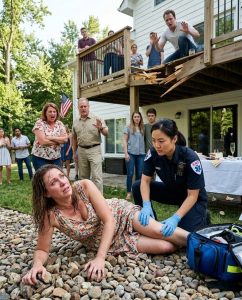
The heat that afternoon felt personal.
It pressed down on my parents’ backyard, on the white patio umbrellas, on the trays of catered food sweating under plastic lids, on the decorative river rocks that would later burn through the back of my dress while I stared up at a broken railing and tried to understand why my legs would not answer me.
I remember the smell first.
Fresh-cut grass, bourbon, sunscreen, grilled shrimp, and the hot mineral smell of stones that had been baking all day in the Connecticut sun.
I remember the sound too.
A champagne flute breaking somewhere behind me.
A woman gasping and then swallowing the rest of it because in my family, even horror had to be polite if there were guests around.
Above me, the second-floor deck railing hung open like a mouth with teeth missing.
Tyler leaned over it.
My brother’s face was pale for one second.
Just one.
Then the fear left his eyes and something flatter settled in its place.
That was when I knew he was already calculating.
He was not wondering whether I was alive.
He was wondering who had seen what.
Twenty minutes earlier, I had walked into my parents’ house knowing his birthday party was never going to be just a birthday party.
My mother had tied blue and silver balloons around the deck posts.
My father had ordered enough champagne for sixty people.
Tyler had turned thirty-eight that day, and the whole house had been arranged to tell him he was still the center of it.
But Grandmother Rose’s will had been read three days before, and that had ruined the performance.
The reading happened at 10:15 a.m. in a quiet attorney’s office with beige walls, weak coffee, and a wall clock that ticked too loudly every time my mother inhaled.
The attorney read slowly.
The jewelry company went to me.
The properties went to me.
The investment accounts went to me.
The controlling shares went to me.
All of it.
Tyler got one letter.
He did not open it in the room.
He held it in one hand, staring at the envelope like it had slapped him.
My mother started crying before the attorney finished the final page.
My father asked whether Rose had been under pressure.
The attorney said Rose had updated the trust documents twice, had submitted a medical competency letter with the file, and had insisted on recorded signing sessions for the final version.
That was Grandmother Rose.
Careful even in death.
She had built Rose & Wren Jewelry from a little repair counter into a company with three storefronts, a warehouse, and clients who trusted her more than they trusted their own relatives.
She loved beautiful things, but she loved proof more.
Receipts.
Inventory logs.
Copies of copies.
When Tyler borrowed money, she wrote it down.
When my parents excused him, she wrote that down too.
I had spent the last seven years helping her keep those records straight.
I drove her to appointments.
I sat beside her during chemo.
I made sure vendor contracts were scanned, payroll was approved, insurance policies were renewed, and every piece in the estate collection had a photographed condition report.
Tyler called that sucking up.
My parents called it hovering.
Rose called it being the only adult in the room.
That was the part no one wanted to say at the birthday party.
They did not want to say Tyler had been offered chances, jobs, loans, forgiveness, and introductions, and had burned through all of them.
They did not want to say Rose had watched him charm, rage, borrow, deny, and vanish whenever responsibility walked in the door.
They wanted to call me greedy because greed was easier than accountability.
Family has a strange way of turning labor invisible until money makes it useful.
The moment I stepped into the house, I could feel the trial begin.
Guests glanced at me and then away.
My mother Diane kissed the air beside my cheek without touching me.
My father Harold said, “Bridget,” like my name was a problem he was tired of hearing about.
Tyler found me before I reached the kitchen.
He smelled like bourbon and mint gum.
His wife Lauren stood behind him with her hand wrapped around their son Mason’s shoulder.
Mason was eight, skinny and serious, with the kind of quiet children learn when adults make too much noise.
Lauren’s eyes were lowered.
I noticed that before I noticed anything else.
“You poisoned her against me,” Tyler said.
His voice was low enough to pretend it was private, but loud enough for my parents to hear.
I looked at him.
Then I looked past him at my mother, who was standing by the patio doors with a glass in her hand, already waiting for me to apologize for being accused.
“I didn’t poison anyone,” I said.
Tyler’s mouth twitched.
“You always do this,” he said. “You play the victim and then act shocked when people finally see through it.”
I felt something in me go cold.
Not angry.
Not yet.
Just tired in a way that felt older than my body.
“Grandmother made her choice,” I said.
That was the sentence that changed his face.
His jaw shifted.
Lauren’s fingers tightened on Mason’s shoulder.
My father looked toward the deck, as if the view suddenly interested him.
My mother said, “Not here,” which in our family meant not where people can hear the truth.
Tyler stepped closer.
“You think you won,” he said.
“No,” I said. “I think she knew exactly what she was doing.”
I should have walked away then.
I thought about it.
I pictured setting down my glass, going back through the foyer, stepping onto the front porch, passing the small American flag my mother had stuck into the planter beside the door, getting into my car, and leaving them to choke on their own party.
For one ugly second, I also pictured throwing my drink in his face.
I did neither.
Restraint is not weakness.
Sometimes it is the last door you leave open before someone else chooses violence.
Tyler followed me onto the second-floor deck at 4:37 p.m.
I know the time because I had checked my phone after a message from Emma, my best friend, asking if I was okay.
I had typed, “Not really,” and never sent it.
The deck was crowded with people pretending to enjoy themselves.
There were paper plates balanced on cocktail napkins, champagne glasses catching sunlight, and a birthday cake waiting under a plastic cover near the sliding door.
The skyline shimmered in the distance.
Someone laughed too loudly.
Someone else said Tyler’s name in that bright warning tone people use when they want a man to stop without having to confront him.
Tyler did not stop.
He crowded me backward.
The railing pressed into my spine.
“Give it back,” he said.
I could feel the heat of the wood through my dress.
“It was never yours.”
His hands hit my shoulders.
I remember that clearly.
Not a stumble.
Not an accident.
Hands.
Both of them.
The railing gave way behind me with a rotten crack.
For a second, there was only sky.
Then the world turned.
I hit the river rocks on my back hard enough that every breath disappeared from my body.
Pain burst through my lower spine, bright and brutal.
Then came the absence.
I could see my legs.
They were there, one knee angled slightly, one shoe twisted halfway off.
But they had gone silent.
I tried to move my toes.
Nothing happened.
I tried again.
Nothing.
Panic moved up through me so fast I could taste metal.
Above me, the party froze.
A woman held her hand halfway to her necklace.
A man stared down into his champagne glass.
The birthday cake slid off its plate on the deck above, leaving a smear of frosting on the boards.
Nobody bent to pick it up.
Nobody moved.
Then my father came down the stairs.
Slowly.
Like he had all the time in the world.
My mother reached the rocks before he did, but she did not kneel.
She stood over me with her arms tight against her body, furious and embarrassed.
“Bridget, get up,” she snapped.
“I can’t,” I said.
My voice barely came out.
“You are making a scene.”
I looked at her and understood that she truly believed the worst part of this moment was the audience.
Harold crouched near me.
For one second, I thought he might touch my shoulder.
Instead he lowered his voice.
“You’ve embarrassed this family enough.”
I tried to breathe through the pain.
I tried not to cry.
For the first time in my life, I was too injured to perform the version of myself they preferred.
Tyler leaned over the broken railing above.
“Should we call someone?” he asked loudly.
It was a performance.
Concern shaped for witnesses.
If you did not know him, you might have believed it.
But I saw Marcus slip through the back door.
Marcus was Tyler’s best friend.
He was also the man who had installed my parents’ security cameras the previous fall after my father complained about delivery drivers leaving packages too close to the front walk.
Marcus did not go toward the street.
He did not go toward the front door.
He went toward the interior hallway where the security panel was mounted.
Tyler saw him too.
The fear in my brother’s face eased.
That frightened me more than the fall.
I begged them to call an ambulance.
My mother folded her arms.
My father told everyone I had always done things for attention.
Dr. Patricia Winters stood near the patio table with a paper coffee cup in her hand.
She had been our family doctor since I was twelve.
She had treated my childhood asthma, my mother’s migraines, my father’s blood pressure, and Tyler’s endless mysterious injuries after drunken nights he refused to explain.
She looked at me on the rocks.
Then she looked away.
That hurt in a place pain could not reach.
The ambulance siren cut through the music a few minutes later.
I found out later that one of the catering assistants had called 911 from behind the garage.
She did not know my family.
That was probably why she helped.
Paramedic Sarah Chen came through the side gate with a medical bag in one hand and authority in every step.
She knelt beside me without asking anyone’s permission.
“What’s your name?” she asked.
“Bridget.”
“Bridget, I’m Sarah. I’m going to check you, okay?”
I nodded.
Her partner started moving people back.
My father stepped closer.
“I sit on the hospital board,” Harold said.
Sarah did not look impressed.
“Then you know better than to interfere with my scene,” she said. “Move, or I’ll have police remove you.”
The yard went quiet in a new way.
Harold was not used to being spoken to like a regular man.
He stepped back.
Sarah checked my pulse.
She asked where it hurt.
She asked if I had hit my head.
Then she touched my leg.
“Do you feel this?”
“No.”
She moved lower.
“This?”
“No.”
She moved again.
“This?”
I stared at her face.
“No.”
Something in her eyes sharpened.
Not panic.
Training.
She kept her hand on my wrist.
“How did you fall?” she asked.
Tyler was gripping Lauren’s arm now.
Hard.
I could see the pressure of his fingers through the fabric of her sleeve.
Lauren winced and looked down.
For years, I had swallowed the truth because my family punished truth more harshly than cruelty.
I had swallowed Tyler’s lies.
I had swallowed my parents’ excuses.
I had swallowed being called selfish for keeping records, dramatic for remembering details, cold for not pretending my brother’s rage was pain.
But Sarah’s hand was steady on my wrist.
So I said it.
“My brother pushed me.”
The backyard went silent.
Harold started shouting first.
Diane cried out, “She’s lying.”
Tyler stepped back from the railing and pressed one hand to his chest like I had wounded him.
Sarah did not argue with any of them.
She looked at her partner and made one quiet signal.
Moments later, police were on the way.
The first cruiser turned into the driveway slowly enough for everyone to hear the tires crunch over the gravel.
My mother rushed toward the officers before they had even closed their doors.
“She fell,” Diane said. “She’s confused. This family has been under terrible stress since the will.”
Sarah stayed beside me.
“Patient reports being pushed from a second-floor deck,” she said. “Loss of sensation in both legs. Possible spinal injury. Scene is not secure.”
That sentence changed the whole yard.
It took the story out of my mother’s mouth and put it somewhere official.
Somewhere she could not polish it before handing it over.
Then Detective James Morrison stepped out of the second car.
He was not in uniform.
He wore a blue shirt, dark slacks, and an expression that made Tyler’s face drain before anyone said a word.
Morrison looked at me.
He looked at the broken railing.
He looked at Tyler.
Then he looked toward the patio door.
“Where’s Marcus?” he asked.
Tyler’s mouth opened.
No sound came out.
Lauren’s knees seemed to soften under her.
She caught herself on the deck post and pulled Mason against her side.
For one second, she looked less like Tyler’s wife and more like someone who had been waiting for the right question to break the room open.
Sarah’s partner came back from inside the house with his radio close to his shoulder.
“Security panel’s open,” he said.
Morrison turned fully toward Tyler.
“Then nobody touches another door,” he said, “until I find out what your friend was trying to erase.”
That was when Tyler finally looked afraid again.
The ambulance team lifted me onto a backboard.
The pain was unreal.
It moved through my body in waves, but below my waist there was still that terrible silence.
As they carried me past the deck, I saw my mother standing with one hand over her mouth.
Not because she was worried about me.
Because people were watching her.
My father was speaking to an officer in the same tone he used with contractors, lawyers, and restaurant managers.
The officer was not nodding.
Tyler stood near the stairs while Detective Morrison asked him questions.
Marcus was still inside the house.
I knew he had not gone there to get help.
The ambulance doors closed before I could see what happened next.
Sarah leaned close.
“You’re safe now,” she said.
I wanted to believe her.
At the hospital, everything became lights and ceilings.
White panels sliding over my head.
A monitor beeping.
A nurse cutting fabric near my shoulder.
Someone asking for my date of birth.
Someone else placing a hospital wristband around my wrist.
There is a strange mercy in medical process.
It does not ask whether your family approves of your pain.
It measures it, records it, treats it, and writes it down.
The hospital intake form said fall from height.
The police report would later say alleged assault.
The MRI said what none of them could soften.
My spinal cord had been severed.
Dr. Amanda Foster told me while I was lying in a room that smelled like disinfectant and plastic tubing.
She was kind, but she did not decorate the truth.
“The paralysis in your legs is permanent,” she said.
Permanent.
The word did not land all at once.
It entered the room, sat down beside me, and waited for me to understand it.
I thought of stairs.
Shoes.
Driving.
Standing in Grandmother Rose’s workshop while she showed me how to inspect a clasp under a lamp.
I thought of Tyler’s hands on my shoulders.
Then I stopped thinking because grief was too large to hold and still breathe.
Emma arrived before my parents did.
That was not surprising.
Emma had been my best friend since college, when she found me crying in a dorm laundry room because Tyler had emptied my emergency account and my parents told me I must have misunderstood.
She had believed me then.
She believed me now.
She came into the hospital room crying, carrying her purse against her chest with both hands.
“I have it,” she said.
Dr. Foster looked from her to me.
Emma reached into her purse and pulled out a small USB drive.
It was blue.
I knew it immediately.
My backup.
The one my family never knew existed.
For years, I had documented everything.
Not because I was planning revenge.
Because living around practiced liars teaches you that memory is not enough.
I had copies of emails from Tyler asking Rose for loans he later denied receiving.
I had voice memos of my parents pressuring Rose to change beneficiary forms.
I had photographs of damaged inventory after Tyler’s failed attempt to “help” at the warehouse.
I had a scan of the letter Rose wrote me six months before she died, telling me she was afraid Tyler would do something reckless once the will became public.
Emma had kept the backup at her apartment.
A promise made over takeout food one rainy night, when I finally admitted I was scared of what my brother might do.
Dr. Foster plugged the USB drive into the secure workstation after Emma explained what it was.
The first folder opened on the screen.
It was labeled ROSE ESTATE — INCIDENTS.
Inside were subfolders by date.
February 12.
March 8.
April 22.
June 3.
And then one folder labeled TYLER — THREATS AFTER WILL.
Dr. Foster did not speak for several seconds.
Emma covered her mouth.
The first audio file was time-stamped two days before the party.
Tyler’s voice filled the room.
“You think that will protects you?” he said on the recording. “You have no idea what people will believe about you when I’m done.”
Emma started crying harder.
I closed my eyes.
There it was.
Not drama.
Not attention.
Evidence.
Detective Morrison came to the hospital that evening.
He took my statement with a recorder on the tray table and a notepad balanced against his knee.
He did not interrupt.
He did not ask why my family would do that.
People who investigate harm for a living must learn quickly that cruelty rarely sounds reasonable when spoken plainly.
I told him about the will.
I told him about the deck.
I told him about Marcus.
When I mentioned the security panel, Morrison’s expression did not change, but his pen paused.
“We recovered partial footage,” he said.
My throat tightened.
“Partial?”
“Someone attempted to delete the backyard camera file,” he said. “They didn’t finish.”
Later, I learned why.
Mason had followed Marcus inside.
Not all the way.
Just far enough to see him open the panel and start pressing buttons.
Lauren saw Mason see it.
And when Detective Morrison asked her one question without Tyler standing beside her, something in her finally broke.
She told the truth.
Not all at once.
People who have been controlled do not always step into honesty like a doorway.
Sometimes they crawl toward it.
Lauren admitted Tyler had been drinking before I arrived.
She admitted he had said, “She’ll give it back if she’s scared enough.”
She admitted Marcus knew where the cameras were stored.
She admitted Tyler had grabbed her arm because she whispered, “Stop,” after he followed me onto the deck.
Mason told a child advocate that Uncle Tyler put both hands on me.
He used his own shoulders to show the motion.
That image undid me more than almost anything.
An eight-year-old should not have to demonstrate adult violence because adults were too cowardly to name it.
My parents came to the hospital the next morning.
Diane brought flowers from the gift shop downstairs, still wrapped in plastic.
Harold brought a lawyer.
That told me everything.
My mother cried beside my bed.
She said the family was being destroyed.
She said Tyler’s life would be over.
She said surely I did not want Mason growing up with his father in prison.
I looked at her flowers.
A drop of water had gathered inside the plastic and was sliding slowly down one stem.
“Do you know what the MRI showed?” I asked.
She looked away.
Harold said, “This is not the time for emotional accusations.”
I almost laughed.
My spine was severed, and he was still trying to manage tone.
Dr. Foster entered before I answered.
She was carrying my updated chart.
She looked at my father, then at the lawyer.
“Only approved visitors remain,” she said.
Harold tried the board line again.
It worked no better on her than it had on Sarah Chen.
“Then you know patient consent matters,” Dr. Foster said. “Bridget, do you want them here?”
My mother’s face changed.
For the first time, the question belonged to me.
“No,” I said.
That one word was smaller than a scream and stronger than one.
Security escorted them out.
My mother called my name once in the hallway.
I did not answer.
The months that followed were not clean or triumphant.
Real consequences rarely arrive with music.
They arrive with forms, pain scales, insurance calls, physical therapy schedules, police interviews, attorney meetings, and mornings where you wake up and remember your body has changed before you even open your eyes.
Tyler was charged.
Marcus was charged too, for tampering with evidence and obstruction-related offenses tied to the security system.
Lauren cooperated.
So did the catering assistant who called 911.
So did two guests who admitted they had seen Tyler crowd me backward but had been afraid to get involved because my father was powerful in their circle.
Dr. Patricia Winters lost more than my respect.
After the police report and medical documentation became part of the case file, questions were raised about her failure to render aid despite being present as a physician.
I do not know everything that happened professionally after that.
I only know she sent one apology letter through an attorney.
I did not respond.
Grandmother Rose’s records became the backbone of the estate fight my parents tried to start.
The recorded signing sessions held.
The competency letter held.
The trust documents held.
The company remained mine.
The first time I entered Rose & Wren Jewelry in a wheelchair, every employee in the main office stood up.
Not in pity.
In respect.
I hated that I cried.
I hated that I needed help getting through doors I used to open without thinking.
But I also remembered Rose’s voice in that workshop, telling me that good metal bends before it breaks and that repair is a craft people underestimate until something precious is in pieces.
I was in pieces.
But I was not gone.
Emma became my emergency contact.
Sarah Chen visited once, off duty, with a paper coffee cup and a terrible hospital vending machine muffin.
She told me the catering assistant had asked about me.
She told me Lauren and Mason were staying somewhere safe.
She told me I did not have to be grateful for surviving every minute of it.
That helped more than any speech about strength.
My parents tried to reach me for months.
Voicemails.
Letters.
Messages sent through family friends who suddenly remembered my number once the story was no longer controllable.
Diane wrote that she had been in shock.
Harold wrote that public charges helped no one.
Neither of them wrote, “We are sorry we told you to get up when your spine was broken.”
Neither of them wrote, “We are sorry we protected him until he destroyed part of your life.”
So I kept the letters in a file.
Not because I needed them.
Because documentation had saved me once, and I had learned not to throw away proof of who people were.
At Tyler’s sentencing, I gave a statement from my chair.
The courtroom was quiet.
Lauren sat near the back with Mason.
My parents sat on Tyler’s side.
Of course they did.
Tyler did not look at me until the judge asked him to.
When he finally did, I saw the same thing I had seen above the broken railing.
Calculation.
But it was weaker now.
The room no longer belonged to him.
I told the court about the fall.
I told them about the rocks.
I told them about hearing my mother say I was making a scene while I lay there unable to move my legs.
I told them the worst injury was not only what Tyler did with his hands.
It was what everyone else did with their silence.
An entire backyard had taught me, in one frozen moment, how many people will watch harm happen if the person causing it has enough money, charm, or family cover.
Then I looked at my brother.
“You did not push me because you lost an inheritance,” I said. “You pushed me because, for the first time, you could not make a woman who knew the truth hand it back to you.”
Tyler looked down first.
That did not heal me.
It did not give me my legs back.
But it mattered.
Afterward, outside the courtroom, my mother tried to touch my shoulder.
I moved my chair back before her hand landed.
Her face crumpled.
“Bridget,” she said.
I waited.
There was a time when that one word would have pulled me back into the family script.
Daughter.
Peacekeeper.
Apologist.
The one who made things easier for everyone else.
Not anymore.
I rolled past her toward Emma, who was holding the elevator door open with one hand and my coffee in the other.
Care looks different when it is real.
It does not ask you to shrink so someone else can stay comfortable.
It holds the door.
It keeps the backup drive.
It calls 911 from behind the garage.
It kneels beside you on burning rocks and says, “Tell me how you fell.”
I still live with what Tyler did every day.
Some mornings are hard.
Some nights are worse.
But Rose & Wren is still open.
Grandmother’s office is mine now, though I kept her old magnifying lamp exactly where she left it.
On the wall beside the inventory shelves, I framed one thing no one in my family knows about.
Not the will.
Not the sentencing paperwork.
Not the newspaper clipping.
A copy of the first incident log I created after Rose told me, “Write it down, Bridget. The truth deserves a paper trail.”
She was right.
The truth did not save me from the fall.
But it made sure I did not have to lie there forever while my family called it a scene.