The morning Katie Miller ran out of formula, the cold felt personal.
It slipped under her sleeves and bit the skin on her wrists.
It pressed against the twins through the thin blanket she had wrapped twice around them.
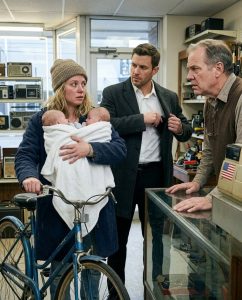
Emma slept with her cheek against Katie’s chest.
Lily was awake, but quiet in the frightening way babies get quiet when they are too tired to ask for anything.
Katie pushed her old blue bicycle along the sidewalk with one hand and held her daughters with the other.
The bicycle had been hers since she was nineteen.
It had carried her to diner shifts, clinic appointments, laundromats, and one midnight walk home after the girls’ father heard the word twins and decided fatherhood was not for him.
Now it was the last thing she owned that might become food.
The pawn shop on East Mercer had a yellow sign with peeling corners and a bell that rang too happily when she pushed inside.
The owner sat behind the counter, scrolling on his phone.
He did not look at the babies first.
He looked at Katie’s shoes.
Then the bicycle.
Then the space around her, as if poverty had a smell he could not stand.
“I want to sell this,” Katie said.
Her voice sounded smaller than she meant it to.
The owner leaned back.
“I do not buy junk.”
“It works,” she said quickly.
“I need formula.”
The word formula should have opened something in him.
It did not.
He set down his phone and stared at the twins.
“Keep begging here and child services will take them by dinner.”
Katie felt the room tilt.
She lifted her girls higher and said nothing.
That was the only strength she had left.
Outside, Dylan Reed sat in a black car at a green light and did not move.
He was supposed to be across town in twenty minutes, sitting under a glass wall while investors talked about expansion.
He had the calendar, the suit, the last name, and the numbness that came with all of it.
He also had a view through the pawn shop window.
He saw the owner point at the door.
He saw Katie step back like someone had hit her without touching her.
He saw the babies pressed against her chest.
The car behind him honked.
Dylan turned off the engine.
When he crossed the street, Katie tightened her hand around the bicycle.
He noticed that too.
Fear had made her practical.
He stopped several feet away and raised his palms.
“I’m sorry,” he said.
“I saw what happened.”
“I don’t need trouble,” Katie answered.
“I know.”
Her daughters whimpered.
Katie bent over them in the wind.
That small motion did something to Dylan that no boardroom had done in years.
It made him feel awake.
He asked her name.
She gave it reluctantly.
When he said his, her face changed.
Everybody knew the Reed name in that city.
It was printed on clinics, towers, shipping offices, and grocery stores where the wealthy bought flowers and the poor counted coins.
“I do not want your money,” Katie said.
“I did not offer money,” Dylan said.
He looked at the bicycle.
“I want to buy what he called junk.”
Inside the pawn shop, Mr. Bell stood straighter when he recognized Dylan.
Rich men were customers.
Poor mothers were problems.
Dylan placed a business card on the glass counter.
“Write her a receipt.”
Mr. Bell blinked.
“For the bike?”
“From Katie,” Dylan said.
“Not from you.”
Katie shook her head.
“It is not worth much.”
Dylan looked at her, and for once she did not see pity.
She saw respect.
“Then let it be worth what your daughters need today.”
She hated how badly she needed that sentence to be true.
She hated that Lily cried at the exact moment her pride tried to stand up.
Dylan did not hand her a wad of cash.
He walked with her to the grocery store next door and stayed half a step behind her, as if letting her choose mattered.
Katie picked up formula.
Only formula.
Dylan added diapers, wipes, bread, oatmeal, fruit, and a small bottle of medicine when the cashier whispered that Katie had skipped her own antibiotics again.
Katie’s face went red.
Dylan did not ask in front of the cashier.
That was the first kindness she trusted.
In the car, warmth filled the back seat so quickly that both babies softened against her.
Katie gave directions in short words.
Left.
Straight.
Two more blocks.
When they pulled up to her duplex, a red eviction notice was taped to the door.
Across the street, a black sedan idled.
Dylan knew the driver.
His father had sent him.
Richard Reed did not need to be in the room to make a place colder.
Dylan carried the grocery bags to the porch while Katie tried to unlock the door with shaking fingers.
“You should go,” she whispered.
“Why?”
“Because men like your father do not like women like me.”
Dylan looked at the sedan until it pulled away.
“Then he can dislike me too.”
Katie let him inside because her daughters needed bottles.
The duplex was small, clean, and tired.
A sofa with a blanket over the torn arm.
A fruit crate under the television.
Baby clothes drying on a string by the window.
A faucet that dripped with the patience of bad luck.
Dylan set the bags on the counter and looked around without judgment.
That mattered.
It mattered more than the groceries.
Over the next weeks, he came back.
At first, he brought things with excuses.
Diapers because they had been on sale.
A bulb because her kitchen light flickered.
A wrench because the faucet had been wasting water.
Katie did not believe in men who stayed for nothing.
So she watched him closely.
He never pushed into her life.
He never tried to hold the babies without asking.
He never made her feel bought.
He fixed the loose doorknob and left before dinner.
He replaced the outlet that sparked and thanked her for coffee in a chipped mug.
He sat on the floor while Emma chewed his sleeve and Lily stared at him like she had appointed him to something.
Slowly, Katie stopped flinching when the doorbell rang.
Slowly, Dylan stopped pretending he came only to help.
One Thursday, Katie asked why he was really there.
Dylan looked down at Emma’s tiny hand wrapped around his finger.
His mother had died when he was eight.
After that, his father filled the house with money and emptied it of warmth.
Dylan grew up learning how to inherit, how to negotiate, how to win, and how to say nothing when he wanted to grieve.
“When I saw you on that sidewalk,” he said, “I remembered what she used to be like.”
Katie did not ask him to explain faster.
She just listened.
That was another kind of rescue.
The day Lily’s fever climbed past one hundred four, Katie called Dylan from the bathroom floor.
She had one baby against her chest and the other crying in the crib.
Her voice broke on his name.
Dylan was in the most important meeting of the quarter when his phone rang.
He left before the CFO finished his sentence.
His father called while Dylan was running through the parking garage.
“Get back in that room,” Richard said.
“I have an emergency.”
“The only emergency is you throwing away this company for that woman.”
Dylan stopped at his car door.
For years, that voice had moved him like a leash.
That morning, it finally snapped.
“My mother would be proud of me,” Dylan said.
“Because I am choosing to be human.”
Then he hung up.
At the hospital, Dylan signed every form they put in front of him.
He held Emma while Katie ran after the nurse carrying Lily.
He fed one twin from a bottle with hands that shook and watched the hallway like his own life had been wheeled through those doors.
When the doctor said Lily was stable, Katie collapsed against him.
He held her and the baby between them.
He did not say she was not alone because it sounded good.
He said it because he meant to make it true.
Real family is the person who stays.
That was the turn Dylan could not untake.
Richard came that night to Dylan’s apartment with whiskey in one hand and disgust in the other.
He called Katie a trap.
He called the twins another man’s burden.
He said Dylan was confusing charity with love.
Dylan listened until his anger went quiet.
Quiet anger is the kind that knows where it is going.
“You gave me money,” Dylan said.
“You never gave me a home.”
Richard’s face hardened.
“If you walk away, do not come back.”
Dylan opened the door.
“I already walked away.”
The silence after Richard left did not feel empty.
It felt clean.
Two days later, Dylan went to Katie’s duplex with breakfast and no suit.
Katie opened the door with Lily on her hip and sleep in her eyes.
She looked like a woman who had survived too many mornings alone.
Dylan wanted every morning after that to be different.
They ate croissants at her tiny table while Emma banged a spoon against a bowl.
Dylan told Katie what had happened with his father.
He told her he loved her before fear could dress itself as caution.
Katie cried because hope can hurt when it arrives late.
“You can still leave,” she said.
“You have a life.”
“I had a schedule,” Dylan said.
“Not a life.”
He asked to build one with her.
Not as a visitor.
Not as a benefactor.
As family.
Katie said yes in a whisper, then again with her whole face.
Moving into Dylan’s apartment should have felt like entering someone else’s world.
Instead, he had already made space.
The spare room had two cribs with their names stitched into soft sheets.
The kitchen cabinets held bottles and cereal.
The living room had a rug where babies could fall and laugh.
Dylan placed a key in Katie’s palm.
“You are not a guest here.”
She closed her fingers around it and understood that this was not charity.
Charity looks down.
Love makes room.
For six months, the apartment learned how to be loud.
Toys appeared under expensive chairs.
Tiny socks turned up in suit pockets.
Emma said dada first and Dylan cried so hard Katie had to laugh into his shoulder.
Lily learned to walk by crashing into his knees and demanding applause.
Dylan resigned from his father’s company before Richard could fire him.
He used his own shares to start a small family assistance fund through one of the clinics his mother had loved.
He named it after her, but he did not make a speech.
He just opened the doors.
The final envelope arrived on a rainy Tuesday.
It came from Richard’s lawyer, thick and expensive, the kind of paper meant to make ordinary people nervous.
Katie found it first and went pale.
Dylan opened it at the kitchen table while the twins napped.
Inside was not a lawsuit.
It was a letter in his mother’s handwriting.
Richard had kept it hidden for twenty-four years.
My dear Dylan, it began.
If your father ever tries to make you choose between the Reed name and a human heart, choose the heart.
There was more.
His mother had left a private trust, separate from the company, to be released only when Dylan built a home of his own or used it to protect families with children in crisis.
Richard had buried it because he thought kindness was a weakness that could be delayed.
Katie covered her mouth.
Dylan read the last line three times.
The right inheritance is not what you receive, son.
It is what you refuse to become.
He went very still.
Then he laughed once, broken and grateful.
His mother had been gone most of his life, but somehow she had still found a way to stand beside him.
The trust paid off Katie’s old eviction debt, funded emergency formula shelves at three clinics, and bought back the pawn shop building on East Mercer when Mr. Bell lost his lease.
Dylan did not go inside to humiliate him.
He turned the place into a community pantry with a clean baby room in the back.
On the wall by the door, there was no plaque with Dylan’s name.
There was an old blue bicycle, restored and mounted carefully, its paint shining again.
Katie cried when she saw it.
“That bike was the day I almost gave up,” she said.
Dylan put his arm around her while Emma and Lily tugged at his pant legs.
“No,” he said softly.
“That was the day you kept going.”
Years later, people would say Dylan Reed saved a poor mother in the snow.
They would be wrong in the way people are wrong when they only see money.
Katie saved him too.
She saved him from becoming a polished man in a silent apartment with no one to come home to.
The twins saved him every morning they reached for him.
His mother’s letter saved the last piece of him that still needed permission to be kind.
And Katie, who had once walked into a pawn shop with nothing but a broken bicycle and two hungry babies, built a home so full of noise that Dylan sometimes stood in the hallway just to listen.
Not because it was perfect.
Because it was real.
Because everyone inside had been chosen.
Because one winter morning, when the world kept walking, one man stopped.