Rebecca gently closed the privacy curtain behind her and pulled a chair beside my bed.
She did not rush.
She did not pressure me.
She simply looked at me with the calm expression of someone who had heard terrible stories before.
“I’ve treated burns like this for fifteen years,” she said quietly.
“They usually have one thing in common.”
“The victim says it was an accident.”
I stared at the white blanket covering my legs.
My throat tightened.
“It wasn’t an accident,” I whispered.
Rebecca nodded as though she had known before I spoke.
“I know.”
“The injury pattern tells us.”
She explained that boiling water accidentally spilled almost never landed in such a controlled line across the back of the hand.
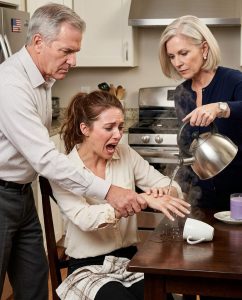
Someone had held my wrist.
Someone had poured deliberately.
Someone had wanted maximum damage.
My stomach twisted.
Hearing another person describe it made everything suddenly real.
It wasn’t anger.
It wasn’t discipline.
It was assault.
Rebecca asked softly, “Are you safe if you go home tonight?”
I laughed.
Not because anything was funny.
Because the question felt impossible.
“I don’t have a home anymore.”
“My apartment.”
“My fiancé.”
“They’ll come looking.”
She nodded again.
“Then we help make sure they can’t hurt you again.”
Within an hour, a police officer arrived.
His name was Daniel Ruiz.
He spoke gently, almost awkwardly, as if he understood that every question hurt.
He asked me to describe everything.
Every word felt like betrayal.
Every sentence felt like I was breaking some invisible family rule.
But once I started…
I couldn’t stop.
I told him about the pressure to marry Ethan.
The threats.
The folder full of money.
The dinner arguments.
My father’s ultimatum.
My mother’s fake apology.
The tea.
The kettle.
The smile.
When I finished, Daniel remained silent for several seconds.
Finally he said, “Miss Brooks…”
“What happened to you wasn’t a family disagreement.”
“It was felony aggravated battery.”
Those words echoed inside my head.
Felony.
Battery.
Not discipline.
Not misunderstanding.
Not parenting.
Crime.
Rebecca squeezed my shoulder.
“You did the right thing.”
For the first time that day, I believed her.
Noah arrived twenty minutes later.
Someone from the hospital had called the emergency contact listed on my paperwork.
He rushed through the doors still wearing a wrinkled blue cardigan covered with tiny glitter stars.
His third-grade students had apparently decorated him during art class.
His eyes found my bandaged hand.
Then they filled with tears.
He didn’t ask questions.
He didn’t demand explanations.
He simply knelt beside my bed and kissed my forehead.
“I’m here.”
Those two words shattered whatever strength I had left.
I cried harder than I had since childhood.
“I’m sorry,” I kept saying.
“I’m sorry.”
He frowned.
“For what?”
“They hurt you because of me.”
He looked genuinely confused.
“Hannah.”
“They hurt you because of themselves.”
“Don’t ever confuse those things.”
I realized then why I loved him.
He never made pain about himself.
The next morning my parents began calling.
Twenty-three missed calls.
Seven voicemails.
Fourteen text messages.
None asked whether I was okay.
Every one demanded that I stop talking to police.
One message from my father read:
“You are destroying this family.”
Another followed minutes later.
“Think carefully before ruining your mother’s life.”
Then another.
“No judge will believe you.”
Rebecca had warned me not to delete anything.
Every message became evidence.
Daniel requested copies.
My parents had unknowingly begun building the case against themselves.
By afternoon Ethan called.
I almost ignored it.
Curiosity answered instead.
“Hannah.”
His voice sounded strangely nervous.
“I’m so sorry.”
I waited.
He sighed.
“I didn’t know they’d do something like this.”
I closed my eyes.
“You knew they were trying to force me.”
“Yes.”
“You kept showing up.”
“Yes.”
“You let them plan a wedding that wasn’t mine.”
Silence.
Then he whispered something I never expected.
“I told them to stop.”
That surprised me.
“They wouldn’t listen.”
“They said you’d come around.”
“They always said they knew what was best.”
I believed him.
Not because he was innocent.
Because he sounded ashamed.
“I don’t love you, Ethan.”
“I know.”
“I never did.”
“I know.”
He breathed deeply.
“I’m leaving for Seattle next week.”
“My father’s taking over the dealerships.”
“I’m done with all of this.”
Before hanging up he said quietly,
“I hope you marry the man you actually smile around.”
That was the last time we ever spoke.
Two days later detectives executed a search warrant at my parents’ house.
They seized phones.
Security cameras.
Computers.
My father had always believed cameras protected property.
Instead they protected truth.
One kitchen camera captured everything.
My mother lifting the kettle.
My father gripping my wrist.
No accident.
No struggle.
Just intention.
When Daniel called with the news, he paused before speaking.
“I’ve watched a lot of difficult footage.”
“This one…”
He exhaled.
“It’s hard.”
The wedding was supposed to be Saturday.
Instead of canceling, Noah asked me a question while helping me change my bandages.
“What matters more?”
“The date?”
“Or us?”
I smiled through swollen eyes.
“Us.”
He grinned.
“Then let’s adjust.”
My doctor cleared me to attend as long as I avoided infection.
The ring couldn’t fit over my wrapped left hand.
So Noah looked at the minister and smiled.
“Is there a rule saying love only fits one finger?”
Everyone laughed softly.
He slid the wedding band onto my right hand instead.
The guests applauded.
Someone cried.
Actually…
Almost everyone cried.
Including me.
Including Noah.
Even the minister wiped his glasses twice.
Our wedding photos showed white flowers, bright sunshine, and thick medical bandages wrapped around my hand.
For years I wondered whether those bandages ruined the pictures.
Eventually I realized they made them honest.
They showed exactly what love had survived.
Three months later the trial began.
My parents pleaded not guilty.
Their attorneys claimed the burn had been accidental.
They claimed emotions were high.
They claimed I exaggerated.
Then prosecutors played the kitchen video.
The courtroom became completely silent.
My mother’s careful movement.
My father’s grip.
His smile.
Her steady hand.
There was no accident to argue.
No misunderstanding.
Only choice.
The jury deliberated less than four hours.
Both were convicted.
As deputies placed handcuffs around my father’s wrists, he looked directly at me.
“I hope you’re happy.”
I surprised myself by answering.
“I am.”
Not because he was going to prison.
Because for the first time in my life…
He no longer controlled the ending.
Healing took much longer than the trial.
Burns do not disappear because justice happens.
Skin tightened.
Scars formed.
Physical therapy hurt almost as much as the injury itself.
Some mornings I couldn’t close my hand.
Some nights phantom pain woke me before dawn.
Whenever frustration overwhelmed me, Noah sat beside me with his old guitar.
He never played complicated songs.
Just simple melodies his students loved.
Sometimes healing sounded like music drifting through a tiny apartment kitchen.
Sometimes it sounded like laughter after dropping burnt pancakes onto the floor.
Sometimes it sounded like silence shared between two people who no longer needed perfect words.
A year after the wedding, Rebecca invited me to speak at a hospital training seminar.
I almost declined.
Then I remembered the woman who had looked at my injury and seen the truth before I could say it.
I stood before dozens of new nurses with my scar visible.
I told them something I wished someone had told me years earlier.
“Victims don’t always need someone to rescue them.”
“Sometimes they need someone to recognize what they’re too frightened to name.”
After the presentation, a young nurse approached with tears in her eyes.
“My sister keeps saying she falls a lot.”
She hesitated.
“I don’t think she does.”
I squeezed her hand carefully.
“Then don’t ignore what your instincts are telling you.”
Rebecca smiled across the room.
I knew exactly why.
Compassion spreads the same way cruelty does.
One person at a time.
The difference is that compassion leaves people stronger.
Five years later Noah’s third graders insisted on planting a small garden outside their school.
Each child chose one flower.
One little girl handed me a packet of lavender seeds.
“They smell safe,” she said.
The words caught me completely off guard.
Lavender.
The same scent my mother’s kitchen had carried that afternoon.
For years I couldn’t smell it without shaking.
I held the seeds for a long moment.
Then I smiled.
“Let’s plant them.”
Months later the flowers bloomed.
Their fragrance drifted across the playground where children laughed under the summer sun.
For the first time since that terrible afternoon, lavender no longer reminded me of betrayal.
It reminded me that memories can change.
Not because the past disappears.
But because life keeps growing around the scars.
And sometimes the deepest wounds become the places where the strongest roots finally take hold.
Five years passed more quickly than I ever imagined they could.
Scars faded.
Some remained white and raised across the back of my hand.
Others existed only inside memories.
The nightmares came less often.
Instead of waking every week, they visited only a few times each year.
When they did, Noah never asked questions.
He simply reached across the bed and held my right hand until morning.
That had become our silent language.
One touch always meant the same thing.
You’re safe now.
Life slowly became wonderfully ordinary.
I was promoted to senior architect.
Noah became the music coordinator for the entire school district.
Our weekends were filled with grocery shopping, neighborhood barbecues, and arguments over whether pineapple belonged on pizza.
For the first time in my life, peace felt normal.
Then one rainy Tuesday afternoon, my phone rang.
The caller ID showed an unfamiliar number.
“I’d like to speak with Hannah Brooks.”
“This is she.”
“My name is Margaret Ellison.”
“I’m the executor of your grandmother Eleanor’s estate.”
I frowned.
“My grandmother died years ago.”
“Yes.”
“However, a trust established before her death has only now become accessible.”
“There are conditions attached.”
My stomach tightened.
Conditions.
I hated that word.
“What kind of conditions?”
“I believe it’s better discussed in person.”
The attorney’s office overlooked Lake Michigan.
Rain slid down the tall windows while Margaret placed a thick folder in front of me.
“Your grandmother anticipated conflict within your family.”
I blinked.
“What do you mean?”
Margaret opened the file carefully.
“She amended her will six months before she passed away.”
“She left a personal letter.”
My hands suddenly felt cold.
I hadn’t heard my grandmother’s voice in nearly ten years.
Margaret handed me an envelope.
My name appeared across the front in familiar cursive.
Dear Hannah,
If you’re reading this, it means enough time has finally passed.
I pray you escaped the life your parents planned for you.
I loved your mother once.
But somewhere along the way she confused control with love.
I watched it happen.
I failed to stop it.
For that, I ask your forgiveness.
Tears blurred the page.
The letter continued.
Your grandfather built our family’s real fortune.
Not the businesses.
Not the houses.
The investment trust.
I moved my share into an account no one knew about.
Not even your parents.
It belongs to you now.
Only you.
Use it to build a life no one can purchase.
I love you always.
Grandma Eleanor.
I couldn’t speak.
Margaret quietly pushed a tissue box across the desk.
“There is one complication.”
Of course there was.
“Your parents discovered the trust exists.”
“They’re contesting the will.”
I laughed bitterly.
“From prison?”
“They’ve retained attorneys.”
“They claim your grandmother was manipulated.”
I looked toward the rain outside.
“They never stop.”
“No.”
“They usually don’t.”
The court hearing was scheduled for September.
I assumed it would be routine.
Instead, reporters gathered outside.
My parents’ criminal conviction had received local attention years earlier.
Now headlines described a new family battle over several million dollars.
I hated every camera.
Noah squeezed my shoulder.
“We walk past them.”
“Nothing else.”
Inside the courtroom my parents looked older.
Much older.
Gray hair.
Stooped shoulders.
Wrinkled faces.
Time had not been kind.
Neither had prison.
For one brief second I almost felt sorry for them.
Then my father smiled.
The same smile.
The one from the kitchen.
Any sympathy disappeared instantly.
Their attorney argued my grandmother had suffered cognitive decline.
He claimed I had influenced her decisions.
Margaret calmly produced years of medical evaluations proving otherwise.
Then she presented handwritten journals.
Page after page.
My grandmother had documented everything.
Every argument.
Every threat.
Every attempt by my parents to control my future.
One journal entry froze the courtroom.
If anything ever happens to Hannah because she refuses the marriage they arranged, I want the world to know I saw this coming.
They frighten me.
The judge looked over his glasses.
“So your grandmother anticipated possible violence?”
Margaret answered quietly.
“Yes, Your Honor.”
The room became silent.
During a recess someone touched my elbow.
I turned slowly.
It was my mother.
She looked thinner than I remembered.
Her prison uniform had been replaced by simple civilian clothing.
“Hannah.”
I said nothing.
“I just want five minutes.”
“No.”
“Please.”
“No.”
Tears filled her eyes.
“I was wrong.”
Still…
I said nothing.
She lowered her voice.
“I thought I was protecting you.”
I finally answered.
“You poured boiling water on your daughter.”
She closed her eyes.
“I know.”
“You don’t know.”
“You remember.”
“Those are different things.”
She began crying openly.
People in the hallway pretended not to watch.
“I pray every night you’ll forgive me.”
I took a slow breath.
“I don’t wake up hoping you suffer.”
“I don’t hate you anymore.”
“But forgiveness doesn’t mean pretending trust still exists.”
She whispered, “Is there anything I can do?”
I looked at the scar stretching across my hand.
“No.”
“There are some things no one gets to undo.”
I walked away before she could answer.
The judge ruled entirely in my favor.
The trust remained untouched.
The journals became permanent court records.
As we exited the courthouse, reporters shouted questions.
“Hannah!”
“Do you have anything to say after today’s victory?”
I stopped.
Not because I wanted publicity.
Because I suddenly knew exactly what needed saying.
“My grandmother believed love should never require obedience.”
“She was right.”
“No amount of money is worth surrendering your freedom.”
Then Noah gently guided me toward the car.
That single statement appeared in newspapers across Illinois the next morning.
The inheritance changed our lives.
Not because we became wealthy.
Because we became useful.
Noah suggested something unexpected.
“What if we create scholarships?”
“For music?”
“And architecture.”
“For students whose families can’t support their dreams.”
I smiled.
“Grandma would love that.”
Within a year the Eleanor Brooks Foundation awarded twelve scholarships.
Then twenty-three.
Then forty.
Every recipient wrote a letter describing what the opportunity meant.
I saved every single one.
Whenever I doubted whether surviving had mattered, I opened those letters.
Hope has remarkable handwriting.
One autumn afternoon I received another unexpected phone call.
Rebecca Collins.
The forensic nurse.
“Hannah.”
“I have someone I’d like you to meet.”
The next day I visited the hospital.
Rebecca introduced me to a young woman named Olivia.
Her left arm rested in heavy bandages.
Olivia stared at the floor.
“She doesn’t believe anyone will understand,” Rebecca explained.
I sat beside her quietly.
“I used to think that too.”
She glanced toward my scar.
“What happened?”
I rolled up my sleeve.
“My parents.”
Her eyes widened.
“My boyfriend.”
For nearly an hour we talked.
Not about injuries.
About fear.
About guilt.
About believing abuse somehow becomes your responsibility.
When I stood to leave, Olivia hugged me carefully.
“You make it seem possible.”
“It is.”
“It won’t feel possible every day.”
“But one day you’ll wake up and realize your life belongs to you again.”
Rebecca smiled as I walked away.
Years earlier she had done exactly the same thing for me.
Now I understood.
Healing always travels forward.
One survivor reaches another.
That Christmas Noah surprised me.
Instead of buying jewelry or expensive gifts, he handed me a small wooden box.
Inside lay my original engagement ring.
I stared at it.
“I thought it was ruined.”
“So did I.”
“I had it restored.”
The tiny diamond caught the firelight.
He smiled nervously.
“I know you already wear your wedding ring.”
“But this belongs to your story.”
I slipped it onto my right hand beside my wedding band.
The scar remained visible beneath it.
Perfect.
Some people hide broken places.
I no longer wanted to.
The ring no longer represented the day my parents tried to stop my future.
It represented the fact that they failed.
On the tenth anniversary of our wedding we returned to the little church where we had exchanged vows.
The minister had retired.
The building looked exactly the same.
Sunlight poured through stained-glass windows.
Fresh flowers lined the aisle.
No guests waited.
Only us.
Noah reached for my scarred hand.
“Anything you would change?”
I looked around the quiet sanctuary.
I thought about pain.
About justice.
About Rebecca.
About my grandmother.
About every person who had helped rebuild a frightened woman into someone stronger.
Then I smiled.
“Only one thing.”
“What?”
“I wish I had believed sooner that family isn’t defined by who raises you.”
“It’s defined by who refuses to let you face darkness alone.”
Noah kissed my forehead exactly as he had in that hospital room years before.
Outside, church bells rang across the neighborhood.
For a long moment we simply stood there listening.
The sound reminded me that time keeps moving.
Pain becomes memory.
Memory becomes wisdom.
And sometimes, after surviving the worst thing you never imagined possible, life gives you something even more extraordinary than justice.
It gives you the freedom to become the kind of person your younger self desperately needed to meet.
Leave a Reply