Part 1: The Coffin That Was Never Meant to Be Opened
I imagined spending my first day home from deployment holding Emily and finally meeting the son I had dreamed about for eleven long months. Instead, I walked through my front door in full military uniform and found a coffin sitting in the middle of my living room. My duffel bag slipped from my hand as I struggled to understand what I was seeing.
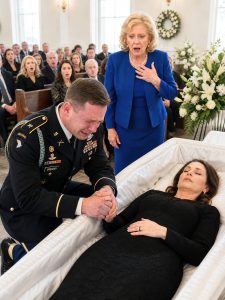
My mother stood beside the coffin without a single tear on her face. Her clothes were perfectly arranged, her posture was calm, and nothing about her resembled a woman mourning the sudden loss of her daughter-in-law.
“Your wife died giving birth, Daniel.”
For several seconds, I couldn’t process her words. Then a weak newborn’s cry drifted down from upstairs, reminding me that while Emily was supposedly gone, my child was still alive somewhere inside the house.
“Where’s my son?” I asked.
“He survived,” my mother replied. “Barely. Emily was careless.”
Across the room, my younger brother Caleb leaned against the fireplace with a whiskey glass in his hand, looking completely at ease.
“She always liked making everything dramatic.”
Ignoring both of them, I walked toward the coffin and looked down at Emily. She was wearing the blue dress she had promised to greet me in when I came home, and someone had arranged her hair so carefully that she almost looked asleep. Yet the details immediately felt wrong because there was no hospital bracelet, no paperwork from the delivery, no flowers from the maternity ward, and no doctor waiting to explain how a healthy young woman had supposedly died.
Every instinct I had developed during my years in military intelligence told me something about the room had been deliberately staged. I had spent months overseas learning to notice the smallest inconsistencies because overlooked details often meant the difference between life and death, and that same instinct immediately warned me that someone wanted me to accept this scene without asking questions.
As I leaned closer, I noticed Emily’s right hand resting tightly against her side. Unlike her left hand, every finger remained locked into a fist as though she had been protecting something until her final breath.
“What is she holding?” I asked.
For the first time since I arrived, my mother’s composure slipped. The change lasted only an instant before she forced herself to smile again.
“Nothing,” she answered quickly. “Leave her dignity intact.”
I ignored her warning and bent over the coffin anyway. She immediately grabbed my sleeve to stop me.
“Daniel,” she said sharply. “Stop.”
I lowered my eyes to her hand before calmly meeting her gaze.
“Take your hand off me.”
She slowly let go without another word. Once she stepped back, I carefully loosened Emily’s stiff fingers and immediately noticed several tiny crescent-shaped cuts beneath her fingernails, as though she had fought desperately to keep her hand closed.
Something small slipped into my palm.
It was a black memory card.
The color drained from my mother’s face the instant she recognized it, while Caleb froze with his whiskey glass suspended halfway to his mouth.
“What is that?” he demanded.
I quietly closed my hand around the card before either of them could move closer.
“You tell me.”
My mother recovered faster than I expected. She forced a nervous laugh and quickly searched for an explanation.
“It probably came from her phone. Emily became obsessed with recording everything after she got pregnant. She was paranoid.”
The baby cried again upstairs, breaking the uneasy silence. Without drawing attention to what I was doing, I slipped the memory card into the concealed pocket sewn inside my uniform jacket and kept my eyes fixed on both of them.
Months before deploying overseas, I had transferred ownership of our home into a protected military family trust that only I could authorize. Emily also had full access to my encrypted evidence vault because she had quietly admitted she no longer trusted my mother with our finances, but neither my mother nor Caleb knew any of that.
They believed they were facing a heartbroken soldier who would accept whatever story they handed him. What they forgot was that I had spent my career as an intelligence warrant officer, where uncovering carefully constructed lies was part of my job every single day.
I looked directly at my mother.
“Tell me exactly how my wife died.”
She opened her mouth, but before she could speak, I raised one hand to stop her.
“Choose your next words carefully, Mother,” I said quietly. “Because your freedom may depend on them.”
Part 2: The Evidence Emily Protected Until the End
My mother insisted that Emily had gone into labor unexpectedly that morning. She claimed Emily refused to call an ambulance, chose to deliver the baby with the assistance of a private midwife, and passed away before anyone could save her. The explanation sounded polished, but every answer created more questions than it resolved.
“Which midwife?” I asked.
“She already left,” my mother replied.
“Which hospital confirmed Emily’s death?”
Before my mother could respond, Caleb slammed his whiskey glass onto the table.
“Why are you interrogating us?”
I turned my eyes toward Emily’s coffin before answering.
“Because somebody should.”
My mother’s voice immediately softened, as though a gentler tone could make her story more believable. She urged me to stop asking questions, go upstairs to meet my son, and leave everything else to her.
“You’re exhausted,” she said gently. “Go upstairs and meet your son. We’ll take care of the funeral tomorrow.”
The word tomorrow echoed in my mind. She wanted Emily buried less than a day after I returned home, and that urgency alone made me trust her even less.
Without arguing, I walked upstairs to the nursery. My son lay quietly inside his crib wrapped in a gray blanket, and relief washed over me when I saw his tiny chest rising and falling with steady breaths. That relief disappeared almost immediately when I noticed a half-filled baby bottle beside him that carried a faint chemical smell no infant formula should have.
I photographed the bottle from several angles before sealing it inside a sterile evidence bag from my deployment medical kit. Then I carried my son into the adjoining bathroom, locked the door, settled him safely inside a portable bassinet, and opened my hardened military laptop.
The first thing I did was create a complete forensic copy of the memory card so its original data would remain untouched. Years in military intelligence had taught me never to examine original evidence directly when preserving the chain of custody could determine whether it remained admissible later.
The memory card contained six video files, all recorded by a hidden nursery camera Emily had secretly installed inside a bookshelf overlooking our son’s crib. I opened the first recording and watched my mother quietly searching through our financial records while Emily was out of the room, carefully photographing bank statements, trust documents, and property files before placing everything back exactly where she found it.
The second recording was even more disturbing. Caleb sat alone at the dining table repeatedly practicing my signature until his forgery became almost impossible to distinguish from my real handwriting.
When I opened the third video, my stomach tightened. Emily stood beside the crib, heavily pregnant, holding several legal documents while my mother blocked the doorway with folded arms.
“Sign the trust amendment,” Mother ordered. “Daniel may never come home, and this family isn’t going to be controlled by you.”
Emily refused without hesitation.
“The trust belongs to Daniel, me, and our baby,” she answered. “I’ve already sent copies of your forged transfers to his secure evidence vault.”
Caleb immediately grabbed her phone before she could react. Emily reached after it, but he shoved her backward so hard that she crashed into the edge of a wooden table before collapsing to her knees, clutching her stomach in pain.
“Call an ambulance,” she gasped.
Instead of helping, my mother crouched beside her with complete indifference.
“Sign first.”
The next recording lasted more than forty minutes, and every second was harder to watch than the last. Emily begged repeatedly for medical help while her contractions grew stronger, but my mother remained by the front door to stop anyone from leaving, and Caleb deliberately disconnected the house telephone before returning to watch her suffer.
Emily cried, pleaded, and struggled to remain conscious while both of them refused to help. Even as her condition visibly worsened, my mother never showed the slightest compassion.
“You’ll sign,” she said coldly, “or both of you can die stubborn.”
Near the end of the recording, Emily somehow found the strength to crawl toward the bookshelf. While neither my mother nor Caleb noticed, she reached behind the hidden camera, removed its memory card, and concealed it inside her clenched fist before collapsing again.
Only after she became critically weak did Caleb finally call emergency services. The final recording ended with my mother calmly giving him one last instruction before the ambulance arrived.
“Tell them,” she said, “that she refused treatment.”
I sat motionless for several minutes after the videos ended, forcing myself to think instead of react. Once I regained control, I uploaded every recording into the encrypted military evidence vault Emily had mentioned, allowing the system to preserve the original timestamps, audit logs, and chain of custody so nothing could ever be altered or challenged.
After securing the evidence, I made three phone calls. The first went to Detective Lena Ortiz, a homicide investigator I had previously worked with during a joint military explosives case. The second went to my military legal counsel, and the third went to Dr. Arjun Shah, a pediatric emergency physician whose judgment I trusted completely.
Less than an hour later, Dr. Shah arrived through the side entrance accompanied by Detective Ortiz, who introduced herself as his medical assistant so my family wouldn’t recognize her. While Dr. Shah examined my son and tested the contents of the bottle, Detective Ortiz quietly reviewed copies of the recordings without drawing attention to herself.
“There may be something unusual mixed into this,” Dr. Shah whispered. “Your son needs to be admitted to the hospital.”
Detective Ortiz gently shook her head.
“Not yet,” she said quietly. “If we move too soon, they’ll stop talking.”
When we returned downstairs together, my mother was already waiting at the dining room table with a stack of neatly arranged legal documents and an expensive fountain pen placed beside them. She smiled as though nothing unusual had happened all day.
“Sign these,” she said. “Then you can grieve.”
Part 3: Emily Left Them Nowhere to Hide
I sat down across from my mother without touching the documents she had placed in front of me. Caleb remained standing nearby with his arms folded, watching me carefully because both of them believed grief had clouded my judgment. Neither realized I had already watched every minute of Emily’s recordings and knew exactly what they had done.
“What am I signing?” I asked.
My mother calmly pushed the first document toward me.
“Authority over the house, the family trust, and the baby. You’ve just come back from combat, Daniel. You’re grieving, you’re exhausted, and you aren’t in any condition to manage everything alone. Caleb and I will protect what’s left until you’re ready.”
Caleb smiled as though the outcome had already been decided.
“You’ve always been good at following orders,” he said. “Money was never really your thing.”
They completely misunderstood my silence. Throughout my years in military intelligence, the person who spoke the least usually learned the most, and while my mother believed she controlled the conversation, I quietly activated the digital recorder hidden beneath my uniform jacket.
I looked directly at her before asking the question I already knew she couldn’t answer honestly.
“Emily told me you were stealing from us. She said she had proof.”
For the first time that evening, my mother’s eyes flickered toward my jacket pocket where the memory card rested. The movement lasted only an instant, but it confirmed she knew exactly what Emily had hidden.
“Emily lied about everything,” she replied quickly.
“What about the memory card?”
Before my mother could answer, Caleb immediately stepped forward.
“Give it to me.”
I ignored him completely and kept my attention fixed on my mother.
“Did you refuse to call an ambulance until Emily signed those papers?”
The room became completely silent. My mother’s carefully controlled expression finally disappeared, and years of pretending to be the reasonable one gave way to pure anger.
“She had no right to defy me,” she snapped. “That house should have belonged to me. Your deployment money should have taken care of your real family.”
I met her eyes without raising my voice.
“My wife was my real family.”
She slammed her hand onto the table, unable to control herself any longer.
“She would still be alive if she had signed!”
The words hung in the air, and nobody spoke for several long seconds. Even Caleb stared at her in disbelief as she slowly realized she had just admitted exactly what happened.
Panic overtook him almost immediately. He shoved his chair aside and lunged across the dining table, reaching for my jacket in a desperate attempt to seize the memory card before I could use it as evidence.
He never reached me.
The front door burst open before he could take another step. Detective Lena Ortiz entered first with her service weapon drawn, followed by two sheriff’s deputies, while Dr. Shah and two paramedics hurried in behind them carrying equipment for my son.
“Don’t move!” Ortiz ordered.
Caleb froze where he stood. My mother slowly turned toward the doorway, her confidence disappearing as she tried to understand what was happening.
“What is this?”
Detective Ortiz never lowered her weapon.
“Margaret Hale and Caleb Hale,” she said clearly. “You are under arrest.”
My mother looked back at me in complete disbelief.
“You set me up.”
I slowly stood from my chair and shook my head.
“No,” I answered. “Emily did. I just refused to let you bury the evidence with her.”
Caleb spun toward the kitchen and tried to run, but one of the deputies intercepted him before he reached the doorway and forced him against the wall. Another deputy handcuffed my mother while she continued screaming that Emily had been unstable, emotional, and impossible to control.
“She provoked us!” my mother shouted. “No jury is going to believe a dead woman.”
Detective Ortiz looked at her without the slightest emotion.
“She doesn’t have to testify,” she replied. “She already did.”
Over the following months, investigators carefully examined every piece of evidence Emily had preserved. The autopsy confirmed she suffered severe internal injuries from the fall Caleb caused, followed by prolonged labor and a fatal hemorrhage that should have been treated hours earlier. Telephone records proved the house phone had been intentionally disconnected, while forensic testing confirmed the baby bottle contained a sedating antihistamine capable of placing a newborn in serious danger.
Financial investigators also uncovered more than two hundred eighty thousand dollars in forged transfers connected to accounts controlled by my mother and Caleb. The documents waiting for my signature that afternoon would have handed them legal control over my family trust, my home, and my infant son if I had signed without asking questions.
During the trial, prosecutors played every recording recovered from Emily’s hidden nursery camera. The courtroom fell completely silent as her voice echoed through the speakers.
“Call an ambulance,” she pleaded.
My mother lowered her head, but the jury never looked away.
After weeks of testimony, Margaret Hale was convicted of second-degree murder, unlawful imprisonment, child endangerment, financial fraud, and several related offenses, receiving a thirty-eight-year prison sentence. Caleb later pleaded guilty to manslaughter, forgery, conspiracy, and evidence tampering, receiving fourteen years in prison, while the funeral director who attempted to rush Emily’s burial lost his professional license after admitting he ignored obvious irregularities.
Eighteen months later, I retired from active military service and accepted a position training future intelligence officers. My son Noah learned to walk beneath Emily’s favorite maple tree, every stolen dollar was recovered and returned to the trust she had fought to protect, and every night before bed I showed him his mother’s photograph.
“She never stopped protecting you,” I always told him.
On the anniversary of Emily’s death, Noah placed a single white flower beside her headstone. I rested my hand against the cool stone and thought about the tiny memory card she had hidden inside her clenched fist while everyone else believed she had already lost.
“They thought your hand couldn’t change anything,” I whispered. “They were wrong.”
As Noah reached for my hand, I realized something had finally changed inside me. The anger that carried me through the investigation had quietly disappeared, and in its place, only justice remained.