The day my grandfather found me walking in the cold with my newborn strapped to my chest, I thought I was having one bad afternoon.
I did not yet understand that I was standing in the middle of a life that had been quietly rearranged around me.
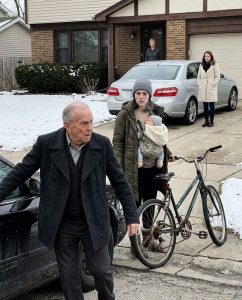
The sidewalk was wet from old snow that had melted and frozen again.
The front tire of my bicycle had gone flat before I even made it past the corner, and by then I was already too committed to turn around.
Ethan needed formula.
The canister at home was almost empty, and the little plastic scoop inside kept scraping the bottom in that dry, hollow way that makes panic sound louder than it should.
So I walked.
One hand on the handlebar.
One hand resting against the carrier on my chest.
Ethan was warm against me, his cheek tucked into the blanket, completely unaware that I was counting dollars in my head while trying not to cry on a suburban sidewalk.
I had once owned a silver Mercedes.
It had been my grandfather’s gift after Ethan was born, his answer to my refusal to let him pay my hospital bills.
He had laughed, kissed my forehead, and said, “Then let me make sure my granddaughter never has to put a baby in an unsafe car seat in a bad car.”
I had cried when he handed me the keys.
Three months later, my sister Mary was driving it.
That was how things worked in my parents’ house.
Nothing was taken all at once.
It happened in pieces so small you kept telling yourself it was temporary.
At first it was just practical, according to my mother.
I was tired after delivery.
Mary had more places to go.
The car would only sit in the driveway if I kept it.
Then my keys were “misplaced.”
Then my bank card stopped working.
Then my father said he had called the bank to “simplify a few things” while I rested.
Then small amounts started vanishing from my account.
Then larger ones.
Then every time I asked about money for diapers, gas, or formula, my mother tilted her head and said the same sentence in the same patient voice: “Olivia, you’ve had a lot on your mind lately.”
It was remarkable what people could do to you while sounding helpful.
I might have stayed in that fog longer if my grandfather had not rolled down the window of his black sedan and seen me standing there.
He looked from Ethan to the bicycle to the driveway of my parents’ house.
The Mercedes was visible even from the street.
“Olivia,” he said.
“Why aren’t you driving the car I gave you?”
I should have softened the answer.
I should have laughed.
That was what I had trained myself to do.
Instead I said, “I only have this bicycle.
Mary is the one driving the Mercedes.”
He was silent for one second.
Then he said, “Get in the car.”
My mother and sister came out before I could move.
Mary in a cream coat, hair curled, expression already practiced.
My mother with that controlled concern she wore like jewelry.
“Dad, please,” she said.
“Don’t start this outside.”
“Olivia doesn’t need the car every second,” Mary added.
“She likes to
make everything sound dramatic.”
My father stayed in the doorway, hands in his pockets, as if refusing to choose a side was the same thing as innocence.
My grandfather did not argue with any of them.
He only looked at me and repeated, “You and the baby.
In the car.”
That should not have felt revolutionary.
Yet it did.
I got in.
Warmth filled the back seat.
Ethan shifted and made a sleepy little sound.
I stared out the window as we drove away, and for the first time in months I watched my parents’ house get smaller without wondering how I would make things easier when I returned.
My grandfather let the silence sit for several minutes.
Only after we had turned out of the neighborhood did he ask, “This is not just about the Mercedes, is it?”
“No,” I said.
Something opened in me then.
Maybe it was exhaustion.
Maybe it was the sight of someone finally believing the evidence of his own eyes.
Maybe it was simply that there was no room left inside me for pretending.
I told him everything.
The missing keys.
The bank card.
The money that disappeared.
The trust he once mentioned for Ethan and me that I had never seen in writing.
The way my mother insisted postpartum stress made paperwork confusing.
The way my father said he would explain later.
The way Mary used my car, my accounts, and even my name when it was convenient.
The way they all made me feel unstable for noticing.
My grandfather did not interrupt.
When I finished, he told the driver, “Take us to Howard & Stein.”
That was his law firm.
“Grandpa,” I whispered, suddenly scared of what would happen next.
“Maybe we should talk to them first.”
He took my hand.
“People who intended to be fair would not have waited for a sidewalk to expose them.”
At Howard & Stein, I sat in a conference room with Ethan asleep in my arms while two attorneys reviewed what little I had—screenshots, old emails, one photo of Mary at a restaurant valet stand beside the Mercedes, and a bank notification I had saved because it made no sense at the time.
My grandfather’s primary attorney was a woman named Andrea Voss.
She had kind eyes and a voice that never rose, which somehow made her more intimidating.
She asked me a series of precise questions.
Did I ever sign a transfer of use agreement for the vehicle?
No.
Did I authorize anyone else to withdraw from my account after childbirth?
No.
Did I receive copies of trust paperwork after my grandfather informed me one had been created?
No.
Did anyone tell me I was incapable of handling my own finances?
Repeatedly.
Andrea wrote something down each time, then finally looked at my grandfather.
“We need the estate records, the trust ledger, and the access history on all related accounts.
Tonight.”
That word—tonight—made me sit straighter.
I think until then I had assumed adults like my parents operated in a space where consequences were slower, softer, and always negotiable.
Apparently not when my grandfather was involved.
He brought Ethan and me back to his estate while the attorneys worked.
The house had always intimidated me when I was younger.
It sat behind iron gates
and tall trees, not flashy but deeply ordered.
Everything had a place.
Every room felt deliberate.
That night, for the first time in months, I sat in a quiet room while my son slept for nearly two uninterrupted hours.
Then the intercom rang.
My family was at the gate.
We watched the security monitor together.
My mother stood closest to the camera.
Her face was strained but arranged into visible distress.
Mary kept her arms folded like armor.
My father stood slightly behind them, wearing the expression of a man who wanted this solved without anyone mentioning how he got here.
“Olivia,” my mother said toward the speaker, “come out.
We need to talk like a family.”
Mary stepped forward.
“If there’s been a misunderstanding, stop humiliating us and come home.”
I felt an old instinct rise in me.
Fix it.
Go smooth it over.
Make this private.
My grandfather gave a quiet order to security instead.
A few minutes later, headlights cut across the gate.
Andrea arrived with two members of estate security and a leather file case.
When she stepped into the floodlight, my mother stopped speaking.
Andrea requested permission to address them at the gate.
My grandfather pressed the intercom button.
“Proceed.”
Andrea opened the first folder.
“Mrs.
Olivia Bennett’s gifted vehicle remains titled for her exclusive use,” she said.
“No transfer of possession or authorization for third-party use appears in our records.”
Mary’s face drained instantly.
My mother recovered first.
“That’s ridiculous.
We were helping Olivia after the baby.”
Andrea opened a second folder.
“Then perhaps you can explain the ongoing withdrawals from accounts under her name after notice of personal control restoration was drafted.”
I looked at my grandfather.
“Drafted?”
He did not take his eyes off the screen.
“Three months ago I requested the papers be sent to you.
Your mother said you had received them.”
The room seemed to tilt around me.
Andrea continued.
“Those documents were never delivered to Ms.
Bennett.
We have internal confirmation of that.”
My father finally spoke.
“This doesn’t need to be a spectacle.”
My grandfather leaned toward the intercom.
“My granddaughter walked in winter with my great-grandson because your household had control of her money and transportation.
Any spectacle began there.”
No one answered.
Andrea removed one last envelope and held it up under the gate light.
The trust seal was visible even through the monitor.
My mother made a sound I had never heard from her before—not anger, not embarrassment.
Fear.
Andrea looked directly at the camera and said, “Mrs.
Bennett, please be advised that the family trust established by Mr.
Calloway for Olivia Bennett and Ethan Bennett includes specific spending limits, disclosure requirements, and prohibitions on unauthorized access.
We have reason to believe those terms were breached.”
Mary whispered, “Mom?”
My father stared at the ground.
My grandfather turned off the monitor.
No speech.
No dramatic victory.
Just the end of audience access.
Then he looked at me and said, “Now we do this properly.”
What followed was not one explosive confrontation.
It was something much worse for my parents.
It was paperwork.
Over the next two days, Andrea and her team reconstructed the last eight months of my financial life.
They discovered repeated transfers from my account into a household operating account my mother
controlled.
The amounts were disguised as temporary reimbursements, then rounded off in ways designed to look ordinary.
There were luxury retail charges linked to Mary’s cards, fuel charges consistent with the Mercedes, and even salon appointments paid from a debit card that should have been in my possession.
There was also the matter of the trust.
My grandfather had established a protected support trust for me after Ethan’s birth.
It was not a massive fortune, but it was enough to ensure that I would never need to ask permission for housing, childcare, healthcare, or transportation during Ethan’s early years.
My mother had intercepted the initial disclosure packet and told both my grandfather and the firm that I wanted her to “manage everything temporarily while I recovered.”
She had forged my consent on two authorizations.
When Andrea said those words out loud, I actually laughed once.
Not because it was funny.
Because I had spent months being treated like I was confused, and it turned out the confusion had been engineered.
My grandfather’s face went still in the way that meant danger to whoever had caused it.
By Friday morning, the Mercedes was returned to the estate driveway by a tow service, not by Mary.
My sister sent six messages before noon.
The first five were furious.
The sixth said she had only done what our parents told her was fair.
My mother left tearful voicemails about family misunderstanding, sacrifice, and how no one appreciates what mothers carry.
My father asked if this could all be handled “quietly.”
Andrea answered for me.
It would be handled legally.
There was a formal demand for repayment.
A notice of fraudulent account interference.
A petition to remove my mother from any role related to my finances or Ethan’s.
A request for further investigation into the forged trust authorizations.
And then, because my grandfather had seen enough of my dependence tied to their roof, he did one more thing.
He offered me the guest cottage on his estate for as long as I wanted it.
I cried harder at that than I had at any point in the legal process.
Not because it was luxurious.
Because it came without conditions.
Two weeks later, I moved in.
The cottage sat behind a line of bare winter hedges, quiet and sunlit in the mornings.
It had pale walls, a real nursery, and a kitchen where I could open a cabinet without wondering who would monitor what I took.
I bought formula with my own card.
I held my own keys.
I reviewed my own statements.
Every ordinary thing felt almost unreal.
The first time I drove the Mercedes again, I had to pull over after three blocks because I started crying at a stoplight.
Freedom can feel embarrassingly simple when you have been deprived of it slowly.
The legal matter took months to resolve.
My mother’s forged signatures were undeniable once handwriting experts reviewed them.
My father insisted he “didn’t understand the details,” which turned out to be less of a defense than he hoped.
Mary avoided direct liability on some parts, but not on the use of the vehicle and several linked charges.
Settlement negotiations followed.
Repayment plans were proposed.
Property was discussed.
Family friends suddenly stopped calling my mother back as quickly.
The story my
family had built around me—that I was fragile, confused, overwhelmed, unready—fell apart the moment facts were placed in order.
That may have been the most shocking part.
I had not needed a better personality.
I had needed a record.
During one mediation session, my mother cried and said she had only wanted to keep me close because she was afraid I would make bad decisions alone.
Andrea replied, “You do not protect an adult daughter by taking her transportation, money, and legal information.”
I will remember my mother’s face at that table for the rest of my life.
Not because she looked sorry.
Because for the first time, she looked seen.
My relationship with my family did not recover.
That is the part people always ask about later, as if survival should naturally end in reconciliation.
It did not.
Mary sent a birthday card for Ethan six months later with no note inside.
My father asked to meet for coffee once and spent most of the conversation telling me how hard the fallout had been on him.
My mother wrote a long letter about forgiveness that used the word family nineteen times and the word sorry exactly once.
I did not answer.
My grandfather never pressured me.
He would check on Ethan, bring little wooden puzzles or books, and sit in my cottage kitchen drinking tea like it was the most ordinary thing in the world to repair someone by refusing to rush their healing.
One spring afternoon, nearly a year after the sidewalk, he watched Ethan sleeping in his stroller and said, “You know what upset me most that day?”
I thought of the car, the money, the forged paperwork.
“What?” I asked.
He looked out the window.
“You had gotten so used to being mistreated that you told the truth like an apology.”
That stayed with me.
Because he was right.
The theft was terrible.
The control was terrible.
The lies were terrible.
But the deepest injury was the version of me they had almost convinced me to become—someone who believed her own life required permission.
Ethan is older now.
He laughs easily.
He reaches for my grandfather whenever he visits.
The Mercedes no longer feels symbolic.
It is just a car.
My bank card is just a bank card.
Keys are just keys.
That is how I know I am healing.
The things that once represented power have become ordinary again.
Still, every winter when the air turns sharp and the sidewalks shine with old ice, I remember that day with perfect clarity.
The flat tire.
The empty formula canister waiting at home.
The black sedan stopping beside me.
My grandfather’s eyes moving from the bicycle to the driveway.
And the moment everything began to change because one person looked at what was in front of him and refused to accept the lie built around it.
Sometimes I wonder what would have happened if he had driven by ten minutes earlier or later.
If Mary had parked somewhere else.
If Ethan had not needed formula that afternoon.
If I had swallowed the truth one more time.
I will never know.
What I do know is this: the most dangerous family cruelty is rarely loud at first.
It arrives disguised as help, concern, practicality, timing, and love.
It asks you to hand over one thing, then another, then another, until your own life starts feeling like a room other people have decorated without you.
And sometimes the biggest red flag is not the day they finally take too much.
It is the day you realize they expected you to thank them for it.