Every morning, Michael Carter found a reason to be angry.
Most mornings, the reason was the same.
Sarah had not given him a son.
He said it like a debt she had refused to pay, like a promise she had broken on purpose, like two little girls sleeping upstairs in pink pajamas were evidence against her.
The house looked ordinary from the street.
There was a small American flag on the porch, a dented mailbox by the curb, and a driveway where Michael parked his aging SUV crooked every night after work.
Neighbors saw the porch light come on before sunrise.
They saw Sarah step outside sometimes with her hoodie pulled too tight around her face.
They heard shouting.
Then windows closed.
That was how the street survived it.
Everybody learned when not to look.
Inside the house, Sarah learned when not to breathe too loudly.
She learned which floorboards creaked.
She learned how to turn the coffee pot on before Michael asked.
She learned how to smile at her daughters with a split lip pressed flat enough that they would only ask once whether Mommy was sick.
Emma was seven.
Olivia was four.
They were bright, soft-hearted girls who loved pancakes, sidewalk chalk, and taping crayon drawings to the refrigerator with crooked strips of clear tape.
Emma drew suns with eyelashes.
Olivia drew everybody with giant hands because, she said, hands were for holding.
Sarah kept every drawing.
Michael tore some of them down when he was in a mood.
He hated evidence of tenderness.
He hated anything that made him look like the smallest person in his own house.
His mother lived with them in the back bedroom off the kitchen.
Her name was Carol.
Carol wore soft sweaters, kept a rosary near the sink, and spoke about family duty as if duty only moved in one direction.
She had been there the first time Michael called the girls a curse.
She had looked at Sarah, then at the stove, then stirred the soup harder.
That was Carol’s gift.
She could make silence look like patience.
Sarah used to think Carol would help her one day.
Early in the marriage, before things got bad enough to name, Sarah had trusted her with small things.
She let Carol watch Emma when Sarah went to prenatal appointments.
She gave her a key to the house.
She told her where she kept the girls’ medical cards, school forms, and emergency cash.
Carol had accepted all of it with a thin smile.
Later, she used that same closeness to pretend she had seen nothing.
Trust is not always betrayed with a knife.
Sometimes it is betrayed by a woman standing ten feet away, drying a coffee mug while your life comes apart in the next room.
On the Tuesday everything changed, Sarah woke before the alarm.
The room was still dark, except for the gray line of dawn at the edge of the curtains.
She heard the furnace click.
She heard Michael’s breathing shift beside her.
Then she heard his feet hit the floor.
Her stomach tightened before he said a word.
By then, her body knew the day before her mind did.
Michael opened the bedroom door too hard.
It struck the wall with a dull pop.
“Get up,” he said.
Sarah pushed herself onto one elbow.
“Michael, the girls are still asleep.”
He turned, and the hallway light cut across his face.
“I said get up.”
She followed him because refusing had never protected her.
The hallway carpet was cold under her feet.
Downstairs, the kitchen smelled like burned toast and old coffee.
Carol stood by the counter in her robe, her rosary wrapped around one hand.
She did not look surprised.
That hurt in a different way.
Michael opened the back screen door and shoved Sarah out ahead of him.
The door snapped shut behind them.
The sound cracked through the gray morning air.
The backyard grass was wet.
Sarah’s nightshirt clung to her legs.
Near the chain-link fence, one of Emma’s chalk drawings had faded into a pink smear from overnight rain.
Sarah stared at it because sometimes focusing on one small thing helped her stay inside her own body.
Michael grabbed her arm.
“No son,” he said.
Sarah closed her eyes.
“No real family.”
The first slap turned her face sideways.
The second made her bite the inside of her cheek.
She tasted blood, sharp and metallic.
A dog barked somewhere behind the neighbors’ fence, then stopped.
A window slid shut across the yard.
Sarah heard it clearly.
That sound stayed with her later.
Not the shouting.
Not even the blow.
The window.
A small, ordinary sound made by someone choosing comfort over courage.
Michael kept talking as he hit her.
He said she had embarrassed him.
He said his friends had sons.
He said his name would die in a house full of girls.
Sarah wanted to tell him what a doctor had told her years earlier, that the father determines whether a baby is a boy or girl.
She had almost said it once.
His reaction had taught her never to say it again.
That morning, her eyes went to the rake leaning against the garage.
For one second, one bright and terrible second, she imagined grabbing it.
She imagined the shock on his face.
She imagined him afraid.
Then she thought of Emma and Olivia upstairs, waking to sirens, strangers, questions, and blood on the patio.
She did not move toward the rake.
She curled inward instead.
That was what survival had taught her.
Protect the head.
Protect the ribs.
Do not provoke the next blow.
But something was different.
A pain tore across her side, low and deep, so sharp her knees folded before she understood she was falling.
The grass rushed up.
Michael’s voice stretched long and strange.
The fence tilted.
The chalk drawing blurred.
Then the whole backyard disappeared into white.
When Sarah woke, she was moving.
Ceiling lights passed above her one after another.
A wheel squeaked under the gurney.
Somewhere close, a woman’s voice said, “Trauma bay two.”
Sarah tried to lift her head.
Pain clamped around her ribs and stole the breath from her chest.
“Easy,” someone said.
The air smelled like antiseptic, plastic gloves, and coffee that had been sitting too long.
A paper bracelet scratched against Sarah’s wrist.
She blinked until the letters became clear.
Chicago General Hospital.
The intake time printed beneath her name was 7:42 a.m.
Michael stood beside the gurney.
His hair was damp like he had splashed water on his face before coming in.
His expression was carefully arranged.
Not tender.
Careful.
There is a difference.
“My wife fell down the stairs,” he told the doctor.
He said it too quickly.
Sarah noticed that.
So did the doctor.
The doctor was a middle-aged man with tired eyes and a calm voice.
His badge said Dr. Harris.
He looked at Michael, then at Sarah, then at the bruising along her cheek and jaw.
“How many stairs?” he asked.
Michael blinked.
“What?”
“How many stairs did she fall down?”
Michael’s jaw shifted.
“Basement stairs. I don’t know. Most of them.”
Sarah’s house did not have basement stairs.
It had a laundry room off the kitchen and a crawl space Michael complained about every winter.
Sarah closed her eyes.
She expected Dr. Harris to miss it.
People missed things all the time when Michael spoke with confidence.
Instead, the doctor’s voice softened.
“Mrs. Carter, can you tell me what happened?”
Michael’s hand landed on Sarah’s shoulder.
Not hard enough for the doctor to call it what it was.
Hard enough for Sarah to understand.
“She’s confused,” Michael said.
Sarah tried to speak.
Her throat worked.
Nothing came out.
Dr. Harris did not argue with Michael.
He reached for the chart.
“We’re going to run a full trauma panel,” he said. “X-rays, blood work, abdominal imaging, and a patient safety screening.”
Michael’s fingers stiffened on Sarah’s shoulder.
“What does that mean?”
“It means we document what we see.”
The sentence was quiet.
It landed like a door locking.
A nurse named Dana came in with a clipboard.
She asked Sarah questions in a voice gentle enough to make Sarah want to cry.
Name.
Date of birth.
Pain level.
Emergency contact.
Did she feel safe at home?
Michael answered the first questions before Sarah could.
Dana stopped writing.
“I need the patient to answer when she can.”
Michael laughed once.
It was ugly because it was nervous.
“I’m just trying to help.”
Dana looked at him for half a second.
Then she wrote something down.
Sarah saw the pen move.
That tiny motion gave her more hope than any speech could have.
They wheeled her into radiology at 8:26 a.m.
The room was cold, and the table beneath her back felt like metal under a thin sheet.
The radiology tech told her when to hold still.
Sarah almost smiled.
Stillness had been demanded from her for years.
This was the first time it was asked for her own good.
The white light above the table made her eyes water.
She stared at it until it became a circle without edges.
She thought of Emma waking up and looking for her.
She thought of Olivia asking why Mommy did not make pancakes.
She thought of Carol standing in the kitchen with that rosary in her hand.
Then the machine moved.
The tech stepped behind the barrier.
The image was taken.
Then another.
Then another.
By the time Sarah was rolled back to the room, she was shaking under two blankets.
Pain came in waves.
Michael was in the hallway on his phone.
He lowered his voice when he saw her.
Sarah heard only one sentence.
“She fell, Ma. That’s all anyone needs to know.”
Carol arrived at 9:11 a.m.
She came in wearing a plain beige coat over her nightclothes, her purse clutched to her chest.
She did not kiss Sarah.
She did not ask if she was all right.
She looked at Michael first.
“What did you tell them?” she whispered.
Sarah turned her face toward the wall.
That was the moment something inside her stopped waiting for rescue from that family.
The shift was quiet.
It did not feel like bravery.
It felt like exhaustion reaching its final shape.
At 9:34 a.m., Dr. Harris asked Michael to step into the hallway.
Sarah lay still behind the half-open door.
The curtain had not been pulled all the way.
She could see the edge of the doctor’s white coat.
She heard a film envelope slide open.
Paper against paper.
Then Dr. Harris said, “Sir, I need you to look at these films.”
Michael did not answer.
That silence was new.
Sarah knew all of Michael’s silences.
His angry silence.
His sulking silence.
His silence before he broke something.
This was different.
This was fear.
Dr. Harris spoke again.
“Your explanation does not match these injuries.”
Michael said, “She fell.”
“No.”
One word.
Flat.
Unmoved.
Sarah closed her eyes and felt tears slide into her hair.
Not because the doctor had saved her yet.
Because someone had finally said no to Michael and meant it.
A moment later, the door opened.
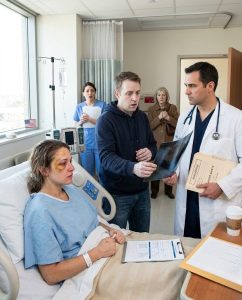
Michael stepped back into the room holding the X-ray film.
His face had lost color.
His mouth opened, but no sound came out.
Carol entered behind him, and her eyes went straight to the film.
“What is it?” she asked.
Michael did not answer.
Dr. Harris followed with Sarah’s chart pressed to his chest.
Dana, the nurse, stood just behind him with another folder.
Across the top, Sarah saw the stamp.
PATIENT SAFETY SCREENING.
Michael saw it too.
His hand dropped from Sarah’s shoulder as if her skin had burned him.
That was the part Sarah would remember for years.
Not the X-ray itself.
Not even Michael’s face.
His hand leaving her body.
For the first time that morning, he was afraid to touch her.
“Mrs. Carter,” Dr. Harris said.
Michael flinched at the name.
Dr. Harris placed the X-ray against the light box on the wall.
The room brightened around the black-and-white image.
He pointed to one area, then another.
“These fractures are in different stages of healing,” he said.
Carol made a small sound.
Dr. Harris did not look away from Michael.
“That means they did not happen from one fall this morning.”
Michael’s face tightened.
“She’s clumsy.”
Dana opened the folder.
“We photographed the visible bruising during intake,” she said. “The patterning is documented.”
“Patterning?” Michael snapped.
Dr. Harris’s voice stayed calm.
“Some of these injuries are recent. Some are older. Several are consistent with repeated blunt-force trauma.”
Carol’s rosary slipped from her fingers.
It hit the tile with a tiny click.
For years, she had used those beads to make herself look holy while refusing to do the one decent thing in front of her.
Now even the beads had fallen away.
“Michael,” she whispered.
He turned on her so fast that Sarah recoiled.
“Don’t start.”
The doctor stepped forward.
“Do not speak to anyone in this room that way.”
Michael looked at him as if he had forgotten doctors could be men who stood their ground.
Dana moved closer to Sarah’s bed.
It was not dramatic.
It was not loud.
But Sarah understood the shape of protection when she finally saw it.
Dr. Harris continued.
“There is also something else on the scan.”
Michael froze again.
Sarah’s heart began to beat harder.
“What?” she whispered.
The doctor turned toward her, and his face softened.
“Mrs. Carter, we need more imaging to be certain about the full extent, but the abdominal trauma is serious. We are admitting you today.”
Michael’s eyes flashed.
“No. She’s coming home.”
“No,” Dr. Harris said again. “She is not.”
The second no was stronger than the first.
Dana pressed the call button by the bed.
Within minutes, a hospital social worker arrived.
Her badge said Patient Advocate.
She introduced herself as Ms. Lewis and spoke directly to Sarah.
Not over her.
Not around her.
Directly to her.
“Sarah, do you feel safe with him in this room?”
The room went silent.
Michael stared at Sarah.
Carol stared at the floor.
The monitor beeped beside the bed.
Sarah’s lips trembled.
For a moment, she was back in the yard, curled around pain, listening to windows close.
Then she saw Dana’s hand resting near the bed rail.
She saw Dr. Harris standing between Michael and the door.
She saw the folder with the photographs, the intake form, the X-ray, and the notes written in black ink.
Tests have a language liars hate.
This time, the paperwork was speaking for her.
“No,” Sarah whispered.
Michael’s face changed.
It was not shame.
It was rage realizing it had witnesses.
Ms. Lewis nodded once.
“Thank you for telling me.”
Michael took one step toward the bed.
Dana hit another button.
Two hospital security officers appeared in the doorway less than a minute later.
One was tall and broad-shouldered.
The other kept his eyes on Michael’s hands.
“Sir,” the taller one said, “we need you to step into the hallway.”
“This is my wife.”
“She is a patient under our care.”
The words changed the room.
For years, Michael had used wife like ownership.
The hospital used patient like responsibility.
Sarah turned her face away as security guided him out.
Michael did not shout at first.
He argued in the polished voice he used for strangers.
Then, as the hallway swallowed him, the polish cracked.
“She’s lying!” he yelled.
No one in the room moved.
Carol began to cry.
It was a small, collapsing kind of cry, the kind people make when they realize their silence has finally been counted.
“I prayed,” she whispered.
Sarah looked at her.
The words came out rough.
“You watched.”
Carol covered her mouth.
There was no answer that could survive that sentence.
Over the next few hours, the hospital became a place of forms, signatures, and careful voices.
Sarah signed a consent for treatment with a shaking hand.
Ms. Lewis helped her complete a safety plan.
Dana documented the bruises and made sure Sarah’s daughters’ school pickup information was changed before Michael could reach them.
At 12:17 p.m., Ms. Lewis called the school office.
At 12:29 p.m., Emma and Olivia were released only to Sarah’s sister, Megan, whose number was still listed as an alternate contact.
Megan arrived at the hospital with both girls just after 2:00 p.m.
Emma had been crying.
Olivia held a crumpled drawing in one hand.
When they saw Sarah in the bed, both girls stopped in the doorway.
Sarah tried to smile.
It broke halfway.
“I’m okay,” she said.
Emma looked at the IV, the bruises, the hospital bracelet.
“No, you’re not.”
Children can be merciless with the truth because they have not yet learned the adult habit of decorating lies.
Megan sat on the edge of the bed and took Sarah’s hand carefully.
“I’ve got them,” she said. “And I’ve got you.”
Sarah believed her because Megan had never asked for gratitude before offering help.
That evening, a police report was opened based on the hospital documentation.
Sarah did not watch the officers write every word.
She did not need to.
For the first time, the story was not being told only by Michael.
It was in the X-rays.
It was in the intake photographs.
It was in the safety screening folder.
It was in the doctor’s notes.
It was in Sarah’s whisper when someone finally asked the right question.
No, I do not feel safe.
Michael was not allowed back into the room.
Carol stayed in the waiting area for another hour, then left without asking to see the girls.
Sarah did not stop her.
Some exits are not losses.
Some exits are the first clean air a room has had in years.
The recovery took longer than anyone wanted.
There were appointments, statements, protective orders, and nights when Sarah woke in Megan’s guest room because a car door slammed somewhere down the block.
There were mornings when Olivia asked whether Daddy was mad at them.
There were afternoons when Emma stopped drawing suns for a while.
Sarah answered as honestly as she could without placing adult weight on small shoulders.
“None of this was your fault,” she told them.
She said it so often that eventually she realized she was saying it to herself too.
Months later, Sarah drove past the old house one last time with Megan in the passenger seat.
The flag was gone from the porch.
The mailbox still leaned toward the street.
The backyard fence stood exactly where it had always stood.
For a moment, Sarah saw herself there again, curled in wet grass, waiting for the world to look away.
Then Olivia spoke from the back seat.
“Mommy, can we get pancakes?”
Sarah looked at Emma, who was holding a new drawing in her lap.
This one had three people standing under a yellow sun.
All of them had giant hands.
Hands for holding.
Sarah started the car again.
“Yes,” she said. “We can get pancakes.”
The old street fell behind them.
The closed windows stayed closed.
But Sarah did not need those neighbors to open anything anymore.
The truth had already opened.
And once it did, Michael could not shut it again.