Kayla’s scream tore through the house before sunrise.
At first, I thought she had fallen.
There is a difference between a teenager yelling because she is angry and a child screaming because the world has changed under her feet.
This was the second kind.
I threw the covers back so fast my foot tangled in the sheet, and I ran down the hallway without my glasses, without my slippers, without a single sensible thought in my head.
The hallway was cold beneath my bare feet.
The house smelled like stale coffee from the pot I had forgotten to empty the night before and the faint lavender shampoo Kayla had used after her shower.
She had washed her hair twice that night because prom was the next day.
That was the first thing my brain offered me as I hit the doorframe with my shoulder and stumbled into her room.
Prom was that night.
Kayla was sitting upright in bed with both hands clamped to her head.
Her eyes were so wide they looked almost black.
Her mouth was open, but for a second no sound came out.
Then she screamed again.
I saw the pillow first.
Blonde hair covered it in soft ruined clumps.
More hair lay across the sheets.
More was scattered on the carpet.
The strands caught the gray morning light from her window and looked almost pretty, which made the sight worse.
My seventeen-year-old daughter, the girl who had spent months talking about loose curls and prom photos and how Steven said she looked like a movie star when she wore her hair down, had no hair left to wear down.
Not short.
Not uneven.
Gone.
She scrambled out of bed and ran to the bathroom mirror, and when the vanity lights flickered on, the scream that came out of her made my hands go numb.
Her scalp was shaved close.
There were uneven patches near one ear, little rough places where whoever had done it had moved too quickly.
Her prom dress still hung from the closet door inside its plastic cover.
Pale blue satin.
Tiny beading at the waist.
Shoes in a box underneath.
A whole night waiting there like a cruel joke.
My husband appeared behind me, breathing hard, his T-shirt twisted like he had yanked it on in the dark.
“What happened?” he asked.
I could not answer.
Kayla was sobbing into her hands in front of the mirror, and all I could think was that no stranger had come into our house.
The doors were locked.
The windows were closed.
The razor was not in the bathroom.
Then my husband turned toward the smaller bedroom across the hall.
Reese’s door was half open.
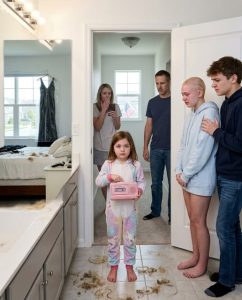
Our eight-year-old was sitting on the edge of her bed in unicorn pajamas, her bare feet not touching the floor.
My husband’s electric razor sat on her nightstand.
Her little face looked pale and exhausted, but not surprised.
She had been waiting for us.
“Reese,” I said, and my voice came out sharper than I meant it to. “What did you do?”
She looked up at me.
Those big brown eyes had gotten her out of trouble more times than I cared to admit.
They had softened teachers, grandparents, babysitters, and me.
That morning, they did not look soft.
They looked terrified and stubborn.
“I saved her the only way I could,” she said.
For a second, rage went through me so fast it felt clean.
I wanted to yell.
I wanted to snatch up the razor.
I wanted to demand how she could do something so cruel to the sister she worshipped.
This was the same child who still crawled into Kayla’s bed during thunderstorms.
The same little girl who sat on the toilet lid while Kayla did makeup and asked why high school girls laughed so loud.
The same Reese who saved every note Kayla wrote her, even grocery-list scribbles that said things like, “Don’t eat my chips. Love you.”
Kayla was not just her sister.
Kayla was her weather report for the whole world.
So I did not understand how Reese could look at the wreckage in that hallway and say she had saved anyone.
Then the front door opened downstairs.
Steven called up before I could speak again.
“Kayla? Babe? Your mom said the florist opens at nine, right?”
His voice moved through our house like it belonged there.
And that was part of what still shames me.
We had let him belong there.
Steven had been dating Kayla for almost a year.
He was polite in the rehearsed way adults praise too quickly.
He took his shoes off by the door.
He helped carry grocery bags from the SUV.
He called me Mrs. Adams and my husband Mr. Adams.
He had been at our kitchen table for dinners, football games on television, school project panic, and lazy Saturdays when Reese built forts from couch pillows.
We had trusted him with the spare-key code because he came by so often.
Trust is strange that way.
Sometimes it wears a clean hoodie and says yes ma’am.
Steven came up the stairs two at a time, still talking about corsage colors, until he reached the bathroom doorway and saw Kayla under the vanity lights.
His face went blank.
It lasted less than a second.
But I saw it.
Not shock.
Calculation.
Then concern slid into place.
“Baby,” he said, stepping around me like I was furniture. “Don’t cry. We can fix this. Maybe a wig. You’ll still be the prettiest girl there.”
Kayla turned into him immediately.
She folded against his chest, and he wrapped one arm around her shoulders.
I remember feeling almost grateful for that half-second.
That is how much I did not know yet.
Reese appeared in the doorway behind us.
She was still holding the sleeve of her pajama top in one fist.
Her voice shook, but she did not back up.
“I cut it so she couldn’t go to prom with you,” she said.
Steven laughed once.
Too loud.
Too quick.
“What?” he said. “She’s eight. She’s upset. Kids say weird stuff.”
Reese took one step forward.
“You hurt my sister all the time,” she said. “I saw the purple marks where you grab her.”
The bathroom changed.
It was not dramatic.
No thunder cracked.
No music swelled.
The sink faucet dripped once.
The hum of the vanity lights seemed suddenly too loud.
Kayla stopped crying.
Steven’s arm tightened around her shoulders.
My husband noticed it too.
His eyes went to Steven’s hand.
Then to Kayla’s face.
“Kids make up crazy stories, Mrs. Adams,” Steven said.
He smiled at me, but his eyes stayed cold.
“Tell her, Kayla. Tell your mom how good I am to you.”
Kayla stared at the sink.
Not at me.
Not at him.
At the drain.
That was when Reese walked to the counter and picked up my phone.
She knew my passcode.
All my children did.
She opened the photo roll like she had practiced.
Her little thumb shook as she tapped the folder.
There were pictures.
Close pictures.
Kayla’s upper arm with finger-shaped bruises near the inside.
Kayla’s ribs with dark marks blooming under the skin.
The side of her back, yellow and purple, in places I had never seen because my daughter had learned to dress like a magician hiding evidence.
Each picture had a timestamp.
11:48 p.m. Tuesday.
7:02 a.m. Thursday.
2:16 p.m. the week before.
The dates lined up with nights Kayla had come home quiet.
Mornings she had worn hoodies in warm weather.
Afternoons she had snapped at Reese for barging into her room.
My mind did what minds do when the truth is too large.
It tried to make smaller explanations.
Sports.
Clumsiness.
Teenagers roughhousing.
But Kayla had quit volleyball months earlier.
And bruises shaped like fingers do not come from gym class.
“Kayla,” I whispered. “Is this true?”
Her eyes lifted to mine in the mirror.
The look on her face was not guilt.
It was apology.
As if she had done something wrong by letting me find out.
Steven’s face flushed red.
“Those could be from anything,” he snapped. “This is insane. She plays sports. She trips over everything. And I spent hundreds on tonight. I got a limo.”
That was the sentence that cut through my panic.
Not, I did not hurt her.
Not, I love her.
Not, Kayla, tell them the truth.
He said he had spent money.
Not fear.
Not guilt.
Receipts.
My husband stepped closer to him.
“Move your hand off her,” he said.
Steven did not move.
Reese reached into the pocket of her pajama pants.
She pulled out a little pink tape recorder.
It was the kind with oversized buttons, the one she used for pretend radio shows and secret interviews with her stuffed animals.
I had bought it at a discount store after she spent a whole month saying she wanted to be “the news.”
She held it in both hands like it weighed more than she did.
“Reese,” I said slowly, “what is that?”
She pressed play.
At first there was static.
Then the sound of our living room.
The television low in the background.
A soda can cracking open.
Steven’s voice came through tiny but clear.
He was laughing with someone.
I did not recognize the other voice.
He talked about the afterparty.
He talked about getting Kayla wasted.
He talked about putting something in her drink so she could not say no.
Then he said getting her pregnant would keep her from leaving for college.
The bathroom disappeared around me.
I heard Kayla make a sound, small and wounded, and I will hear it for the rest of my life.
My husband moved fully into the bathroom.
His voice was low.
“Let go of my daughter right now.”
Steven released Kayla.
He backed toward the hallway, but my husband stepped into his path.
For one second, Steven looked like what he actually was.
A teenage boy caught in a bathroom by the father of the girl he had been hurting.
Then something shifted in his eyes.
He looked at my husband.
And smiled.
“I really don’t think you want to do that, Mr. Adams,” Steven said. “And I think you know why.”
My husband’s face went white.
The color drained from him so quickly I felt the room tilt.
I looked from Steven to my husband and felt a second truth open underneath the first.
Steven had not only been hurting my daughter.
He had something on my husband too.
I pulled my phone from Reese’s hand with fingers that hardly felt like mine and hit record.
The red light blinked on the screen.
Steven saw it.
His smile twitched.
Then he looked straight past me at my husband and said, “Ask him where he was last Friday.”
My husband did not answer.
The silence was worse than denial.
Kayla clutched the towel around her shaved head.
Reese hugged the tape recorder against her chest.
I kept the phone up even though my hand was shaking so badly the frame must have bounced.
“Dad?” Kayla whispered.
That one word broke something in him.
He braced one hand against the doorframe.
His knuckles went white.
Steven enjoyed every second of it.
“Tell them about the school parking lot,” Steven said. “Or I can.”
My husband closed his eyes.
I had been married to David Adams for nineteen years.
I knew the way he looked when he was angry, embarrassed, tired, and afraid.
This was not any of those.
This was recognition.
A man does not go that pale because a liar throws a random accusation.
He goes that pale because the liar has chosen the one truth he thought would stay buried.
“David,” I said, “what is he talking about?”
Before he could answer, Reese made a small choking noise.
She had turned the tape recorder over in her hands, probably without realizing she was doing it.
The back panel had slid loose.
A folded scrap of paper fell onto the bath mat.
Everyone looked down.
For a moment nobody touched it.
Then Kayla bent before I could stop her and picked it up.
The paper was torn from one of her school forms.
I recognized the pale blue edge because I had signed a stack of them at the beginning of senior year.
There was handwriting across the back.
Steven’s handwriting.
A time was circled in blue ink.
10:45 p.m.
Under it, two words.
Afterparty. Garage.
Kayla’s whole body started shaking.
“That was in my backpack,” she whispered.
Steven’s face changed again.
For the first time, irritation broke through the performance.
“You little freak,” he said to Reese.
My husband moved then.
Not toward Steven.
Toward Reese.
He put himself between our youngest daughter and that boy, and for one breath I thought the father I knew had returned.
Then Steven laughed.
“Don’t play hero now,” he said. “Not after last Friday.”
David flinched.
It was small.
But Kayla saw it.
So did I.
I did not lower the phone.
“Say one more word to my children,” I told Steven, “and you say it on record.”
He glanced at the phone again.
Some boys are brave only when they believe girls are too ashamed to speak.
The moment evidence enters the room, bravery starts looking for an exit.
Steven backed into the hallway.
“You’re going to regret this,” he said.
“Maybe,” I said. “But not before you do.”
I told David to take Reese to our bedroom and lock the door.
He did not move.
His eyes were on the scrap of paper in Kayla’s hand.
“David,” I said again, sharper. “Now.”
That broke him loose.
He guided Reese away, but she twisted back to look at Kayla.
“I didn’t want to make you ugly,” she sobbed. “I wanted you alive.”
Kayla made a sound that was almost a cry and almost her name.
Then she sank onto the closed toilet lid, the towel slipping around her shoulders, her shaved head bowed under the vanity bulbs.
I wanted to gather both girls into my arms.
I wanted to rewind the year.
I wanted to become the kind of mother who had noticed every sleeve, every flinch, every cancelled plan.
But want is useless when danger is still standing in your hallway.
I called 911.
I gave my address.
I said there was a recorded threat against my minor daughter and evidence of ongoing physical abuse.
The dispatcher asked if the person was still in the house.
I looked toward the hallway.
Steven had stopped near the stairs.
His phone was in his hand.
“Yes,” I said. “He is still here.”
The word minor changed the dispatcher’s tone.
So did recorded.
She told me to stay on the line.
She told me not to confront him.
She told me officers were being sent.
Kayla looked up at me when I said officers.
Her face crumpled.
“Mom,” she whispered, “everyone will know.”
I knelt in front of her.
There are moments when a parent wants to promise privacy, comfort, and a painless road.
But lying kindly is still lying.
“Some people will know,” I said. “The right people. And this is not your shame.”
She squeezed her eyes shut.
“I was going to break up with him after graduation,” she said.
That sentence told me how long she had been planning an escape inside her own head.
It also told me she had believed surviving until June counted as a plan.
Downstairs, Steven’s voice rose.
He was talking to someone on the phone.
“No, they have some stupid kid recording,” he said. “Her dad knows. Her dad won’t do anything.”
David stood at the bedroom door with Reese behind him.
His face twisted.
I could see the war in him.
Shame on one side.
His daughters on the other.
“What happened last Friday?” I asked.
He swallowed.
“I saw him with her,” he said.
“With Kayla?”
“No,” David said. “With something. In his car. In the school parking lot. I thought it was alcohol at first. Maybe pills. I don’t know. He told me if I said anything, he would tell Kayla I had been following her. He made it sound like I was spying. Like I was some creep who didn’t trust his own daughter.”
I stared at him.
“And you said nothing?”
His eyes filled.
“I thought I could handle it quietly. I told him to stay away from her after prom. I thought if I pushed too hard she would choose him over us.”
There are mistakes parents make from ignorance.
There are mistakes parents make from fear.
Fear still leaves bruises when it stands between a child and protection.
I wanted to scream at him.
I wanted to ask how a grown man let a teenage boy silence him.
But Kayla was listening.
Reese was listening.
And Steven was still in our house.
The sirens came without sirens at first.
Just two patrol cars pulling to the curb beyond our front porch, lights flashing silently against the neighbor’s mailbox and the small American flag by our steps.
Steven saw them through the front window.
That was when his confidence finally slipped.
Not disappeared.
Slipped.
He straightened his hoodie, shoved his phone into his pocket, and tried to become the polite boy again before the officers reached the porch.
It did not work as well the second time.
I met them at the door with my phone still recording.
I told them where everyone was.
I told them we had photos, audio, and a written note.
I used words I had never imagined using in my own living room.
Threat.
Drug.
Minor.
Assault.
The officers separated us.
One spoke to Steven downstairs.
One came up to Kayla’s room.
A female officer arrived a few minutes later after hearing Kayla’s age and the nature of the recording.
She sat on the edge of the bathtub and spoke to Kayla like the room belonged to Kayla, not the emergency.
That mattered.
She asked before she touched anything.
She asked before she photographed the bruises.
She asked Kayla whether she wanted me in the room for every question.
Kayla said yes.
Reese sat in my bedroom with David, wrapped in a quilt, still holding the tape recorder.
When the officer asked for it, Reese handed it over like she was giving away a pet.
“Will Kayla be mad at me forever?” she asked.
I looked at my youngest daughter and realized she had made a terrible choice because every adult had missed the terrible truth.
“No,” I said. “She may be hurt. She may be angry. But you are not the reason this happened.”
The officer bagged the tape recorder.
She wrote down the time.
7:24 a.m.
She took screenshots of the photo timestamps.
She photographed the scrap of paper.
She asked for Steven’s full name, his address, his school, and whether he had access to Kayla’s devices.
Every ordinary detail became evidence.
The spare-key code.
The Saturday morning visits.
The afterparty plan.
The limo.
The prom schedule.
The fact that he had let himself into our house without knocking.
By 8:11 a.m., Steven was no longer smiling.
By 8:39 a.m., his parents had been called.
By 9:05 a.m., Kayla was sitting at our kitchen table in a hoodie with the hood pulled up, holding a mug of tea she did not drink.
Prom was still happening that night.
The school was still decorating.
Girls were still getting nails done.
Someone was probably still texting about dresses and photos and who would ride in which car.
Our house had stepped out of that normal world completely.
The female officer told us there would be reports, statements, follow-up interviews, and likely school involvement because the afterparty and parking lot were connected to students.
She did not promise easy outcomes.
She did not promise quick justice.
But she looked Kayla directly in the eye and said, “You did the right thing by letting the recording be heard.”
Kayla whispered, “I didn’t. Reese did.”
Everyone looked toward the hallway.
Reese was standing there in her quilt, small and hollow-eyed.
Kayla stared at her for a long moment.
Then she opened one arm.
Reese ran to her so fast the quilt fell behind her.
She stopped right before touching Kayla’s head, as if she had only just remembered what she had done.
Kayla pulled her in anyway.
They cried together at the kitchen table while the officer pretended to review her notes.
David stood near the sink, looking like a man who had aged ten years before breakfast.
I was still angry at him.
I loved him.
Both things were true.
Marriage does not make betrayal simpler.
Parenthood does not make fear noble.
He had seen something and chosen a quiet strategy when our daughter needed a loud rescue.
That would have to be faced.
But not before Kayla was safe.
The next weeks were not clean.
People imagine that once evidence appears, everything becomes simple.
It does not.
Evidence still has to be reviewed.
Statements still have to be taken.
Teenagers still whisper.
Schools still worry about liability.
Families still try to protect reputations before children.
Steven’s parents called him misunderstood.
One of his friends claimed the recording was a joke.
Another said boys say stupid things.
Kayla lost friends who preferred not to choose sides because choosing sides would have cost them invitations.
Reese had nightmares for a month.
David started counseling after I told him love was not enough if his fear made him unreliable.
That was a hard sentence to say.
It was harder for him to hear.
Kayla did not go to prom.
That night, she sat on the back porch in sweatpants with a blanket around her shoulders while Reese painted tiny crooked flowers on her sneakers with fabric markers.
I made grilled cheese because it was the only thing either of them would eat.
At 9:17 p.m., Kayla’s phone buzzed with a photo from the school gym.
The prom court was standing under silver streamers.
Someone else wore the crown.
Kayla looked at it for a long time.
Then she turned the phone face down.
“I thought that was the worst thing he could take from me,” she said.
I sat beside her.
The porch light hummed above us.
The little flag by the front steps moved in the night breeze.
“It wasn’t,” I said.
She nodded.
Then, after a long time, she leaned her shaved head against my shoulder.
Months later, her hair began growing back soft and uneven.
She joked once that she looked like a baby bird.
Reese cried when she said it, and Kayla hugged her until she stopped.
Their relationship did not magically become simple.
Kayla had days when seeing Reese’s face reminded her of the bathroom mirror.
Reese had days when guilt made her too careful, too quiet, too eager to help.
But healing is not one apology.
It is a hundred small permissions to come close again.
A shared blanket.
A borrowed hoodie.
A sister asking, “Do you want me to sit here?” and the other saying, “Yeah.”
The case moved through the proper channels.
There were reports, interviews, and consequences I will not dress up as satisfying enough, because nothing felt satisfying after what almost happened.
Steven did not get to walk into prom with my daughter.
He did not get to turn her college plans into a trap.
He did not get to keep using charm as a locked door.
And my husband did not get to hide behind good intentions.
That may have been the hardest part inside our house.
David had to tell Kayla he had been afraid she would hate him if he interfered.
Kayla listened with her jaw tight.
Then she said, “I needed you to be my dad more than I needed you to be liked.”
He cried then.
Not loudly.
Just enough that Reese reached for my hand under the table.
I think about that morning more often than I admit.
I think about the sound of Kayla screaming.
I think about the pink tape recorder.
I think about all the ordinary objects that became proof because one little girl paid attention.
A phone.
A timestamp.
A scrap of school paper.
A toy recorder with stickers peeling at the edges.
I used to think safety looked like locked doors, good neighborhoods, polite boyfriends, and parents who were home by dinner.
Now I know safety looks like children being believed before they have to do something desperate to be heard.
Reese once asked me if shaving Kayla’s head made her bad.
We were folding laundry in the hallway, months after everything, and she asked it so quietly I almost missed it.
I set down the towel in my hands.
“No,” I told her. “But it means the adults around you missed something they should have seen.”
She nodded like she had been carrying that answer around and finally found a shelf for it.
Kayla came out of her room right then, her new hair tucked under a baseball cap.
She heard enough to understand.
She walked over, took the towel from Reese, and flicked it at her leg.
“You still owe me,” Kayla said.
Reese froze.
Then Kayla smiled.
“For the ugliest haircut in American history. You’re doing my laundry until college.”
Reese laughed so hard she cried again.
Kayla did too.
I stood there with a laundry basket against my hip and let them have that moment without turning it into a lesson.
Because some love comes back loudly.
Some comes back carefully.
And some comes back as two sisters laughing in a hallway after one of them ruined prom morning to save the other’s life.