The taxi dropped me at the curb just after the rain stopped.
The street looked exactly the way I had remembered it during deployment, right down to Mrs. Smith’s leaning mailbox and the small American flag on our porch snapping in the wind.
That was the cruel thing about coming home to something wrong.
The house still looked like home.
My duffel hit the driveway with a wet scrape, and I stood there for half a second breathing in old vinyl, damp pavement, and somebody’s lawn clippings from two houses down.
Sixteen hours earlier, I had been on a military transport plane with my knees jammed against a metal seat, thinking about hot coffee, my mother’s lemon pie, and my wife running down the driveway when she saw me.
I had pictured Abigail crying.
I had pictured Mom pretending she had not cried.
I had pictured a kitchen light left on for me.
Instead, I found Abigail on the porch in a cream-colored dress, talking to the neighbors like she had been rehearsing.
“She gets confused,” Abigail said gently.
Mrs. Smith looked up first.
Then Abigail turned and saw me.
For one second, her face went blank.
Not surprised.
Not happy.
Blank.
Then she smiled and hurried down the porch steps.
“Samuel,” she said, and wrapped both arms around me.
I smelled her perfume before I felt her hug.
Too sweet.
Too carefully chosen.
Behind her, a sound came from upstairs.
A fist against wood.
Once.
Then again.
“Samuel!” my mother cried. “Please don’t leave me in here.”
Every neighbor on that porch heard it.
Mrs. Smith’s coffee cup stopped halfway to her mouth.
The man from next door looked at the doormat.
Another neighbor stared up at the second-floor window where a curtain had shifted.
Nobody wanted to be the first person to ask the obvious question.
So I did.
“Why is Mom’s room locked?”
Abigail’s arms tightened around my back.
Then her body went hard.
“For her safety,” she said.
There are lies people tell because they are afraid.
There are lies people tell because they are ashamed.
Then there are lies that come dressed as concern, and those are the ones you have to handle carefully.
I smiled.
“Of course.”
That smile may have saved my mother.
Deployment teaches a man what panic looks like before it has a name.
A shoulder stiffens.
A voice softens too much.
A person starts filling silence because the silence is about to accuse them.
Abigail filled the silence all the way into the house.
She talked about wandering episodes.
She talked about falls.
She talked about how hard it had been while I was away and how guilty she felt for not telling me sooner.
“I didn’t want to worry you,” she said.
I set my duffel by the stairs.
Upstairs, Mom hit the door again.
I kept my face calm.
That was the hardest thing I did all day.
After the neighbors left, Abigail went into the kitchen to make coffee, though her hands were shaking too badly for the spoon not to rattle against the mug.
I went upstairs.
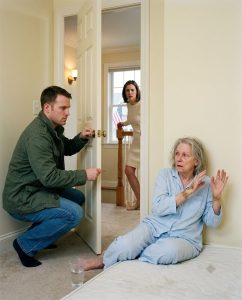
The bedroom door was locked from the outside.
That detail sat in my chest like a stone.
My mother had moved into our house the previous year after a bad winter and one fall on her front steps.
She was stubborn, proud, and sharper than most people half her age.
She forgot where she put her reading glasses.
She did not forget who her son was.
She did not lock herself in from the outside.
I found the key at 5:37 p.m.
It was inside Abigail’s jewelry box, tucked under the velvet tray.
I knew that tray.
I had bought the box for her three anniversaries ago, back when I still believed the softest person in the room was always the safest.
I opened the door.
At first, all I saw was darkness.
Then the room adjusted around me.
A bare mattress.
A plastic cup of water.
No phone.
No lamp within reach.
No cane.
No framed photos, though Mom had brought plenty when she moved in.
She was sitting against the wall in yesterday’s clothes, her knees pulled close and her hair flattened on one side.
When she looked up, her eyes were not confused.
They were furious.
“I am not losing my mind,” she said.
“I know.”
Her wrists lifted, and I saw the bruises.
Purple, deep, uneven.
The kind that does not come from bumping into furniture.
My mouth went dry.
My hand reached for the wall, not because I needed balance, but because I needed something solid before I did something stupid.
Mom started to explain.
Then footsteps crossed the hallway.
Her face changed so fast it scared me.
“Not yet,” she whispered. “She watches everything.”
So I did the thing I still hate remembering.
I locked the door again.
Before I did, Mom squeezed my hand.
Not forgiveness.
Permission.
Abigail reached the hallway with a laundry basket pressed to her hip.
Her eyes went to my face.
Then to the door.
Then back to my face.
“She gets agitated when she hears voices,” she said.
I nodded as if that made sense.
At dinner, Abigail poured wine and presented her story like a case file.
The family doctor was concerned.
Mom had been wandering.
Mom had fallen.
Mom had accused Abigail of things that were not true.
A psychiatric evaluation had been scheduled for the next morning.
Then Abigail placed a folder beside my plate.
Power-of-attorney forms.
Medical authorization forms.
A checklist of care facilities.
Everything neat.
Everything ready.
That was when I knew this had not begun when I came home.
This had been built while I was gone.
“You’ve done so much,” I told her.
Her shoulders dropped.
She believed me.
That was Abigail’s mistake.
She thought a uniform made a man simple.
She forgot that before the Army, I spent four years investigating financial fraud for the state attorney general’s office.
After she went upstairs, I opened the home security system.
Three months of footage were gone.
But the cloud account still had access logs.
Deleted file.
Deleted file.
Deleted file.
Every one of them traced back to Abigail’s laptop.
At 10:18 p.m., I took screenshots.
At 10:46 p.m., I found bank forwarding notices showing Mom’s monthly statements had been redirected to Abigail’s email address.
At 11:03 p.m., I found the transfer request.
Eighty thousand dollars.
Not pending care.
Not emergency repairs.
Not some accidental click by an elderly woman who could not remember her password.
A transfer request prepared while Abigail was telling people Mom had dementia.
I sat at the kitchen table with that number glowing on my screen.
The refrigerator hummed.
The hallway clock ticked.
Somewhere upstairs, my mother was locked in a room inside my own house.
For one ugly minute, I pictured waking Abigail up and putting the laptop in her face.
I pictured her trying to explain.
I pictured myself not letting her finish.
Then I closed the laptop.
Revenge is loud.
Evidence is quiet.
At midnight, I placed a recorder under the kitchen table.
At 12:14 a.m., Abigail came downstairs and made a call on speaker.
Her voice was low, irritated, and nothing like the soft voice she used for neighbors.
“She’ll be evaluated tomorrow,” Abigail said.
A pause.
Then she laughed.
“Nobody is ever going to believe that old woman.”
I stood in the dark laundry room with one hand pressed over my mouth.
That sentence did something to me.
It did not make me angrier.
I was already angry.
It made me patient.
At 12:32 a.m., I emailed my commanding officer and requested emergency family leave.
At 12:49, I changed every password Abigail might know.
Bank login.
Home security.
Cloud storage.
Email recovery.
The old tablet Mom used for recipes.
I downloaded the access logs, screenshot the deleted video records, saved the bank notices, photographed the bedroom, and wrote down every time stamp in a notebook from my duffel.
Then I went back upstairs.
This time, I unlocked Mom’s door and left it open.
She looked at me from the mattress.
I crouched beside her.
“Tomorrow,” I whispered, “act confused.”
Mom looked at the bruises around her wrists.
Then she looked at me.
“How confused?” she asked.
“Confused enough,” I said, “to let her talk.”
The next morning, Abigail dressed like she was attending a meeting with people she intended to impress.
Cream sweater.
Gold watch.
Soft makeup.
Hair pinned back.
She carried the folder against her chest as if it contained love instead of paperwork.
Mom sat in the back seat of our SUV and stared out the window.
At the clinic, Abigail spoke first at the intake desk.
“She has good moments,” she told the receptionist. “But she can become very convincing.”
That word did more damage than Abigail knew.
Convincing.
Not forgetful.
Not frightened.
Convincing.
The receptionist handed over a packet that Abigail had not shown me.
It had been faxed at 7:18 a.m.
The note on top requested a same-day competency letter for financial protection.
The phrase sat there in black ink.
Financial protection.
Abigail reached for the packet.
I put my hand on it first.
She smiled at me.
It was small, warning, and private.
I smiled back.
When the doctor called us in, Abigail tried to position herself closest to the desk.
Mom leaned on my arm and asked what day it was.
Then she asked again two minutes later.
Abigail relaxed.
She was watching the performance and missing the performer.
The doctor asked Mom simple questions.
Her name.
Her birthday.
Where she was.
Who I was.
Mom hesitated just long enough to make Abigail breathe easier.
Then the doctor looked at her wrists.
He stopped writing.
“May I ask how these happened?” he said.
Abigail answered before Mom could.
“She grabs things when she panics.”
The doctor did not look at Abigail.
He looked at Mom.
Mom looked at me.
I nodded once.
“I was locked in a bedroom,” Mom said.
Abigail made a soft sound, almost a laugh.
“This is exactly what I mean,” she said. “She has been saying things like this for weeks.”
I opened my bag.
There are moments when a room changes temperature without the thermostat moving.
This was one of them.
I placed the file on the doctor’s desk.
Access logs.
Bank forwarding notices.
The eighty-thousand-dollar transfer request.
Photographs of the bedroom.
Photographs of Mom’s wrists.
A written timeline.
The recorder.
Abigail stared at the file as if it had appeared by magic.
The doctor opened the first page.
He read quietly.
Then he read the second page.
Then he looked at Abigail.
“Did you delete home security footage?” he asked.
Her mouth opened.
Nothing came out.
He clicked the first audio file.
Abigail’s voice filled the room.
“Nobody is ever going to believe that old woman.”
The receptionist outside stopped typing.
Mom closed her eyes.
I did not look away from Abigail.
She tried to recover.
“That is out of context,” she said.
The doctor paused the recording.
“What context makes that sentence appropriate?”
For the first time since I came home, Abigail had no soft voice ready.
The evaluation did not end with Mom being declared incompetent.
It ended with the doctor documenting her injuries, noting her orientation and lucidity, refusing to sign Abigail’s requested letter, and making the reports he was required to make.
It ended with Abigail sitting in a chair she had chosen because she thought it would make her look caring, staring at a folder that no longer belonged to her.
The bank stopped the transfer that morning.
My commanding officer approved my emergency leave before noon.
By sunset, Mom’s bedroom door was off its hinges.
I removed it myself.
Not because a door is evil.
Because that door had become a promise.
I moved Mom into the front bedroom where the morning light came through the curtains and the phone charger reached the nightstand.
Mrs. Smith came by with soup and did not ask for details.
She just held Mom’s hand on the porch while the flag clicked in the wind.
Abigail left that house carrying one suitcase, her laptop, and the expression of a woman who still believed she could explain herself to someone.
Maybe she did try.
Maybe she told people I overreacted.
Maybe she told them deployment had changed me.
In one way, she was right.
Deployment had taught me to read danger when it wore a calm face.
But my mother taught me something older.
She taught me that love is not loud when it finally arrives.
Sometimes it is a key in a trembling hand.
Sometimes it is a file placed on a doctor’s desk.
Sometimes it is a son smiling at a lie just long enough to save the woman who raised him.
Weeks later, Mom baked lemon pie again.
It was not perfect.
The crust cracked on one side, and she cursed at it like the pie had personally betrayed her.
I drank coffee at the kitchen table and watched her move around a room where no one locked doors anymore.
She caught me staring.
“What?” she asked.
“Nothing,” I said.
She narrowed her eyes.
“I am still not losing my mind.”
“I know.”
Then she set a slice of pie in front of me, tapped the plate twice, and said, “Next time, Samuel, you do not wait so long to come upstairs.”
I laughed because I could.
Because she could.
Because an entire porch had heard her cry for help, but in the end, one locked door, one hidden key, and one quiet file told the truth louder than every lie Abigail had rehearsed.