My husband left me for a twenty-seven-year-old woman and took nearly everyone in our family overseas for his wedding.
At 2:13 a.m., while they were drinking champagne without me, he sent the message that finally broke the last polite bone in my body.
“Disappear before we get back. I hate old things. I deserve a new life.”
For nineteen years, I had been married to Richard Stone.
Nineteen years is long enough to know the sound of a man’s keys in the front door before he even turns the knob.
It is long enough to know which mood is coming by the way he sets his laptop bag on the floor.
It is long enough to recognize the shirt he wears when he wants to look innocent.
That night, he told me in the kitchen.
Not in a therapist’s office.
Not after some careful conversation at the dining table.
Not with any shame in his voice.
He stood beside the granite island, scrolling through his phone while I packed Chloe’s lunch and reminded Dylan that his SAT prep folder was still open on the counter.
The kitchen smelled like peanut butter, dish soap, and burnt toast.
Outside, the sprinklers clicked in their slow half-circle across the front lawn.
“I’m starting over,” Richard said.
I looked up because, for one second, I thought he meant his job.
Or his health.
Or the drinking he kept calling networking.
Anything but us.
Then he said her name.
Valerie.
She was twenty-seven.
She worked at his advertising agency.
She had perfect hair, soft little social-media captions, and a talent for appearing in photos beside things she had not paid for.
“The wedding is in Santorini,” Richard said.
He did not look nervous.
He looked relieved.
“My parents are coming. My sister’s family too. The kids need to see me happy.”
“The kids?” I asked.
His face changed immediately.
It was a small change, but I had lived with him long enough to feel it like a door locking.
“Don’t make this ugly, Alexandra,” he said. “They’re old enough to know who creates peace in this family and who doesn’t.”
That was Richard’s talent.
He could humiliate me and still sound like the reasonable adult in the room.
For years, I had been the invisible part of his life.
I remembered dentist appointments, school permission slips, flu shots, sports physicals, HOA notices, property tax deadlines, grocery lists, birthday cards, teacher emails, and his mother’s favorite brand of tea.
He remembered applause.
He was the man people congratulated.
I was the woman who made sure there was something to congratulate.
Over the years, I learned how a marriage can become a stage set.
From the street, ours looked beautiful.
Brick mailbox.
Trimmed lawn.
Front porch flag.
Family SUV in the driveway.
In the kitchen, Richard had already been gone for a long time.
He just waited until he had a younger woman, a foreign wedding, and a full audience before he announced it.
Chloe was seventeen.
Dylan was sixteen.
They were old enough to understand pain, but young enough to trust the parent who spoke first and loudest.
Richard had been careful with them.
He did not tell them he was abandoning me.
He told them he was choosing happiness.
He did not tell them I had carried the house, the bills, the details, the boredom, and the quiet panic of ordinary family life.
He told them I was sad.
Heavy.
Difficult.
The old thing in the hallway.
At O’Hare, Valerie posted a photo under the departure screen.
She was leaning into Richard like a prize winner.
His mother commented, “Finally, a fresh start.”
His sister added hearts.
My daughter did not call.
My son sent one text.
“Dad says you should let everyone enjoy the trip.”
I stared at that sentence for a long time.
Not because it hurt the most.
Because it told me exactly how carefully Richard had prepared them.
He had not just left me.
He had arranged witnesses.
That night, I slept badly.
The house made all its usual sounds.
The refrigerator hummed.
The air conditioner clicked on.
A car passed too slowly outside, tires whispering over the street.
At 2:13 a.m., my phone lit up on the nightstand.
“Disappear before we get back. I hate old things. I deserve a new life.”
I read it once.
Then again.
A second message came through before my hands could stop shaking.
“The house will feel better without your sadness in it.”
The porch light was still on.
The brick mailbox still said STONE in black letters Richard had ordered years before because he said “Reed-Stone” looked messy.
He had erased my father’s name from the mailbox.
But he had never checked the deed.
My father, Arthur Reed, had left me that land before he died.
Not the furniture.
Not Richard’s desk.
Not the kitchen island.
Not the new countertops Richard loved to mention when neighbors came over for summer cookouts.
The land.
The thing underneath everything.
My father was not a dramatic man.
He was quiet.
He kept receipts in labeled envelopes.
He balanced his checkbook with a pencil.
He never trusted men who smiled too much in other people’s kitchens.
A year before cancer took him, he handed me a county-stamped folder at the small table in his kitchen.
His hands were thinner by then.
The skin had started to loosen over his knuckles.
Still, his grip on that folder was steady.
“Never give dirt to someone who thinks love means ownership,” he said.
Richard laughed when I told him later.
“Your dad was dramatic,” he said. “It’s a patch of ground, Alex.”
For years, I let that sentence sit in the back of my mind.
A patch of ground.
That was what he called it.
The place where our children learned to ride bikes.
The place where I planted hydrangeas after my father’s funeral because I needed something alive to look at.
The place where Richard hosted cookouts and acted as if the lawn itself had come from his ambition.
At 6:41 that morning, Richard made his first real mistake.
The return itinerary landed in our shared email.
Flight number.
Arrival time.
Terminal.
Every detail.
At 7:18, I pulled my father’s old storage bin from the laundry room shelf.
Dust came down over my hair and shoulders.
The plastic lid made a dry cracking sound when I opened it.
Inside were labeled envelopes, old tax receipts, inspection records, permit copies, and the county-stamped folder my father had handed me years before.
At 8:03, I logged into the county recorder portal.
At 8:04, my hands stopped shaking.
Owner: Alexandra Reed.
Not Richard Stone.
Not Richard and Alexandra Stone.
Not Mr. and Mrs. Stone.
Just me.
I sat there in the laundry room while the washer ticked behind me and the house breathed around me.
Then I did something Richard would never have expected.
I did not scream.
I did not reply.
I did not call his mother and ask how long she had been waiting to replace me.
I did not beg my children to see me.
I made coffee.
Then I called an attorney.
Gloria Miller’s office sat between a UPS store and a nail salon in a small strip center with faded parking lines.
The reception area smelled faintly like printer toner and burnt coffee.
There was a framed map of the United States on one wall and a small American flag tucked into a pencil cup on the front desk.
Gloria was not warm.
That was why I trusted her.
She had silver hair cut at her chin, reading glasses on a chain, and the expression of a woman who had seen too many men confuse volume with ownership.
She read Richard’s messages without blinking.
Then she read the deed.
Then the old modular-home permits.
Then the tax records.
Then the travel itinerary.
“He told you to disappear from land he does not own?” she asked.
“Yes.”
Her mouth tightened.
“Then we don’t need revenge,” she said. “We need procedure.”
That sentence settled something in me.
Revenge would have been easy to imagine.
Throwing his clothes on the lawn.
Smashing his office monitor.
Posting screenshots under Valerie’s wedding photos.
For one ugly second, I wanted all of it.
I pictured Richard’s face when he saw the messages printed in black ink.
I pictured his mother’s smile dropping.
I pictured Valerie learning that a man who builds a new life on another woman’s labor has a habit of not reading the foundation documents.
Then I put my phone facedown.
Rage wants witnesses.
Power wants paperwork.
Gloria made copies of everything.
She had me forward the 2:13 a.m. messages.
She had me print the return itinerary.
She reviewed the county recorder entry and matched it against the permit history.
She told me what I owned.
She told me what I did not.
She told me which steps would be legal, which steps would be expensive, and which steps would be satisfying but stupid.
By the fourth day, Richard was still posting ocean views.
Valerie was still calling herself “Mrs. Stone-to-be.”
His mother was still commenting as if my life had been a room they had finally aired out.
The children appeared in one photo at a restaurant table, both smiling too tightly.
I saved the picture.
Not because I wanted to punish them.
Because someday they would ask what really happened.
And I had learned by then that memory without documents becomes whatever the loudest person says it was.
At 11:32 a.m., Gloria called me.
“The contractor is available today,” she said. “Do you want to meet him at the house?”
I looked around the kitchen.
There was Chloe’s favorite mug in the drying rack.
Dylan’s hoodie was still over the back of a chair.
Richard’s coffee pods were stacked in the drawer because he hated when the box looked messy.
My whole life was arranged in ordinary objects.
That is the cruelest part of being discarded.
The big betrayal happens once.
The little betrayals keep sitting on shelves.
The contractor arrived at 1:06 p.m.
He wore a hard hat, work boots, and a dark jacket with dust ground into the cuffs.
He walked through the living room quietly.
He did not make jokes.
He did not ask personal questions.
He tapped the walls.
Checked the frame.
Checked the foundation.
Checked the old permit file my father had saved.
He stood in Richard’s office longer than anywhere else.
The room had a leather chair, a glass desk, framed agency awards, and a shelf of business books he had never finished.
Richard used to stand in that doorway during parties and say, “This is where the magic happens.”
The contractor looked at the wall behind the desk and then at the documents in his hand.
“Mrs. Reed,” he said, “your husband is going to come back expecting a house.”
It was the first time all week that someone had used my father’s name for me.
Reed.
Not Stone.
I looked past him into the kitchen.
That was where Richard had told me the kids needed to see him happy.
That was where he had said “Valerie” like he was announcing a promotion.
That was where my hands had been on a lunch bag while he stood there dismantling nineteen years.
“And what will he find instead?” I asked.
The contractor glanced toward the front window.
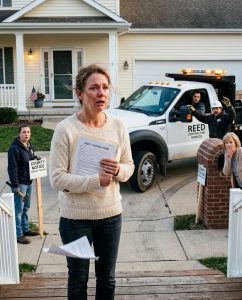
The first truck was already backing into the driveway.
Its warning beep cut through the afternoon quiet.
A neighbor two houses down stepped onto her porch.
The little American flag in our planter flicked sideways in the breeze.
The truck did not rush.
That was what made it feel final.
The driver eased backward over the driveway Richard had power-washed every spring.
The contractor raised one gloved hand.
Another worker carried a wooden stake and a hammer toward the lawn beside the brick mailbox.
I stood on the porch with Gloria’s folder pressed to my chest.
The folder edge dug into me through my sweater.
The worker set the stake in the ground.
The hammer came down once.
Then again.
Each blow sounded clean.
Not angry.
Not wild.
Official.
At 5:07 p.m., Gloria called.
“Alexandra,” she said, “I need you to listen carefully. Richard just emailed my office from overseas.”
My throat tightened.
“He says he intends to remove you from the property when he returns.”
I closed my eyes.
Of course he did.
Even from another continent, even beside the woman he had chosen, Richard still believed the world would rearrange itself if he sounded certain enough.
The contractor stopped mid-step.
The driver looked over from the truck.
Gloria’s voice sharpened.
“So now we add that to the file.”
“What was the subject line?” I asked.
She paused.
Then she read it aloud.
“Removal of Alexandra From My Residence.”
The contractor stared at me.
“He really put that in writing?” he asked.
“He did,” I said.
And for the first time all week, I smiled.
Not because I was happy.
Because Richard had always believed paperwork was boring.
He had no idea paperwork was where quiet people kept their knives.
The next days moved with a strange calm.
The county notice went up.
The utility confirmations were filed.
Every room was photographed.
Every item that belonged to me was packed, listed, and moved.
Richard’s personal property was boxed separately under Gloria’s instructions.
Not thrown out.
Not damaged.
Not hidden.
Boxed, cataloged, and stored.
Procedure.
When Richard’s plane landed, I knew because the shared itinerary updated automatically.
At 4:38 p.m., his phone left airplane mode.
At 4:52, Valerie posted one final airport selfie.
At 5:19, Chloe texted me for the first time since the trip began.
“Mom, are you home?”
I stared at that message for a long time.
There were a hundred answers I could have given.
I wanted to say yes.
I wanted to say no.
I wanted to say I had been home for nineteen years and somehow all of you walked past me.
Instead I wrote, “I’m safe.”
Three dots appeared.
Then disappeared.
Then appeared again.
No reply came.
At 6:03 p.m., I parked across the street at a neighbor’s house with Gloria beside me.
We had agreed I would not be alone when Richard returned.
The evening light was bright and flat over the neighborhood.
The kind of light that makes every detail impossible to romanticize.
Raw dirt sat where the house had been.
Tire tracks cut across the ground.
The brick mailbox still stood at the curb with STONE on it, ridiculous now, like a label on an empty box.
Beside it, the county notice was nailed to the wooden stake.
At 6:17 p.m., Richard’s car turned onto the street.
His parents were in the back seat.
Valerie sat up front, wearing sunglasses on top of her head.
Chloe and Dylan were in the second car with Richard’s sister and her husband.
They slowed before they reached the driveway.
I watched Richard’s face through the windshield.
At first, confusion.
Then irritation.
Then something thinner.
Fear trying not to show itself.
He pulled in too fast and braked hard.
Valerie got out first.
She looked at the dirt.
Then the tire tracks.
Then the notice.
“What is this?” she said.
Richard did not answer her.
He walked to the stake and grabbed the paper with one hand.
His mother stepped out of the car, her fresh-start smile already dying.
His sister’s mouth opened but no sound came out.
Dylan stood near the second car, pale and stiff.
Chloe looked directly across the street and saw me.
For a moment, she did not move.
Then Richard turned.
His eyes found mine.
“What did you do?” he shouted.
Gloria opened her door before I could answer.
She walked across the street with the calm, even pace of a woman who bills by the hour and enjoys being underestimated.
I followed.
Richard jabbed a finger toward the dirt.
“My house,” he said.
Gloria handed him a copy of the deed.
“No,” she said. “Her land.”
The whole group went still.
Even Valerie stopped touching her engagement ring.
Richard looked down at the page.
His mouth moved once without sound.
Then again.
His mother stepped closer.
“Richard?” she whispered.
He ignored her.
He looked at me instead.
“You can’t just do this.”
“I didn’t just do anything,” I said. “I followed procedure.”
Gloria handed him the next document.
Then the next.
County record.
Permit file.
Posting confirmation.
Utility clearance.
Storage inventory for his personal property.
Copy of his 2:13 a.m. message.
Copy of his email to Gloria’s office.
Removal of Alexandra From My Residence.
Valerie read that one over his shoulder.
Her face changed.
Not heartbreak.
Calculation.
The first time a mistress realizes she has not stolen a king, only inherited a man who lies badly, something very cold enters her eyes.
“Richard,” she said quietly, “you told me the house was yours.”
“It was,” he snapped.
“No,” Gloria said. “It was not.”
His mother looked at me with a kind of stunned anger, as if I had broken a rule by not remaining disposable.
“You destroyed your children’s home,” she said.
That one almost got through.
I looked at Chloe and Dylan.
Dylan’s eyes were wet.
Chloe had both hands tucked into the sleeves of her sweatshirt.
“No,” I said carefully. “Their father told their mother to disappear from land he never owned. I preserved what belonged to me before he returned to remove me.”
Nobody spoke.
A car passed at the end of the street and kept going.
Richard looked around at the dirt as if the house might reappear if he was angry enough.
Then he lowered his voice.
“Alex, don’t do this here.”
There it was.
The old tone.
The one that meant behave because people are watching.
For nineteen years, that tone had worked.
In grocery stores.
At school events.
At family dinners.
In our own kitchen.
That evening, standing beside raw dirt and a county notice, it finally had nowhere to land.
“I’m not the one who made this public,” I said. “You took our children, your parents, your sister, and every smiling relative overseas to celebrate replacing me.”
Valerie stared at the dirt.
Richard’s sister looked away.
His mother clutched her purse strap like it was the only solid thing left.
Chloe stepped forward.
“Mom,” she said.
Her voice cracked on the word.
That hurt more than Richard’s shouting.
Because there was my daughter again.
Not the version trained to call me sad.
Not the version told to let everyone enjoy the trip.
My daughter.
“I didn’t know,” she whispered.
I believed her.
Not completely.
Not in the way that erases pain.
But enough.
Dylan wiped his face with the heel of his hand.
“Dad said Grandpa left it to both of you,” he said.
Richard turned on him.
“Dylan.”
The boy flinched.
That was the moment something shifted in me.
For years, I had absorbed Richard’s corrections so the children would not have to feel them.
I had softened his moods.
Translated his impatience.
Smoothed rooms after he left them sharp.
And in doing that, I had taught them to mistake my silence for weakness.
I looked at Dylan.
“He lied,” I said.
Richard took a step toward me.
Gloria moved half an inch.
Not much.
Just enough.
“Mr. Stone,” she said, “I would be very careful about what you say next.”
He froze.
That was when Valerie took off her sunglasses and looked at him like she was seeing the foundation for the first time.
“Richard,” she said, “where are we supposed to live?”
No one saved him.
Not his mother.
Not his sister.
Not the children.
Not me.
The man people had congratulated stood in front of raw dirt, holding proof that the life he thought he owned had always been resting on someone else’s name.
The laughter died exactly the way I knew it would.
Not all at once.
First his mother.
Then his sister.
Then Valerie.
Then Richard himself.
For nineteen years, I had been the woman who made sure there was something to congratulate.
That evening, I became the woman who made sure there was something to verify.
Gloria took the folder back from Richard.
“We’ll be in touch through counsel,” she said.
Then she turned to me.
“Are you ready?”
I looked once at the mailbox.
STONE.
Black letters on brick.
A name Richard had chosen because he thought mine looked messy beside his.
The house was gone.
The land was not.
My father had understood that long before I did.
Never give dirt to someone who thinks love means ownership.
I walked back across the street without raising my voice.
Behind me, Richard shouted something I did not need to hear.
Chloe called my name once.
I stopped.
I did not turn all the way around.
Not yet.
Some wounds deserve a door before they get a conversation.
But I looked back enough for her to see my face.
“I love you,” I said. “And when you’re ready to hear the truth without your father’s voice in the room, you know where to find me.”
She covered her mouth.
Dylan started crying then.
Richard did not comfort him.
That told them more than any speech I could have given.
A month later, Chloe came to my apartment with a paper coffee cup and swollen eyes.
Dylan came the next weekend.
Neither visit fixed everything.
Real families do not heal in one scene.
They sit awkwardly on secondhand couches.
They apologize badly.
They ask questions they should have asked sooner.
They learn that love is not proven by choosing sides fastest.
Richard tried to fight the land issue for a while.
Then he stopped.
There is only so much a man can do when the deed says what the deed says.
Valerie did not become Mrs. Stone.
At least not then.
I heard that through Dylan, who heard it from Chloe, who heard it from a cousin who suddenly had much less to say online.
I did not celebrate that.
I had already spent too much of my life orbiting Richard’s choices.
I built a smaller life after that.
A quieter one.
An apartment with morning light.
A kitchen table that did not hold nineteen years of swallowed answers.
A storage box under my bed with my father’s folder inside.
Sometimes, when Chloe visits, she brings groceries.
Sometimes Dylan fixes things that are not broken because he wants an excuse to stay longer.
We are not perfect.
But we are honest more often than we used to be.
And when people ask what happened to the old house, I do not tell the whole story.
I say the land belonged to me.
Then I let that be enough.