On my 16th birthday, my entire family left me alone in a $4.2 million house with one sticky note on the refrigerator: “Stay out of sight, freak.
Don’t embarrass us.” They were at the Monarch Hotel celebrating my father’s biggest business deal, while I cried upstairs with the only letter my dead mother had left me.
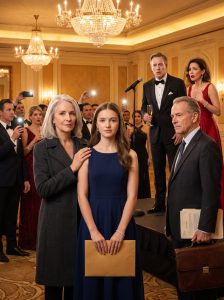
Then, at exactly 7 p.m., a stranger named Eleanor Vance appeared at my door holding legal papers and said, “Your dad signed you away.”
What he did not know was that by giving me up, he had just handed me the key to everything he had spent twelve years stealing from me.
Part 3 – Ending:
Harold Finch did not raise his voice.
He did not need to.
He walked onto the stage with the careful confidence of a man who had waited twelve years to tell the truth and knew every word was going to land.
“My name is Harold Finch,” he said into the microphone. “I served as attorney for Thomas Hartwell, founder of Hartwell Industries, until 2014, when Richard Hartwell terminated my position after I refused to destroy this document.”
My father stood below the stage, one hand at his side, the other curled around nothing.
For once, he had nothing to hold.
Finch lifted the will.
“This is the original last will and testament of Thomas Hartwell, dated December 15th, 1999. It was witnessed, notarized, and filed with the Suffolk County Probate Court in January of 2000.”
He opened the document.
The ballroom was silent enough to hear the paper shift.
“Section 7.3,” Finch read. “Fifty-one percent of Hartwell Industries shares shall be transferred to the sole legitimate granddaughter of Thomas Hartwell upon her sixteenth birthday, provided her legal guardian at that time confirms the transfer in writing.”
Then he looked directly at me.
“Sierra Holloway turned sixteen today.”
Every face in that ballroom turned.
Investors.
Partners.
Board members.
Journalists.
People who had never known I existed until twenty minutes earlier.
“Eleanor Vance became Sierra’s legal guardian today,” Finch continued. “By virtue of the parental rights termination signed by Richard Hartwell himself. The conditions of the will have been met.”
The Meridian Medical representative stood from his table.
“Mr. Hartwell,” he said, “we need to pause the contract signing until this ownership matter is resolved.”
My father finally found his voice.
“This is a family matter.”
“No,” the representative said coldly. “If ownership is disputed, it is a business matter.”
That was the first public consequence.
The twelve-million-dollar deal stopped in front of everyone.
Victoria appeared beside my father in her red gown, her face white under perfect makeup.
“This is absurd,” she said. “Sierra is clearly having an episode. She has always been unstable. Her mother was the same way.”
Something in me went still.
“Do not talk about my mother.”
Victoria smiled, but her mouth trembled.
“Catherine was a nobody. A woman who trapped Richard with a child and never belonged in this family.”
I looked at Eleanor.
She was shaking with rage.
But I lifted one hand.
“Let her talk,” I said. “Let everyone hear her.”
Then I turned to the ballroom.
“My mother was not a nobody. Catherine Holloway was the first accountant Hartwell Industries hired. She helped build this company from the ground up. And in 2012, before she died, she found proof that Richard Hartwell had embezzled money from the business.”
The silence changed.
It became heavier.
Dangerous.
A woman near the stage lifted her phone. I saw the press badge on her lanyard.
Boston Business Journal.
My father’s face hardened.
“Enough.”
“No,” Eleanor said. “Not anymore.”
She pulled out the printed email I had found in his study that afternoon.
“This email was sent from Richard Hartwell’s personal account to Morrison and Associates on October 2nd, 2024.”
She read it aloud.
Eleanor Vance has been asking questions about the original will. We need to finalize Sierra’s guardianship transfer before her 16th birthday. The inheritance clause expires 30 days after she turns 16 if no legal guardian claims it.
There was no way to explain that email.
No way to reframe it.
No way to turn it into concern for a difficult child.
It was a confession in corporate language.
My father opened his mouth.
Closed it.
Victoria whispered, “Deny it.”
He did not.
Because he could not.
That silence did more than any speech.
Guests began leaving.
Not all at once.
First the cautious ones.
Then the board members who suddenly needed to call attorneys.
Then investors.
Then the Meridian representatives.
The gala my father had spent six months planning became a room full of people trying not to be photographed near him.
I walked to the stage.
Finch handed me the microphone.
My hands trembled.
My voice did not.
“My name is Sierra Holloway. I am the granddaughter of Thomas Hartwell and the daughter of Catherine Holloway, two people who built this company before I was old enough to know what a company was.”
I looked at my father.
“For twelve years, I was told I was a burden. I was erased from family photographs, left out of holidays, left alone on birthdays, and three months ago, signed away without a goodbye.”
His eyes dropped.
“But I am not here to destroy Hartwell Industries. I am here because the truth belongs in the room. This company was my grandfather’s legacy. It was my mother’s work. And now it is mine to protect.”
At first, no one moved.
Then someone in the back clapped.
Then another.
Not everyone joined.
But enough did.
Enough to make my father understand that the room had shifted.
He no longer owned the silence.
We met upstairs afterward in a private conference room.
Eleanor, Harold Finch, and me.
The table was polished. The room smelled like expensive coffee and panic from the meeting that had probably happened there before us.
Finch spread documents across the table.
“The will is airtight,” he said. “Richard will contest it, but he will not win. We file for formal recognition with Suffolk County immediately.”
“What about the company?” I asked.
“Interim control will likely be placed under fiduciary supervision while the court finalizes the share transfer,” Eleanor said. “Until you are eighteen, I act on your behalf. With you beside me.”
“With me?”
“You are the majority shareholder, Sierra. You are young, not irrelevant.”
I almost cried at that.
Young, not irrelevant.
No one had ever made that distinction for me before.
That night, I did not go back to my father’s house.
I went to Eleanor’s apartment in Back Bay.
It was not a mansion.
It had brick walls, too many books, plants in every window, and a kitchen that smelled like cinnamon and real meals.
She opened a bedroom door.
“This was your mother’s room when we were in college,” she said.
The room had a blue quilt, a wooden desk, and a photograph of my mother and Eleanor laughing in front of a Christmas tree.
“You can change anything you want,” Eleanor said. “But this is your home for as long as you want it.”
Home.
The word felt too big to trust at first.
I sat on the bed and touched the quilt.
It smelled faintly like lavender, like someone had washed it for years just in case I ever came.
Eleanor sat beside me.
“You do not have to be strong right now.”
That was when I broke.
Not like that morning.
Not like the kitchen with the sticky note.
This time I cried because someone had opened a door and meant it.
Meredith texted that night.
I didn’t know about the will. I didn’t know Dad signed you away. I thought you just didn’t want to be part of the family.
Then another message.
I’m sorry for calling you a freak. I was wrong.
I read it three times.
I did not answer.
Not because I wanted to punish her.
Because apologies are doors, not bridges.
Someone has to keep walking after the door opens.
The next morning, the Boston Business Journal published the story.
Hartwell Industries Gala Ends in Chaos: Hidden Will Surfaces, CEO’s Daughter Claims Majority Stake.
The article had pictures.
My father’s ashen face.
Victoria’s ruined makeup.
Brendan frozen at the microphone.
And me, standing on the stage in my mother’s navy dress, looking like someone braver than I felt.
Hartwell stock dropped.
Meridian paused the contract.
The board called an emergency meeting.
By the end of the week, my father had stepped aside temporarily.
By the end of the month, temporarily became permanently.
On January 31st, Judge Patricia Coleman ruled that Thomas Hartwell’s will was authentic and binding.
The transfer of 51% of Hartwell Industries shares to me was ordered, with Eleanor serving as legal guardian and fiduciary representative until I turned eighteen.
Then the judge said the court had serious concerns about the concealment of the will and the circumstances around the parental rights termination.
She referred the matter for further review.
My father stared straight ahead.
He did not look at me.
Two days later, he called.
I answered after four rings.
“Sierra,” he said. “I know you probably don’t want to talk.”
“You’re right.”
“I made mistakes.”
Mistakes.
Such a small word for twelve years.
He said he was wrong to hide the will.
Wrong to sign the papers.
Wrong about many things.
Then he said, “But you are still my daughter. Blood does not change because of legal documents.”
For one second, the child in me leaned toward the sound of those words.
Then I remembered the refrigerator note.
The empty kitchen.
The rejected calls.
The photographs with my body cut out of the frame.
“You’re not calling because you regret what you did,” I said. “You’re calling because you lost. If the will had never surfaced, you would still be pretending I did not exist.”
“That’s not fair.”
“Fair was telling me the truth. Fair was remembering my birthday. Fair was not signing me away and then asking for family when the money disappeared.”
I ended the call.
My hands shook.
But I did not cry.
That was progress.
Meredith and I met a month later in a coffee shop in Cambridge.
Neutral place.
Public.
Easy exit.
She looked smaller without the makeup and the armor.
“I believed what they told me,” she said. “That you were difficult. That you did not want us. But I still chose to be cruel.”
I waited.
“I’m not asking for forgiveness. I just want you to know I see it now.”
“Words are easy,” I said. “Actions are harder.”
“I know.”
“So show me over time.”
It was not forgiveness.
But it was a beginning with boundaries.
Brendan never reached out.
I made peace with that faster than I expected.
Three months after the gala, I sat in the Hartwell Industries conference room as an observer.
Sixteen years old.
Still in high school.
Still learning.
But legally entitled to be there.
The company had lost money at first because scandal has a cost. But under interim leadership, the Meridian deal was renegotiated. The internal audit recovered misallocated funds and uncovered more irregularities from my father’s tenure.
Eleanor walked me through the financial reports line by line.
“You do not have to become CEO tomorrow,” she told me. “You just need to learn enough to choose honest people.”
That became my first lesson in power.
Power was not taking the microphone.
It was knowing who should hold it.
On January 16th, 2026, I woke to the smell of cinnamon rolls.
For a second, the old dread came back.
Birthday.
Silence.
Sticky note.
Then I remembered where I was.
Eleanor’s kitchen was warm.
The table was set for two.
There were winter flowers in a vase and a cake with seventeen candles.
“Happy birthday, sweetheart,” she said.
No performance.
No agenda.
Just love.
Her gift was my mother’s silver bracelet, polished, repaired, with a new charm added.
A tiny heart engraved with the date of my sixteenth birthday.
“The day everything changed,” Eleanor said.
“The day I stopped being invisible,” I whispered.
I blew out the candles.
I did not make a wish.
I did not need to.
Everything I had spent sixteen years begging for had been replaced by something better.
Not my father’s approval.
Not a place in his fake family photos.
Not a seat at a table where everyone secretly wanted me gone.
I had truth.
I had my mother’s legacy.
I had Eleanor.
I had a future that belonged to me.
My name is Sierra Holloway.
My father signed me away.
And in doing so, he accidentally gave me back my life.