PART 3 — The Gate at JFK Where His Empire Began to Collapse
By the time our Mercedes pulled up outside Terminal 8, the sky above JFK looked bruised with rain, and my children were quiet in a way children should never have to be.
Connor kept one hand wrapped around the strap of his backpack. Madison clutched her stuffed rabbit against her chest, her eyes too big for her little face.
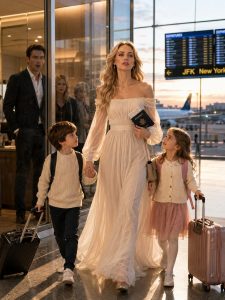
“Mom,” Connor asked, “are we really going to London?”
I looked at him and smiled, though my heart felt like it had been folded into sharp corners.
“Yes, sweetheart. We are.”
Not running.
Escaping was what people did when they had no plan.
I had a plan.
Inside the terminal, crowds moved around us in every direction—families hugging, businessmen rushing, children crying near security lines. For the first time in years, I was not waiting for Bradley to arrive, apologize, explain, or disappoint us.
I was moving forward without him.
My phone rang just as we reached the airline counter.
Bradley.
I let it ring.
It rang again.
Then Brittany.
Then Bradley’s mother.
Then a message appeared.
BRADLEY: You don’t get to take my children out of the country.
I almost laughed.
My children.
The same children he had called “less responsibility” eight minutes after our divorce.
Another message arrived.
BRADLEY: Answer me now, Sarah.
I opened the folder again while the airline agent checked our passports.
The first page showed a wire transfer from our joint savings account into a shell company named Ellison Holdings.
The second showed Ellison Holdings purchasing a condominium in Tiffany’s name.
The third showed Bradley’s signature.
But the fourth page made the noise of the airport disappear.
It was a medical report.
Not Tiffany’s.
Bradley’s.
Five years earlier, after Madison was born, Bradley had undergone a private procedure. A vasectomy. Then another report from six months ago showed that he had secretly tried to reverse it.
The result was written in cold clinical language.
“Probability of natural conception: medically negligible.”
My breath caught.
Tiffany was pregnant.
Bradley had told everyone it was his miracle.
But the report in my hands said otherwise.
I looked at Connor and Madison standing beside the luggage cart.
Bradley had humiliated me. Lied to me. Robbed me.
But he had also built his new life on a lie someone else had sold him.
“Ms. Bennett?” the airline agent said gently. “Your seats are confirmed. Boarding begins in forty minutes.”
I nodded.
Then my phone rang again.
This time, the name was Mr. Harrison.
“Sarah,” he said, his voice calm and precise, “Bradley just called my office threatening emergency action.”
“Can he stop us?”
“He can try,” Harrison said. “But he signed full custody this morning. The travel authorization is attached to the settlement agreement. He didn’t read it.”
I closed my eyes.
Bradley’s arrogance had finally done something useful.
“And the assets?” I asked.
“I filed the motion ten minutes ago,” Harrison said. “The court has frozen the condominium, the shell accounts, and three business transfers. By tonight, Bradley will know.”
I looked through the glass wall toward the gray runway.
“And the medical report?”
A pause.
“That,” Harrison said, “is the part you should let him discover in public.”
Before I could answer, a message flashed from Brittany.
BRITTANY: What did you do? Bradley just left the clinic. Tiffany is crying. Mom is screaming.
I stared at the screen.
Then I whispered, “It’s begun.”
Madison tugged my coat.
“Mommy, are we safe?”
I knelt in front of her.
The airport blurred behind her small face.
“Yes,” I said, brushing hair from her cheek. “For the first time in a long time, we are safe.”
And when they called our flight, I took my children’s hands and walked toward the gate while Bradley Bennett’s perfect new family began falling apart behind us.
PART 4 — The Celebration That Turned Into a Confession
Across town, Bradley had arrived at the clinic too late to control the story.
I learned the details later from three sources: Harrison’s investigator, a nurse who had already been subpoenaed, and Brittany herself, who sent messages faster than pride could stop her.
The clinic had arranged a private ultrasound room with champagne chilling outside, despite the irony of champagne at a pregnancy appointment. Bradley’s mother, Eleanor Bennett, had brought white roses. Brittany had brought a tiny cashmere blanket.
Tiffany had arrived wearing pale pink silk and a diamond bracelet Bradley had purchased with money he claimed we did not have.
Everyone was smiling.
Everyone was ready to applaud.
Then Bradley’s phone buzzed with an email from Harrison’s firm.
NOTICE OF EMERGENCY MOTION TO REOPEN DIVORCE SETTLEMENT DUE TO FRAUDULENT CONCEALMENT OF MARITAL ASSETS.
Attached were documents.
Wire transfers.
Property filings.
A photograph of Bradley and Tiffany standing under the polished gold sign of a luxury development office.
His mother read over his shoulder.
“What is this?” she demanded.
Bradley went pale.
Tiffany’s face changed first—not into fear, but calculation.
That was what the investigator said.
Not panic. Calculation.
“Brad?” she whispered. “What did you do?”
He turned on her instantly.
“What did I do? This condo was your idea.”
Eleanor’s voice sharpened. “Condo?”
Brittany stepped back. “What condo?”
Then the nurse entered, holding a tablet.
“Ms. Vale,” she said to Tiffany, “the doctor will see you now.”
But nobody moved.
Bradley’s phone rang again.
This time it was his attorney.
His attorney was not gentle.
“You signed what?” he shouted loudly enough for the room to hear.
Bradley turned his back, but his voice carried.
“I didn’t read every page.”
A silence fell so complete that even Tiffany stopped crying.
His lawyer continued, “You signed full custody, international travel authorization, and a disclosure statement declaring under penalty that there were no hidden assets. You signed it all.”
Eleanor sat down as though her knees had forgotten their job.
Then came the moment no one expected.
Tiffany grabbed her purse.
Bradley caught her wrist.
“Where are you going?”
She looked at him with eyes suddenly cold.
“To call my lawyer.”
“Your lawyer?” Bradley snapped. “For what?”
Tiffany smiled then. A small, poisonous smile.
“Because I’m pregnant, Bradley. And you promised me security.”
His jaw tightened.
“You said it was mine.”
The room froze.
Eleanor whispered, “What does that mean?”
Bradley did not answer. He opened the second attachment Harrison had sent—the medical report.
His face drained of color.
Brittany later admitted she had never seen her brother truly afraid until that moment.
He read the words once.
Then again.
“Probability of natural conception: medically negligible.”
Tiffany stared at the tablet in his hand.
For the first time, she looked genuinely shocked.
“You had a vasectomy?” she breathed.
Bradley stared at her.
“You’re pregnant.”
Neither of them spoke.
The answer was already in the room.
Eleanor’s white roses slipped from her lap onto the floor.
Brittany covered her mouth.
And Bradley—the man who believed he could divide people into useful and disposable—stood in the middle of a private clinic while his money, mistress, mother, and unborn fantasy all turned against him at once.
At 2:17 p.m., while my children and I were over the Atlantic, Harrison sent me one sentence.
“The pregnancy is not Bradley’s.”
I looked at that message under the dim airplane light.
Then I turned the phone face down.
Connor was asleep against my shoulder.
Madison’s rabbit was tucked beneath her chin.
I did not feel victory.
Not exactly.
I felt the strange ache of a door closing on a burning house.
And somewhere below us, hidden by clouds and ocean, Bradley Bennett was finally trapped inside the life he had built.
PART 5 — London Rain, Small Shoes, and the First Quiet Morning
London welcomed us with rain.
Not dramatic rain. Not cinematic rain. Just a soft gray drizzle that made the city shine like old silver.
At Heathrow, Connor looked exhausted but curious. Madison refused to let go of my hand.
A driver held a sign with my name.
SARAH BENNETT.
Seeing it there, plain and steady, made something inside me loosen.
Bennett had been Bradley’s name first. Then mine by marriage. Then a name I carried like a bruise.
Now it looked different.
Like something I could reclaim.
Our temporary flat stood in Kensington, with tall windows, creaking floors, and a tiny balcony overlooking a row of plane trees. It belonged to a former client of Harrison’s, arranged quietly until my new work contract began.
Madison ran straight to the smallest bedroom and gasped.
“There are yellow curtains!”
Connor tried not to smile, but failed.
“Can we really stay here?”
I stood in the doorway and watched them explore.
“Yes,” I said. “We can really stay here.”
That first night, I made pasta in a kitchen where nothing reminded me of Bradley. No whiskey glass near the sink. No expensive cufflinks left on counters. No cold silence after arguments he pretended had never happened.
Just steam on the windows.
Two children in pajamas.
The sound of rain.
And my phone buzzing with the ruin of my former life.
Bradley had filed an emergency motion claiming I had kidnapped the children.
Harrison responded with the signed agreement.
Bradley claimed he had been coerced.
The mediator submitted a statement saying he had laughed while signing.
Bradley claimed the assets were business investments.
The bank records showed marital funds.
Then Tiffany filed her own claim against him.
That surprised me.
What did not surprise me was her cruelty.
She stated Bradley had promised marriage, housing, and support, and had represented himself as “effectively divorced” months before he actually was.
She included text messages.
Photos.
Voice notes.
One message from Bradley read:
“Sarah won’t fight. She never does. Once the papers are signed, everything is yours.”
I read that line three times.
Sarah won’t fight.
He had mistaken endurance for weakness.
He had mistaken love for stupidity.
He had mistaken my silence for surrender.
The next morning, Connor found me on the balcony with coffee growing cold in my hands.
“Mom?”
I turned. “You okay?”
He stepped outside in socks despite the chill.
“Is Dad mad because we left?”
I swallowed carefully.
“Dad is mad because choices have consequences.”
Connor looked down at the wet street.
“Was it because of us?”
The question cut clean through me.
I knelt so we were eye to eye.
“No. Never. None of this happened because of you or Madison.”
His mouth trembled, but he tried to be brave.
“He didn’t come to my games because he didn’t want to?”
I could have lied.
I almost did.
But children know when adults wrap knives in velvet.
“Your dad made choices that hurt you,” I said softly. “That does not mean you were not worth showing up for.”
Connor’s eyes filled.
I pulled him into my arms.
He cried for the father he wanted, not the father he had.
That afternoon, I bought Madison new shoes.
Red ones with tiny buckles.
She danced in them on the pavement outside the shop, spinning beneath a striped awning while rain dotted her hair.
For the first time in months, Connor laughed.
And I realized something so simple it felt revolutionary.
Happiness did not arrive like fireworks.
Sometimes it arrived as warm pasta, dry socks, new shoes, and a child laughing under a gray London sky.
PART 6 — The Courtroom Where Bradley Finally Read the Fine Print
Three weeks later, I returned to New York for the hearing.
I did not bring the children.
They stayed in London with Mrs. Patel, our gentle downstairs neighbor who had somehow become grandmother, baker, and guardian angel in record time.
I walked into the courthouse wearing navy blue and no wedding ring.
Bradley was already there.
He looked thinner.
Not humbled.
Just angry in a more desperate way.
His mother sat behind him, stiff as porcelain. Brittany was absent. Tiffany sat across the aisle with her own attorney, one hand resting on her stomach, her face pale beneath perfect makeup.
Bradley’s attorney approached Harrison before proceedings began.
“This has gotten out of hand,” he said.
Harrison smiled without warmth.
“Fraud tends to do that.”
When the judge entered, the room rose.
The hearing began with Bradley claiming confusion.
“I was under emotional distress,” he said. “I didn’t understand what I was signing.”
The judge looked over her glasses.
“Mr. Bennett, you are a senior financial executive, correct?”
“Yes, Your Honor.”
“And you signed a financial disclosure form?”
“Yes, but—”
“And you initialed each page?”
Bradley’s mouth tightened.
“Yes.”
“And you stated there were no undisclosed assets?”
He swallowed.
“Yes.”
Harrison stood.
“Your Honor, we have evidence that Mr. Bennett transferred approximately 1.8 million dollars in marital funds through shell entities and used those funds to purchase real estate for Ms. Vale.”
A murmur moved through the courtroom.
Bradley turned red.
“That money was mine.”
Harrison placed a document on the screen.
“Then why did it come from a joint account funded by the sale of Mrs. Bennett’s inherited shares?”
My stomach twisted.
Those shares had come from my father.
Bradley had told me the market had turned. That the money was gone. That I had never understood investments.
He had not only stolen from our marriage. He had stolen from my dead father’s legacy.
The judge’s expression hardened.
Then came the messages.
Bradley’s words filled the courtroom screen.
“Sarah won’t fight.”
“Move the funds before the settlement.”
“The kids will adjust. They always do.”
My hands clenched in my lap.
Tiffany began to cry quietly.
Her attorney rose next.
“My client was also deceived, Your Honor.”
Bradley spun toward her. “You lied about the baby!”
Tiffany’s face changed.
There it was again.
Calculation.
“No,” she said softly. “You assumed what was convenient.”
A silence fell.
Harrison did not smile. He simply opened the next exhibit.
A fertility clinic intake form.
Tiffany had listed the biological father as unknown.
Not Bradley.
Unknown.
Bradley stared at the screen as if the letters might rearrange themselves.
Eleanor made a wounded sound behind him.
The judge called for order.
Bradley leaned toward Tiffany, voice shaking.
“You were going to let me raise another man’s child?”
Tiffany’s reply was barely audible.
“You were going to let Sarah’s children grow up thinking they were disposable.”
The words landed harder than anyone expected.
For one second, Tiffany did not look like a villain.
She looked like a mirror Bradley had not meant to face.
The judge ordered the freeze to remain in place, reopened the divorce settlement, referred the financial documents for investigation, and scheduled a custody review only to confirm the existing order.
Then she looked directly at Bradley.
“Mr. Bennett, the court does not appreciate being used as a tool to launder dishonesty.”
His shoulders sank.
Outside the courtroom, Eleanor approached me.
Her lipstick was smudged. Her eyes were wet.
“Sarah,” she said, “I didn’t know.”
For years, I had wanted that sentence.
Now it felt small.
“You didn’t ask,” I replied.
She flinched.
I walked past her.
Bradley called my name.
I stopped, but did not turn.
“I lost everything,” he said.
I looked back then.
No anger. No tears.
Just truth.
“No, Bradley. You threw everything away. Losing it came later.”
Then I left him standing beneath the courthouse lights, surrounded by the wreckage he still wanted to blame on me.
PART 7 — The Letter Hidden Inside My Father’s Watch
When I returned to London, Connor and Madison met me at the door like I had been gone for months instead of three days.
Madison threw herself into my arms.
Connor tried to act older, but hugged me just as tightly.
That evening, after they fell asleep, I opened the small velvet box Harrison had given me before I left New York.
“I was waiting until the first hearing was done,” he had said. “Your father asked me to hold this until you were free.”
Free.
The word still startled me.
Inside the box was my father’s watch.
Gold. Scratched near the clasp. Still faintly smelling of cedar and aftershave, though that was impossible after so many years.
Beneath it lay an envelope.
My name was written across the front in my father’s handwriting.
My hands trembled as I opened it.
My dearest Sarah,
If you are reading this, then I failed to protect you while I was alive, but I hope I can still protect you now.
I stopped breathing.
The letter continued.
My father had never trusted Bradley.
Not fully.
Before he died, he placed a portion of his estate into a trust Bradley could never touch. Harrison had managed it quietly, waiting until I either asked for help or reached a point where help had to come without asking.
There was money.
Enough to rebuild.
Enough to educate the children.
Enough to buy something permanent.
But that was not the shocking part.
At the bottom of the letter, my father had written:
There is a house in Richmond. Your mother loved it. I bought it when you were little and never sold it. It was meant to be yours one day—not as an escape, but as a beginning.
The next morning, Harrison’s London associate drove us there.
The house stood behind a blue gate, covered in climbing roses, with a garden wild enough to feel enchanted. Madison gasped like she had found a castle.
Connor stepped onto the path slowly.
“This is ours?”
I nodded, tears blurring the windows, the ivy, the old brass knocker.
“Yes.”
Inside, sunlight poured across wooden floors. Dust floated in the air like tiny golden ghosts. In the sitting room, there were covered sofas, shelves of old books, and a piano slightly out of tune.
On the mantel stood a photograph I had never seen.
My mother holding me as a baby in the garden.
My father beside her, laughing.
I pressed my fingers to my mouth.
For ten years, Bradley had made me feel homeless inside my own marriage.
Now my parents, gone for so long, had somehow left me a door.
Madison ran upstairs and shouted, “I found my room!”
Connor stood beside me.
“Mom,” he said quietly, “does this mean we don’t have to go back?”
I touched his hair.
“It means we choose where home is now.”
Two months passed.
The children began school.
Connor joined a football club and discovered he was good at something his father had never bothered to watch.
Madison lost her first tooth and wrote a letter to the “London tooth fairy,” requesting payment in both pounds and dollars.
I began consulting for a firm near Mayfair, then started my own small practice helping women untangle finances they had been told were too complicated for them to understand.
The work felt personal.
Maybe too personal.
But every time a woman sat across from me and whispered, “I think something is wrong with the accounts,” I heard my own silence from years before.
And I knew exactly where to begin.
Then, on an ordinary Thursday afternoon, an email arrived from Harrison.
Subject line:
Final Settlement Offer.
Bradley was ruined enough to negotiate.
But the attachment beneath it made my blood go cold.
He wanted visitation.
In London.
With Connor and Madison.
And he wanted to come in person.
PART 8 — The Man at the Blue Gate and the Ending No One Expected
Bradley arrived in London on a Sunday morning.
I watched him through the front window as he stood outside the blue gate, staring at the house like it had personally betrayed him.
He wore an expensive coat, but it hung loose on him. His face was pale. His confidence had thinned into something brittle.
Connor stood beside me, silent.
Madison peeked from behind the curtain.
“He looks different,” she whispered.
He did.
But different was not the same as changed.
I opened the door before he could knock.
“Bradley.”
His eyes moved past me into the house.
“So this is where you’ve been hiding.”
“No,” I said. “This is where we’ve been living.”
That struck him harder than I expected.
Harrison had arranged supervised visitation in a nearby park café. One hour. No private conversations. No promises. No gifts designed to purchase forgiveness.
Bradley tried anyway.
He brought Connor a signed football jersey and Madison a bracelet.
Connor did not touch the jersey.
Madison looked at the bracelet and asked, “Did you remember my birthday this year?”
Bradley froze.
Her birthday had been six weeks earlier.
He had sent nothing.
Not even a message.
The bracelet stayed in its box.
For the next hour, he talked too much. About the weather. About New York. About how busy things had been. About how unfair people had been to him.
Connor finally interrupted.
“Dad, are you sorry?”
Bradley stopped.
“For what?”
Connor’s face closed.
That was the answer.
Madison slid off her chair and came to me.
“I want to go home.”
Bradley’s jaw tightened.
“Sarah, don’t do this.”
I looked at him calmly.
“I’m not doing anything.”
Connor stood.
“You didn’t answer,” he said.
Bradley’s voice dropped. “I lost my job. The condo is gone. Tiffany left. Mom barely speaks to me. Do you understand what I’ve been through?”
Connor looked smaller and older at the same time.
“We were your kids,” he said. “You were supposed to care what we went through.”
No courtroom had ever judged Bradley as completely as that sentence did.
He reached for Connor, but Connor stepped back.
Madison took my hand.
And that was the end of the visit.
Outside the café, Bradley followed us to the gate of the park.
“Sarah,” he said, and for once his voice cracked. “Please. I have nothing left.”
I turned around.
The wind moved through the trees. The children stood close to me.
“You still don’t understand,” I said. “You’re not here because you love them. You’re here because losing them made you feel poor.”
He stared at me.
Then from behind him, someone called my name.
“Sarah?”
I turned.
A man stood near the curb holding a paper bag from the bakery.
For a moment, I did not recognize him.
Then I did.
Daniel Reyes.
My first love.
The boy who had once kissed me under the library stairs at Columbia. The man I had walked away from because my father got sick, life became complicated, and Bradley had arrived with certainty disguised as devotion.
Daniel looked older, of course. Broader. Gentler around the eyes.
“Daniel,” I breathed.
Bradley’s face twisted.
“You’ve got to be kidding me.”
Daniel glanced at him, then at me, then at the children.
“Bad time?”
Madison looked up at him.
“Do you have pastries?”
Daniel smiled and held up the bag.
“Emergency almond croissants.”
Connor, despite everything, laughed.
That laugh changed the air.
Bradley saw it too.
He saw my children relax near a man who had done nothing but arrive with breakfast.
He saw me smile without fear.
And perhaps for the first time, he understood that he had not been replaced.
He had been removed.
There was a difference.
Months later, the final settlement became official.
The hidden assets were liquidated. My father’s stolen inheritance was restored with penalties. A portion went into trusts for Connor and Madison. Bradley avoided prison by cooperating, but his career in finance was finished.
Tiffany had her baby, a little girl, and left New York quietly. I heard she moved near her sister in Oregon. I wished the baby well. Only the baby.
Eleanor wrote letters to the children. Connor read his once and put it away. Madison drew a picture of the blue gate and mailed it back without words.
As for Daniel, he did not rush in like a savior.
That was why I trusted him.
He fixed the garden fence. He taught Connor how to make proper scrambled eggs. He let Madison paint his thumbnail purple and wore it to a client meeting.
One evening, nearly a year after the divorce, we gathered in the Richmond garden beneath strings of warm lights. Connor kicked a football against the old brick wall. Madison chased fireflies that were probably just reflections from the lanterns.
Daniel stood beside me, shoulder brushing mine.
“Happy?” he asked.
I looked at the house. The roses. My children laughing.
I thought of the mediator’s office.
Bradley’s smirk.
The passports.
The folder.
The sentence that had started it all.
“There’s nothing worth dividing.”
He had been wrong.
There had been so much worth dividing.
Truth from lies.
Love from possession.
Children from neglect.
A woman from the life that had nearly erased her.
I slipped my hand into Daniel’s.
Then Connor shouted, “Mom! Watch this!”
Madison yelled, “No, watch me first!”
And I laughed so hard I nearly cried.
Because the ending no one predicted was not Bradley’s ruin.
It was not Tiffany’s secret.
It was not the money, the house, or even Daniel returning with croissants at the exact wrong perfect moment.
The real surprise was that after losing everything I thought made me safe, I found a life that did not require me to be small.
And under the London twilight, with my children calling my name, I finally understood:
I had not taken them away from a family.
I had brought them home.