At exactly 8:11 p.m.
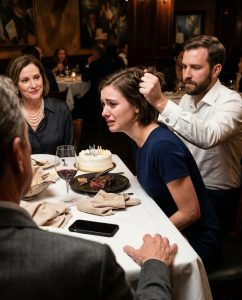
on my daughter’s thirty-first birthday, her husband reached across a white linen tablecloth, grabbed a fistful of her hair, and pulled her head back in front of seventeen people.
At 8:12, her mother smiled and said, “Maybe now she’ll learn her place.”
By 10:52 that same night, a county investigator was standing on my porch with my video in his hand.
And by sunrise, the life my daughter had been quietly surviving inside for months had finally started to collapse in the open.
My name is Ernesto Salgado.
I am fifty-eight years old, a widower, and a retired police officer.
For twenty-two years in San Antonio, I walked into homes after the damage was already done.
I knew the smell of fear before I opened the door.
I knew the way abused people made themselves smaller in their own kitchens.
I knew what silence looked like when it had been practiced for years.
That is why, when Rodrigo pulled my daughter’s hair in public, I recognized the moment for what it was.
Not the beginning.
The reveal.
The birthday dinner had been Ofelia’s idea.
Ofelia was Rodrigo’s mother, polished and cold, a woman who wore pearls the way other people wore armor.
She had reserved a private section of an upscale steakhouse, invited family and friends, and insisted on a full celebration for Valeria.
She called it “special.” Looking back, I think it was a stage.
The restaurant was crowded but hushed, all amber lighting and polished glass.
The air smelled of grilled meat, butter, and expensive liquor.
Jazz hummed from overhead speakers.
Candlelight flashed in the bowls of wineglasses.
It should have been warm, festive, ordinary.
Instead, from the moment I sat down, I felt the wrongness.
Valeria was trying too hard.
Parents know the difference between happiness and performance.
My daughter smiled when spoken to, thanked the server too quickly, kept her elbows close to her body, and looked at Rodrigo before answering simple questions.
He, on the other hand, played charming.
He filled glasses.
He laughed on cue.
He kept one hand resting behind Valeria’s chair in a way that would have looked affectionate to anyone who did not know how possession works.
Then he made a comment about how much time she had been spending at my house.
A week earlier, Valeria had come over to help me sort Teresa’s things.
My wife had been gone seven months, and some days I still found it impossible to open certain drawers.
Valeria did not complain.
She simply came, made coffee, folded sweaters, and sat beside me when the quiet got too loud.
Rodrigo brought it up over appetizers.
“She was gone the whole weekend,” he said, smiling at the others.
“Apparently her father can’t put away a closet without taking my wife from her own home.”
A few people laughed awkwardly.
Valeria lowered her eyes and said softly, “Your mother knew where I was.”
Rodrigo’s smile thinned.
“That’s not the point.”
“It was my mother’s clothes,” she said.
“I was helping my dad.”
The table shifted.
Forks slowed.
People started listening without wanting to look like they were listening.
Ofelia dabbed at the corner of her mouth with her napkin and said, “A married woman should know where her priorities belong.”
Valeria inhaled
carefully, the way people do when they are choosing every word to avoid punishment.
That was when I knew.
I had seen that breathing pattern too many times.
Then Rodrigo reached across the table and grabbed her hair.
He did not yank wildly.
That would have looked emotional.
Instead, he used a quick, practiced motion, close to the scalp, enough to hurt and humiliate without creating a scene he could not later explain away.
My daughter’s head snapped back.
She went still.
And Ofelia smiled.
“This is how a wife learns where she belongs,” she said.
Seventeen people saw it.
None of them moved.
I wanted to put Rodrigo through the window.
Instead, I kept my hands flat on the table.
A retired cop learns two things the hard way: rage is honest, and honest rage is often the first thing used against you.
So while Rodrigo sat back in his chair, while Ofelia sipped her wine as if she had merely corrected an etiquette breach, I took out my phone and recorded four seconds.
That was enough.
His hand still near Valeria’s neck.
Her eyes full of tears.
Ofelia’s expression.
The untouched birthday cake.
The timestamp.
The witnesses in the background.
Then I paid the bill.
Every cent of it.
The bourbon Rodrigo had ordered.
The steak he had barely touched.
The cake my daughter never got to cut.
When the server brought the folder, my total was $286.40.
I signed it.
Then I stood and told Valeria to get her coat.
Rodrigo rose halfway and said, “Don’t make this dramatic.”
Ofelia added, “Marriages are corrected in private.”
I looked at them both and said, “Enjoy the rest of your night while you still can.”
That was not a threat.
It was information.
In the parking lot, Valeria shook so badly she could not close the truck door.
I drove three blocks before speaking.
“Do you want to go home?” I asked.
She stared straight ahead.
“Not with him.”
So I took her to my house.
There, under the kitchen light, the truth came out in pieces.
Not because she was hiding it.
Because that is how people survive this kind of life.
They do not tell it as a single story.
They carry it as fragments.
I saw the red patch on her scalp.
A small round place where strands had been pulled free.
Then she unlocked her phone and showed me a note she had been keeping.
Dates.
Incidents.
Short, flat sentences.
January 15 — grabbed my wrist hard enough to bruise.
February 2 — took my keys.
March 19 — his mother said I provoke everything.
April 7 — blocked the doorway for an hour.
May 11 — squeezed my jaw and told me to smile.
Tonight — in front of my dad.
I read it twice.
“Why didn’t you tell me?” I asked quietly.
Her face crumpled for the first time that night.
“Because I knew you’d blame yourself.”
That hurt worse than anything Rodrigo had done in front of me.
I made coffee neither of us drank.
Then I started moving.
Old habits returned fast.
I uploaded the video to cloud storage.
I copied it to two encrypted drives.
I photographed the injury to her scalp.
I asked Valeria to text herself every date
from her note so there would be a digital timestamp.
I told her not to delete anything, not even messages that embarrassed her.
Then I called Sofia Merrow, a family attorney who had once handled a brutal custody case for the daughter of an old partner.
She answered on the second ring.
I described what happened.
I sent the video.
Her reply was immediate.
“Keep her there.
Don’t let her go back tonight.
I’m drafting a protective petition.”
After that I sent the same video to Damon Ruiz, a former detective I had worked with years earlier.
He now consulted with the county prosecutor’s office on domestic violence screening.
At 10:43 p.m., Damon texted me back.
Don’t let her go back with him.
I’ve seen enough already.
Valeria’s second phone began buzzing on my counter around then.
Rodrigo.
Then Rodrigo again.
Then Ofelia.
Then three more calls from Rodrigo.
Two messages arrived in between.
Where are you?
Don’t do this.
You’re making me look bad.
That second text told me everything.
He was not worried about her.
He was worried about exposure.
At 10:52 p.m., someone knocked on my front door.
A county investigator stood there in a dark windbreaker with his ID out.
“Mr.
Salgado, I’m Investigator Tom Greer with the county family violence unit,” he said.
“Is Valeria Salgado inside, and is she safe right now?”
I stepped aside.
Greer entered, saw my daughter standing in my old flannel robe by the kitchen, and his face hardened in that professional way that means he has already reached a conclusion and is now gathering proof to support it.
He asked careful questions.
He looked at the injury.
He reviewed the video twice.
Then he opened a folder and began preparing an emergency protective order request.
“What triggered the immediate response?” I asked.
He did not soften his answer.
“The public assault is one issue,” he said.
“The prior documented pattern is another.
But your former colleague also flagged a possible escalation risk based on the mother-in-law’s reinforcement and the repeated attempts to isolate the victim tonight.”
Then there was another knock.
Hard.
Valeria flinched so violently her mug rattled against the counter.
Greer motioned me back and went to the door himself.
Rodrigo was standing on the porch with Ofelia behind him.
Even then, even with a county investigator opening the door instead of me, Rodrigo tried to smile his way through it.
“My wife is upset,” he said.
“Her father is overreacting.”
Greer held up the printed still frame from my video.
“You need to step back from the porch.”
Rodrigo’s expression changed.
Ofelia stepped forward and said, “This is a family misunderstanding.”
Greer looked at her and replied, “Ma’am, encouraging assault in front of witnesses does not make it a misunderstanding.”
Rodrigo tried to push past the threshold.
That was his final mistake.
Greer gave one warning.
Rodrigo ignored it.
Within thirty seconds, two patrol units that had been parked down the block rolled up with lights flashing blue across my lawn.
Valeria went pale.
I stood beside her but did not touch her until she leaned into me first.
From the front room we heard raised voices, then the metallic click of handcuffs.
Rodrigo was not dragged away shouting innocence.
He kept demanding to know who
had “blown this up.” Men like him always think exposure is something done to them, as if their own actions are incidental.
Ofelia shouted too, but not about Valeria.
She yelled about embarrassment, reputation, and how this would destroy her son’s future.
No one listened.
That night, Rodrigo was arrested on suspicion of assault causing bodily injury and interference related to prior allegations pending review.
Ofelia was not arrested, but Greer documented her statements and behavior as potential corroboration of coercive control within the household.
By 2:00 a.m., Sofia had filed emergency paperwork.
By 8:30 a.m., a judge signed a temporary protective order.
The next week was ugly.
Rodrigo’s attorney tried to cast the restaurant incident as a “misinterpreted marital interaction.” That lie died the second the restaurant turned over partial security footage showing the movement, the table reaction, and my standing to remove Valeria immediately.
Two guests who had stayed silent that night found their consciences once the arrest made things public.
A server gave a statement.
So did the hostess, who said Valeria looked terrified before leaving.
Then more evidence surfaced.
Valeria searched old emails and found apologetic messages Rodrigo had sent after prior incidents, careful little notes that never admitted specifics but dripped with ownership.
I shouldn’t have put my hands on you like that.
You know how stressed I’ve been.
Don’t turn this into something bigger.
He had thought vagueness would save him.
Instead it showed pattern.
Her bank records revealed small acts of control I might once have dismissed if I had not seen this exact system before: canceled cards, restricted access, grocery purchases questioned, gas spending monitored.
Worse still, a neighbor from their building reported hearing Ofelia tell Valeria in the parking garage one month earlier, “A smart wife keeps bruises where clothes can cover them.”
That statement changed everything.
The prosecutor added witness intimidation concerns.
Sofia used the mounting evidence to secure exclusive access for Valeria to retrieve her belongings with law enforcement escort.
When she went back to the condo, she found three things laid out on the kitchen island: her spare key, a copy of their marriage certificate, and a note in Ofelia’s handwriting.
If you leave now, don’t come back expecting dignity.
Sofia smiled when she read it.
“Wonderful,” she said.
“They keep documenting for us.”
For a while, Valeria barely slept.
She apologized for everything.
For staying too long.
For not telling me sooner.
For “making trouble.” That was the hardest part to hear.
Abuse had trained her to experience rescue as inconvenience.
So we rebuilt slowly.
She started seeing a trauma therapist.
She moved into my guest room, then into a small apartment six months later.
She cut her hair shorter than she had ever worn it, not to hide the missing patch but because she said she wanted every inch on her head to feel like it belonged to her again.
During the divorce proceedings, Rodrigo performed remorse when it was useful and anger when it was not.
He claimed stress.
He blamed alcohol, though he had not been drunk that night.
He blamed me for “turning his wife against him.” He even blamed Valeria’s grief over her mother’s death, as if mourning had made her provoke him.
The judge was not interested.
The video mattered.
The note mattered.
The pattern mattered.
Most of all, Valeria’s calm testimony mattered.
When she described the birthday dinner, she did not dramatize it.
She simply said, “He did it because he believed no one would stop him.”
The courtroom went very still.
Rodrigo was ordered into a batterer intervention program as part of the criminal disposition, placed under a longer protective order, and forced to accept a divorce settlement that gave Valeria more than he ever expected she would demand.
Ofelia spent months telling anyone who would listen that the family had been persecuted.
Fewer and fewer people listened.
The part that stays with me most did not happen in court.
It happened the first spring after the divorce.
Valeria came over on a Sunday afternoon with groceries and a cheap bakery cake.
We sat at my kitchen table, the same table where she had shown me that note of six dates.
The windows were open.
The house smelled like coffee and cut grass.
She wore a green blouse and laughed at something ordinary, and for one second I heard my wife Teresa in that laugh so clearly it almost knocked the breath out of me.
Then Valeria reached up absentmindedly and touched the side of her head where the hair had grown back.
Not checking.
Not hiding.
Just touching it because it was there.
Alive.
Hers.
I thought about the restaurant.
The silence.
The witnesses.
The smile on Ofelia’s face.
I thought about how close we had all come to letting one public act stay disguised as a private matter.
People like Rodrigo count on birthdays, anniversaries, holidays, and crowded rooms.
They count on good manners.
They count on the fear of ruining the evening.
They count on everyone asking the wrong question.
Not Did this happen?
But Must we make a big deal out of it?
That is how violence keeps its seat at the table.
So no, I did not let it go because it was a birthday.
And if there was any aftershock left once the courts finished and the papers were signed, it was this: the hand in her hair was not the ugliest thing in that room.
The ugliest thing was the smile that told her to accept it.