That Thursday morning did not look like the kind of day anyone would remember.
It looked ordinary in the way public high schools look ordinary before something terrible happens.
The hallway smelled like lemon floor cleaner, cafeteria fries, and wet hoodies drying under fluorescent lights.
Lockers slammed hard enough to make the metal vents tremble.
Sneakers squeaked across the polished tile.
A paper coffee cup rolled beneath a bench near the main office, stopping against the leg of a trash can.
Near the front entrance, a small American flag hung beside a framed map of the United States, lifting slightly whenever cold air pushed through the glass doors.
Outside, a yellow school bus idled by the side entrance, coughing exhaust into the gray morning.
Nobody came in thinking the whole school would be talking about a broken guitar before lunch.
Nobody came in thinking silence could feel like a choice.
Emma arrived at 7:52 a.m., the same way she arrived most mornings.
Books hugged tight against her chest.
Hair tucked behind one ear.
Guitar case bumping softly against her knee as she walked.
She was the kind of student teachers trusted without having to say it.
Straight A’s.
No trips to the office.
No drama in the cafeteria.
No habit of rolling her eyes or arguing back.
She was quiet in a way adults often praised and students often misunderstood.
When the hallway got too loud, she would sit outside the music room and play something soft enough that anyone who wanted to hear it had to lean closer.
That was part of why Ms. Parker loved having her around.
Emma did not play to show off.
She played like the music was somewhere safer than the hallway and she was trying to step inside it for a few minutes.
The guitar was not expensive in the way rich people use that word.
It had scratches near the lower edge.
The case zipper stuck if you pulled it too fast.
One corner had been taped after it got knocked against a bus seat the previous semester.
But Emma knew every mark on it.
She wiped it down after practice.
She kept extra picks in the front pocket of the case.
She had once spent almost ten minutes in the music room trying to fix a buzzing string because she could not stand the sound being even slightly wrong.
People who did not love anything that carefully usually had no idea how cruel it was to mock someone who did.
Daniel had been mocking her for months.
He did not do it every minute.
He did not do it loudly every time.
That was what made it hard to catch and easy for people to excuse.
A comment by the lockers.
A shove that looked like an accident.
A fake apology when a teacher turned around.
A laugh delivered just soft enough that Emma heard it but an adult could pretend not to.
He had a talent for making meanness look like entertainment.
He also knew how to choose an audience.
Daniel was not the biggest boy in school, but he carried himself like everyone else had agreed to move out of his way.
He wore his confidence like a jacket he never took off.
Two friends usually trailed behind him, laughing before they even knew what was supposed to be funny.
That morning, one of them had a half-zipped backpack hanging from one shoulder.
The other kept checking his phone and smirking at nothing.
They were not brave.
They were comfortable.
There is a difference.
Comfortable people do not always start cruelty, but they make room for it.
They laugh early.
They block the path.
They let the person doing harm believe the whole room is on his side.
By second period, Emma had already been to English, dropped off a worksheet at the school office, and checked in with Ms. Parker before the bell.
Ms. Parker had been waiting near the music room door with a blue folder tucked under her arm.
“After lunch,” she told Emma, tapping the folder with two fingers.
Emma looked nervous and hopeful at the same time.
“Do you think it’s good enough?” she asked.
Ms. Parker smiled at her.
“I think you are good enough,” she said. “The recording just needs to prove what I already know.”
Emma looked down at the guitar case and nodded.
She did not know Daniel had heard part of that exchange from across the hall.
He had not heard every word.
He had heard enough to understand that the guitar mattered.
That was all he needed.
At 11:43 a.m., the break between second and third period turned the hallway into a moving wall of noise.
Backpacks bumped shoulders.
Locker doors clanged open and shut.
A group near the trophy case laughed at something on a phone.
Someone’s binder slipped, spilling loose paper across the floor.
Emma walked through it carefully, her hand wrapped around the guitar case handle.
She was almost past the row of lockers near the music room when Daniel stepped in front of her.
He planted one sneaker against the bottom locker and leaned back like he was blocking a doorway he owned.
His two friends slowed behind him.
Emma stopped.
She knew that look.
So did everyone else.
“So, Emma,” Daniel said, pitching his voice just loud enough for the nearby students to turn. “Are we getting another concert for broke people today, or are you still pretending you’re perfect?”
A few students laughed.
Not because it was funny.
Because laughing gave them somewhere to stand.
Emma’s fingers tightened around the guitar handle.
“Please let me pass,” she said.
It was not dramatic.
It was not loud.
It was the voice of someone trying to get through a doorway without giving the person blocking it anything else to use.
Daniel smiled.
“Please let me pass,” he repeated, turning the words soft and ugly.
One of his friends snorted.
Emma shifted to the side.
Daniel moved with her.
She tried the other side.
He put his hand out and grabbed her arm.
The hallway did not go silent all at once.
That was what made it so awful.
The normal sounds kept going for one extra second.
A locker shut.
A laugh finished.
A shoe squeaked.
Then the quiet spread in pieces, like everyone was deciding one by one whether they had just seen what they had seen.
“Where are you going so fast?” Daniel asked.
Emma pulled her arm back.
“Let go.”
He let go of her arm only to grab the guitar case from her hand.
“Come on,” he said. “Let everybody hear it.”
“Daniel, stop.”
The words came out thinner this time.
He liked that.
You could see it on his face.
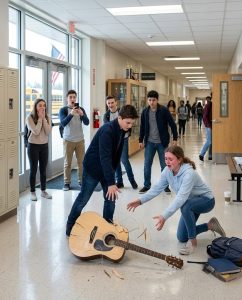
That was the moment the phones started coming up.
One student near the lockers held his phone chest-high, unsure whether to record openly or hide it.
Another raised hers without hesitation.
A girl with a red backpack looked down at her shoes and kept her hands around her binder like she could disappear behind it.
Everyone understood the scene had changed.
It was no longer teasing.
It was no longer a joke anyone could honestly pretend was harmless.
Still, nobody stepped forward.
Cruelty loves an audience, but it survives on hesitation.
Daniel unzipped the guitar case.
The sound of the zipper was small and harsh.
Emma reached for it.
One of Daniel’s friends moved half a step, just enough to block her without touching her.
That half step mattered.
A lot of people think cruelty is only the hand that swings.
Sometimes it is the shoulder that shifts, the laugh that lands, the silence that gives the bully more room.
Daniel pulled the guitar out.
He held it up by the neck like it was a thing he had won.
“Give it back,” Emma said.
Her voice cracked on the last word.
Daniel looked around.
He wanted the hallway to see him.
He wanted Emma to know they were seeing him.
Then he threw the guitar down.
The crack was not loud like thunder.
It was worse.
It was sharp, dry, and final.
Wood hit tile, and the sound seemed to travel through every locker on the wall.
The neck split near the headstock.
One string snapped loose and curled outward like wire.
The side of the guitar body opened, pale splinters showing under the finish.
The guitar case slid backward and bumped against Emma’s books.
For one second, Emma did not move.
Then she dropped to her knees.
She gathered the broken pieces with both hands.
Her fingers shook so badly that a splinter fell back onto the tile.
Tears slipped down her cheeks, but she did not sob.
She did not curse.
She did not shout at him.
Some kinds of pain are too stunned to make noise at first.
The bell buzzed overhead.
That was the part several students remembered later.
The bell rang like the building still believed it could push everybody toward third period and call this normal.
Nobody moved.
Forks at a dinner table freeze one way.
A school hallway freezes another.
Backpacks hang from one shoulder.
Phones hover in the air.
A locker door stays open with a sweatshirt sleeve caught in it.
One student stares at the trophy case as if polished glass can save him from choosing a side.
Daniel stood over Emma and tried to laugh.
The laugh came out wrong.
Even he heard it.
“It’s just a stupid guitar,” he said.
Emma looked down at the broken neck in her hands.
The sentence landed harder than he meant it to.
Because it was not just a guitar.
It was the thing she carried every day.
The thing she practiced with when the hallway felt too loud.
The thing Ms. Parker had photographed for the county arts program packet.
The thing attached to an opportunity Daniel did not even know existed.
That was when the music room door opened.
Ms. Parker stepped into the hall.
She had the blue folder from the school office in one hand.
Behind her came the assistant principal, his radio clipped to his belt.
He was not walking fast.
He did not need to.
His face had already changed.
The students nearest the door moved back.
Ms. Parker stopped when she saw the floor.
She looked at the broken guitar.
She looked at Emma kneeling beside it.
Then she looked at Daniel.
For the first time all year, Daniel’s smile disappeared.
The blue folder in Ms. Parker’s hand suddenly seemed heavier than paper should be.
“Emma,” she said softly.
Emma tried to wipe her face with the back of her wrist, but both hands were full of broken wood.
“I’m sorry,” Emma whispered.
That was the sentence that shifted the hallway.
Not Daniel’s insult.
Not the crack of the guitar.
Emma apologizing for being the one hurt.
Ms. Parker’s face tightened.
“No,” she said. “You do not apologize for this.”
The assistant principal turned to Daniel.
“Stay where you are.”
Daniel blinked.
His confidence tried to come back by habit.
“I didn’t even do anything that serious,” he said.
No one laughed this time.
Ms. Parker opened the folder.
The first page had Emma’s name typed at the top.
Below it was a printed timestamp from the school office log.
11:43 a.m.
Under that was a note from Ms. Parker documenting Emma’s planned audition recording after lunch.
Daniel stared at it without understanding.
He understood only that adults were no longer using the voice adults used for teasing.
Ms. Parker turned to the second page.
It was the county arts program recommendation packet.
Emma’s name appeared again.
So did the instrument description.
Acoustic guitar.
Submitted by school music department.
Photographed and verified through the school office.
The assistant principal took the page from Ms. Parker and read silently.
His jaw set.
One of Daniel’s friends whispered, “Dude.”
Daniel shot him a look, but it had no power left in it.
Ms. Parker pulled out one more page.
This one was labeled INCIDENT REPORT.
The title alone seemed to make the air change.
The phones that had been recording stayed up, but differently now.
Not like entertainment.
Like evidence.
“Daniel,” the assistant principal said, “you are going to come with me.”
Daniel’s face flushed.
“For a guitar?”
Ms. Parker looked at him with a calm that was more frightening than anger.
“For taking another student’s property, destroying it in front of witnesses, and interfering with a documented school arts submission,” she said.
Emma closed her eyes.
She still had the broken guitar against her lap.
A girl near the lockers started crying quietly.
Maybe because she felt sorry for Emma.
Maybe because she had laughed first.
Maybe because guilt sometimes takes a few seconds to find the right face.
Daniel’s second friend stepped backward.
“I didn’t touch it,” he said.
The assistant principal turned his head.
“You blocked her from retrieving it. We will talk about that too.”
The friend went pale.
Daniel looked around the hallway, searching for the old version of the crowd.
The version that laughed.
The version that looked away.
It was gone.
In its place were students holding phones, teachers emerging from doorways, and Ms. Parker standing with a blue folder that had turned a hallway joke into something official.
That was when Emma finally looked up.
Her cheeks were wet.
Her hands were scratched lightly from the splintered wood.
Her voice was quiet, but this time it did not break.
“It wasn’t stupid,” she said.
No one answered.
No one needed to.
The assistant principal asked Ms. Parker to take Emma to the music room.
Emma tried to stand while still holding the broken pieces, and two girls moved at the same time to help her.
One of them was the girl who had looked down at her shoes.
She did not say anything at first.
She just picked up the loose string and placed it carefully inside the open case.
Then she whispered, “I’m sorry.”
Emma nodded once.
It was not forgiveness.
It was only acknowledgment.
There is a difference.
Inside the music room, the air smelled like rosin, old sheet music, and the dusty carpet under the piano bench.
Ms. Parker set the blue folder on her desk and helped Emma lay the broken guitar across a towel.
The damage looked worse away from the hallway.
The split neck sat at the wrong angle.
The cracked body gaped slightly along the side.
Emma touched the edge of it with one finger and pulled back.
“I can’t record now,” she said.
Her voice was flat in a way that hurt to hear.
Ms. Parker pulled a chair beside her.
“We are going to handle one thing at a time.”
“The deadline is today.”
“I know.”
Emma stared at the guitar.
“My mom can’t buy another one.”
Ms. Parker did not offer the kind of easy promise adults sometimes offer because they are uncomfortable with a child’s fear.
She did not say everything would magically be fine.
She opened the folder again.
“I already emailed the program coordinator this morning to confirm your recording window,” she said. “Now I am going to send an update with the incident report, the office log, and witness statements. The deadline matters, but so does the truth.”
Emma swallowed.
“Will they think I’m trouble?”
Ms. Parker’s eyes softened.
“They will think someone tried to take something from you. That is not the same thing.”
In the hallway, the assistant principal escorted Daniel toward the office.
Daniel kept saying the same things.
It was a joke.
He did not mean to break it that badly.
Everyone was overreacting.
It was just a guitar.
Each sentence sounded smaller than the last.
By 12:16 p.m., the school office had pulled hallway camera footage.
By 12:28 p.m., three student videos had been forwarded to the assistant principal.
By 12:41 p.m., Ms. Parker had completed the first written statement.
By 1:03 p.m., Emma’s mother had been called.
That was the moment the story stopped being something the hallway could contain.
Emma’s mother arrived still wearing her work badge, her hair pulled back too tightly and her face pale from the drive over.
She did not rush into the room shouting.
She came in, saw Emma, saw the guitar, and put one hand over her mouth.
Emma stood up too fast.
“I’m sorry,” she said again.
Her mother crossed the room and held her before the sentence could finish.
“No,” she said into Emma’s hair. “No, honey. You didn’t do this.”
That was when Emma finally cried the way everyone had expected her to cry in the hallway.
Not loud.
Not dramatic.
Just broken open.
Ms. Parker turned toward the window for a moment and let them have privacy.
On her desk, the blue folder sat open.
The pages inside were ordinary school pages.
Office log.
Recommendation packet.
Incident report.
Witness names.
Plain paper has a strange kind of power when someone has spent months pretending nothing can be proven.
Daniel’s parents arrived later that afternoon.
His father looked angry before anyone spoke.
His mother looked embarrassed, which is not the same as sorry.
In the assistant principal’s office, Daniel tried one more time.
“She was acting like she was better than everybody,” he said.
The assistant principal slid the printed still from the hallway camera across the desk.
It showed Daniel holding the guitar up.
Emma stood in front of him with her hand out.
Two students stood behind Daniel.
Several others watched.
The small timestamp in the corner matched the office log.
Daniel stopped talking.
His father picked up the page and put it back down.
For the first time that day, there was no joke left to hide inside.
The school did what schools sometimes do when enough evidence makes inaction harder than action.
They documented.
They called parents.
They collected statements.
They reviewed video.
They separated students.
Daniel was suspended pending a disciplinary hearing.
His friends received consequences too, though smaller ones.
The broken guitar was photographed, bagged in its case, and listed in the office report as damaged property.
Emma hated that phrase when she saw it later.
Damaged property sounded too clean.
It did not sound like her knees on cold tile.
It did not sound like everyone watching.
It did not sound like the bell buzzing above her while she held the pieces and tried not to fall apart.
But the phrase mattered.
It put the truth somewhere no one could laugh it away.
That evening, Ms. Parker stayed late.
The hallway was quiet by then.
The cafeteria smell had faded.
The lockers looked innocent again, which somehow made the whole place feel worse.
She sat in the music room with Emma and her mother and opened a storage cabinet near the back wall.
Inside was an older school guitar.
It had been used by dozens of students.
The finish was dull.
The tuning pegs were scratched.
But the neck was solid, and the sound was warm.
“It is not yours,” Ms. Parker said. “I know that. But it can carry the song today.”
Emma looked at the guitar for a long time.
Then she took it.
Her hands shook when she tuned it.
They shook less by the second song.
The first recording was not perfect.
The second was better.
The third made Ms. Parker stop writing and look up.
Emma’s mother cried silently in the back of the room, one hand pressed to her mouth, the other gripping the strap of her purse like it was holding her upright.
At 5:37 p.m., Ms. Parker uploaded the audition recording.
Attached to it were the incident report, the school office note, the instrument verification photo taken before the damage, and a statement explaining why a school loaner instrument had been used for the final recording.
She did not write the email like a plea.
She wrote it like a record.
That mattered too.
A week later, the county arts program replied.
Emma had been accepted for the showcase round.
The email did not undo what Daniel had done.
It did not repair the guitar.
It did not erase the students who laughed first and apologized later.
But it proved something Emma badly needed proved.
The worst thing someone did to her in a hallway did not get to become the final word on what she was allowed to keep.
The school changed after that, not all at once and not perfectly.
Schools rarely change like movie endings.
But teachers started standing in different places between periods.
The assistant principal made a point of walking the hallway near the music room.
Students who had recorded the incident were called in one by one.
Some were thanked for providing evidence.
Some were asked why recording had felt easier than speaking.
That question followed more than one of them home.
The girl with the red backpack wrote Emma a note.
It was folded twice and left on the music stand.
I should have said something.
That was all it said.
Emma kept it for a while.
Not because it fixed anything.
Because it was the first honest sentence anyone had given her.
Daniel returned eventually, quieter than before.
He did not become a different person overnight.
That is not how consequences work.
But he no longer moved through the hallway like it belonged to him.
He kept his eyes forward.
His friends did not trail him the same way.
When he passed the music room, he looked away.
Emma noticed.
She did not smile.
She did not need to.
Months later, at the spring showcase, Emma walked onto a small stage with the borrowed school guitar.
The room was not fancy.
Folding chairs.
A scuffed floor.
Parents holding phones.
Teachers standing along the back wall with paper programs folded in their hands.
A small American flag stood near the side of the stage beside a county arts banner.
Emma’s mother sat in the second row.
Ms. Parker stood in the back.
The assistant principal came too, though he pretended he was only there because several students were performing.
Emma adjusted the strap and looked down at her hands.
For a second, she saw the hallway again.
The broken wood.
The phones.
The faces.
The terrible quiet.
Then she breathed in and began to play.
The first notes were soft.
People leaned forward without realizing it.
That was always how Emma’s music worked.
It did not demand attention.
It made attention feel like the only decent response.
By the end, the room was completely still.
Then the applause came.
Not wild.
Not theatrical.
Warm, steady, and real.
Emma looked toward her mother first.
Then toward Ms. Parker.
Ms. Parker nodded once.
Emma nodded back.
An entire hallway had once taught Emma that silence could hurt.
That night, a room full of people taught her that quiet could mean listening.
The guitar Daniel broke was eventually repaired enough to hang on Emma’s bedroom wall.
It never sounded right again.
The crack remained visible along one side.
Emma did not hide it.
Sometimes people thought that meant she could not let go.
They were wrong.
Keeping a scar is not the same as worshiping the wound.
Sometimes it is just proof that the thing meant to end you became evidence instead.
Years later, people would still tell the story as if the most shocking part was Daniel smashing the guitar.
But the people who had been there knew better.
The shocking part was the moment after.
The hallway full of witnesses.
The quiet honor student on her knees.
The bully saying it was just a stupid guitar.
And a teacher opening a blue folder that made every silent person understand the same hard truth at once.
It had never been just a guitar.