When my husband cracked my ribs and walked out the door, my five-year-old son did not cry first.
He listened.
He listened to the tires spitting gravel across the driveway.
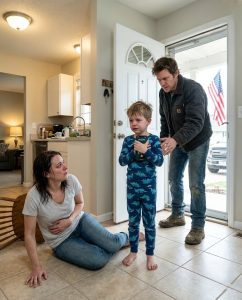
He listened to the front door slam so hard the old kitchen light flickered above us.
He listened to my breath dragging against the tile while I lay on my side, one hand pressed to my ribs, the taste of copper thick in my mouth.
Then Noah crawled toward me.
He did not look like a child in that moment.
He looked like someone who had been handed a job no child should ever have to understand.
My phone had slid under a fallen kitchen chair.
He pulled it out with both hands, held it against his chest, and stared at the screen like it might bite him.
“This is what Grandpa is for,” he whispered.
His thumb found the contact he knew by the little fishing-boat emoji.
We lived in a split-level house in Tacoma, Washington, with squeaking stairs, old wiring, and a small American flag by the porch that my father had given Noah on the Fourth of July.
There was a key hook beside the front door.
Evan always hung my car keys there.
Not on the counter.
Not in my purse.
There.
He said it kept us organized.
I had been married to him for seven years, and by then I understood that some men use ordinary household systems the way other men use locks.
A bad mood passes.
A pattern stays.
A pattern learns your passwords, checks your receipts, counts the miles on your car, and calls it caring.
That night, the pattern started with seventy-three dollars.
Not jewelry.
Not an affair.
Not some secret credit card hidden behind a stack of old mail.
Seventy-three dollars in a separate savings account under my name.
It came from grocery change.
It came from birthday cash my sister slipped into a card.
It came from the money I saved by skipping lunch when Evan thought I was eating at work.
The account was not freedom.
Not yet.
It was proof that I had started imagining a door.
At 8:17 p.m., Evan saw the bank app open on my screen.
I remember the time because I had looked at the stove clock right before he asked why I had my phone turned away from him.
At 8:19 p.m., he was holding it.
At 8:22 p.m., the kitchen chair was on its side.
By 8:24 p.m., my ribs hit the counter with a sound so clean and awful that even Noah stopped screaming for half a second.
It was like his little body understood what had broken before I did.
“You think you’re leaving me?” Evan asked.
“No,” I said.
It was a lie.
It was also the only answer I could afford.
Sometimes survival does not look brave from the outside.
Sometimes survival is choosing the smallest sentence in the room and praying it does not make the man in front of you larger.
His hand came first.
Then the chair.
Then the counter.
I remember the sink dripping.
I remember the refrigerator humming.
I remember Noah standing in the hallway with his stuffed dinosaur pressed to his chest, barefoot in twisted pajamas, his mouth open with no sound coming out.
Evan looked from me to our son.
For one frozen second, I saw the math in his eyes.
Not guilt.
Not panic.
Calculation.
How much damage could be explained.
How much fear could be managed.
How much silence he still owned.
“Clean yourself up,” he said.
His voice was almost calm.
“And teach him not to cry like that.”
Then he took my car keys from the hook and walked out.
The house stayed too normal after him.
That was the part nobody tells you.
After something terrible happens, the refrigerator still hums.
The water still drips.
The same little magnets still hold the same school calendar against the fridge.
The world does not immediately understand that your life has split in half.
I lay there and listened to his truck door slam outside.
The engine started.
The sound faded down the driveway.
For one ugly heartbeat, I thought about dragging myself to the door and locking it.
I thought about hiding the phone.
I thought about finding a way to make this look smaller before anybody saw the truth of it.
That is what shame teaches you.
It does not teach you how to leave.
It teaches you how to clean evidence before help arrives.
Noah did not ask if I was okay.
Children know when adults are lying.
He pressed the call button.
My father answered on the second ring.
“Grandpa,” Noah whispered, his little voice shaking so hard I felt it in my broken side. “Come now. Mama can’t breathe.”
My father’s voice came through the speaker sharp and awake.
“Is she bleeding?”
Noah leaned close to me.
He studied my face with the serious, terrified focus only a child has when the world becomes too big for him.
“No,” he said. “But she sounds broken.”
Broken.
There it was.
The word I had spent years dressing up as tired, clumsy, stressed, private, complicated.
“Put the phone by her mouth,” my father said.
Noah obeyed.
The phone scraped softly across the tile.
“Lena,” Dad said.
His voice changed then.
Softer, but not weaker.
“Listen to me. Do not move. I’m calling 911 on the other phone. I’m coming too.”
I tried to answer.
The air came out in pieces.
“No talking,” he said. “Tap once if Evan did this.”
I tapped the tile once.
The silence on the line went heavy.
My father had been a dock foreman for thirty-four years.
He had pulled men out of snapped rigging.
He had broken up fights with one look.
He had once driven three hours in the rain because my sister had a flat tire and sounded scared.
But I had kept this from him.
I had kept Evan’s voice out of family dinners. I had kept bruises under sleeves.
I had kept my marriage looking whole because shame is a room with no windows.
Now my five-year-old had opened the door.
“Noah, buddy,” Dad said carefully, “go unlock the front door. Then come right back to your mom. Do not go outside.”
Noah ran.
I heard the chain slide.
I heard the deadbolt turn.
I heard his socks slip on the wood floor.
Then an engine revved outside.
My ribs seized around the sound.
For one terrified second, I thought fear itself had learned how to drive.
Noah came back pale, both hands wrapped around my phone.
“Mama,” he whispered, “Daddy’s truck is in the driveway again.”
The front door opened before I could pull in enough air to scream.
Evan stepped inside.
His work boots were loud on the entryway floor.
His eyes fixed on the phone in Noah’s hand.
“Who did you call?” he asked.
Noah backed toward me.
Through the speaker, my father drew one slow breath.
Then he said, “Evan, step away from my grandson.”
The kitchen went still.
Not silent.
Still.
There is a difference.
The refrigerator hummed.
The sink dripped.
The old light buzzed overhead.
But everything that could decide the next minute seemed to stop moving.
Evan stood in the entryway with one boot on the tile and one hand on the doorframe.
His eyes moved from Noah to me, then down to the phone.
“Give me that,” he said.
Noah tucked it against his chest.
He was five years old.
His pajama shirt was twisted at the collar.
His cheeks were wet.
His stuffed dinosaur was clamped under one arm.
And still he stood between Evan and my body like he was big enough to hold back a whole storm.
“Grandpa said no,” Noah whispered.
That was when Evan’s face changed.
Not angry yet.
Afraid.
Because from the other end of the line came my father’s second voice.
The one he used with men on the docks who thought yelling made them stronger.
He was speaking to someone else.
Calm.
Exact.
He gave our address.
He gave Evan’s full name.
He said the words “possible broken ribs.”
He said “child present.”
He said “he returned to the house.”
Evan’s hand dropped from the doorframe.
Then a siren cut through the driveway.
Far off at first.
Then closer.
Noah heard it too.
That brave little body finally folded.
His knees bent, his stuffed dinosaur slipped from under his arm, and he started crying so quietly it was worse than screaming.
Evan looked at him.
Then at me.
Then at the open door behind him.
My father’s voice came through the speaker again.
“Lena, sweetheart, listen carefully. Do not let him take that phone. Help is almost there.”
Evan took one step forward.
Noah flinched, and the sound that came out of me did not feel human.
It was not a scream.
I did not have enough air for that.
It was a warning dragged through broken ribs.
Evan stopped.
For the first time in seven years, I saw him measure a room and realize he did not control every exit.
Red and blue light washed across the front window.
The little American flag on the porch flickered in the reflection.
A car door opened outside.
Then another.
Evan looked at the phone again.
“Tell them she fell,” he said.
He was looking at Noah when he said it.
That was the worst part.
Not that he said it.
That he thought our son still belonged to his silence.
Noah shook his head.
His mouth trembled.
“No,” he whispered. “Mama didn’t fall.”
The knock came hard enough to shake the doorframe.
“Tacoma Police,” a voice called. “Open the door.”
Evan did not move.
My father’s truck came in fast behind them.
I could hear it even through the buzzing in my ears.
The engine cut off.
Boots hit gravel.
The front door was still open, but the storm door had swung partway shut, and for a few seconds all I could see was movement through the glass.
Two officers stepped onto the porch.
My father came up behind them in a faded work jacket, his gray hair flattened from the wind, his face set in a way I had not seen since my mother’s funeral.
He looked past Evan.
He looked at Noah.
Then he saw me on the floor.
Whatever was left of his face changed.
The officer nearest the door put one hand out.
“Sir, step outside.”
Evan turned that familiar calm on them.
It had worked on neighbors.
It had worked on coworkers.
It had worked on my own shame for years.
“She slipped,” he said.
The officer did not look convinced.
My father did not look at Evan at all.
He looked at Noah.
“Buddy,” he said, and his voice broke only once. “Come to me.”
Noah looked at me first.
I wanted to nod.
I could not.
So I blinked twice.
He ran.
My father caught him on the porch and wrapped both arms around him.
Noah made one sound into his jacket, one small animal sound, and my father closed his eyes like something inside him had been split open.
The second officer came around Evan.
She knelt beside me.
Her badge swung forward as she lowered herself to the tile.
“Lena, I’m Officer Daniels,” she said. “Do not try to sit up. Can you tell me where it hurts?”
I pressed my fingers to my ribs.
She followed my hand with her eyes.
Then she looked at the overturned chair.
The missing keys.
The phone still lying on the floor with my father’s call active.
Her expression changed into something professional and cold.
She asked Noah one question from the porch.
“Did you see what happened?”
Noah nodded against my father’s jacket.
Evan said, “He’s five.”
My father finally looked at him.
“Yes,” he said. “And somehow he knew better than you.”
Nobody yelled after that.
That surprised me.
I had imagined rescue would be loud.
But real rescue sounded like process.
A radio call.
A request for medics.
An officer asking for Evan’s hands.
A notepad flipping open.
A small voice answering questions from the safety of my father’s arms.
The ambulance arrived at 8:41 p.m.
I remember that because the medic said it into his radio while another one cut the side seam of my T-shirt to check my breathing.
They loaded me onto a stretcher in my own hallway.
The same hallway where Noah had stood with his stuffed dinosaur.
The same hallway where I had learned how small fear could make a house feel.
Evan was on the porch when they brought me out.
His wrists were behind him.
He would not look at me.
He looked at Noah instead.
Noah hid his face in my father’s jacket.
At the hospital, everything became paper.
Hospital intake form.
Incident report.
Imaging order.
Discharge safety plan.
A nurse with tired eyes asked me the same questions three different ways, not because she doubted me, but because the system needed words to pin down what my body already knew.
The X-ray showed two cracked ribs.
The doctor said I was lucky.
I did not feel lucky.
I felt like a woman who had survived something everyone had politely refused to see.
My father sat beside the bed with Noah asleep across his lap.
Noah’s fingers were still curled around the stuffed dinosaur.
Dad kept one hand on his back, steady and warm.
“I should have known,” he said.
I turned my face toward him.
It hurt to breathe.
It hurt to speak.
Still, I made myself say it.
“I hid it.”
He shook his head.
“No,” he said. “He made you hide it.”
That sentence did something to me.
Not all at once.
Not like healing.
More like a door unlatching.
A police report was filed that night.
An officer photographed the kitchen before the chair was moved.
My phone call log was documented.
The 911 recording was preserved.
My father gave his statement.
Noah gave a child-safe statement the next morning with me in the building and my father holding his hand outside the room.
I hated every second of it.
I was grateful for every second of it.
Both things can be true.
Evan tried to call me from holding.
Then he tried through his sister.
Then through a coworker.
Then through an apology letter folded into a church bulletin and handed to my father by someone who should have known better.
My father read the first line, folded it back up, and said, “No.”
The temporary protection order came two days later.
The family court hallway smelled like floor cleaner and paper coffee.
I stood there in borrowed sweatpants because bending still hurt too much to put on jeans.
Noah sat beside my father with a juice box and his dinosaur.
When Evan’s attorney suggested “a private marital misunderstanding,” the victim advocate placed the medical records on the table.
The room went quiet.
There is something powerful about paper when you have spent years being told your pain is too emotional to count.
Paper does not tremble.
Paper does not apologize for taking up space.
Paper says this happened at 8:24 p.m., and here is the image, and here is the call, and here is the child who knew enough to dial Grandpa.
The order was granted.
Not forever.
Not the final ending.
But long enough for me to breathe somewhere he could not reach.
My sister took a week off work and came with grocery bags, clean pajamas, and a look on her face that told me she was angry enough to be useful.
My father changed the locks.
He took Evan’s key hook off the wall and threw it in the trash.
Then he installed a new one lower down, where Noah could reach it.
“For your keys,” he said to me.
He did not make a speech.
That was not his way.
He just fixed the thing that had been used against me.
Some kinds of love arrive with flowers.
Some arrive with a drill, a new deadbolt, and a man standing on your porch until you fall asleep.
Noah had nightmares for a while.
He asked if Daddy was coming back.
He asked if phones could run out of help.
He asked if Grandpa was always allowed to answer.
I told him yes.
Even when that was not the whole truth, it was the truth he needed first.
Weeks later, after the bruising faded and the ribs stopped turning every breath into a negotiation, I found the seventy-three-dollar account still open on my phone.
I had forgotten about it.
That tiny secret that had started everything.
I stared at the balance in the grocery store parking lot while Noah slept in the back seat, his dinosaur tucked under his chin.
Seventy-three dollars.
It looked different now.
Not like escape.
Like evidence that some part of me had been trying to save us before I could say the word.
I added twenty dollars to it that day.
Then another ten the next week.
Then my sister added fifty without asking.
My father added one hundred and wrote “boat fund” in the transfer note because he knew Noah watched for that little fishing emoji like a lighthouse.
I did not become brave overnight.
People like to tell survival stories as if there is one clean moment when fear ends.
There is not.
There are forms.
There are court dates.
There are nights when a truck backfires and your whole body returns to the kitchen floor.
There are mornings when your child asks a question that breaks your heart because he should have been asking about cereal, cartoons, or whether his shoes light up.
But there are also new keys.
There are locks that turn because you chose them.
There are fathers who answer on the second ring.
There are five-year-old boys who should never have had to be brave, but were.
Months later, Noah and I stood in that same kitchen while my father patched the dent in the counter.
The chair had been replaced.
The key hook was new.
The small flag still moved on the porch in the wind.
Noah looked at the phone on the counter and asked, “Was I bad for calling?”
I sat down very carefully, even though my ribs had healed.
Some habits stay in the body longer than pain does.
I pulled him into my lap.
“No,” I said. “You did exactly what you were supposed to do.”
He leaned into me.
“But Daddy got mad.”
I kissed his hair.
“Daddy was already wrong,” I said. “You just called someone who could see it.”
He thought about that for a long time.
Then he picked up his dinosaur and walked to the fridge, where my father had taped a paper with three numbers on it.
911.
Grandpa.
Aunt Sarah.
Noah pointed at the middle one.
“This is what Grandpa is for,” he said again.
And for the first time, the sentence did not sound like a child trying to rescue his mother.
It sounded like a home learning how to have windows again.