When Sarah Thompson woke up on the morning of her graduation, the first thing she saw was the crack in the ceiling above her bed.
It had been there since she moved into the apartment two years earlier, a thin crooked line that spread a little farther each winter.
Her landlord kept promising to patch it.
He never did.
On damp days it looked darker, like it was thinking about splitting open for good.
Sarah lay still for a moment beneath the thin blanket, listening to the old radiator click and settle.
Graduation day.
The day most people pictured with flowers, breakfast photos, and proud parents fighting back tears.
She looked over at the navy gown hanging from the closet door and felt the same strange mix of relief and dread that had followed her for weeks.
The relief was easy to understand.
She had made it.
Four years of lectures, labs, shifts at the campus coffee shop, tutoring sessions, unpaid research hours, rent checks, utility bills, and nights so short they barely counted as sleep.
Somehow she had made it.
The dread was simpler too.
Her family was coming.
She got up, brewed cheap coffee, and set the iron on the board near the tiny kitchen window.
Steam rose in soft bursts as she pressed the wrinkles from the gown.
She was halfway down one sleeve when she heard her mother’s voice through the wall.
The apartments were narrow and badly insulated.
You heard everything.
Neighbors arguing.
Television game shows.
Squeaking pipes.
And, on that morning, her mother’s voice on speakerphone.
“Yeah, we’re going,” Denise Thompson said with a sigh.
“At this point it’s basically just a formality.”
Sarah froze.
There was a pause, then her mother laughed softly.
“I keep telling David that money should’ve gone toward Marcus’s law school instead.”
The iron hissed against the fabric.
Sarah didn’t move.
It was not new.
That was the worst part.
If her mother had suddenly become cruel, maybe Sarah could have named the injury and fought it.
But this had been happening for years in a thousand small cuts: the tone whenever tuition came up, the way her father asked whether she was “still doing that biology thing,” the way every family dinner somehow ended with Marcus being praised for plans he hadn’t finished while Sarah’s actual accomplishments drifted by unnoticed.
She set the iron upright and stared at the gown.
Molecular biology.
Best GPA in her department.
Three years of research on protein folding in relation to Alzheimer’s disease.
A publication acceptance email sitting starred in her inbox.
None of it had ever sounded like enough inside her parents’ house.
She finished dressing in silence.
The apartment was neat because she had trained herself to need little.
Secondhand books stacked under a lamp with a crooked shade.
Two plants on the windowsill, one healthy and one clinging to life.
A narrow table that doubled as a desk and a place to eat.
On the fridge, tucked beneath a magnet from the campus bookstore, was a note in Dr.
Patricia Hendricks’s handwriting: You belong in every room your work opens.
Sarah looked at it before leaving.
That note had appeared during sophomore year after she bombed a presentation and nearly convinced herself she didn’t deserve to stay in the research lab.
Dr.
Hendricks had not allowed self-doubt to become permanent.
She had become mentor, shield, and occasional accomplice in Sarah’s secret life.
Because Sarah’s family knew she worked in a coffee shop.
They knew she tutored chemistry.
They knew just enough to make jokes.
They did not know about the faculty recommendations, the conference calls, the meetings with Harvard, or the fellowship committee that had spent the past month reviewing her work.
They did not know because Sarah had learned long ago that dreams became harder to kill if you kept them in quiet, protected places until they were strong enough to survive ridicule.
By ten o’clock the campus looked like a postcard.
Bright May sunlight washed across brick walkways and trimmed lawns.
Families clustered under budding trees.
Balloons bobbed in the breeze.
A little American flag near the student union snapped sharply whenever the wind picked up.
Sarah arrived early and volunteered to help at the auditorium entrance, arranging programs into neat stacks just to keep her hands busy.
“There’s our lab star,” Dr.
Hendricks said behind her.
Sarah turned and managed a small smile.
The professor was dressed in dark green academic regalia and wore the same sensible shoes she wore in the lab, as if she were incapable of pretending to be anyone but herself.
“We’ll see if my family agrees with that,” Sarah said.
Dr.
Hendricks’s expression softened.
She knew enough to understand what that meant.
“Trust me,” she said.
“They’re about to learn something today.”
Before Sarah could ask, Dean Morrison approached with a folder tucked under his arm.
“Sarah, good,” he said.
“I just wanted to go over the announcements one more time.”
Her stomach tightened.
“I thought I was just walking with everyone else.”
“You are,” he said kindly.
“But there are a few achievements the university would like to recognize.”
Good news had always made Sarah nervous.
In her world, good news often attracted scrutiny, and scrutiny led to family commentary, and family commentary could turn joy into something brittle.
Still, she nodded.
When her parents arrived, they brought the same atmosphere they always did: impatience disguised as duty.
Her father, David Thompson, wore a tie he looked uncomfortable in and the expression of a man attending an obligation.
Her mother checked the time before she’d even sat down.
Marcus came carrying an expensive camera and the smug confidence of someone whose future had always been treated like a certainty.
Emma, still in high school, barely looked up from her phone.
Sarah approached to say hello.
“The graduate,” her father said with a smile that did not feel warm.
“How’s it feel knowing this expensive phase of your life is finally over?”
“Very expensive,” her mother added.
Marcus pushed his sunglasses up his nose.
“What was your major again?”
“Molecular biology,” Sarah said.
“Right,” he replied.
“Super practical.”
She walked away because there was nothing left to explain.
When people had already decided your worth, facts became background noise.
Inside the auditorium, polished wood floors reflected the bright stage lights.
Programs crackled softly.
Somewhere near the back, a baby started crying and was quickly bounced into silence.
Sarah found her seat among the biology graduates, smoothed her gown over her knees, and tried to breathe.
A few rows behind her, she could feel her family more than hear them.
Then, during one pause before the ceremony formally began, she heard her father lean toward her mother and whisper, “I’m finally done throwing my money at this loser.”
A breath of muffled laughter followed.
Sarah stared straight ahead.
That, too, was a familiar survival skill.
Do not turn around.
Do not react.
Do not give cruelty a second scene.
The ceremony began.
There were speeches about perseverance and service, jokes that landed unevenly, applause for scholarships and student leaders.
Sarah heard none of it clearly.
Her pulse had settled into a steady hard beat in her throat.
Then Dean Morrison stepped back to the podium before diplomas were distributed.
“Before we begin presenting degrees,” he said, “I’d like to recognize several extraordinary achievements from this graduating class.”
Sarah lowered her eyes to the folded program in her lap.
He was not talking about her, she told herself.
There were brilliant students everywhere.
Students with stronger networks, cleaner resumes, families who knew how to celebrate excellence instead of question it.
“This year’s Undergraduate Research Award,” the dean continued, “goes to a student who dedicated three years to groundbreaking research in protein folding and its implications for Alzheimer’s progression.”
Sarah went still.
Protein folding.
Alzheimer’s.
Her fingers dug into the paper.
“Her work has already been accepted for publication in the Journal of Molecular Biology and she has been invited to present at the International Conference on Neurodegenerative Diseases this fall.”
The applause began before she even fully processed the words.
Then came her name.
“Sarah Elizabeth Thompson, would you please join me on stage?”
She stood on shaky legs and started walking.
The aisle felt impossibly long.
With every step, memories came at her in sharp flashes: closing the coffee shop after midnight while Marcus posted from rooftop bars, tutoring exhausted freshmen who looked at her like she knew more than she felt, eating vending-machine crackers between lab tasks, pretending family jokes didn’t sting.
Dean Morrison handed her a glass award.
Camera flashes burst through the room.
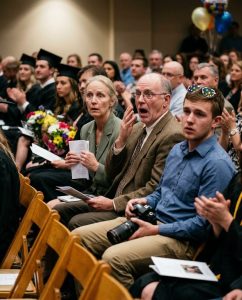
She looked up and saw her family staring.
Marcus had lowered his camera.
Emma’s phone hung useless in her hand.
Her mother’s face had gone blank.
Her father looked as though his own body had betrayed him by forgetting how to move.
Then the dean returned to the microphone.
“In addition,” he said, “Ms.
Thompson’s academic and scientific achievements have earned her full-scholarship admission to Harvard Medical School.”
A collective gasp moved through the auditorium.
Someone stood.
Then another person.
Then rows of people were rising into a standing ovation.
Sarah’s vision blurred for a second.
All around her, people were applauding not out of obligation, not because they shared her last name, not because they were trying to keep up appearances, but because her work had reached them before her story had.
And there, in the middle of it, sat the family who had spent four years acting as if she were a burden.
Dean Morrison opened the folder in his hands.
“There is one more announcement,” he said.
“This morning I received a personal call from Harvard’s dean of admissions and from the director of the Winfield Physician-Scientist Fellowship.
After reviewing Ms.
Thompson’s research, they requested that the following be announced publicly.”
The room fell silent again.
Sarah could hear her own breathing.
“In addition to full tuition,” he said, “Ms.
Thompson has been selected for a four-year fellowship that includes a living stipend, funded housing support, and direct placement into Harvard’s combined M.D.-Ph.D.
research track should she choose to accept it.”
The applause returned, louder now, but Dean Morrison raised a hand for one final note.
“Harvard also asked me to state,” he said, glancing down at the page, “that this offer reflects not only Ms.
Thompson’s scientific promise but the extraordinary determination she demonstrated while supporting herself through multiple jobs and maintaining the highest GPA in the graduating class.”
At that, people turned.
Not to Sarah this time, but toward the audience.
Toward her family.
Sarah saw it happen row by row: the realization that the people sitting behind her had not been her support system.
They had been witnesses to her struggle and had mistaken it for weakness.
Her father lowered his head.
For the first time in Sarah’s life, he looked small.
The dean smiled at her.
“Congratulations, Ms.
Thompson.
You have made this university very proud.”
When Sarah left the stage, Dr.
Hendricks squeezed her shoulder.
“Hold your head up,” she whispered.
“This belongs to you.”
After the ceremony ended, families spilled into the sunlit courtyard.
Flowers changed hands.
Cameras clicked.
Graduates cried and laughed and hugged each other.
Sarah stood near a brick wall trying to absorb what had just happened when she saw her family approaching.
Her mother reached her first.
Her eyes were glossy, but Sarah had learned the difference between emotion and accountability.
“Sarah,” she said breathlessly, “why didn’t you tell us?”
That question nearly made Sarah laugh.
Why didn’t you tell us.
As if the burden had been hers.
As if they had ever been safe to tell.
Marcus shifted awkwardly, gripping the camera strap.
“Harvard is…
huge,” he said, sounding like someone speaking a foreign language badly.
“That’s actually incredible.”
Emma looked embarrassed for the first time in her life.
Then her father stepped forward.
The old authority was gone from his posture.
So was the casual contempt.
“Sarah,” he said, voice low, “I may have underestimated you.”
May have.
Not I was wrong.
Not I’m sorry.
Sarah looked at him for a long moment.
Then she looked past him at the campus, at students hugging mentors, at parents lifting bouquets, at Dr.
Hendricks speaking with Dean Morrison under the bright noon sky.
“You didn’t underestimate me,” she said quietly.
“You just never cared enough to see me clearly.”
Her mother’s face crumpled.
Marcus looked away.
Her father opened his mouth, but no words came.
Dr.
Hendricks approached with two faculty members and a photographer from the university.
“Sarah,” she said brightly, saving her from whatever would have come next, “Harvard’s team wants a photo for the press release, and the conference coordinator is here to confirm your fall presentation.”
The photographer lifted his camera.
“Family photo too?” he asked automatically.
Sarah hesitated.
Then she turned toward Dr.
Hendricks.
“Could we do one with the people who actually got me here?”
The answer landed with surgical precision.
No one argued.
Minutes later, Sarah stood between Dr.
Hendricks and Dean Morrison while the camera flashed.
She smiled this time, not because the day had become easy, but because for the first time she understood something that would matter for the rest of her life.
Being loved by the wrong people had taught her to doubt herself.
Being seen by the right people had taught her to become herself anyway.
That afternoon she returned to her apartment, set the glass award on the table, and finally let herself cry.
Not from sadness exactly.
Not even from triumph.
From release.
Her phone buzzed three times.
A text from her mother.
One from Marcus.
One from her father.
She did not open them right away.
Instead, she took the magnet note from the fridge, read Dr.
Hendricks’s handwriting again, and smiled.
You belong in every room your work opens.
Weeks later, Sarah accepted the fellowship.
Months later, she moved to Boston with two suitcases, a stack of notes, and a life no one in her family had predicted for her.
She spoke at the conference that fall.
Her paper attracted attention from senior researchers.
During her first semester at Harvard Medical School, she called Dr.
Hendricks after her first anatomy exam and cried laughing when she realized she was still afraid of success arriving too loudly.
Her family kept reaching out in uneven ways.
Her mother sent careful messages.
Marcus offered awkward congratulations that sounded suspiciously like attempts to repair his own image.
Her father wrote a short email one evening that simply said: I was wrong.
Sarah read it twice.
She did not reply immediately.
Forgiveness, she learned, was not the same as pretending the wound never happened.
Some apologies arrive years too late and still matter.
Others arrive only because the truth became public.
The trick was learning the difference.
On the day she received her first white coat, Sarah looked at her reflection and thought of the auditorium, the polished floor, the standing ovation, the moment her family’s certainty collapsed under the weight of facts they could no longer mock.
She also thought about the quieter truth underneath it all.
The biggest turning point in her life had not been Harvard.
It had been the moment she stopped measuring her worth by whether her family could recognize it.
Sometimes the people who should love you most are the last to understand who you are.
Sometimes they understand only after the world confirms what they refused to see in private.
And sometimes the most painful question isn’t whether they were proud in the end.
It’s whether they would have ever looked closely enough if nobody else had applauded first.