At 6:58 that morning, my phone warned me that someone was trying to enter my apartment with my stolen spare key.
By the time the alert lit up my screen, I had slept maybe ninety minutes in scattered fragments.
I was already sitting upright before the second chime sounded, my pulse hard and fast, as if my body had been waiting for proof that the threat from the night before had not been empty.
I opened the live camera feed.
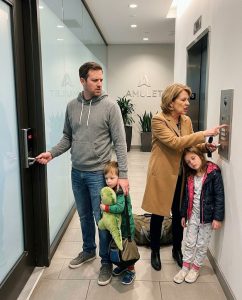
There was my brother, Derek, in the lobby outside my floor, still wearing the same dark hoodie he had on in half his family photos.
One child leaned against each side of him, sleepy and rumpled and far too young to understand they had been brought there as leverage.
Mia’s hair was half braided, half fallen out.
Caleb had a dinosaur pillow tucked under one arm and confusion stamped all over his face.
At Derek’s feet sat a duffel bag and a little pink backpack.
Beside him stood my mother in a camel coat, chin lifted, posture rigid with the kind of moral certainty she always wore when she was doing something indefensible and wanted to arrive looking righteous.
Then the intercom flashed.
‘Open the door,’ she snapped.
‘Or don’t call me your mother again.’
The strange thing was that by then, the threat no longer carried the power she thought it did.
Hearing it a second time was like hearing a line from a play whose ending I already knew.
I didn’t answer.
I watched Derek slide the old key into the lock.
The bolt refused him.
His face changed in one quick, ugly flicker—from confidence to confusion to anger.
He tried again, harder, as if force could make the wrong key become permission.
When the lock denied him a second time, he jerked back and hit the intercom button with the heel of his hand.
‘Enough, Iris,’ he barked.
‘Open up.
We don’t have time for this.’
That sentence almost made me laugh.
We.
As if I had been included in anyone’s planning at any point.
I stood in my kitchen, barefoot on cold hardwood, and looked around my apartment.
The muted gray sofa.
The clean counters.
The mug I had left in the sink before trying and failing to sleep.
Every object in that room belonged to a life I had paid for, protected, and arranged with care.
A life my family had spent years treating like open inventory.
The elevator at the end of the hall opened.
Aaron from the front desk stepped out with another security guard beside him.
I watched my mother pivot instantly, her expression rearranging itself into something offended and fragile.
‘Thank God,’ she said loudly.
‘My daughter is having some kind of episode.
She won’t open the door, and the children are exhausted.’
Aaron did not even glance at her at first.
He looked directly at Derek’s hand on my doorknob.
‘Sir, step away from the unit,’ he said.
Derek let go but did not move back.
‘This is ridiculous.
I’m her brother.’
Aaron’s voice stayed level.
‘And the resident reported an attempted unauthorized entry by a family member in possession of a stolen key and disabled fob.’
The word stolen landed harder than I expected.
Even through the camera speaker, I heard Derek recoil from it.
‘It wasn’t stolen,’ he snapped.
‘Mom had it.’
‘Which means it wasn’t yours to use,’ Aaron replied.
My mother lifted one hand dramatically, as if she were the calm adult in a room full of unreasonable people.
‘This is a family misunderstanding.
Iris is overreacting.
We just need her to open the door so we can talk like adults.’
I still didn’t answer.
Mia’s lip started to tremble.
Caleb looked up at Derek and asked, in a small sleepy voice, ‘Are we staying here?’
Something in me twisted.
I was furious at my brother, at my mother, at the way children had been turned into props in a power struggle they couldn’t possibly understand.
But that fury did not make me open the door.
If anything, it made me grip the phone tighter.
My intercom flashed again.
This time my mother’s voice dropped into that falsely tender register I knew too well.
‘Iris, don’t do this in front of the kids.’
That was always the technique.
The violation first, the shame second.
Hurt you, then accuse you of causing the bruise.
The police elevator chimed at the far end of the hall.
Two officers stepped out, one older and broad-shouldered, the other younger with a tablet in her hand.
Aaron turned immediately and briefed them in clipped, professional sentences.
I saw the younger officer glance up toward my camera, then toward Derek, then toward the children.
‘Who’s the resident?’ she asked.
I finally answered through the speaker system.
‘I am.
Unit 1908.
My name is Iris Marlo.
I reported this last night.’
All four adults in the hallway froze at the sound of my voice.
The officer looked toward the camera.
‘Ma’am, are you safe inside?’
‘Yes.’
‘Do you want these individuals removed from your floor?’
‘Yes.’
Derek threw up his hands.
‘Come on.
We were just dropping off the kids.
She always watches them.
She just likes making everything dramatic.’
The older officer turned to him.
‘If she already told you no, why did you bring two minors and a key that doesn’t belong to you?’
No one answered right away.
My mother drew herself up.
‘Because family helps family.’
The officer’s expression did not change.
‘Family still needs permission to enter a private residence.’
Then the elevator opened again.
My father stepped out.
He was wearing yesterday’s clothes, as if he had not slept either.
In one hand he held a printed copy of the email I had sent in the middle of the night.
In the other, pinched awkwardly between two fingers, was a brass key.
For a second, no one moved.
My mother looked at him with raw disbelief.
Derek actually took a step back.
My father had spent most of my life arriving late to conflict and earlier to silence.
He was not a dramatic man.
He was not a brave man in any consistent way.
But something in his face that morning was different.
Not strong, exactly.
More like ashamed enough that he could no longer keep pretending shame was the same thing as innocence.
He looked at the officers and said, ‘I need to make a statement.’
My mother hissed his name.
He didn’t look at her.
‘I made that spare key during the pipe leak two years ago,’ he said.
‘My wife told me she returned it.
She did not.
And I found a second copy in her purse this morning after I read my daughter’s email.’
The hallway went silent.
Derek said, ‘Dad, what are you doing?’
He finally looked at him then, tired and flat.
‘Telling the truth too late, which seems to be my specialty.’
The younger officer took the key from him with a gloved hand and asked a few quick questions.
When had he found it? Did he know it had been given to Derek? Had he heard the conversation about dropping off the children? My father answered every one.
Yes, he had known my mother still had access.
No, he had not stopped her soon enough.
Yes, after reading my email and listening to the recording, he understood she intended to force entry anyway.
Then my mother did what she always did when cornered by facts: she attacked the tone.
‘You’re humiliating this family over babysitting,’ she snapped toward my door.
‘After everything we have done for you.’
The officer nearest her said, very evenly, ‘Ma’am, bringing children to pressure someone after a clear refusal is not babysitting.
Using a key you were not authorized to use is not a misunderstanding.
We need you to lower your voice and step back.’
That was when I finally opened my door.
Not all the way.
Just enough to step into the hall with my phone, my tablet, and the printed copies I had made before dawn.
My mother stared at me as if I were the person who had betrayed her.
Derek looked embarrassed now, but only in the way people look embarrassed when a plan fails in public, not when they understand why it was wrong.
Mia looked relieved to see me.
Caleb looked scared.
I crouched so I was level with them.
‘You did nothing wrong,’ I said softly.
‘None of this is your fault.’
Then I stood and handed the officers my screenshots, the access log from the building app, and the audio recording of my mother’s call.
The younger officer listened to part of it through an earpiece.
I watched the moment she heard the line: We planned it this way because you always say no at first.
Her mouth tightened.
She asked if I wanted a formal report filed.
‘Yes,’ I said.
My mother let out a bitter laugh.
‘You’re calling the police on your own family.’
I met her eyes.
‘No.
I’m responding to people who tried to use my home without consent after I said no.’
The older officer turned to Derek.
‘Do the children’s parents know you are attempting to leave them here against the resident’s wishes?’
Before Derek could answer, a woman in oversized sunglasses appeared at the far end of the hall, dragging a rolling suitcase and looking furious.
Fiona.
So that was the real plan.
She had been downstairs or in the rideshare loop waiting for the handoff to happen cleanly enough that she and Derek could sprint to the airport afterward.
When she realized police were involved, her face changed color.
‘Are you serious?’ she said to me.
‘You’re doing this now?’
I looked at her and thought about the messages, the money, the total absence of apology.
‘No,’ I said.
‘You did this now.’
By the time the officers finished, Derek and Fiona had missed their flight.
I know because Derek said it three times, each louder than the last, as though lost airfare were the true injustice of the morning.
The officers informed them that if they attempted to leave the children without consent again, the next conversation would be much more serious.
Aaron and the second guard escorted my mother, Derek, Fiona, and the kids back to the elevator.
Mia looked back at me once as the doors closed.
I raised a hand and smiled at her the way I wished someone had smiled at me when I was young and learning that adult chaos can arrive dressed as family love.
After the elevator doors shut, the hallway became very quiet.
Aaron asked if I wanted a full trespass notation added for Derek and my mother.
I said yes.
The building manager later extended it to Fiona too.
No access, no visitor approval, no release to my floor without explicit confirmation from me every single time.
The older officer gave me a case number.
The younger one told me I had done the right thing by documenting first instead of opening the door to argue.
I thanked both of them.
Then they left.
That left me standing in the hallway with my father.
He looked older than he had the week before.
Maybe older than he had ever allowed himself to look.
‘I should have stopped this years ago,’ he said.
The sentence was true, but it was not enough.
I didn’t tell him it was okay, because it wasn’t.
I didn’t rescue him from his guilt, because I had spent too much of my life rescuing everyone else from the natural consequences of their choices.
Instead I said, ‘You knew she kept the key.’
He nodded.
‘And you said nothing.’
Another nod.
There were tears in his eyes then, but I had no room left to make that my problem too.
‘I am not doing this anymore,’ I said.
‘Not the money, not the access, not the guilt.
If you want a relationship with me, it has to exist without her speaking through it.’
He swallowed and said, ‘I understand.’
Whether he truly did, I couldn’t tell.
He left the way he had arrived: quietly, holding the manila envelope like it weighed more than paper should.
I went back inside and locked the door.
Then I did something small and almost absurdly practical.
I made coffee.
My hands were still shaking when I poured it, but the act itself calmed me.
Water.
Grounds.
Mug.
Counter.
The ordinary sequence of a life that still belonged to me.
At 9:14 a.m., the family group chat exploded.
My mother said I had terrorized the children.
Derek said I had cost them thousands of dollars.
Fiona said I had humiliated them in front of police over a misunderstanding.
I did not answer each message.
I sent one email.
To my parents, Derek, Fiona, and the handful of relatives who usually got recruited as audience members whenever my mother wanted backup.
I attached the screenshots, the call transcript, the audio file, the access log, and the spreadsheet showing $11,600 in transfers over twenty-six months.
Then I wrote three paragraphs.
I said that effective immediately, I would no longer provide money, emergency coverage, child care, access to my residence, or unscheduled contact.
I said any future attempt to enter my home without permission would be treated the same way.
And I said that the phrase family helps family had been used for years to describe a one-way pipeline that ended in my bank account, my front door, and my silence.
My father replied to everyone twenty minutes later.
For most people, it would not have looked like much.
Everything Iris attached is true.
I should have stopped this.
I didn’t.
Do not contact her today.
It was the first time in my life he had contradicted my mother where anyone else could see it.
It did not erase anything.
But it mattered.
By the following week, I had moved my emergency savings into new accounts, removed every informal payment route they used, changed passwords, updated beneficiaries, and locked down every financial permission the way I would have for a compromised system at work.
My attorney sent a formal cease-and-desist letter after Derek left two voicemails calling me vindictive and unstable.
Once a law office letterhead entered the chat, the volume dropped fast.
Silence, I discovered, can be purchased very cheaply when the free access ends.
Two months later, my mother mailed my childhood photo albums to me without a note.
Not all of them.
Only the ones where I appeared alone.
It was such a precise little cruelty that I almost admired the craftsmanship of it.
I put the box in my closet unopened for three weeks before I could face it.
My father sent one email every month for a while.
No excuses.
No speeches about forgiveness.
Just brief updates and once, finally, an apology that did not ask me to relieve him of it.
I answered some of those messages and ignored others.
I have not spoken to my mother since that morning in the hallway.
Derek reached out exactly once after the cease-and-desist period expired.
He said Mia missed me.
That part, I believed.
Then he asked if I could help with camp tuition because things had been tight since the missed trip and some other expenses.
I did not reply.
That was the real ending, I think.
Not the police report.
Not the failed key.
Not even my father stepping out of the elevator with the truth in his hand.
The real ending was the moment I understood that love offered only in exchange for access is not love.
It is a contract written by other people and enforced with guilt.
For years I had treated my family like a security exception.
Dangerous, yes, but familiar enough to permit.
That morning I stopped.
People still ask whether I regret involving the police.
I regret that I spent so long believing blood gave someone the right to step over a locked door.
I regret that two children had to watch adults use them as tools.
And sometimes, in the quietest moments, I regret something even more uncomfortable: that my mother’s cruelty was easier to see than my father’s silence.
Her damage was loud.
His was upholstered in restraint, which made it easier to mistake for decency.
The lock on my apartment was never really the point.
The point was whether I would finally believe I was allowed to close it.
I did.
And once I did, the strangest thing happened.
My home did not feel smaller without them.
It felt like mine for the first time.