I drove eighteen hours in an old truck to watch my daughter become an Army officer.
By the time I reached the stadium parking lot, the sun was already climbing over the top row of bleachers, bright enough to make the windshield glare white.
My Freightliner rumbled once, coughed hard, then settled into silence with the kind of tired shudder only old trucks make.
I sat behind the wheel for a moment with both hands on the steering wheel.
Outside, families were crossing the lot in clean clothes and polished shoes, carrying bouquets, folded ceremony programs, camera bags, and small American flags.
The morning smelled like diesel, cut grass, sunscreen, and popcorn warming somewhere near the concession stand.
A loudspeaker crackled above the stadium gate, but the words blurred into static.
I checked my phone.
9:18 a.m.
The commissioning ceremony started at ten.
My right knee throbbed deep under the kneecap, the way it always did before rain, even though the sky was blue enough to look painted.
Pain had been part of my life so long that I had stopped treating it like news.
Today was not about me.
Today was about Jessica.
My daughter was becoming a United States Army officer.
Before I opened the truck door, I looked down at the leather band around my wrist.
It was old enough to look almost black in some places and pale brown in others, the edges cracked and the stitching frayed.
A small metal plate sat against the inside of my wrist, scratched nearly smooth from years of work, weather, road grime, and nervous thumbs.
Most people thought it was a sentimental bracelet.
Some old veteran thing, maybe.
Some trucker keepsake.
They were wrong.
It was a promise.
I ran my thumb across the plate once, then climbed down from the cab slowly, favoring the bad knee.
My boots hit the pavement hard.
At 4:07 a.m., I had shaved in a truck stop bathroom under lights that flickered every few seconds.
I cut my jaw twice because my hands were stiff from driving.
At 5:22 a.m., I ironed my blue flannel shirt inside the sleeper cab with a travel iron that had given up on half its life.
By 8:49 a.m., I had parked outside the stadium and sat there too long because I needed a few minutes before Jessica saw me.
Not because I was ashamed.
Because fathers like me are careful with what our daughters have to carry.
She had carried enough.
When Jessica was little, she used to ride beside me in the truck during summer runs, strapped into the passenger seat with crayons in her lap.
She colored state maps while I hauled freight from one end of the country to the other.
She knew the sound of Jake brakes before she knew multiplication tables.
She knew how to sleep through diesel engines, warehouse alarms, and rain hammering against a sleeper cab roof.
I missed school plays.
I missed parent nights.
I missed more ordinary dinners than any father wants to count.
But I paid rent.
I bought winter coats.
I kept the lights on.
Every mile had been for her, even the ones she never saw.
I had almost reached the stadium entrance when I heard her voice.
“Dad!”
I turned.
Jessica was running toward me in full dress uniform, sunlight catching the trim on her shoulders.
For one second, I forgot every ache in my body.
Cadet First Class Jessica Carter looked like discipline itself.
Straight back.
Clean gloves.
Hair pinned perfectly.
A face trying to be professional and failing because she was still my girl.
In less than an hour, she would become Second Lieutenant Jessica Carter.
She threw both arms around me anyway.
“You made it,” she said into my shoulder.
“Wouldn’t miss it,” I told her.
She pulled back and looked at my face.
Her eyes went straight to the little cut on my jaw.
“You drove through the night again.”
“Maybe.”
“Dad.”
“The truck’s still running, isn’t it?”
She rolled her eyes, but she hooked her arm through mine and held on.
That was Jessica.
She had learned early that love does not always arrive rested, clean, or on time.
Sometimes it arrives in steel-toe boots with gas station coffee on its breath.
As we walked toward the seating area, people glanced at me.
Not all of them meant anything by it.
Some did.
I had been in enough places where money speaks before a man does.
The families around us looked polished, pressed, and expensive.
Tailored suits.
Bright dresses.
Watches that caught the light.
Shoes that had never seen a loading dock.
Then there was me.
Heavy boots, work hands, weathered skin, blue flannel, and a face the road had sanded down over the years.
I was used to being overlooked.
It happened at school offices when I showed up late from a route.
It happened at hospital intake desks when my insurance card did not impress anyone.
It happened at banks, dealerships, parent meetings, and every place where people look at your clothes and decide how much of your story they need to hear.
But none of that mattered that morning.
Jessica squeezed my arm as we reached her section.
“I’m glad you’re here,” she said softly.
“Me too.”
She glanced at the wristband, the way she had done her whole life.
When she was ten, she asked me if it was from an old friend.
When she was fourteen, she asked if it was from the Army.
When she was seventeen, she stopped asking because she had learned that certain quiet places in a parent are not doors you can force open.
I never lied to her.
I just never gave her the whole answer.
The ceremony began beneath a sky so clear it made the field look sharper than real life.
Rows of cadets stood at attention, trying not to shift in the heat.
The military band played.
Families clapped.
Programs fluttered like paper birds.
Phones lifted everywhere, recording sons and daughters stepping into lives their parents could not fully protect them from.
I held Jessica’s program in my hand.
Her name was there in black print.
Jessica Marie Carter.
Cadet First Class.
Soon to be commissioned.
I read it at 10:14 a.m., then again at 10:21, then again at 10:32, as though the ink might change if I looked away too long.
Paper has a way of making sacrifice look tidy.
Real life is never tidy.
Real life is unpaid sleep, bad coffee, worn tires, and a daughter standing on a field while her father prays the world will be gentler with her than it was with him.
Then the guest speaker stepped to the podium.
Lieutenant General George Henderson.
Three stars on his uniform.
The stadium clapped with the kind of respect that does not need instructions.
He looked like a man who had spent his whole adult life being obeyed.
He began speaking about leadership.
About service.
About the weight of command.
His voice carried cleanly through the speakers, steady and practiced, and I listened because I wanted to know the world my daughter was stepping into.
I did not expect to become part of it again.
Not in front of thousands of people.
Not after all those years.
Then the general stopped talking.
The silence was small at first.
A missed word.
A breath too long.
Then the silence spread.
He stood behind the podium with one hand near his notes, staring out across the crowd.
His gaze moved over the bleachers, then stopped.
On me.
At first, I thought I was imagining it.
Then his face changed.
Confusion.
Recognition.
Shock.
The old band suddenly felt heavier on my wrist.
Jessica turned her head toward me.
“Dad?”
I could not answer.
General Henderson stepped away from the podium.
One of the officers near the stage leaned forward as if to ask whether something was wrong.
The general ignored him.
He walked down from the stage and onto the field.
Across the grass.
Toward my section.
People began turning.
A woman in the row ahead lowered her phone.
A little boy holding a tiny flag let it sag against his knee.
The band members sat frozen with instruments halfway lowered.
I could feel Jessica’s hand tighten around my arm.
For one ugly second, I thought about pulling my sleeve down.
I thought about hiding the band and letting the day stay clean for my daughter.
I had kept my silence for twenty-two years.
Another hour should have been easy.
But promises do not disappear because a stadium is watching.
The general reached the railing and stopped close enough that I could see the lines around his eyes.
Two officers followed behind him, uncertain and alert.
His gaze dropped to my wrist.
To the leather.
To the scratched metal plate.
He stared at it like a man staring at a grave marker.
“You…” he whispered.
The microphone near the podium was still live enough to catch the word and carry it thinly through the speakers.
Every head around us turned.
Jessica looked from him to me, and the strong, composed officer she was trying to become disappeared for a moment.
She was just my daughter.
Confused.
Afraid.
Waiting for me to explain something I had spent most of her life avoiding.
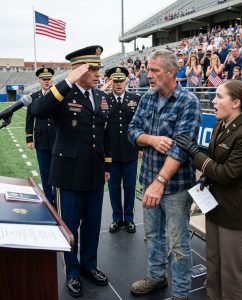
Then Lieutenant General George Henderson snapped into a salute.
It was not casual.
It was not ceremonial.
It was a full military salute, sharp enough that the officers behind him froze.
Directed at me.
A truck driver in blue flannel.
A tired father with a bad knee.
A man everyone had already finished judging.
The stadium went dead quiet.
Jessica’s mouth opened slightly.
The general held the salute for one long second before lowering his hand.
“Sir,” he said, voice low, “where did you get Sergeant Burton’s rescue band?”
The name hit me so hard my fingers went numb.
Sergeant Burton.
Not just Burton.
Not Mike.
Sergeant Burton.
The way his name had appeared in reports.
The way it had been printed on the folded notification form.
The way men say a name when guilt has kept it polished for years.
I heard Jessica whisper, “Dad, what is he talking about?”
I covered the band with my other hand before I realized I had moved.
Old habit.
Old fear.
The general saw the motion and his face tightened.
He had not forgotten either.
Nobody who was there could forget.
Twenty-two years earlier, before I was a long-haul driver and before Jessica was born, I wore a uniform too.
Not for long compared to some men.
Long enough.
Long enough to learn how young a person can feel while doing old men’s work.
Long enough to learn that the loudest moments are not always the ones that follow you home.
Sometimes what follows you is a hand gripping your wrist in the dark.
Sometimes it is one promise made under fire.
Sometimes it is a strip of leather handed over by a man who knows he may not get another chance to speak.
Back then, Burton was the kind of soldier people trusted before they knew why.
He was older than most of us, calm in the way only tired brave men are calm.
He kept extra socks in his pack for younger guys who forgot theirs.
He wrote letters with a pencil sharpened by knife.
He could make a whole squad laugh with one sentence and then go dead serious the second danger entered the air.
The rescue band had been his.
He wore it on his right wrist.
He said it was not for luck.
Luck was too flimsy.
It was for remembering who you owed.
The day everything changed, we were moving through a stretch of road I still see in dreams.
The transport took damage before most of us understood what had happened.
There was smoke.
Metal screamed.
Someone was yelling numbers.
Someone else was praying in a voice that sounded too young.
Burton shoved me hard enough to bruise my ribs and got me clear of the worst of it.
Then he went back.
That is the part official language never knows how to handle.
The report said he re-entered a compromised vehicle to assist wounded personnel.
The report said contact was lost at approximately 1430 hours.
The report said presumed dead.
Reports are clean because paper cannot smell smoke.
I remembered his hand clamping around my wrist before he pushed the leather band into my palm.
“Carter,” he said, because back then everyone used last names first, “if I don’t make it, you keep this moving.”
I told him to shut up.
He almost smiled.
“Promise me.”
So I did.
I promised.
Then the world broke open again.
Afterward, I left the service with a knee that never worked right and a silence nobody knew what to do with.
I signed statements.
I answered questions.
I sat through one debriefing, then another.
I read the casualty report and saw Burton’s name where no living man’s name should be.
I kept the band because I had given my word.
I became a truck driver because sitting still was worse.
I raised Jessica because life does not wait for grief to become convenient.
And I never told her the whole story because I did not want her childhood built around the worst day of mine.
Standing in that stadium, I realized silence has a cost too.
Jessica had grown up beside the promise and never known what it was.
General Henderson waited.
The crowd waited.
My daughter waited hardest of all.
I swallowed once.
“Burton gave it to me,” I said.
The general’s eyes sharpened.
“When?”
I looked at him, then at Jessica.
“Before he went back in.”
A sound moved through the rows around us.
Not quite a gasp.
Not quite understanding.
General Henderson went pale.
“He went back in after you?”
“No,” I said. “After everybody.”
The officer behind him whispered something under his breath.
Jessica’s fingers were still locked around my sleeve.
“Dad,” she said, barely audible, “you were there?”
I nodded.
Her eyes filled before she could stop them.
All those years she had seen the bad knee, the nightmares I denied, the way I checked exits in restaurants, the way I hated fireworks, the way I went quiet every year around one particular week in August.
Children notice what parents hide.
They just do not always know what they are seeing.
General Henderson reached into his breast pocket.
Slowly, carefully, as if everyone around him might shatter if he moved too fast.
He pulled out a folded photograph.
The edges were soft from handling.
He opened it and held it between two fingers.
Four young soldiers stood beside a damaged transport truck, dusty and exhausted, trying to look tougher than they were.
One of them was me.
One was Burton.
One was Henderson, younger, leaner, with no stars on his chest and fear hidden badly behind his eyes.
Jessica stared at the photo.
Her breath shook.
“Why have I never seen this?”
I did not have a good answer.
There are reasons that sound noble when you keep them inside, and cowardly when your daughter finally asks for them out loud.
“Because I thought I was protecting you,” I said.
She blinked hard.
“From him?”
“No.”
I looked down at the band.
“From me.”
General Henderson turned the photo over.
There was writing on the back.
Old ink.
Two dates.
Four names.
And one line that made the general’s hand tremble before he steadied it.
He read it silently first.
Then he looked at me as if a missing piece of his life had just fallen into place.
“Carter,” he said, and this time his voice was not for the crowd. “We were told Burton died before extraction.”
I felt the stadium tilt.
“What?”
He lowered the photograph.
“That is what the official report said.”
My chest tightened.
I had signed statements.
I had answered questions.
I had told them Burton was alive when I last saw him.
I had told them he went back in.
I had told them he handed me the band.
I had told them everything.
But by the time the final paperwork came back, the story had been narrowed into something cleaner.
Presumed dead before recovery.
No living witness account attached.
No mention of the band.
No mention of the promise.
No mention of the men he saved after he should have saved himself.
Jessica looked at the general.
“Are you saying my father’s report was buried?”
The words sounded strange from her mouth because they sounded like an officer’s words now.
Not just a daughter’s.
General Henderson glanced toward the stage, then back to us.
“I’m saying,” he replied, “that I have spent twenty-two years believing I was the last living man to speak Sergeant Burton’s name in that convoy.”
The crowd was completely still.
He looked at me.
“And I was wrong.”
The ceremony staff did not know what to do.
The cadets on the field remained at attention, but every eye was turned toward our section.
Jessica released my arm and stood a little straighter.
The movement was small.
I noticed it anyway.
The daughter who had run to me in the parking lot was still there.
But so was the officer she had worked years to become.
“Sir,” she said to the general, voice trembling but clear, “what happens now?”
General Henderson looked at her, and something like respect passed across his face.
“Now,” he said, “we correct the record.”
Then he looked back at me.
“If your father is willing.”
My first instinct was to say no.
Not because Burton did not deserve it.
Because attention had never felt safe to me.
I had built my life around moving through places without being remembered.
Truck stops.
Warehouses.
Rest areas.
Empty highways.
I knew how to survive as a man nobody looked at too closely.
Now thousands of people were watching, and my daughter was waiting to see whether I would disappear into silence again.
I looked at the band.
I heard Burton’s voice.
Keep this moving.
I nodded once.
General Henderson turned toward the stage and signaled to one of the officers.
The ceremony did not stop entirely, but it changed shape.
You could feel it.
A ripple moved through the officers, then the cadets, then the families.
Something formal was giving way to something true.
The general returned to the microphone and stood there for a moment without speaking.
When he finally did, his voice had lost all its polish.
“Ladies and gentlemen,” he said, “before we continue, there is a matter of service and record that requires our attention.”
Jessica stood beside me so close our shoulders touched.
I wanted to tell her I was sorry.
I wanted to tell her everything at once.
Instead, I stood still and let the truth arrive.
General Henderson did not tell the whole story.
Not there.
Not in front of cadets who had come to receive their commissions and families who had come to celebrate them.
But he said enough.
He said Sergeant Michael Burton’s name.
He said there had been an unresolved discrepancy in an old battlefield account.
He said a surviving witness had just been identified in the audience.
He said acts of courage do not expire because paperwork fails them.
Then he asked me to stand.
My knee hated me for it.
Jessica reached for my elbow, but I shook my head once.
I needed to stand on my own.
The stadium rose with me.
Not all at once.
First the cadets.
Then the officers.
Then the families in the lower rows.
Then everyone.
Applause began softly, uncertain at first, then grew until it rolled across the field.
I did not know what to do with my hands.
I had spent years gripping steering wheels, load straps, fuel pumps, cheap coffee cups, and hospital forms.
I had not spent my life being applauded.
Jessica cried openly then.
She did not wipe the tears away.
When the ceremony resumed, something about the day had changed for both of us.
She still took her oath.
Her voice was steady.
Her right hand rose.
Her eyes found mine in the crowd.
For the first time, I wondered whether she understood that service was not an idea to me.
It had a face.
It had a name.
It had a band of cracked leather and a promise I had been too afraid to explain.
After the ceremony, people approached us in awkward waves.
Some thanked me.
Some shook my hand.
Some only nodded because words failed them.
The same polished parents who had glanced past me that morning now looked at me like they had been handed a new set of eyes.
I did not enjoy it.
But I understood it.
People often need permission to see what was already in front of them.
General Henderson found us near the edge of the field.
He had removed his hat and held it under one arm.
Up close, he looked older than he had onstage.
So did I, probably.
“Mr. Carter,” he said, “I owe you an apology.”
“You don’t owe me anything.”
“I do.”
His jaw tightened.
“I was pulled out before the final recovery. I accepted the report because I needed it to be true enough to live with.”
I looked at him for a long moment.
That was a kind of honesty most men avoid.
Jessica stood between us, listening.
“Burton saved me,” I said.
The general nodded.
“He saved all of us.”
Then Jessica asked the question that neither of us had been brave enough to ask.
“Does his family know?”
The general closed his eyes briefly.
“No,” he said. “Not the full account.”
I felt the band against my skin.
The promise had not been finished after all.
It had only been waiting.
Over the next few weeks, phone calls followed.
Official ones.
Careful ones.
The kind where people say phrases like documentation, amended record, witness statement, and review board.
I gave my account again.
This time, Jessica sat beside me at the kitchen table with a notebook open and her uniform jacket hanging over the back of a chair.
At 7:43 p.m. on a Thursday, I spoke Burton’s name into a recorded statement and did not look away.
At 8:16 p.m., I described the transport.
At 8:39 p.m., I described the band.
At 9:02 p.m., when they asked what his last words were, I had to stop.
Jessica put her hand over mine.
Not to silence me.
To keep me there.
A month later, a letter came.
Not the final one.
Not the public one.
Just a preliminary notice that Sergeant Michael Burton’s file had been reopened for correction of record.
I read it twice in the driveway beside the mailbox while the truck idled behind me.
Jessica was home that weekend, and she stood on the porch watching me.
The little American flag by the steps moved in the wind.
For years, I thought keeping the band meant keeping the pain.
I had been wrong.
Keeping the band meant keeping the promise alive long enough for someone else to hear it.
When Burton’s sister called me, I almost did not answer.
Jessica saw the number on my phone and said, “Dad.”
Just that.
So I answered.
The woman on the other end did not speak right away.
Then she said, “Mr. Carter?”
“Yes, ma’am.”
“My brother saved you?”
I closed my eyes.
“Yes.”
“And others?”
“Yes.”
She cried then, but it was not the kind of crying that asks to be comforted.
It was the sound of a door opening in a house that had been locked for twenty-two years.
I told her what I could.
Not everything.
Some details belong to the people who survived them, and some belong to the dead.
But I told her he was brave.
I told her he was funny.
I told her he had extra socks in his pack and pencil marks on his letters and a way of making scared young men feel less ashamed of being scared.
I told her he did not die forgotten.
When the call ended, Jessica was crying too.
“I’m sorry,” I told her.
“For what?”
“For not telling you.”
She shook her head.
“I wish you had.”
That hurt because it was fair.
Then she added, “But I understand why you didn’t.”
That helped because it was mercy.
The next time I drove my route, the band stayed on my wrist.
Same leather.
Same cracks.
Same scratched metal plate.
But it felt different now.
Not lighter, exactly.
True things are not always light.
It felt shared.
Months later, when Jessica called from her first assignment, she asked me to tell the story again.
Not the stadium version.
Not the official version.
The real one.
So I did.
I told her about Burton.
I told her about fear.
I told her about surviving when better men did not.
I told her that courage is not being untouched by terror.
It is doing the next necessary thing while terror has its hands around your throat.
She was quiet for a while after that.
Then she said, “I think I needed to know where I came from.”
I looked through the windshield at the highway unspooling ahead of me.
Mile after mile.
White lines.
Open road.
The same life I had always known, and somehow not the same at all.
That morning at the stadium, people looked at me as though they had overlooked something important all these years.
Maybe they had.
Maybe I had too.
I had spent so long being the truck driver in the back row, the tired father in the blue flannel, the man with the bad knee and the old band, that I forgot a person can be ordinary and still be carrying something sacred.
Jessica did become Second Lieutenant Carter that day.
That was still the most important part.
But before she stepped into her future, she finally saw the part of my past I had hidden from her.
And because she saw it, the promise moved one more time.
From Burton to me.
From me to the record.
From the record to his family.
From silence into the open air.
I still drive the truck.
I still stop for bad coffee.