My dad smashed my jaw for talking back.
That was what he called it.
Talking back.
Not asking a question.
Not refusing to be treated like a maid in a house where I paid bills, cooked meals, and cleaned up after grown adults.
Talking back.
The crack was not loud like it is in movies.
It was sharper than that.
Cleaner.
It snapped through the kitchen, through the hum of the refrigerator, through the smell of burnt butter in the skillet, and through every small lie I had ever told myself about surviving until things got better.
My father’s fist caught me across the lower face with the calm certainty of a man who had done damage before and always found somebody else to blame for it.
My teeth slammed together.
White light burst behind my eyes.
The kitchen tilted sideways, and for one strange second I noticed the smallest things.
The yellow bulb above the table buzzing.
The coffee ring spreading on the counter.
The sticky tile under my palms.
The faint summer heat coming through the cracked window over the sink.
Then I tasted copper.
Blood slipped under my hand, warm and humiliating.
My mother stepped around me with the coffee pot.
She did not gasp.
She did not say my name.
She did not even set the coffee pot down.
She moved around me the way someone moves around a spill they are too irritated to clean.
“That’s what you get for being useless,” she said.
Her laugh was small and sharp, almost private.
Then my father looked down at me and said, “Maybe now you’ll learn to keep that gutter mouth shut.”
Kyle laughed from the doorway.
Kyle was my older brother.
Thirty years old, unemployed more often than employed, brilliant at blaming the world and allergic to any task that did not make him look clever in his own head.
He had been stretched across the couch all morning, sneakers on, phone glowing, while I cleaned breakfast dishes and took the trash out and started a load of laundry that somehow contained none of my clothes.
All I had asked was why he could not clean the backyard.
That was all.
“Why can’t he do anything around here?”
In a normal house, it would have been a question.
In our house, it became a crime.
My father called it disrespect.
My mother called it attitude.
Kyle called it funny.
He stood in the doorway in yesterday’s T-shirt, one shoulder against the frame, smiling that lazy little smile he wore whenever somebody else was paying for his comfort.
He did not help me up.
He did not look away.
He watched me bleed like I was entertainment.
“Get up,” Dad snapped.
I pressed one hand against the tile and tried.
Pain flashed through my jaw so hard my eyes watered instantly.
I hated that.
I hated that they could still make my body tell the truth even when my face had learned to lie.
“Or do you need another lesson?” he asked.
I got up.
Because that was what I had been trained to do.
I got up when I was hurt.
I got up when I was sick.
I got up when Kyle needed a ride, when Mom needed groceries, when Dad wanted dinner early, when the washer overflowed, when bills came in, when the car needed gas.
I got up because staying down in that house only made people angrier.
I pressed a dish towel to my mouth until the red turned dark and sticky.
Then I took the broom and walked outside.
The backyard shimmered in the summer heat.
The broom handle was rough against my palm.
A neighbor’s small American flag hung from the porch two houses down, barely moving in the heavy air.
A family SUV rolled past the mailbox, slow and ordinary.
It was the kind of neighborhood where people waved from driveways and pretended not to hear what happened through thin kitchen windows.
I swept leaves and grass clippings into a pile while my jaw throbbed in time with my heartbeat.
Through the window, I could see Kyle on the couch again.
He was stretched out like a man born into royalty.
He caught me looking.
Then he smirked.
Some people do not need to throw the punch themselves.
They just learn where to stand so the blood never touches them.
For years, leaving had been something I planned in secret and failed at in public.
I worked part-time wherever I could.
Retail.
Reception.
Stockroom shifts.
A front desk job that lasted six months until my car mysteriously refused to start twice in one week.
I saved quietly.
Then the money would disappear under names that sounded harmless.
Family emergency.
Temporary loan.
Helping Kyle get on his feet.
Kyle’s custom T-shirt idea needed startup money.
Then his drop-shipping business needed a website.
Then his cryptocurrency course was apparently the opportunity of a lifetime, and if I did not help, I was the reason he stayed stuck.
My mother had a way of saying things that made theft sound like duty.
“He’s your brother,” she would say.
My father had a way of standing in doorways until I stopped arguing.
“This family pulls together,” he would say.
Kyle had the easiest line of all.
“Relax. You’ll get it back.”
I never got it back.
But money was only the beginning.
My phone disappeared on afternoons when I was waiting for callbacks.
My email password changed after I applied for a warehouse office job.
My car died the morning of two interviews and started perfectly the next day.
My mother called it bad luck.
My father called it responsibility.
Kyle called it family helping family.
I called it nothing for a long time.
That is how long fear can live inside you.
It steals the names off things.
Then, three weeks before my father broke my jaw, I went to the public library after work because my phone had been acting strange again.
The library smelled like carpet cleaner, old paper, and rain someone had tracked in from the parking lot.
A teenager at the next computer was watching videos with one earbud in.
An older man read the newspaper near the front window.
Nobody looked at me.
That made me brave enough to keep going.
At 6:42 p.m., I pulled my credit report.
At 6:51, I stopped breathing right.
At 7:03, I printed the first page.
The printer coughed out my life in black ink.
Two credit cards in my name.
A personal loan I had never applied for.
Late notices attached to an email address that was not mine.
A mailing address that was ours.
A signature that looked enough like mine to pass if nobody cared, and bad enough to make my stomach turn if anybody did.
I stood by the printer with those pages in my hands and understood something so cold and simple it felt like weather moving through me.
They had not only kept me from leaving.
They had built a fence around my future and put my name on every nail.
I wanted to drive home and scream.
I wanted to throw the papers in Kyle’s face.
I wanted to ask my mother how she could look at me every morning knowing what had been done.
Instead, I went to the library desk and asked how much it cost to print the rest.
That was the first smart thing I did.
After that, I began documenting everything.
Not emotionally.
Not loudly.
Precisely.
Bank statements.
Loan notifications.
Insurance letters.
Screenshots.
Call logs.
Photos of bruises taken under bathroom light with the fan running so nobody could hear the camera click.
A folder hidden behind a loose panel at the bottom of my closet.
A second phone wrapped inside an old hoodie in a storage bin marked winter blankets.
I saved dates.
I saved times.
I saved the way Kyle’s number appeared near verification messages.
I saved the email headers I did not understand yet because I hoped somebody else would.
The second smart thing I did was stop warning them.
People who count on your silence will often mistake it for defeat.
They get comfortable.
They get sloppy.
They start saying things in front of you because they believe you are too broken to keep score.
So I kept score.
On the night my father hit me, I sat on the edge of my bed at 11:18 p.m. with one side of my face swelling and my mouth barely able to open.
The house had gone back to normal.
That was the part that scared me most.
Not the violence.
The normalcy after it.
From the living room, I could hear them arguing over dinner like a man had not just split his daughter’s lip in the kitchen.
Pizza or Thai.
Extra sauce.
Delivery fees.
Kyle wanted someone else to pay, as usual.
My mother laughed at something on TV.
My father coughed and turned the volume up.
I opened the loose panel at the bottom of my closet and pulled out the folder.
My fingers were shaking so badly the first stack slipped from my lap and scattered across the carpet.
Credit report.
Credit card statement.
Loan notice.
Screenshot.
Photo.
Photo.
Photo.
I gathered them back together.
Then I took out the second phone.
It was cheap, prepaid, and ugly, with a cracked corner on the case.
I had bought it with cash at a gas station two towns over after Kyle joked one too many times about how easy it was to “fix” my regular phone when it glitched.
I sent the folder photographs to the one person I trusted enough to believe me.
Her name was Megan.
She had been my coworker at the front desk job before I lost it.
She was not dramatic.
She did not use words like toxic or trauma in a casual way.
She was the kind of person who labeled leftovers, paid bills early, and kept spare phone chargers in her glove compartment.
When I had once shown up to work with a bruise near my collarbone, she had not asked a question in front of anyone.
She had waited until lunch, slid a paper coffee cup toward me, and said, “You don’t have to tell me. But if you ever do, I know how to listen.”
That was why I sent it to her.
At 11:44 p.m., she wrote back.
I have it. I copied it. You are not crazy.
I read that last sentence three times.
You are not crazy.
It felt like somebody had opened a window in a room I had been locked in for years.
The next morning, I went downstairs.
I did not do it because I was brave.
I did it because the plan required them to believe nothing had changed.
My jaw had swollen into a crooked line.
My cheek was purple near the bone.
My mouth would not open wide enough for toast.
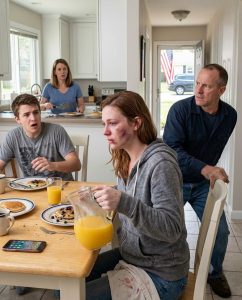
The kitchen smelled like pancakes and burnt coffee.
My father sat at the table with the business section folded in his hands.
He always read that section first, though he had never built anything that lasted besides fear.
My mother stood at the stove.
She slid pancakes onto Kyle’s plate and dropped blueberries over them like he was a child who had done something wonderful.
Then she put two plain pancakes on my plate.
She did not look at my face.
“Don’t just sit there,” she said.
Her voice was flat.
Routine.
“Pour juice for your brother.”
I stood and picked up the orange juice pitcher.
The cold glass sweated against my palm.
Every muscle in my face hurt.
Kyle held out his cup without looking up from his phone.
I poured.
He finally glanced at me.
Then he twisted his mouth sideways, making an ugly imitation of my swollen jaw.
“Still talking funny,” he said.
My father did not correct him.
My mother did not turn around.
Kyle grinned.
“Guess Dad finally knocked some sense into you.”
For one second, I saw myself throw the juice.
I saw it spill across his lap.
I saw the glass pitcher crack against the floor.
I saw my father standing up, and I saw myself not caring anymore.
Then I set the pitcher down.
Carefully.
Because rage would have given them the story they wanted.
Stillness gave me mine.
At 8:14 that morning, while they were still asleep, I had sent Megan the final folder scan.
At 8:19, I had made the call from the second phone.
At 8:22, I had placed the phone back inside the hoodie pocket near my feet.
At 8:27, just as Kyle set his juice glass down, there was a hard knock at the front door.
Nobody moved.
The sound landed in the kitchen like a plate breaking.
My father’s eyes lifted first.
My mother’s spatula froze over the pan.
Kyle looked annoyed for half a second, as if even a knock at the door was an interruption designed to inconvenience him.
Then the voice came from the other side.
“County sheriff’s office. Open the door, please.”
The change in my father’s face was small.
But I saw it.
Men like him spend years practicing anger because anger makes them look powerful.
Fear is different.
Fear exposes the child under the bully.
He pushed his chair back slowly.
The chair legs scraped the tile.
My mother turned toward me then.
Not toward the door.
Toward me.
For the first time all morning, her eyes actually took in my swollen jaw, the stiff way I held my mouth, the dish towel tucked into my lap.
Kyle stood too fast.
His chair hit the cabinet behind him.
“What did you do?” he hissed.
I did not answer.
The knock came again.
My father started toward the hallway, but before he reached the lock, the second phone buzzed inside the hoodie pocket by my foot.
I bent down and picked it up.
Kyle saw it.
That was the first time I saw real panic cross his face.
Not confusion.
Recognition.
The message on the cracked screen was from Megan.
They found the loan application email.
Only six words.
Only six words, and suddenly the whole kitchen rearranged itself around them.
My mother’s face went pale.
Kyle’s mouth opened, then closed.
My father looked from the phone to me.
“What folder?” he asked.
His voice was low.
Dangerously low.
But the danger had changed direction.
I looked at Kyle.
He looked like a man trying to remember exactly how many things he had done and which one might finally be visible.
The useless son had left a fingerprint somewhere he thought nobody would ever look.
I picked up the phone, looked at the three people who had spent years teaching me to be quiet, and said, “The one with my credit report. The loan. The cards. The photos. All of it.”
My mother whispered my name.
It sounded wrong in her mouth.
Too gentle.
Too late.
The voice outside spoke again.
“Open the door. Now.”
Dad turned the deadbolt.
Two deputies stood on the porch.
Behind them, Megan stood near the driveway with her arms wrapped around herself, her face white and determined.
She had not come inside.
She had not needed to.
She had done exactly what she promised.
She had listened.
One deputy asked if I was Emily Carter.
I said yes as clearly as my jaw allowed.
His eyes moved to my face.
Then to the towel.
Then to my father.
The room went still in a way I had never felt before.
This was not the old stillness, the one that protected my father.
This stillness was different.
It was the kind that happens when everyone understands somebody official has finally seen the room exactly as it is.
My father started talking immediately.
He said there had been a misunderstanding.
He said I was emotional.
He said I had always been dramatic.
He said families fought.
He said I had fallen.
My mother nodded too quickly.
Kyle stared at the phone in my hand.
The deputy did not look impressed.
He asked me if I needed medical attention.
I almost said no.
That was the old training rising up again.
No, I’m fine.
No, don’t make trouble.
No, it looks worse than it is.
Instead, I touched my jaw and said, “Yes.”
The word hurt.
It was worth it.
My mother made a sound like I had slapped her.
“Emily,” she whispered, “don’t do this to your father.”
That was when something inside me went completely quiet.
Not numb.
Clear.
I looked at her and realized she was still asking me to protect him from the truth after he had never protected me from his fist.
“I’m not doing this to him,” I said.
My voice was uneven, but it did not break.
“He did it. I’m just not hiding it anymore.”
Kyle cursed under his breath.
The deputy turned toward him.
“You need to stay where you are.”
Kyle lifted both hands in that fake innocent way he had perfected over years.
“I didn’t do anything.”
Megan, still on the porch, spoke for the first time.
“The email trail says different.”
Kyle looked at her like he wanted to erase her from the doorway.
For once, there were too many witnesses.
The deputies separated us.
One stayed with my father and Kyle.
The other guided me toward the porch and asked questions slowly.
My name.
My age.
Whether I felt dizzy.
Whether my jaw hurt when I tried to speak.
Whether the injury had happened last night.
Whether I had somewhere safe to go.
That last question almost undid me.
Not because I did not know the answer.
Because nobody in that house had ever asked it.
Megan stepped forward.
“She can stay with me,” she said.
My mother started crying then.
Loudly.
The kind of crying meant for an audience.
She said she loved me.
She said I was tearing the family apart.
She said my father had a temper but a good heart.
She said Kyle was confused and overwhelmed and had never meant harm.
I listened to all of it from the porch, with the morning sun on my face and my jaw pounding so hard I could barely think.
Then I looked past her into the kitchen.
The pancakes were still on the plates.
Kyle’s juice glass was still full.
The coffee ring was still on the counter.
The house looked normal.
That was how I knew I had to leave before it swallowed the moment whole.
At the hospital intake desk, they asked me what happened.
I told the truth.
The nurse’s face did not change much.
Only her eyes did.
She gave me a clipboard.
She spoke gently.
She did not rush me.
A doctor examined my jaw and ordered imaging.
The swelling was bad.
The bruising was worse by noon.
There was no neat way to make it sound smaller than it was.
While I sat in the waiting room, Megan placed a paper coffee cup beside me and did not ask if I was okay.
She knew better.
She said, “I made three copies of everything.”
That was when I cried.
Not loudly.
Not the way my mother had cried.
Just one hand over my eyes, shoulders shaking, trying not to move my mouth because every sob pulled at the pain.
Megan sat beside me and looked straight ahead.
“You’re not crazy,” she said again.
I needed it again.
By late afternoon, a police report had been started.
The financial documents had been forwarded for review.
The loan application email became the first loose thread.
Then the cards.
Then the verification number sent to Kyle’s old phone.
Then a login from our home internet.
It did not all resolve in one dramatic hour.
Real consequences rarely do.
They arrive in forms, calls, appointments, signatures, follow-ups, and people asking you to repeat the worst night of your life in a voice steady enough to be useful.
My father tried to call it discipline.
My mother tried to call it a family matter.
Kyle tried to call it a misunderstanding.
Paperwork has a way of being less sentimental.
The hospital record said injury.
The police report said statement.
The credit file said fraud.
For the first time, the world outside that house used words that did not bend around their feelings.
I stayed with Megan for eleven days.
Her apartment was small and smelled like laundry detergent and coffee.
She had a blue couch that sagged in the middle and a kitchen table covered with mail, pens, and two grocery bags she kept forgetting to unpack.
It was not fancy.
It was safe.
The first night, I slept for fourteen hours.
The second night, I woke up at 3:12 a.m. because no one had slammed a cabinet.
The silence scared me before it comforted me.
That is the part people do not understand about leaving.
Peace feels suspicious at first.
When you grow up reading footsteps, a quiet hallway can feel like a trap.
But day by day, my body learned.
No one took my phone.
No one mocked how I chewed.
No one asked me to pour juice for a man who had laughed at my pain.
The legal and financial mess took months.
Some accounts were frozen.
Some charges were disputed.
Some things could not be undone as quickly as they had been done.
But the folder mattered.
The timestamps mattered.
The screenshots mattered.
The ugly little details I had saved while shaking in a bathroom mattered.
My father was forced to explain why his daughter had a documented injury and why his version kept changing.
My mother was forced to explain why she had ignored it.
Kyle was forced to explain why his information kept appearing near accounts opened in my name.
He was not nearly as funny when nobody at the table was laughing.
I wish I could say I felt victorious.
Mostly, I felt tired.
Freedom is not always fireworks.
Sometimes it is a borrowed couch, a stack of forms, a swollen jaw, and a friend who makes coffee without asking you to earn it.
A few weeks later, I went back to the house with an officer present to collect my things.
My mother stood in the kitchen doorway.
She looked smaller than I remembered.
Or maybe I had just stopped shrinking.
“You really want to do this?” she asked.
I looked at the counter.
The coffee ring was gone.
The tile had been mopped.
The house had tried to make itself innocent.
I picked up my storage bin, the one that had hidden the second phone, and said, “I already did.”
Kyle stayed in his room.
My father did not come out.
For once, nobody ordered me to clean the backyard.
Nobody told me to pour juice.
Nobody said I was useless.
Outside, the summer air felt heavy and bright.
The neighbor’s small American flag moved softly on the porch.
Megan opened the back of her SUV.
I loaded my clothes, my documents, my old hoodie, and the folder that had helped save me.
Then I stood in the driveway for one final second and looked at the house where I had learned to survive quietly.
The crack had not just been bone.
It had been the sound a life makes when it bends too far and finally decides it will never bend for those people again.
I got into Megan’s car.
This time, when we drove away, nobody had borrowed my keys.
Nobody had hidden my phone.
Nobody had the power to call my silence love anymore.