The bathroom smelled like vanilla frosting, hand soap, and the damp towels my mother always forgot to hang up properly.
From the hallway, the party kept going.
Kids were laughing in the living room.
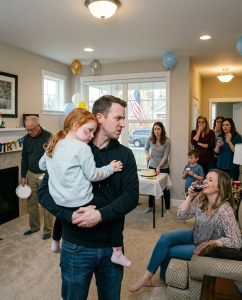
Balloons squeaked against the ceiling.
Somebody opened another beer with a sharp little pop that sounded obscene once I saw my daughter behind the toilet.
Rosie was curled into herself on the tile, knees tight to her chest, both arms wrapped around her body as if she could make herself small enough to disappear.
She was four years old.
Barely four.
Her red hair stuck to her damp cheeks, and her little sneakers were pressed flat against the baseboard.
At first, my mind tried to make it something ordinary.
A fall.
A tantrum.
A birthday party scare.
Then she lifted her face.
The left side was swollen purple under the bright vanity lights.
Not a faint mark.
Not a bump from running into a table.
A bruise shaped by force.
“Daddy,” she whispered.
The word came out like it had to climb over fear first.
I reached for her, and she flinched so hard my hand stopped halfway between us.
That was the first thing that broke me.
Not the bruise.
Not even the shaking.
The flinch.
My daughter had never flinched from me in her life.
I crouched slowly and said her name the way I used to say it when she woke from nightmares after her mother died.
“Rosie. It’s me. I’m here.”
Her eyes found mine, and the second they did, she launched herself into my arms.
I lifted her carefully.
Her whole body trembled against my chest.
When her sleeves shifted, I saw the marks on her arms.
Small round burns.
Clustered.
Fresh enough that the skin around them was angry and raised.
For a second, the house went silent in my head, even though the party noise kept moving beyond the bathroom door.
Forks scraping plates.
Laughter.
My nephew yelling about presents.
My mother calling for someone to bring more napkins.
The world had not stopped, and that felt like its own betrayal.
Some cruelties do not need a confession.
They leave evidence on a child.
I held Rosie with one arm and opened the bathroom door with the other.
The hallway was lined with family photos, all those smiling pictures my mother liked to arrange by year.
Graduations.
Christmas mornings.
Backyard cookouts.
Bethany holding her son at the hospital, my parents glowing beside her like she had handed them a crown.
There was one picture of my wife, Anna, holding newborn Rosie in a blue blanket.
I did not look at it for long.
I could not.
Anna had died when Rosie was two.
Cancer took her fast, cruelly, and without the dignity people like to pretend illness gives the dying.
In the hospital, with monitors blinking beside her and disinfectant in the air, she gripped my hand and made me promise.
“Protect her,” she said.
I promised.
I meant it.
After the funeral, my parents told me I could not raise a little girl alone without help.
They said Rosie needed family.
They said Bethany could watch her when my office ran late.
They said stability mattered.
I believed them because grief makes you reach for whatever hand is offered, even when that hand has been careless before.
Bethany had always been careless.
When she crashed her first car at seventeen, my parents blamed the rain.
When she failed out of college, they blamed the professors.
When she quit three jobs in one year, they blamed bad managers.
Every consequence in Bethany’s life had arrived at my parents’ door and been politely turned away.
Now my daughter was shaking in my arms, and I already knew they would try to turn this away too.
I walked into the living room.
The birthday banner hung crooked over the fireplace.
Blue paper plates were stacked beside the cake.
My nephew was sitting on the floor with wrapping paper around his knees, holding a plastic dinosaur.
My mother stood by the dining table with a cake knife in her hand.
My father was near the window, one elbow on the mantel, talking to my uncle about something that stopped as soon as he saw my face.
Bethany sat on the couch with a glass of wine.
She looked comfortable.
That is the word I remember most.
Comfortable.
Her legs crossed.
Her hair smooth.
Her smile loose from drinking and attention.
The table froze before anyone spoke.
A plastic fork slid off somebody’s plate and hit the hardwood.
A balloon bumped lazily against the ceiling fan string.
My mother’s knife hovered over the cake, and frosting clung to the edge like the room had been paused mid-celebration.
My father looked first at me, then at Rosie, then at the carpet.
Nobody moved.
“Who did this?” I asked.
My voice did not sound like mine.
It was low and controlled and so quiet that everyone leaned toward it without meaning to.
Bethany looked at Rosie and laughed.
Not nervously.
Not in shock.
A real laugh.
“Oh, relax,” she said.
She lifted her glass like she was making a point at brunch.
“It was just a joke. She was whining and acting like a brat. Somebody had to teach her.”
Rosie’s fingers dug into my shirt.
I felt her breath stutter against my neck.
For one ugly heartbeat, I saw myself crossing the room.
I saw Bethany’s glass hitting the wall.
I saw every person in that house finally understanding what fear looked like when it belonged to someone bigger than a child.
Then Rosie whimpered.
That sound brought me back.
The part of me that wanted violence was not the part my daughter needed most.
I tightened my arms around her and took one step back instead.
My mother finally spoke.
“Don’t make a scene.”
A scene.
That was what she called it.
Not the bruises.
Not the burns.
Not her granddaughter hiding behind a toilet during a birthday party.
A scene.
My father set his plate down.
“You’re overreacting,” he said, but his eyes would not stay on Rosie.
Bethany rolled her eyes.
“She’s dramatic because you baby her,” she said.
I looked at my sister then, really looked at her, and realized she did not think she had done anything unforgivable.
She thought she had done something inconvenient.
Something I was making loud.
Something my family could manage if I would just cooperate.
I walked to the front door.
My mother followed fast enough that her shoes slapped the hardwood.
“Michael,” she hissed.
My name sounded like a warning in her mouth.
I did not stop.
At 4:18 PM, I carried Rosie down the porch steps and across the driveway.
A small American flag stuck out of my mother’s planter by the walkway, bright and ridiculous against the birthday balloons still tied to the mailbox.
My father shouted from the doorway that I needed to calm down.
Bethany called something from inside the house, but I only caught the laugh at the end.
That laugh followed me all the way to the car.
Rosie would not let go of my sleeve while I buckled her into the car seat.
“I won’t leave you,” I told her.
She nodded once, but her eyes stayed fixed on the front door like she expected someone to come drag her back inside.
I drove to the ER with one hand on the wheel and the other reaching back whenever the road was straight enough for her to touch my fingers.
The hospital lights were too bright.
The waiting room television played some afternoon talk show no one was watching.
A man in work boots held a towel around his hand.
A teenage girl leaned against her mother with a fever-flushed face.
Ordinary pain sat everywhere in that room.
Then the nurse saw Rosie.
Her expression changed before she said a word.
That was the first adult that day who reacted correctly.
By 5:06 PM, the hospital intake desk had our names.
By 5:32, a pediatric specialist had been called.
By 6:10, a social worker stood beside the exam room door with a clipboard pressed against her chest.
They asked careful questions.
They examined Rosie gently.
They photographed every visible injury.
They wrote an incident report.
They used words like “pattern,” “non-accidental,” and “mandatory report.”
In the hallway, away from Rosie, their voices became colder.
That coldness helped me breathe.
It meant I was not insane.
It meant someone else saw what I saw.
“Do you know who did this?” the social worker asked.
I looked through the glass at Rosie sitting on the exam bed under a thin hospital blanket.
A nurse had given her a stuffed rabbit.
She held it by one ear.
“My sister,” I said.
The social worker wrote that down.
“And were other adults present?”
“My parents were in the house.”
She wrote that down too.
A police officer arrived later.
He was calm in the way people become calm when they have trained themselves not to show anger in front of victims.
He asked me to start at the beginning.
So I did.
The bathroom.
The bruise.
The burns.
Bethany laughing.
My mother saying not to make a scene.
My father calling me dramatic.
Every sentence made my hands shake harder.
The officer did not interrupt.
When I finished, he asked whether I had any photographs from before we arrived at the hospital.
I did.
I had taken two in the car before I drove away because some buried practical part of my brain knew my family would try to rewrite the room the second I left it.
He looked at them, then at me.
“Keep everything,” he said.
So I did.
The discharge papers.
The hospital bracelet.
The incident report number.
The name of the social worker.
The time stamps from my phone.
The call log showing three missed calls from my mother between 7:44 PM and 8:03 PM.
The voicemail from my father telling me to stop embarrassing the family.
Forensic proof is what you collect when love has already failed to protect you.
I wish that sentence sounded less bitter.
It does not.
Near dawn, I drove Rosie home.
She slept in the back seat with her face turned away from the window.
Her breathing was uneven but steady.
The sky had gone pale gray, and the neighborhood was still quiet, sprinklers ticking on lawns, trash cans lined up at curbs, porch lights fading against morning.
Inside, I laid her on the couch because she panicked when I tried to take her upstairs.
I made toast she did not eat.
I wrapped an ice pack in a dish towel.
I turned cartoons on low.
Then I sat on the floor beside her until she fell asleep again with one hand in my hair.
At 8:43 AM, the doorbell rang.
I looked through the peephole.
My mother was on my porch.
She was on her knees.
For one foolish second, I thought she had come to ask how Rosie was.
I opened the door.
“Please,” she sobbed.
Mascara streaked down her cheeks.
Her hair was unbrushed in the exact way that looked arranged to seem unarranged.
“Please, don’t destroy your sister’s life.”
Not Rosie’s life.
Not Rosie’s body.
Not Rosie’s trust.
Bethany’s life.
My mother grabbed the leg of my jeans and held on.
Behind her, my father sat in the family SUV at the curb with the engine running.
He stared straight ahead through the windshield.
He would not look at my house.
“Your sister was drinking,” my mother said.
“She got carried away. You know how sensitive Rosie is. Please just tell them it was a misunderstanding.”
I looked down at her hands on my jeans.
Those hands had held Rosie as a baby.
Those hands had brought casseroles after Anna died.
Those hands had taken my house key when I was too exhausted to cook and promised me family would always show up.
Trust is just a key until someone uses it to open the wrong door.
“Get off my porch,” I said.
My mother shook her head.
“If you press charges, Bethany could lose everything. Her job. Her son. Her future.”
There it was again.
Bethany’s future.
I stepped back, and my mother reached into her purse.
“I brought something,” she said.
My father’s car door opened.
“Linda,” he called.
My mother ignored him.
She pulled out a folded envelope.
Rosie’s full name was written across the front in Bethany’s handwriting.
Rosemary Anna Carter.
Not Rosie.
Not sweetheart.
Her full name, formal and cold.
My father walked up the driveway fast.
“Linda, don’t,” he said.
That was the first time fear entered the morning.
Not fear for Rosie.
Fear of what Bethany had put on paper.
I took the envelope.
My mother’s fingers resisted for a second before letting go.
Inside was a single page.
It was not an apology.
The first line read like a threat dressed as concern.
If Michael continues this, people need to know he has been unstable since Anna died.
I read it twice.
Then I read it out loud.
My mother’s face collapsed.
My father shut his eyes.
The letter went on.
Bethany had written that Rosie was “emotionally fragile.”
She wrote that I was “overwhelmed as a widower.”
She wrote that the injuries could have happened when Rosie “threw herself around during a tantrum.”
She wrote that if necessary, the family should “present a united front.”
A united front.
Against a four-year-old.
My mother whispered, “She was scared.”
I folded the letter slowly.
“No,” I said. “She was planning.”
That was when Rosie appeared behind me in the hallway.
She held the stuffed rabbit by one ear.
Her cheek was still swollen.
Her eyes moved from my mother to my father, and her whole body stiffened.
“Daddy,” she asked in a tiny voice, “do I have to say sorry?”
My mother made a sound like someone had stepped on her breath.
My father looked away.
I crouched in front of Rosie, blocking her view of them.
“No,” I said. “You never have to say sorry for being hurt.”
She looked at me for a long moment.
Then she nodded.
It was not a childlike nod.
It was solemn.
That is what they took from her first.
Not innocence in some big poetic way.
Something smaller and worse.
They made her careful.
I stood up with the letter in my hand.
My mother started pleading again, but her words had changed shape.
Now she wanted the letter back.
She said Bethany had not meant it.
She said it was written in panic.
She said family should not ruin family.
I almost laughed at that.
Instead, I opened my phone.
I called the officer who had given me his card at the hospital.
I told him my sister had sent a written statement attempting to shift blame onto my daughter and question my fitness as a parent.
He asked if I still had it.
I looked at my mother.
“Yes,” I said. “And my parents tried to deliver it.”
My father turned toward the street like he might leave.
The officer told me to keep them there if I safely could, but not to block them if they left.
I repeated that sentence out loud.
My mother finally let go of my porch rail.
For the first time since she arrived, she looked small.
Not sorry.
Small.
There is a difference.
Within forty minutes, an officer was standing in my driveway.
He took the letter in a clear evidence sleeve.
He asked my mother when Bethany had written it.
My mother said she did not know.
My father said nothing.
The officer asked whether they had read it before bringing it.
My mother started crying harder.
My father said, “Parts of it.”
That answer did more damage than silence.
By noon, Bethany had called me seventeen times.
I did not answer.
She texted instead.
You’re ruining my life.
Then:
You always hated me.
Then:
Mom said you kept the letter. Give it back.
Then:
You can’t prove anything.
I screenshotted every message.
I sent them to the officer.
I sent them to the social worker.
I put copies in a folder with Rosie’s hospital paperwork and the incident report number written on the front.
The next few weeks did not feel like justice.
They felt like paperwork.
Calls.
Appointments.
Follow-ups.
A child therapist with soft cardigans and a basket of washable markers.
A pediatric checkup where Rosie cried before anyone touched her.
A family services interview where I sat with my hands folded so tightly my knuckles hurt.
Bethany was charged.
My parents were questioned.
I was told not to discuss details with them, which was easy because they had already made clear who they believed deserved protection.
My mother left voicemails anyway.
At first, she begged.
Then she scolded.
Then she cried about Thanksgiving.
As if a holiday table mattered after a child had learned to hide behind a toilet.
My father sent one text.
This has gone too far.
I stared at it for a long time.
Then I replied.
You are right. It went too far when you looked away.
He did not answer.
Rosie healed slowly.
The bruises changed color.
The burns became tender marks, then scars that made bath time difficult because she did not like looking at her arms.
Her therapist told me not to rush her.
Children, she said, often ask for the same reassurance over and over because their bodies believe what their minds are still learning.
So I answered every time.
No, she did not have to see Aunt Bethany.
No, she did not have to go to Grandma’s house.
No, she was not bad.
No, Daddy was not mad at her.
Yes, the door was locked.
Yes, I would stay until she fell asleep.
Yes, I promised.
The first time she laughed again, really laughed, it was over a piece of toast that landed jelly-side down on the kitchen floor.
It was small and sudden.
I had to turn toward the sink because my eyes filled too fast.
Months later, there was a hearing.
I will not pretend it felt satisfying.
The hallway outside the courtroom smelled like coffee, floor cleaner, and wet coats.
Bethany arrived with a lawyer and sunglasses on her head like she had come to an appointment she expected to manage.
My mother came behind her.
My father followed last.
When Bethany saw me, she looked angry first.
Then she looked past me and realized Rosie was not there.
That disappointed her.
I saw it.
She had wanted to perform remorse in front of the child she hurt.
The prosecutor had the hospital records.
The incident report.
The photographs.
The text messages.
The letter in Bethany’s handwriting.
The envelope with Rosie’s name on it.
Evidence is not dramatic when it is laid out on a table.
It is quiet.
It is numbered.
It waits.
Bethany’s lawyer tried to argue panic.
He tried to argue alcohol.
He tried to argue family misunderstanding.
The letter ruined that.
Planning always sounds different from panic when someone reads it aloud.
My mother cried in the hallway afterward.
This time, she did not kneel.
She stood by the wall with her purse clutched to her chest and said, “She’s still my daughter.”
I nodded.
“And Rosie is mine.”
That was all I said.
Because the truth was simple by then.
Family is not the people who demand silence after harm.
Family is the person who carries you out while everyone else is asking him to lower his voice.
Rosie is six now.
She still has faint scars.
Some mornings, she forgets about them completely.
Other mornings, she touches one and asks whether bad people can still be family.
I tell her the truth in words a child can hold.
“Sometimes people we know do bad things. And when they do, we are allowed to be safe away from them.”
She thinks about that every time.
Then she usually asks for pancakes.
We moved the year after the hearing.
Not far.
Just far enough that my parents could not drive by “accidentally.”
Our new house has a small porch, a mailbox Rosie painted with crooked flowers, and a nightlight in every room she wants one.
On her last birthday, she had balloons again.
For a while, I worried the sound of them would scare her.
It did not.
She picked purple ones.
She ate cake with frosting on her nose.
When someone dropped a fork, she jumped, then looked at me.
I smiled at her.
She smiled back.
That was the moment I understood healing does not always look like forgetting.
Sometimes it looks like a child hearing a loud noise and realizing nobody is going to hurt her after it.
I still think about that first birthday party.
The fork hitting the floor.
The balloon brushing the ceiling.
My father staring at the carpet.
My mother saying not to make a scene.
An entire room of adults taught my daughter to wonder if she had to apologize for being hurt.
I have spent every day since teaching her the opposite.
And I will keep teaching her for as long as it takes.