The house smelled like hospital plastic when Daniel brought me home.
Not roses.
Not soup.
Not the clean cotton blanket I had imagined during the last hour in the recovery room, when the nurse kept telling me to breathe through the pain and press the call button if I felt dizzy.
Just plastic, winter air, and Margaret’s perfume.
My mother-in-law stood near the entry table as if she had been waiting for a package, not a person.
She wore pearl earrings, a cream sweater, and the calm smile she used at church when she wanted everyone to believe she was generous.
Daniel’s hand tightened around my elbow.
I thought he was steadying me.
Later, I understood he was positioning me.
The brace ran from my thigh to my ankle, black straps cutting across gray sweatpants the hospital had helped me pull over swollen skin. My femur had been repaired with metal, pain, and instructions so strict the nurse had repeated them twice.
No weight on the leg.
Medication on schedule.
Watch for shock, fever, or swelling.
Do not be left alone in unsafe conditions.
Daniel had nodded through every word.
He had even thanked her.
Then, as soon as we reached the front hallway, Margaret said, ‘Finally. Now we can finish what you made so difficult at the hospital.’
The papers.
That was all this was ever about.
Three hours earlier, while the anesthesia still made the ceiling wobble, Daniel had placed a folder on my hospital tray. He said it was just practical. He said married people handled emergencies together. He said the house, the accounts, and my medical decisions needed to be easier for him to manage while I recovered.
I had looked at the first page long enough to recognize what he hoped I would miss.
Temporary financial authorization.
Property transfer.
Medical power of attorney.
Not help.
Control.
Margaret had leaned over the bed and murmured, ‘A good wife trusts her husband.’
I let the pen fall into the blanket.
That was the moment Daniel stopped pretending to be worried.
In our hallway, he checked his watch.
‘Claire, don’t start again,’ he said.
I was dizzy, frightened, and in the kind of pain that makes every thought feel far away, but I still knew the word no.
‘I am not signing anything tonight.’
Margaret’s face hardened so fast it looked practiced.
The right crutch disappeared from under my arm.
Her shoe had struck it clean.
I fell before my body understood what happened.
The hardwood hit my shoulder, then my hip, then the edge of my brace. Pain flashed white behind my eyes. I made a sound I did not recognize as mine.
Margaret stepped back.
‘Stop making that noise. The neighbors will hear.’
Daniel did not help me.
That is the sentence that took the longest to accept.
He did not panic.
He did not kneel.
He did not call for an ambulance or say my name with fear in it.
He looked tired, annoyed, inconvenienced.
‘Mom, hurry,’ he muttered. ‘I have a call in twenty minutes.’
I stared up at him and saw pieces of our marriage falling into place in a new order.
The passwords he had asked for.
The account questions.
The way Margaret kept calling my house ‘family property’ even though my grandmother had helped me buy it before I ever met Daniel.
The folder at the hospital.
The accident that had left me too weak to resist.
Maybe he had not caused the accident.
But he had been ready for it.
‘Please,’ I whispered. ‘Help me up.’
Daniel crouched just enough for me to see the blankness in his eyes.
‘You should have signed.’
Margaret took my discharge bag from the bench and searched through it until the pharmacy paper crackled.
She pulled out the orange prescription bottle.
My name was on it.
My dosage was on it.
My pain was inside it.
‘You need discipline,’ she said, dropping it into her purse.
Then they dragged me.
I remember the hallway in pieces.
The baseboard against my brace.
The kitchen lights shining warm and useless.
Daniel’s coffee cup on the counter.
Our wedding photo on the wall, Margaret standing behind us with one hand on Daniel’s shoulder like a claim.
I begged for the couch.
I begged for the medication.
I told him to call the hospital if he thought I was exaggerating.
Daniel said, ‘You always make everything bigger than it is.’
Margaret said, ‘She knows exactly what she’s doing.’
Then the garage door opened.
Cold air rolled into the hall.
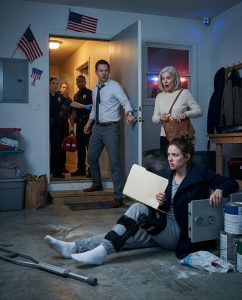
The garage was dark except for the thin gray light near the side window. It smelled like dust, concrete, motor oil, and snow. A fallen crutch would have sounded loud in there. A body sounded worse.
They threw me in.
My shoulder hit first.
My palms scraped the floor.
My injured leg jolted hard enough to make the room tilt.
Daniel stood in the doorway.
‘Maybe a few hours alone will make you cooperative.’
Margaret touched her purse, the one holding my medicine.
‘Think carefully this time, Claire.’
The steel door closed.
The lock clicked.
For a minute, I was only pain.
Not a wife.
Not a homeowner.
Not a woman with a plan.
Just pain, breath, cold, and the bitter taste of blood from my bitten lip.
Then I saw the blue light.
It blinked from the far corner above the paint cans.
The hidden camera was still recording.
I had installed it two weeks earlier after I found a copy of a document tucked inside Daniel’s printer tray.
He had laughed when I asked why his mother needed our property tax records.
He said Margaret was helping us organize things.
But I had grown up with a grandmother who believed paper told the truth when people got tired of lying.
So I took a picture of the page.
Then I called an attorney.
Then I bought a small camera, a backup battery, and a floor safe Daniel thought held old Christmas ornaments.
The safe was behind the paint cans because Daniel never touched work he considered beneath him.
Getting to it took everything I had.
I dragged myself with my elbows.
Inch by inch.
The brace scraped.
My palms shook.
Once, I nearly blacked out and had to press my cheek to the concrete until the darkness behind my eyes pulled back.
The blue light kept blinking.
It looked calm.
That made me calm.
When I reached the safe, my fingers were so stiff I missed the keypad twice. On the third try, the lock gave a small beep.
Inside were three things.
A backup phone.
A sealed envelope from my attorney, Angela Morales.
And the page Daniel thought I had never seen.
The phone powered on with one bar of service.
Before I could type, a message appeared.
Camera feed received. Police and EMS are on the way. Stay where you are if you can.
I laughed once.
It came out broken.
Then the knob on the steel door turned.
Daniel’s voice came through the door.
‘Claire, are you ready to be reasonable?’
I looked at the page in my hand.
At the top was the name of the person meant to receive my house, my accounts, and the controlling shares of the small design firm my grandmother had left me.
Not Daniel.
Margaret Elaine Hale Revocable Trust.
That was the part I had not told Daniel I knew.
He thought he was stealing for both of them.
His mother had arranged the papers so everything would land in her private trust, with Daniel listed only as the temporary agent who had obtained my signature.
If it went wrong, he would be the face of the fraud.
If it worked, she would own the prize.
Daniel opened the door before I answered.
Margaret stood behind him with the folder from the hospital tucked under one arm and my medication still in her purse.
For a second, they saw only what they expected to see.
Me on the floor.
Me shaking.
Me trapped.
Then Daniel noticed the open safe.
Then Margaret saw the phone.
Then the blue light blinked above them.
Nobody moved.
‘What is that?’ Daniel asked.
I held up the page.
‘Your mother’s name.’
Margaret’s face changed before Daniel’s did.
Hers went hard.
His went young.
Confused.
Almost betrayed.
It would have been funny if I had not been freezing.
‘You said it was going to us,’ he whispered.
Margaret snapped, ‘Don’t be stupid.’
That was when the front door opened.
Police officers do not enter a house like guests.
They enter with command in their voices.
They enter with radios, boots, and questions no one can perfume into manners.
Daniel turned toward the hallway.
Margaret tried to close her purse.
The orange bottle fell out and rolled across the threshold.
My name flashed on the label as it spun.
One officer saw it.
The EMS worker saw me.
Everything Daniel and Margaret had kept behind walls was suddenly in a room full of witnesses.
The camera had sound.
It had the crutch strike.
It had Margaret taking the prescription.
It had Daniel saying a few hours alone might make me cooperative.
It had the lock.
It had my breathing in the dark.
Daniel tried to explain that I was confused from medication.
The EMT looked at the bottle on the floor and said, ‘What medication?’
That shut him up.
Margaret tried a different performance.
She lifted her chin and told the officer this was a family misunderstanding.
Angela arrived before the sentence finished.
My attorney was small, gray-haired, and dressed in a black coat that made her look like she had walked out of a courtroom and into a storm.
She did not raise her voice.
She did not need to.
She handed the officer a printed still from the camera feed and a copy of the document with Margaret’s trust named at the top.
Then she looked at me.
‘Claire, do you want medical help first or a protective order first?’
I said, ‘Medical help.’
Then I looked at Daniel.
‘And then both.’
The hospital confirmed what they had done was not discipline, not marriage, not a misunderstanding.
It was assault.
It was unlawful restraint.
It was theft of prescribed medication.
The paperwork became something uglier once Angela compared it with the printer files and the copies I had photographed.
The signatures Daniel wanted from me would have given him immediate control.
The transfer pages behind them would have moved that control into Margaret’s trust within forty-eight hours.
Daniel had not even read the whole packet.
That was the final insult waiting for him.
He betrayed me for a throne his mother had never planned to share.
The divorce was not dramatic in the way people imagine.
No screaming across a courtroom.
No last-minute speech that healed anything.
Just documents, evidence, dates, and Daniel staring at tables while other people described what he had done.
Margaret came in pearls the first day.
By the third hearing, she stopped wearing them.
The church ladies she used to impress had seen the footage online after someone from her own circle shared the public arrest report.
Her politeness did not survive contact with proof.
Daniel asked to speak to me once.
Angela asked if I wanted to hear him.
I did.
Not because I missed him.
Because I wanted to know what kind of apology a man gives after locking his injured wife on concrete.
He cried.
He said his mother pressured him.
He said he panicked.
He said he never thought I would get seriously hurt.
That sentence told me everything.
He had imagined hurt.
Just not consequences.
I told him the truth as calmly as I could.
‘You did not lose me in the garage, Daniel. You brought me there.’
After that, there was nothing left to discuss.
Recovery took months.
Bones heal in a way betrayal does not.
A femur can be measured on an X-ray.
A marriage has to be measured in moments you replay at night until your mind finally accepts what your body already knows.
Physical therapy was humiliating at first.
I had to relearn stairs, showers, grocery aisles, and sleep.
Some mornings I woke reaching for a husband who no longer existed, and then remembered that maybe he never had.
Angela told me healing would feel boring compared with survival.
She was right.
There were no dramatic speeches in the clinic, just rubber bands, counting, sweat, and the tiny victory of standing two seconds longer than the day before.
I learned to trust boring.
Boring meant safe.
I sold the house the following spring.
Not because they ruined it.
Because I wanted no doorway in my life that remembered them.
The safe came with me.
So did the camera.
So did the little American flag from the garage, cleaned and set in a clay pot on the balcony of my new apartment.
People ask why I did not leave sooner.
The honest answer is that cruelty rarely arrives wearing its real face.
Sometimes it warms your side of the bed.
Sometimes it drives you home from the hospital.
Sometimes it calls paperwork protection.
But the night they left me on the concrete, they made one mistake that cruel people always make.
They mistook silence for surrender.
I was not surrendering.
I was listening.
I was recording.
And in the darkest corner of that garage, the truth was already blinking blue.