The automatic doors kept opening for other people.
Grandparents with coffee cups.
Fathers carrying stuffed animals.
A woman in a red coat who ran straight into the arms of her daughter and sobbed before either of them said a word.
Every time those doors slid apart, Caleb looked.
He was seven years old, and he was trying so hard to be brave that it made him look younger.
The dinosaur blanket under his chin was the same one he had dragged through every fever, every cardiology visit, every night he asked whether his heart was “being bad again.”
I had washed it at midnight before the surgery because he said it smelled like home.
Home, that morning, was one mother and one scared little boy in the pediatric wing of St. Mary’s Hospital in Denver.
My family knew the time.
They knew the address.
They knew the floor.
My mother, Patricia, had been told three weeks earlier.
My sister, Vanessa, had been told twice.
I had even sent them the surgeon’s name because my mother liked to act helpless when responsibility stood too close to her.
At 5:58 a.m., Caleb squeezed my fingers.
“Is Grandma lost?”
I looked toward the doors and saw strangers being loved in ways my son had earned a hundred times over.
“She’s probably on her way, buddy.”
It was a gentle lie.
Sometimes mothers lie because the truth is too heavy for a child already carrying wires on his chest.
At 6:22, the nurse unlocked the bed wheels.
Caleb tried to smile.
His lower lip shook.
“Tell Aunt Vanessa I wasn’t scared.”
That was the moment something in me cracked, but it did not break yet.
Breaking would come later.
For six hours, I sat alone.
I stared at a vending machine I never used.
I counted ceiling tiles.
I refreshed my phone until the screen started to feel cruel.
No call.
No text.
No one asking whether Caleb had made it through the first hour.
No one asking whether I had eaten.
The same mother who posted old photos on birthdays and wrote “family above everything” in long captions could not send one sentence while her grandson was under anesthesia.
The same sister who had once cried because I could not attend a cake tasting had no interest in the fact that my son’s chest was open in an operating room.
When the surgeon came out, I stood so fast my knees almost folded.
He said the surgery had gone well.
Not easy.
Not over.
Well.
That word was a cup of water in a desert.
Caleb was moved to the ICU with tubes taped to him and a nurse watching numbers I did not understand.
I thanked every person who touched him.
Then I went into the bathroom, locked the stall, and cried into my sleeve because I refused to let him wake up and see me shattered.
Three days passed in the thin blue light of the ICU.
I learned to sleep sitting up.
I learned which alarm meant a nurse would walk instead of run.
I learned that hospital coffee tastes worse when no one is coming to relieve you.
Then my phone buzzed.
Mom: Need 5,000 dollars for your sister’s wedding dress. Send today. Vanessa found the one.
I stared at the message until my eyes stopped reading words and started reading character.
Not How is Caleb?
Not I am sorry.
Not We should have been there.
A dress.
My son had a drainage tube taped to his side, and my mother wanted satin.
For years, I had called it helping.
After my father died, my mother said grief made her afraid of money, so I added her to a secondary checking account for emergencies.
Then Vanessa needed my credit card for one temporary bill.
Temporary became a season.
A season became a habit.
They used my account for gas, phone bills, rent shortfalls, insurance gaps, and little purchases they forgot to mention until the statement arrived.
If I objected, my mother sighed.
“Family helps family.”
If I cried, Vanessa rolled her eyes.
“You’re always making things dramatic.”
But there was nothing dramatic about the ICU.
There was only my son breathing carefully beneath a blanket while the people who demanded my money ignored his name.
I opened the banking app.
My hands were strangely steady.
I sent my mother 50 cents.
Memo: Buy a veil.
Then I called the bank.
I froze every card.
I removed every authorized user.
I changed passwords.
I blocked linked transfers.
I asked for a review of old charges, including ones I had swallowed because peace had once seemed cheaper than confrontation.
Peace, I was learning, can become the most expensive thing in a woman’s life.
The next morning at 8:11, the bank manager called.
His name was Mr. Hale, and I knew him only as a polite man who wore dark suits and remembered Caleb’s name from the medical reserve account.
That morning, his voice had lost all small talk.
“Mrs. Whitaker, your mother came into the branch with your sister. They were very upset.”
I looked through the ICU glass at Caleb sleeping.
“What did they do?”
A pause.
“They tried to withdraw everything.”
For a second, I thought he meant my secondary checking account.
It would hurt, but it would not surprise me.
Then he said, “Not just from your account.”
I sat down.
Mr. Hale explained that Patricia and Vanessa had brought printed authorization forms.
They claimed I had asked them to manage my finances because I was too emotional to handle Caleb’s care.
One form named my mother as emergency family representative.
Another requested a transfer from Caleb’s medical reserve account.
That account was not rich.
It was not a secret fortune.
It was where I kept money for copays, medication, follow-up therapy, and the ugly little expenses that come after people stop asking how a sick child is doing.
One transfer note listed a bridal boutique.
Another listed a wedding planner.
Vanessa’s wedding dress had never been the whole request.
It had been the first bite.
I asked why the bank had stopped them.
Mr. Hale grew quiet again.
“There is an alert on Caleb’s account. It says if Patricia Whitaker ever attempts access, we call you directly and halt the transaction until you appear in person.”
My mouth went dry.
“I did not put that alert there.”
“No,” he said. “Your father did.”
My father had been dead for four years.
For four years, my mother had told me he left her frightened and broke.
For four years, I had paid things I could not afford because I believed grief had hollowed her out.
Now a bank manager was telling me my father had expected this.
“He left something here,” Mr. Hale said. “A sealed letter. Your mother demanded we destroy it this morning. We did not.”
I arranged for a nurse to call me if Caleb stirred, then I asked the hospital social worker to sit nearby for twenty minutes.
She saw my face and did not ask unnecessary questions.
The bank was nine minutes from the hospital.
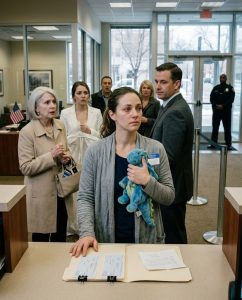
I drove there wearing the same gray cardigan I had slept in for three nights.
My hair was tied badly.
There was tape residue from a visitor badge on my shirt.
I had Caleb’s dinosaur blanket folded under my arm because it had been in my lap when the call came, and I could not make myself leave it behind.
When I walked through the bank doors, my mother was at the counter.
Vanessa stood beside her with perfect hair and a white garment bag hooked over one wrist.
A bridal garment bag.
In a bank lobby.
While my son was in ICU.
My mother saw me first.
Her face tightened, then rearranged itself into injury.
“How dare you embarrass us like this?”
I looked at the garment bag.
Vanessa followed my eyes and pulled it behind her leg.
“Don’t start,” she said. “The deposit is due. You know how these boutiques are.”
I did not answer.
I walked to Mr. Hale’s office.
My mother followed.
“You froze my card,” she hissed.
“My card,” I said.
“You sent me 50 cents like trash.”
I turned then.
“No. I sent you 50 cents like a receipt.”
Something flashed across her face.
Fear, maybe.
Not shame.
Shame requires a door inside you that still opens.
Mr. Hale placed a folder on the desk.
Inside were the withdrawal slips.
Copies of the authorization forms.
A printed transfer request.
My signature was on one page, but it leaned wrong. The W in Whitaker was rounder than mine. The date was the morning of Caleb’s surgery.
At 6:41 a.m.
At 6:41, I had been standing outside the operating room with both hands pressed over my mouth.
Vanessa muttered, “It’s not like we were stealing. We were going to put it back.”
I looked at her.
“With what money?”
She said nothing.
My mother lifted her chin.
“Your father would be disgusted by how selfish you’ve become.”
Mr. Hale’s expression changed.
It was small, but I saw it.
He opened the bottom drawer of his desk and removed a cream envelope sealed in plastic.
My name was written across the front in my father’s handwriting.
My mother made a sound like someone had stepped on her foot.
“That is private family property,” she snapped.
Mr. Hale did not hand it to her.
He handed it to me.
My fingers shook for the first time all morning.
Inside was one page.
My father had written it six months before he died.
He said he had discovered withdrawals he had not approved.
He said Patricia had blamed confusion, stress, widowhood before she was even widowed.
He said he had moved what he could protect into accounts for me and for Caleb because love without boundaries had nearly ruined him.
Then came the line that made the room disappear.
If your mother asks you for money while your child is hurting, do not argue with her. Believe her.
I read it twice.
My mother lunged for the paper.
The security guard stepped closer.
Vanessa began to cry, but even her crying had calculation in it.
“My wedding is in five weeks,” she said.
There it was.
Not Caleb.
Not forgiveness.
Not fear of losing me.
The wedding.
I folded the letter and put it inside my cardigan pocket.
Then I turned to Mr. Hale.
“I want every fraudulent form reported. I want copies for the hospital social worker. I want every authorized user removed permanently. I want every old charge reviewed. And I want my son’s account locked so no one touches it without me present.”
My mother stared at me as if I had slapped her.
“You would call the police on your own mother?”
I thought of Caleb asking if Grandma was lost.
I thought of him asking me to tell Vanessa he had not been scared.
I thought of all the years I had paid invoices for people who could not pay attention.
“No,” I said. “You called them when you forged my name.”
That sentence landed quietly.
Quiet is sometimes better.
It gives people room to hear themselves losing.
The bank filed the report.
The bridal boutique did not get its money.
The wedding planner called me three times that afternoon, then stopped when my lawyer returned the call instead.
I did not know I had a lawyer that morning.
By evening, I did.
The hospital social worker helped me document the attempted access to Caleb’s medical account.
The fraud department found months of charges I had never approved.
Vanessa had used my card for alterations, hair appointments, venue samples, and a hotel block deposit she had labeled “family travel.”
My mother had used the secondary checking account to pay her car insurance while telling me she was skipping meals.
She had not been broke.
That was the final twist my father left for me.
Along with the letter, he had left copies of an insurance payout statement.
Patricia had received enough after his death to live comfortably for years.
She had spent hers, then trained me to feel guilty for protecting mine.
When I returned to the hospital, Caleb was awake.
His voice was scratchy.
“Did Grandma come?”
I sat beside him and took his hand.
I did not lie this time.
“No, buddy. But Grandpa helped us today.”
He blinked, sleepy and confused.
I placed the dinosaur blanket beside him.
“How?”
I smiled for the first time in days.
“He made sure nobody could take what was yours.”
Caleb fell back asleep holding one corner of the blanket.
My phone filled with messages that night.
Patricia called me cruel.
Vanessa called me jealous.
An aunt I had not heard from in eight months told me I was tearing the family apart.
I did not reply to any of them.
The next morning, I paid my own bills.
Only mine.
The silence after that was almost holy.
No overdraft alerts from my mother’s spending.
No bridal emergencies.
No phone bill reminders from Vanessa.
No one asking me to prove love with a transfer.
A week later, Caleb was moved out of ICU.
The first thing he asked for was chocolate pudding.
The second thing he asked was whether Aunt Vanessa knew he had been brave.
I looked at his small face, at the scar hidden under his gown, at the eyes still searching for people who had not deserved his hope.
“She knows,” I said.
Then I added the part he needed more.
“And I know. That’s what matters.”
My mother tried one more time.
She left a voicemail saying she was willing to forgive me if I unfroze “the family money.”
I saved it for the fraud investigator.
Vanessa sent a photo of the dress she could no longer afford.
I saved that too.
Not because I wanted revenge.
Because evidence is what you keep when people rewrite pain and call it misunderstanding.
The wedding was postponed.
Then canceled.
I heard from a cousin that Vanessa blamed me in front of everyone.
That was fine.
For years, I had funded the version of the family that existed online.
Smiling photos.
Matching captions.
Big words about loyalty.
But loyalty that only flows toward the loudest hand is not family.
It is a bill.
And I was done paying it.
Months later, Caleb and I visited my father’s grave.
Caleb brought a small plastic dinosaur and set it near the stone.
I brought the letter.
I did not bury it.
I read it once more, folded it carefully, and kept it.
Some inheritance is not money.
Sometimes it is a warning from someone who loved you before you learned how to love yourself with boundaries.
My mother missed my son’s surgery.
My sister chose a wedding dress over a hospital room.
They thought the cruelest thing I could send was 50 cents.
They were wrong.
The cruelest thing, to them, was access denied.
And the kindest thing, to me and my son, was finally meaning it.