My old Freightliner pulled into the stadium parking lot shortly after sunrise, rattling hard enough to make the coffee shake in the cup holder.
The coffee had gone bitter somewhere outside Nashville, but I kept drinking it because bitter was better than falling asleep behind the wheel.
When I shut off the engine, it coughed once, shuddered through the cab, and went still.
For a few seconds I stayed where I was with both hands on the wheel.
Diesel hung in the air.
Cold vinyl pressed against my back.
The faint smell of truck-stop soap clung to my skin from the sink where I had shaved at 5:12 a.m. and cut my jaw twice because the mirror was fogged and the light over it kept buzzing.
I had driven eighteen hours to see my daughter become an Army officer.
I would have driven twice that.
Families were already crossing the parking lot toward the football stadium.
Some carried flowers wrapped in clear plastic.
Some held phones out in front of them, already recording everything.
A few had small American flags tucked into purses or gift bags, the kind that get handed out at ceremonies and parades and then end up in kitchen drawers beside batteries and old receipts.
They looked rested.
I did not.
I glanced at my phone.
9:18 a.m.
The commissioning ceremony started at ten.
My right knee throbbed when I climbed down from the cab, a deep ache under the kneecap that had been with me long enough to feel like weather.
Too many years of clutch pedals, loading docks, cheap motels, and sleeping folded into a cab will teach a body where to store pain.
Mine stored it in the knee, the back, and the hands.
I stood beside the truck and looked down at my right wrist.
The old leather band was still there.
Its edges were cracked.
The black stitching had faded nearly gray.
The little metal stamp pressed into the leather had gone smooth in places from my thumb rubbing across it for years.
Most people saw a worn-out wristband and nothing more.
That was fine.
Most people had been missing the important parts of me for a long time.
I brushed my thumb over it once, then straightened my blue flannel.
I had pressed that shirt inside the sleeper cab with a travel iron that barely had the will to heat up.
It still had a crease in the wrong place, but it was clean.
Clean mattered.
Lily would be looking for me.
Before I reached the gate, I heard her.
“Dad!”
That one word went through me faster than fear, faster than memory, faster than the sound of brakes locking on wet highway.
I turned.
She was running toward me in full dress uniform, the morning sun catching the gold trim on her shoulders.
Cadet First Class Lily Carter.
In less than an hour, Second Lieutenant Lily Carter.
She looked calm and proud and older than she had any right to look.
But her smile was still the same one she had worn at eight years old when she sat in my passenger seat coloring maps while I hauled freight across three states.
“You got here,” she said, and then she was in my arms.
“Wasn’t going to miss it.”
She pulled back and looked at my face the way daughters do when they can read the damage before you admit it.
“You drove all night again, didn’t you?”
“Maybe.”
“Dad.”
“Truck’s still in one piece.”
She rolled her eyes, but she smiled anyway and slid her arm through mine.
That little motion nearly undid me.
There are things a father misses when he has to keep driving.
School concerts.
Parent lunches.
Flu days.
Tiny emergencies that do not seem tiny to a child.
I missed more than I ever wanted to count.
But I made the calls from rest stops.
I helped with homework over speakerphone while she sat in diner booths.
I mailed birthday cards from towns whose names I forgot before I reached the next exit.
And years ago, when she first told me she wanted to serve, I made one promise I meant more than any other.
“When that day comes,” I told her, “I’ll be there.”
So I was.
We walked toward the family seating, and that was when I started noticing the looks.
They were not loud looks.
That would have been easier.
They were quick, polished, practiced little glances from people who took me in and sorted me before I had even passed them.
Heavy boots.
Rough hands.
Sunken eyes.
Weathered face.
A clean flannel that still looked like it belonged in a cab, not in a reserved section beside families in dark suits and pressed dresses.
Nobody said anything cruel.
They did not have to.
Being dismissed has a sound.
It is the pause before someone decides you are not worth asking about.
A woman in pearls looked at my boots and then looked away.
A man with a bright watch shifted his legs so I could pass but did not meet my eyes.
A younger couple lowered their voices when Lily hugged me again near the aisle.
I had been underestimated in truck stops, warehouses, offices, banks, and hospital intake desks where clerks spoke slower when they saw my clothes.
I knew the routine.
Let them look.
I had not come to impress them.
I had come for my daughter.
The ceremony began under a clear Tennessee sky.
The brass band played first.
The loudspeakers crackled.
Rows of cadets stood at attention across the field with the kind of stillness that makes a parent understand how much of childhood is already gone.
Somewhere behind me, a mother cried into a folded tissue.
A father kept trying to take pictures even though his hands shook so badly that every photo would probably be blurred.
Lily stood with her class, chin high and shoulders squared.
I watched her and remembered her in a purple backpack, saluting me as a joke in the driveway beside my rig.
She had been missing one front tooth then.
She had laughed so hard her backpack slid off one shoulder.
“Sir, yes, sir,” she had shouted, and then she asked if officers got ice cream.
Now she stood in uniform, and I had to grip my knee to keep my hand steady.
At 10:07 a.m., the guest speaker stepped onto the platform.
Lieutenant General Whitaker.
Three stars.
Decorated commander.
Veteran leader.
The kind of man who did not need to ask for silence because silence arrived before he opened his mouth.
He began speaking about sacrifice, duty, leadership, and the quiet price of service.
His voice carried cleanly across the stadium.
Parents held their phones higher.
Cadets stared forward.
A breeze snapped the small American flag near the platform.
I sat with one hand resting on my knee and the other near the old leather band around my wrist.
I was listening, but not only to him.
I was listening to the years.
To the clatter of diners where Lily did math homework while I checked routes.
To the buzz of motel signs outside cheap rooms when I could afford to stop.
To her little voice over the phone saying, “It’s okay, Dad,” when it was not okay and we both knew it.
Then something changed.
The general’s eyes moved over the crowd the way speakers’ eyes do.
They passed over rows of parents and grandparents and siblings.
They passed over flowers and phones and flags.
Then they stopped.
On me.
At first I thought I had imagined it.
Men like me get used to assuming we are not the subject of any important attention.
But Lieutenant General Whitaker was no longer scanning the crowd.
He was staring.
Not at my face.
Not at my shirt.
At my wrist.
His sentence broke in the middle.
The microphone caught the silence and threw it across the stadium.
A few people looked up from their phones.
Someone behind me whispered, “What happened?”
The leather band suddenly felt tight.
On the field, Lily turned her head just enough to risk looking toward the stands.
She knew me well enough to know when something was wrong.
The general stepped back from the podium.
An aide moved as if to stop him, then froze.
Whitaker kept walking.
Down the platform steps.
Across the track.
Straight toward the reserved family section.
The crowd’s confusion spread in little waves.
Phones turned.
Heads shifted.
Cadets held formation, but I could feel their attention pulling toward us.
I wanted to stand.
My knee complained when I tried.
The man with the bright watch beside me finally looked at my face.
For the first time that morning, he looked as if he wished he had noticed me sooner.
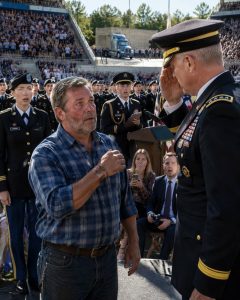
Lieutenant General Whitaker stopped in front of me.
Up close, his expression was not ceremonial.
It was personal.
He looked at the band again, and his throat moved once before he spoke.
“Carter?”
I nodded.
The stadium seemed to hold its breath.
Then his right hand rose to the brim of his cap.
He saluted me.
Not a polite nod.
Not a quick gesture to calm an awkward moment.
A full salute.
Held steady.
In front of thousands.
For one second I did not remember what to do.
I was back in another place, another heat, another kind of dust, with men shouting and radios cracking and one promise made under circumstances no ceremony could ever explain.
Then my body remembered.
I returned the salute.
The leather band creaked against my wrist.
Behind me, the woman in pearls made a small sound and pressed her hand to her mouth.
The man with the bright watch stared at the band as if it had turned into a document he was trying to read.
On the field, Lily’s face changed.
She had seen people salute officers all morning.
She had never seen a three-star general salute her truck-driver father.
Whitaker lowered his hand slowly.
He turned just enough for the microphone to catch his voice.
“Second Lieutenant Carter,” he said.
Lily stood very still.
“There is something about your father you were never told.”
The aide behind him had gone pale.
He opened the folder under his arm and pulled out a folded insert from the program.
At the top, in block letters, it said HONORED SERVICE GUESTS.
My name was not printed there.
It should have been.
Whitaker saw that I saw it.
Something hard passed across his face.
Not anger.
Worse than anger.
Recognition.
The kind that arrives too late to prevent shame but not too late to expose it.
He turned back toward the crowd.
“Years ago,” he said, “before some of these young officers were old enough to understand the word sacrifice, a convoy outside a combat zone took fire during a night movement.”
The stadium went still in a different way.
This was no longer a speech.
This was testimony.
Whitaker looked at me once, silently asking permission.
I did not give much.
Just a small nod.
He continued.
“There was a soldier in that convoy who should not have made it home. Several of us should not have made it home.”
Lily’s eyes stayed on me.
“An enlisted driver refused to leave the route blocked. He went back under fire, twice, and pulled men out before the second vehicle burned.”
My mouth went dry.
The old leather band pressed against my skin.
I could smell dust that was not there.
I could hear metal that had not moved in twenty years.
I had spent most of my life trying not to make that night into a story because stories become performances, and men had died there.
Men with mothers.
Men with photographs in their pockets.
Men whose names deserved more than applause.
Whitaker’s voice lowered.
“The leather band on his wrist was cut from the sling strap of a man he carried out. The mark on it belonged to that unit.”
A murmur moved through the stands.
Lily’s hand lifted toward her mouth, then stopped because she was still in formation and discipline had become the last thing holding her together.
“For reasons that should have been corrected long ago,” Whitaker said, “his name was left out of today’s printed honors.”
The aide’s face tightened.
Someone near the platform looked down at the folder like paper could open up and swallow him.
Whitaker did not look away from the crowd.
“I am correcting it now.”
The applause did not start right away.
That was the part I remember most.
First came silence.
Real silence.
The kind that lets shame land where it needs to land.
Then one cadet began clapping.
Then another.
Then the stadium rose in pieces until the sound became too large to measure.
I did not want it.
I did not know what to do with it.
I had spent years being a man who delivered things and left before anyone remembered his name.
Now thousands of people were looking at me like I had carried something heavier than freight all along.
Lily broke formation only when her commanding officer gave the smallest nod.
She walked toward me first.
Then faster.
By the time she reached the stands, she was not trying to hide the tears in her eyes.
“Dad,” she said.
I could not answer.
She looked at the wristband.
Then at me.
“All these years?”
I swallowed.
“It wasn’t the kind of thing you tell a little girl before bedtime.”
Her face crumpled at that.
Not because I had kept a secret.
Because she finally understood how much silence had been living beside her.
Lieutenant General Whitaker stepped closer.
“Your father carried men out when everyone else believed the road was lost,” he told her. “One of those men was me.”
Lily looked from him to me.
The polished families around us had gone quiet again.
Nobody shifted their feet.
Nobody checked their phone.
For once, no one was trying to decide whether I belonged.
The question had answered itself.
The man with the bright watch stood and moved aside so Lily could reach me fully.
She wrapped both arms around me, uniform and all, and I felt her shoulders shake.
“I thought you were just tired all the time,” she whispered.
I almost laughed.
I almost cried.
Both would have been true.
“I was,” I said. “But not just from driving.”
Whitaker returned to the podium after that, but the ceremony was different.
Everyone could feel it.
When Lily took her oath, her voice was steady.
When they pinned her rank, she looked toward me first.
Not for permission.
Not for approval.
For recognition.
Like she had finally found a missing chapter in her own story and needed to make sure I was still standing there while she read it.
Afterward, families crowded the field.
People who had looked through me earlier now wanted to shake my hand.
Some apologized without saying the word apology.
They said things like, “I didn’t realize,” and “Thank you for your service,” and “Your daughter must be so proud.”
I took the handshakes because refusing them would have made Lily uncomfortable.
But I did not need them.
The only person I needed was walking beside me, one arm looped through mine the same way she had done before the ceremony began.
Only now she was holding on tighter.
At the edge of the parking lot, we stopped beside the Freightliner.
The truck looked exactly the way it had that morning.
Old.
Loud.
Practical.
Easy to underestimate.
Lily touched the leather band gently.
“Can I ask who it was?”
I knew what she meant.
The man whose sling strap had become a promise.
I looked out over the stadium, where the small American flag near the platform still moved in the breeze.
“His name was Daniel Mercer,” I said. “He had a little boy at home and a laugh you could hear over any engine.”
She nodded like she was receiving something sacred.
“Is that why you never took it off?”
“Yes.”
“And why you always came when it mattered?”
That one hurt more.
I looked at my daughter in her new officer’s uniform and thought of every missed pickup line, every late birthday call, every time I had been too exhausted to be the father she deserved.
Then I thought of the promise I had kept.
Being dismissed has a sound, but so does being seen.
Sometimes it is not applause.
Sometimes it is your child asking the right question at last.
“I came when I could,” I said. “And when this day came, I was always going to make it.”
She leaned her head against my shoulder for a second, just like she had when she was little and sleepy in the passenger seat.
The polished families were still walking by.
Some looked at the truck now with different eyes.
That almost made me smile.
The truck had never changed.
Neither had I.
Only the room had finally learned how to see what had been standing in front of it.
Lily wiped her face, straightened her uniform, and looked up at me.
“Dad?”
“Yeah?”
“Will you tell me the rest sometime?”
I looked at the road beyond the stadium, the same kind of road that had taken me away from her too many times and brought me back when it mattered most.
Then I looked at my daughter, Second Lieutenant Lily Carter, and nodded.
“Yeah,” I said. “I think it’s time.”