A room full of Marines laughed at the faded tattoo on my wrist, and for ten minutes, I let them.
Not because it did not hurt.
Because I had learned a long time ago that some rooms reveal themselves before they ever reveal the truth.
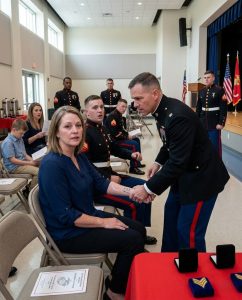
The battalion auditorium at Camp Lejeune smelled like floor wax, old wood, pressed uniforms, and coffee that had been sitting too long in silver urns near the entrance.
The chairs were arranged in clean rows.
The American flags stood on either side of the stage.
Families filled the room with camera straps, paper programs, children in stiff shoes, and parents trying not to cry before the ceremony even started.
I sat in the front family section with my purse tucked beneath my chair and my hands folded neatly in my lap.
My son, Corporal Tyler Whitaker, stood near the front in his dress blues.
He looked impossibly grown.
He had the same serious mouth he had as a boy whenever he was concentrating too hard.
Only now, instead of sitting at our kitchen table with spelling words and a peanut butter sandwich, he was standing under the lights in a Marine uniform, waiting for the new chevrons that would mark the next step of his life.
I had dreamed of that moment in smaller pieces.
I dreamed it when I was clocking into the grocery store before sunrise.
I dreamed it when I was answering phones at the clinic after dinner, my feet aching so badly I kept my shoes on until Tyler went to bed because I did not want him to see me limp.
I dreamed it when I paid his school fees three days late and pretended the late charge did not make my stomach turn.
A mother learns to hide fear so her child can borrow courage.
Sometimes that is the whole job.
At 9:20 a.m., I opened the printed ceremony program and found his name.
Corporal Tyler Whitaker.
There it was, black ink on white paper, official and clean and real.
Then I heard the voice behind me.
“Cute tattoo.”
It was loud enough to turn heads.
Not loud enough to be called a disturbance.
That was the careful part.
Staff Sergeant Brent Harlan stood a few rows back with his arms crossed over his chest.
I had seen men like him before.
Men who made a performance out of authority because they were never quite sure they had earned respect without it.
He had broad shoulders, a shaved head, and a smile that did not reach his eyes.
His gaze dropped to my wrist.
My sleeve had slipped back.
The old tattoo showed.
Three faded numbers.
A broken spear.
A thin crescent-shaped scar running through the ink.
“Did you get that at a strip mall, ma’am?” he asked. “Or was it some kind of midlife crisis?”
A few people laughed.
Not everyone.
That matters.
Some laughed nervously.
Some looked down at their programs.
Some turned their faces away because public cruelty always asks bystanders to make a quick moral decision, and most people choose comfort before they choose courage.
Tyler heard it.
I saw his shoulders tighten from ten feet away.
“Staff Sergeant,” he said quietly.
Harlan’s eyes moved to him.
“What was that, Corporal?”
“My mother is a guest.”
The room went uncomfortable in that way public rooms do when everyone knows something wrong is happening and no one is sure who is allowed to say so.
Harlan smiled wider.
“Your mother is sitting in a restricted section.”
“She was told to sit here.”
“By whom?”
Tyler’s mouth opened.
Then it closed.
Because every Marine in the auditorium knew what was hanging in the air.
Rank.
Rules.
Ceremony.
The invisible pressure that tells a younger man to swallow insult because he cannot afford to be seen as emotional.
I reached up and touched Tyler’s arm.
“It’s okay.”
It was not okay.
But there are moments when a mother lies to protect the future instead of the present.
His eyes met mine, and what I saw there almost broke me.
He was angry for me.
He remembered the double shifts.
He remembered the winter our heat went out and I told him camping in the living room was an adventure.
He remembered the stack of envelopes on the kitchen counter and how I always turned them facedown when he walked in.
Harlan leaned closer, studying my wrist.
“You know,” he said, “symbols like that actually mean something to certain people.”
His voice sharpened just enough to perform for the row behind him.
“Looks a little disrespectful when civilians wear military-style ink for attention.”
A woman beside me lowered her program.
A little boy stopped swinging his feet.
The auditorium seemed to take one quiet breath and hold it.
I looked at the tattoo.
Old ink.
Older memories.
“I agree,” I said.
Harlan blinked.
“You agree?”
“Symbols should mean something.”
For the first time, he looked less amused.
Not afraid.
Not yet.
Just uncertain, the way a man looks when a joke lands against something heavier than he expected.
Then he found his smirk again.
“Maybe next time, pick flowers instead.”
Tyler’s hands closed into fists.
The movement was small, but I knew my son.
I knew the exact second his restraint started to tear.
For one ugly heartbeat, I wanted to let him speak.
I wanted that whole auditorium to hear what kind of son he was, what kind of man he had become, and what kind of mother he thought he was defending.
But rage is expensive.
My son had already paid enough.
“Tyler,” I said.
He froze.
“Stand tall.”
The words carried through the front rows.
A few Marines looked over.
Even Harlan’s face changed for a second, as if the phrase had brushed against an old door inside his mind but not opened it.
I looked toward the small velvet box on the table near the front.
His new chevrons waited inside.
“This day belongs to you,” I said. “Not him.”
Tyler breathed in slowly.
Then he turned back toward the stage.
The ceremony began.
Names were called.
Families applauded.
Cameras clicked.
The official language of the ceremony moved cleanly across the room.
Rank.
Service.
Commitment.
Promotion.
Words that should have felt simple.
But Harlan stayed behind me, and I could feel him watching my wrist like he wanted one more chance to prove he had been right.
I kept my hands still.
That is what I had done twenty-six years before.
Kept my hands still.
Kept my breathing even.
Listened for the sound that meant the door was about to open.
The past does not come back like thunder.
Sometimes it comes back as a man in uniform stopping mid-step.
Colonel James Mercer entered a few minutes later.
The auditorium snapped into a different kind of attention.
He was not loud.
He did not need to be.
He had silver at his temples and a face that seemed built out of decisions.
He moved down the aisle greeting families, shaking hands, thanking parents, speaking to children at eye level when they were brave enough to look up at him.
When he smiled, it was measured and kind.
When he listened, he listened with his whole face.
The real commanders rarely need to remind people they are in charge.
Colonel Mercer came closer.
His eyes passed over the row.
Then they stopped on my wrist.
Everything about him changed.
The smile vanished.
His right foot hung in the middle of a step for half a second before it came down.
His eyes narrowed, not in suspicion, but recognition.
Deep recognition.
The kind that reaches past years, past rank, past the clean version of history printed in ceremony programs.
He turned away from the family he had been greeting and walked directly toward me.
Conversations thinned.
The applause staggered.
Harlan straightened behind me.
Colonel Mercer stopped in front of my chair.
He looked at the tattoo.
The broken spear.
The three numbers.
The scar.
I watched his throat move.
He swallowed hard.
“No,” he whispered.
It was not a question.
It was the sound a person makes when something impossible has become real in front of him.
Then he lifted his eyes to mine.
“Ma’am,” he said, and his voice was low enough that the first row leaned forward to hear it, “where did you get that tattoo?”
The auditorium went silent.
I could hear the coffee urn clicking near the entrance.
I could hear a child breathing through his mouth.
I looked down at my wrist.
There were days when I forgot it was there.
There were other days when I felt it under my sleeve like a brand.
I had been younger than Tyler when I got it.
Not in a tattoo shop.
Not for attention.
Not because I wanted the world to ask questions.
It had been given to me in a room with no windows, after three weeks of names nobody used, maps nobody signed, and orders that were never meant to survive on paper.
I had been told the operation did not exist.
I had been told that if anyone ever asked, I had been stateside.
I had been told that silence was the price of coming home.
Most of the people who told me that were gone now.
Some had died with medals.
Some had died without records.
Some had lived long enough to become people no one recognized in old photographs.
I kept the tattoo because I had promised I would.
I kept the scar because scars do not ask permission.
Harlan’s face had changed completely by then.
His mouth was open just slightly.
Not enough for apology.
Too much for arrogance.
Tyler stepped forward.
“Sir?”
The colonel looked at my wrist again, then at my face, as if comparing the woman in the chair with someone he had been told about in briefings a lifetime ago.
Finally, he whispered one word.
“Raven.”
The sound of it moved through me so sharply I had to close my hand around the edge of my chair.
I had not heard that name aloud in twenty-six years.
The room did not understand the word, but it understood the colonel’s face.
That was enough.
Harlan said, “Sir?”
His voice cracked at the edge.
Colonel Mercer did not look at him.
He turned toward a young Marine near the doors.
“Get the sealed recognition folder from my office,” he said. “Now.”
The Marine moved at once.
The whole auditorium listened to his dress shoes strike the floor as he left.
No one laughed now.
Tyler looked at me.
“Mom,” he whispered, “what is he talking about?”
There are many ways to fail your child.
Some are loud.
Some are quiet.
Some look like protecting them from the truth until the truth walks into a room wearing rank and a dark uniform.
“I was going to tell you someday,” I said.
His eyes searched mine.
“When?”
I wanted to give him a better answer.
After graduation.
After your first deployment.
After I found the courage.
After the government stopped pretending people like me were footnotes in files nobody opened.
Instead, I said, “When I could do it without making you carry it.”
That hurt him.
I saw it.
The Marine returned with a flat gray folder held carefully in both hands.
It looked ordinary.
That was the cruel thing about paper.
A page can carry a war and still look light enough to tear.
Colonel Mercer took the folder.
His fingers paused on the seal.
Then he opened it just enough to see the first page.
The blood left his face.
He turned the page once.
Then again.
The auditorium remained silent.
I saw Harlan trying to read upside down from where he stood, as if information might save him if he could grab it quickly enough.
Colonel Mercer closed the folder.
Then he faced Tyler.
“Corporal Whitaker,” he said, “before this ceremony continues, you need to know who your mother really is.”
Tyler did not move.
Neither did I.
The colonel turned to the room.
“Twenty-six years ago,” he began, “there was an operation that most people in this room will never find in a public record.”
A murmur moved through the back rows.
He raised one hand, and it stopped.
“I will not disclose classified details,” he said. “But I can confirm what is already authorized in this recognition file.”
He looked at me again, and this time his eyes were not shocked.
They were heavy.
“She saved Marines.”
No one breathed.
He continued carefully.
“Not symbolically. Not administratively. Directly.”
The colonel’s voice stayed controlled, but there was something underneath it now.
“That mark was not decoration. It was an identifier used by a team that officially did not exist at the time. The scar through it came from the extraction that brought our people home.”
Someone in the back whispered, “Oh my God.”
Harlan looked like he wanted to disappear into his own uniform.
Colonel Mercer turned then.
Finally, he looked at him.
“Staff Sergeant Harlan.”
Harlan straightened so hard his heels nearly clicked.
“Sir.”
“Were you the Marine making remarks about this woman’s tattoo?”
The question was calm.
That made it worse.
Harlan’s throat worked.
“Sir, I—”
“Yes or no.”
“Yes, sir.”
“Were you also questioning why she was seated in the family section?”
“Yes, sir, but I was attempting to maintain—”
“No.”
The word cracked through the room.
Not shouted.
Worse.
Final.
“You were not maintaining order. You were humiliating a guest in front of her son on the day of his promotion.”
Harlan’s face went red.
Then pale.
Then something between the two.
Colonel Mercer took one step closer to him.
“You saw a civilian woman with old ink and assumed she had no history worth respecting.”
Harlan said nothing.
“That assumption was your first failure.”
The colonel lifted the gray folder slightly.
“Speaking after that assumption was your second.”
A sound moved through the room.
Not laughter.
Judgment.
I wanted to feel satisfied.
Part of me did.
But mostly I felt tired.
Tired in the old way.
The way I had felt after returning home and realizing nobody teaches you how to put groceries in a cart after you have watched people disappear from maps.
Tyler came toward me.
He crouched beside my chair, uniform creasing at the knees.
“Mom,” he said softly.
That was all.
Just Mom.
Not Raven.
Not ma’am.
Not hero.
Mom.
That was the word that almost undid me.
I put my hand on his cheek the way I had when he was small.
“I’m sorry,” I whispered.
His eyes were wet now, and he did not care who saw.
“Why didn’t you tell me?”
“Because I wanted you to become yourself before you had to understand who I had been.”
He shook his head, not angry this time.
Hurt.
Trying.
“You were always yourself,” he said.
The words reached a place no medal ever had.
Colonel Mercer turned back to the stage.
“This ceremony will continue,” he said. “But first, a correction will be made.”
He looked at Harlan.
“Staff Sergeant, you will apologize to Mrs. Whitaker.”
Harlan stepped forward.
Every eye in the auditorium followed him.
He stopped in front of me.
For the first time that morning, he looked smaller than his rank.
“Ma’am,” he said, “I apologize for my comments. They were disrespectful and out of line.”
I looked at him for a long moment.
An apology said under command is still an apology, but it is not always repentance.
Still, my son was watching.
So were the children in the front row.
And I had learned long ago that dignity is not proven by how much anger you can display.
It is proven by how carefully you choose what not to hand away.
“I accept your apology,” I said.
Harlan blinked like he had expected something harsher.
Then I added, “I hope you remember why you had to make it.”
That landed harder.
He nodded once.
“Yes, ma’am.”
The ceremony resumed, but it was not the same ceremony anymore.
When Tyler’s name was called, the applause came differently.
Bigger.
Not because people knew the full story.
They did not.
They never would.
But because everyone in that room had watched a young Marine stand tall while his mother was mocked, and then watched the room discover that the woman they had underestimated had been carrying a history no one had bothered to ask about.
Tyler walked forward.
His new chevrons were presented.
He stood straighter than I had ever seen him stand.
When he turned back toward me, his eyes found mine first.
Not the colonel’s.
Not the stage.
Mine.
After the ceremony, Colonel Mercer came to me with the gray folder against his side.
“I owe you an apology too,” he said.
“You didn’t mock me.”
“No,” he said. “But men like me knew enough to remember the symbol and still not enough to make sure the people behind it were honored properly.”
I did not answer.
Because what could I say to that?
He lowered his voice.
“There are parts I still cannot say out loud.”
“I know.”
“But your son can know more than he does.”
I looked at Tyler.
He was watching me with a careful expression, as if he had discovered a locked room in the house where he had lived his whole life and did not know whether opening it would hurt me.
“Then tell him what you can,” I said.
That evening, Tyler came by my small apartment instead of going out with the others.
He brought takeout in a brown paper bag and two coffees because he knew I liked mine even when it was too late for caffeine.
We sat at the kitchen table where I had once helped him with fractions and financial aid forms.
For a while, neither of us talked about the auditorium.
Then he said, “Was Raven your name?”
“For a while.”
“Did you choose it?”
“No.”
“Did you hate it?”
I thought about that.
“No,” I said. “I hated what came with it.”
He nodded.
That was Tyler.
He did not rush a silence.
Finally he reached across the table and touched the faded tattoo with two fingers, careful not to press the scar.
“I was proud of you before today,” he said.
My throat tightened.
“I know.”
“No,” he said. “I mean before I knew any of that.”
The kitchen hummed around us.
The refrigerator.
The old clock.
A car passing outside in the apartment parking lot.
The ordinary sounds of a life I had fought very hard to have.
“I was proud because you were my mom,” he said.
That was when I cried.
Not in the auditorium.
Not in front of Harlan.
Not when Colonel Mercer said the old name.
At my kitchen table, with cooling takeout between us and my son holding my wrist like it was something precious instead of something to explain.
A room full of Marines had laughed at the faded tattoo on my wrist.
Ten minutes later, they learned laughter can die quickly when history walks into the room.
But the part I remember most is not Harlan’s apology.
It is not the colonel’s folder.
It is not even the silence when my old name was spoken.
It is Tyler looking at me afterward and understanding, finally, that standing tall was not just something I told him to do.
It was what I had been doing his whole life.